Whitehot Magazine
November 2026
"The Best Art In The World"
"The Best Art In The World"
November 2026
Interview with Gabriela Garcez at the Museum of the Moving Image
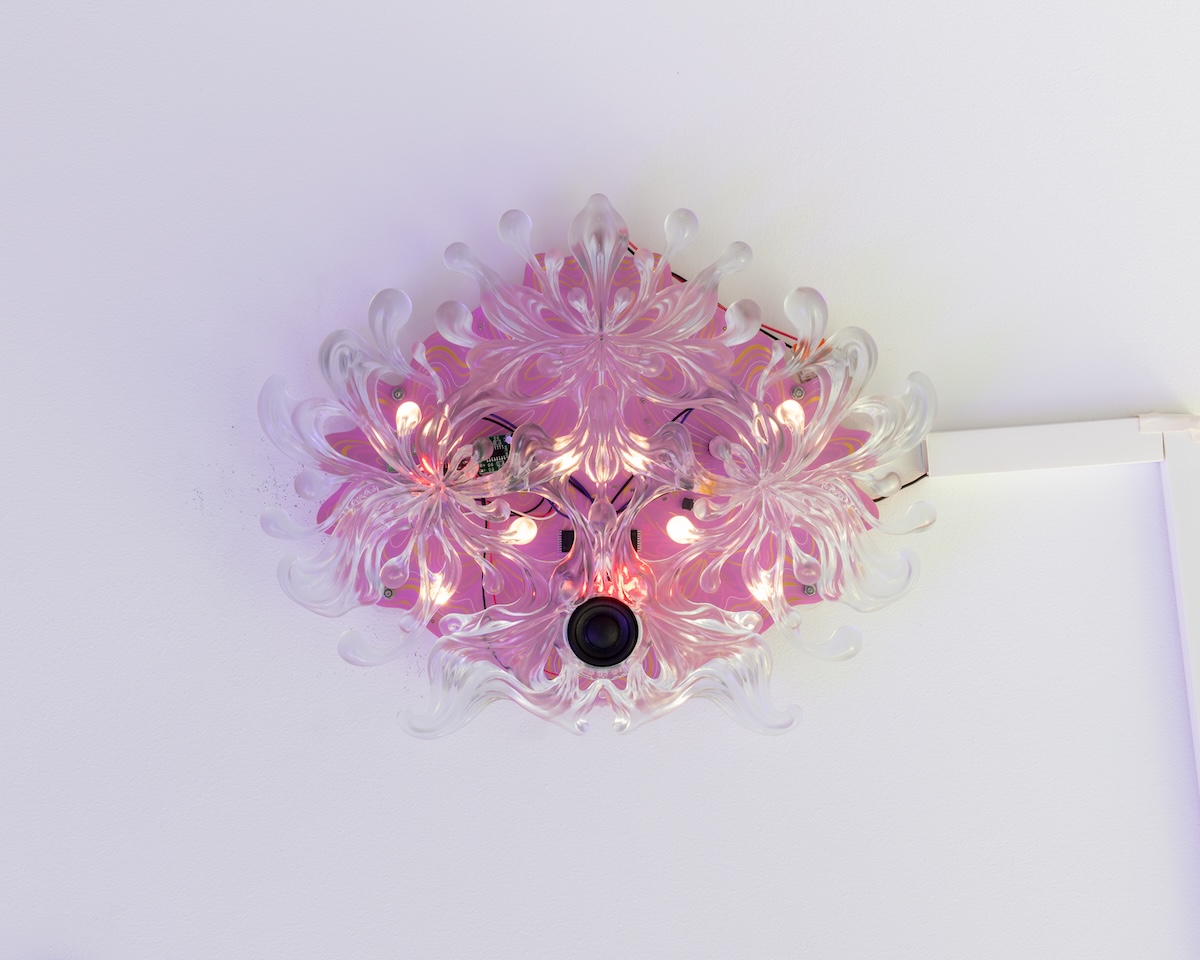 Installation view, courtesy of the artist and the Museum of the Moving Image. Photograph by Morgan Waltz.
By ESME GRAHAM, November 19, 2026
Four sensors are placed throughout the Museum of the Moving Image. When a visitor enters the building, one of them is latched to the ceiling above the door like a facehugger from Alien. They may not be initially identifiable as sensors, instead as membrane-like forms, futuristic repositories of data. The sensors are decorated by two external sculptural layers: an outer shell made of clear plastic, which fans outward in a splashing gesture, and an elaborate circuit board underneath. in vitro veritas, by artist Gabriela Garcez, often known by her online name Godmin, is a hybrid between sculpture and digital intervention. While visitors in the museum may examine the complex physical forms, the data gathered through the sensors activates an “interruption” on MoMI’s website, which can be activated by clicking the prompt at the bottom of the page. There, all of the living movement detected by the sensors is reflected on the website. If the front door opens, the colors become inverted; if people walk up the stairs, their movement blurs across the page; if the elevator moves, the site scrolls and all of the text from the site collapses to the top or bottom of the screen. Finally, in a corner of the second floor, a sensor sits above a live projection of the site. Standing in front of that sensor, an outline of the visitor’s own body is seen on the site made up of collected letters. When visiting the site during the museum’s open hours, a viewer can track the abstract human movement throughout the museum.
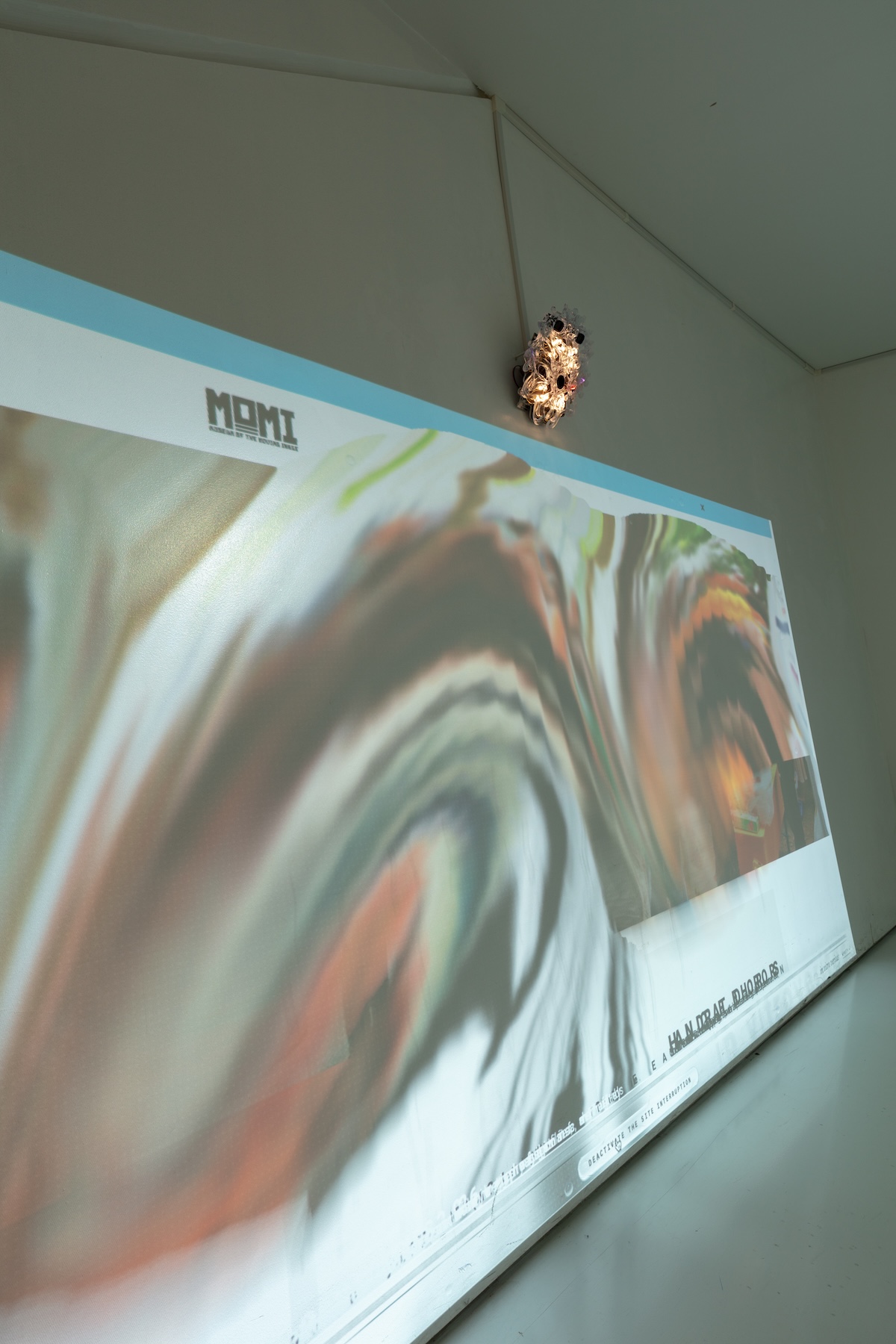 Installation view, courtesy of the artist and the Museum of the Moving Image. Photograph by Morgan Waltz.
However, when the museum is closed, the site is not inert. Instead, Garcez instructs an AI model to train on the data collected both from that day and from the entire run of the installation. During the night, the site emulates the previous human movement, hallucinating bodies that don’t exist and replicating the movement of a stationary elevator. This manufactured data, although based on no real activity, is then incorporated into the mass of data that is used to train the model. Thus, the site becomes a kind of echo chamber, where more and more fake data is treated as real. This type of cannibalism—referred to as model autophagy disorder, or M.A.D.—is a central interest in Garcez’s practice, as AI bots continue to learn from AI-generated information. Ultimately, the human element is removed entirely, as the internet becomes awash in hallucinations and cannibalized AI slop. Visiting the website at night, I watch as ghostly figures of imagined bodies move across the page.
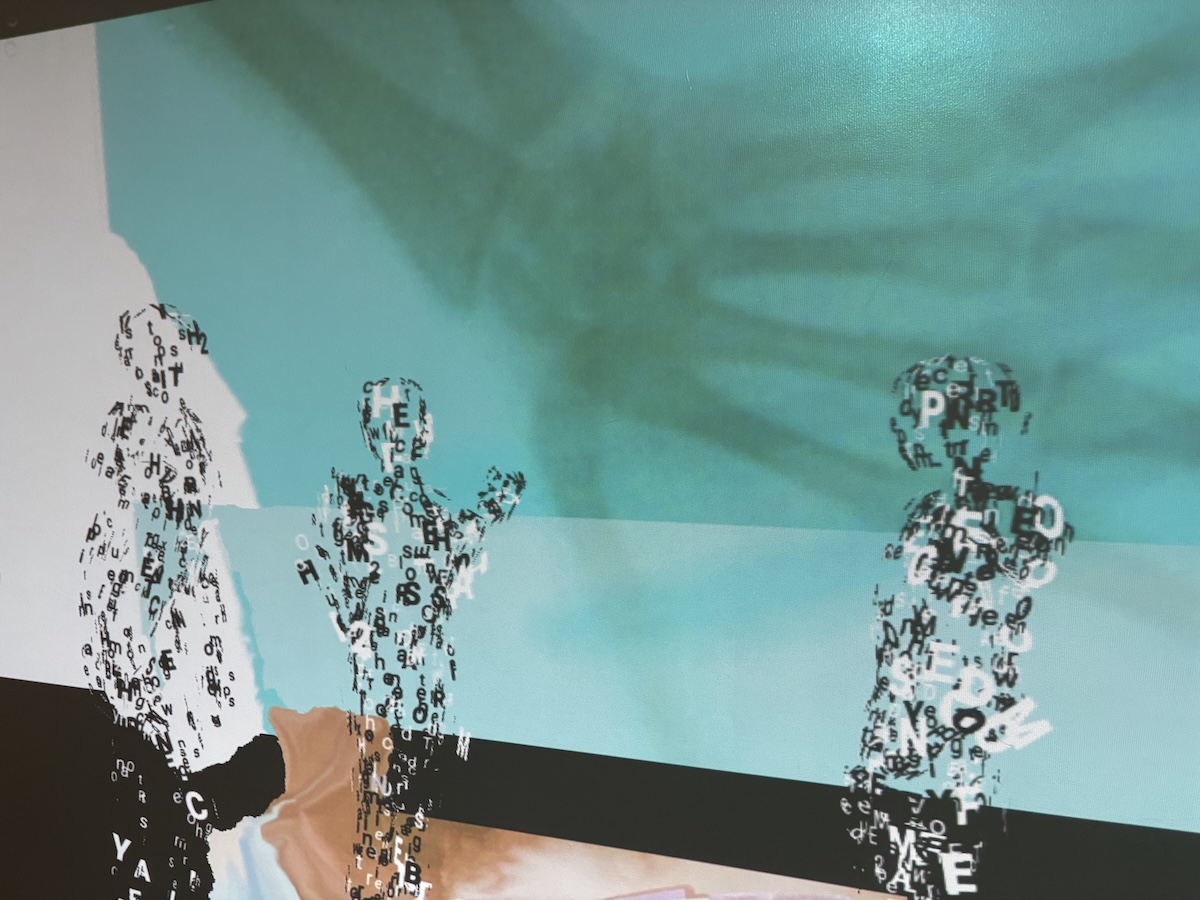 The artist and the author, engaging in the site interruption. Photograph by Esme Graham.
It was greatly illuminating to be given the opportunity to interview Garcez, who has a profound understanding of the internet and a reverence for its possibilities. I must confess that I never willingly use AI, but this principle has not seemed to deter its growth; indeed, engaging with it intellectually is a modern imperative. Speaking with Garcez revealed how this technology can be controlled and deployed, attending to both its uses and its pitfalls. In our conversation, we discussed this piece, her artistic process, questions of surveillance, the “dead-internet theory,” and her relationship to AI.
This interview has been edited for length and clarity.
Esme Graham: How did you begin thinking about this exhibition, and how did you come up with this idea?
Gabriela Garcez: I’ve been doing sensor art, where a visitor or user interacts with sensors and that translates into art. I have also been very interested in the concept of model degradation, or model collapse, as it is called in machine learning. So I thought, how do I combine those while still adhering to the theme of the museum’s “Site Interruption” series, which is a physical piece with a digital part of the artwork that interacts with the website? I thought this was perfect, because I can create the sensors to interact with the museum that will display that interaction on the website. Meanwhile, during closing hours, what do you do? There’s no interaction because there are no visitors; that’s where the model collapse part comes in. So it kind of all came together with these, both in having an experience in it but also a new interest in the concept of M.A.D.
EG: I was interested in the way that you are engaging with “dead internet theory.” What do you think about it? And do you think that the internet can be revived, and is that something artists can play with?
GG: The dead internet theory is definitely a big part of the underlying theme that motivated my work. I have so many concerns about how we archive the human web, how do we even verify that these things are human anymore? All of these are things that, I don’t want to say I lose sleep over, but I don’t know. I grew up on the internet; it is very dear to my heart and I miss going to forums and being able to interact with people. I don’t know if there is a solution to all of this, I just know that as an artist I make commentary on it, even if it’s in a very ethereal abstract way. Although people may not fully understand that it is a commentary as they interact with it, it is happening on the back end.
EG: I was also thinking about the surveillance of museum visitors. Is that something that you were thinking about?
GG: Yes, that’s not a main commentary, but it’s also something that I was careful about, because in order to get that data from that sculpture into the website, there’s a server doing that. I was very careful to not store, for example, image data of people. For example, in the sensor with the motion vectors, I’m really only capturing and transmitting motion vector data, so no information like people’s faces is going to leave the museum through the tech that I built. So while surveillance is not a theme of the artwork itself, it’s something that I am aware of as a developer and try to take measures so that nothing gets leaked.
EG: So not a theme, but maybe a concern?
GG: Yeah.
EG: What was the concept for the sculptures themselves?
GG: The concept was, I don’t even know if this word exists, aquamorphism, maybe water-morphism? Ultimately I wanted them to look like water-based life forms. The choice for that was a little bit of a play on the fact that people say that AI is consuming our water, and if you are what you consume, then what would an AI life form look like? Probably water-based.
EG: Is it typical of your practice for you to create a physical object to be paired with the ephemeral, internet-based work?
GG: No, not really, I mean I grew up on the internet, and so every time I would build something it would be for the internet. In this installation I’m signed as Gabriela Garcez aka Godmin because that’s the first time I’m actually bringing my two lives together. Because the internet, this immaterial world of the internet, was always separate from my real, material world where I was Gabriela. This is actually the first time I’m making something that directly connects the physical to the digital and it’s also the first time that I’m bridging Gabriela with Godmin, my digital and analog worlds.
EG: What is your relationship to AI technology? Is it positive, negative, ambivalent?
GG: Ambivalent is the word. Because AI technology is so broad, with so many use cases. I’m not even going to talk about regulations because I also don’t know about the politics of it. What I can do as a developer is comprehend the dangers of it and the tools that I use on a daily basis, be that social media, or the internet as a whole. I cannot prevent the worst from happening, but if I see something going awry, for example with these models, the best thing I can do is create something to fix it. So, regarding AI, I’m not keen on putting out AI slop myself, I would rather use AI to fix the web that we have now than to add to the further load. I’m not anti-AI; it’s just how we use it.
EG: Are there any specific sources that you use as inspiration?
GG: I usually take inspiration from visual arts, from movies. For this installation specifically, because it had the physical piece, I used a lot of inspiration sources that I wouldn’t normally. So for example, Iris van Herpen, the designer, she was all over my Pinterest boards. Zaha Hadid, the architect, does a lot of parametric architecture. Normally I would go with sci-fi movies, but this time I had physical artists as inspiration. Zaha Hadid and Iris van Herpen were two big ones for the physical parts.
EG: What projects are you planning in the future?
GG: I would really hope to continue expanding on this universe that I’m building and creating interactive art.
Museum of the Moving Image
October 15, 2026–January 10, 2027

Esme Graham
Esme Graham is a writer and critic based in New York. She began writing while receiving her master's degree in art history from the University of Chicago. Her specific focus is on modern and contemporary art.
view all articles from this author