Whitehot Magazine
October 2026
"The Best Art In The World"
"The Best Art In The World"
October 2026
An Unexpected Pairing in Public Gallery's 'Fault lines'
By MARGARET RAND June 29th, 2026
Since opening in 2020, Public Gallery has become one of London’s most ambitious emerging galleries, introducing unexpected dialogues between international and cross-disciplinary artists. Their latest duo show, Fault Lines, is no exception.
Pairing the biomorphic alabaster sculptures of London-based artist Hannah Morgan with the vibrant impasto canvases of American New Haven, CT-based painter Gabriel Mills, the exhibition traces a thread between two practices grounded in material investigation. Mills layers and sculpts dense accumulations of pigment, allowing oxidation and chance to produce ridges and fissures on his surfaces. Morgan reworks English alabaster, responding intuitively to its veins and mineral deposits, leaving some passages raw while polishing others to an uncanny sheen.
The exhibition embraces a rare sense of space. Spread across three floors, each work has room to breathe on its own. Bare walls don’t feel incomplete as they might in the traditional white cube, but instead allow complex relationships between works to unfold without overwhelming the viewer.
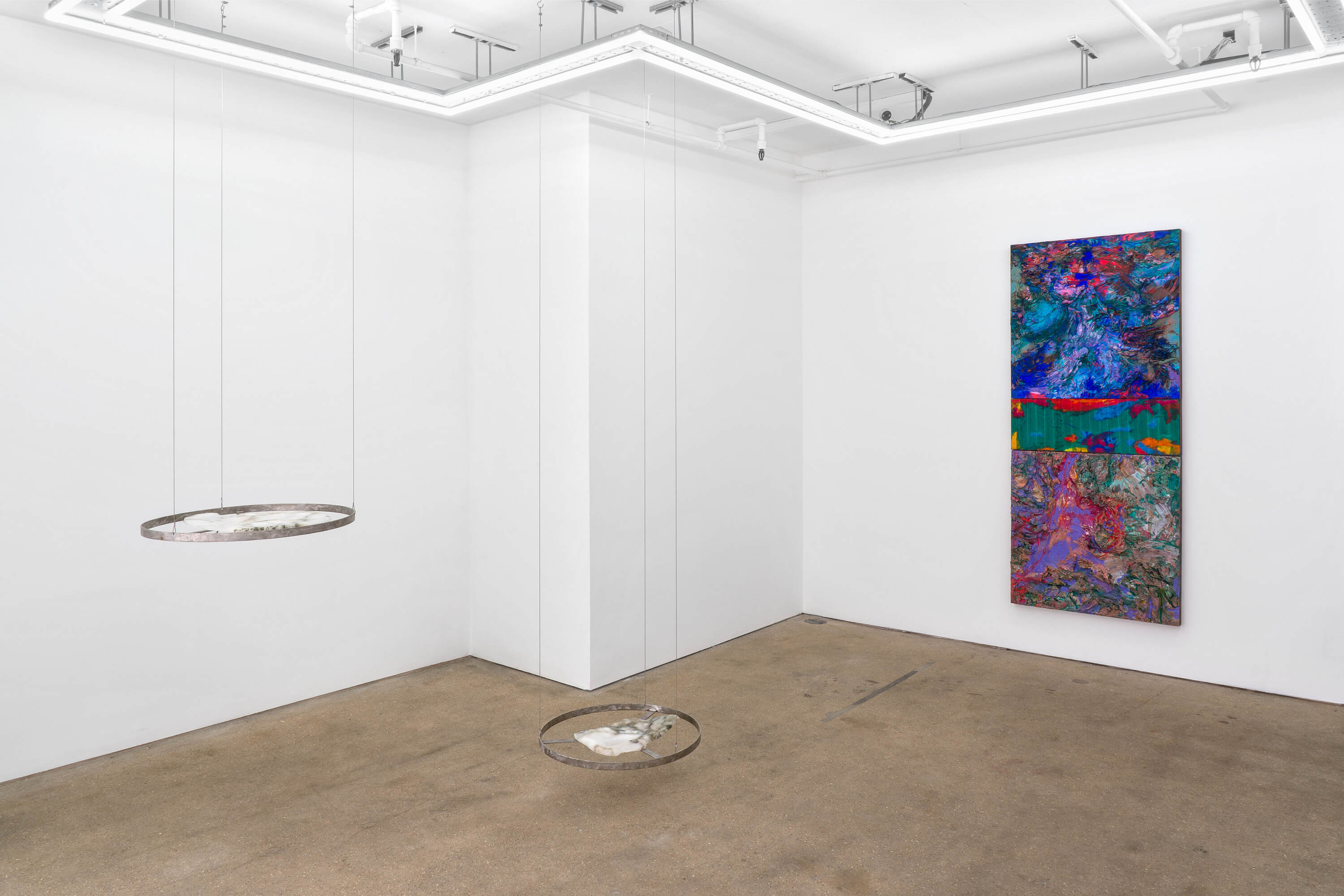 Hannah Morgan’s Horizon Slips (2026) (left) and Gabriel Mills' Auaienm (2026) (right). Image courtesy of Public Gallery
Upon entering the gallery, Gabriel Mills' Auaienm (2026) draws the viewer in with a dizzying surge of colours. Structured across three panels, the upper and lower registers are built from thick swirls of paint, where electric blues, bright magentas and incandescent reds collide in impasto ridges that resemble molten geological formations. Between them, a central panel of combed paint introduces a moment of order, its crisp linear passages recalling Gerhard Richter's squeegeed abstractions while producing a faintly optical, Bridget Riley-esque vibration.
Across from the painting hangs Hannah Morgan's suspended alabaster sculptures Horizon Slips (2026), her latest work from her ongoing Animula series. Emerging from the artist’s formative research trips through caves and mines across Scotland, these works investigate the stone’s embedded history, made up of layers of ancient seabeds and past ecosystems. Scattered across the exhibition, these sculptures are made from alabaster combined with metal elements stripped and carved with texture that recall the ancient cave markings in Dordogne in the South of France where she fondly remembers visiting as a young girl.
Yet standing before Auaienm, it is difficult to read Morgan's sculptures as simply geological objects. Instead, the encounter makes Mills' colours feel almost kitsch, or synthetic, while Morgan's alabaster becomes increasingly corporeal. Referred by the artist as ‘creatures’ or ‘feral beings,’ Morgan has spoken of the stone’s fleshy properties that she surrenders to while working. Vulnerable to its surroundings, the ancient rock transforms and regenerates spontaneously due to its fragility, falling apart and coming back together as if it has a life of its own.
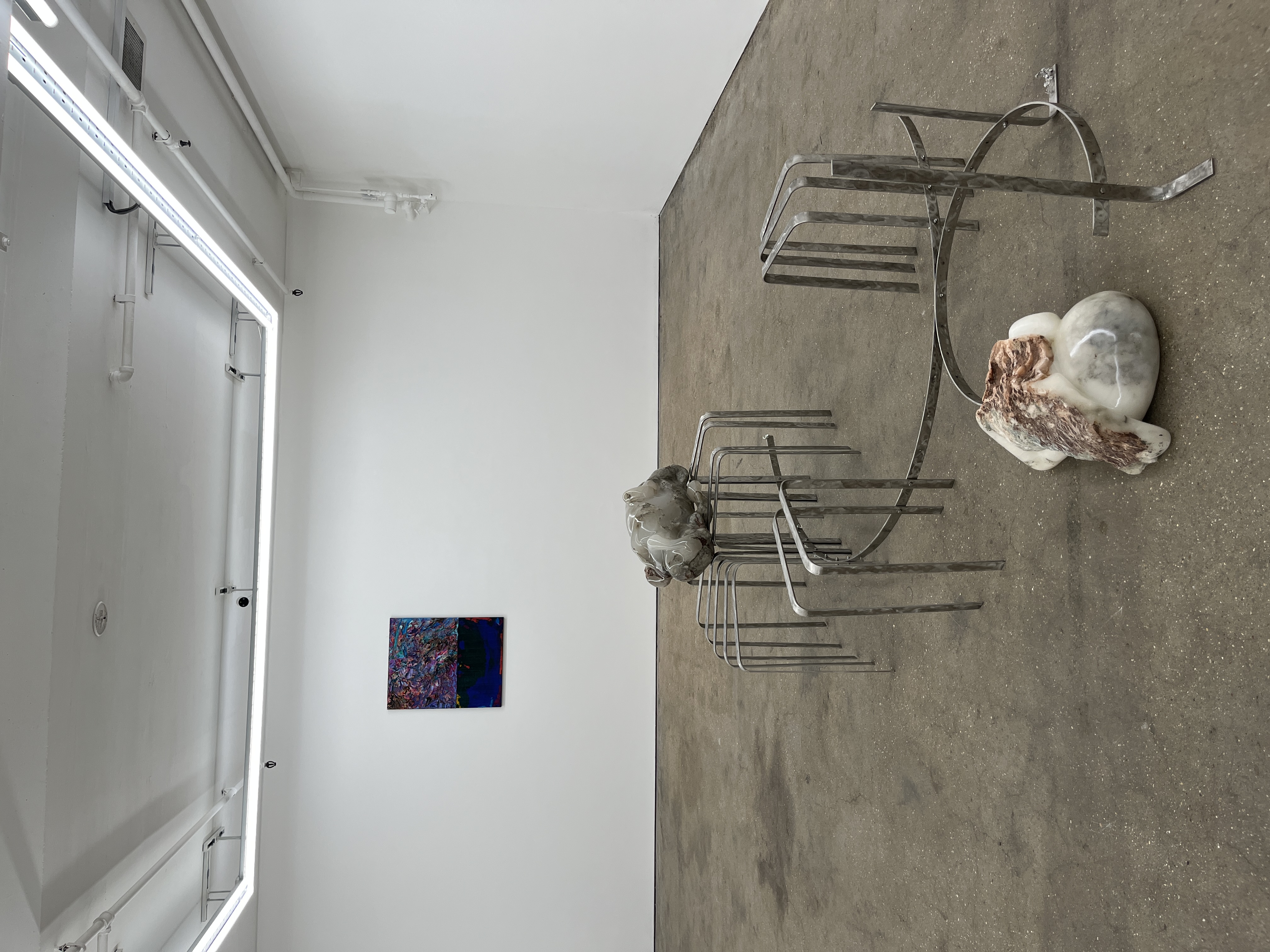 Animula VIII (2024)
This sensation becomes even more pronounced one floor below, where Morgan's Animula VIII (2024) features metal supports that cradle or encircle the alabaster forms. This metal skeletal framework recalls a caterpillar's legs, resembling a crawling insect, its industrial cage-like forms further unsettling the stone's natural origins.
One section of the sculpture has been polished to achieve a slimy sensation, its glossy surface catching the light with an unsettling viscerality. Beside it, rougher passages of exposed alabaster retain their fractured, mineral texture. At moments, the work resembles an octopus collapsing onto the gallery floor: a bulbous form appears to spill outward from a rougher organic mass in matte mauves and peaches.
Seen alongside Morgan's sculptures, the heavily worked surfaces of Mills' paintings begin to feel similarly tactile. Their ridges of pigment no longer read simply as landscapes or strata, but as accumulations of touch and gesture. Against the smoothness of the surrounding stone, the crusted impasto becomes unnervingly tangible, provoking an instinctive desire to run one's own fingers across the surface and retrace the artist's gestures.
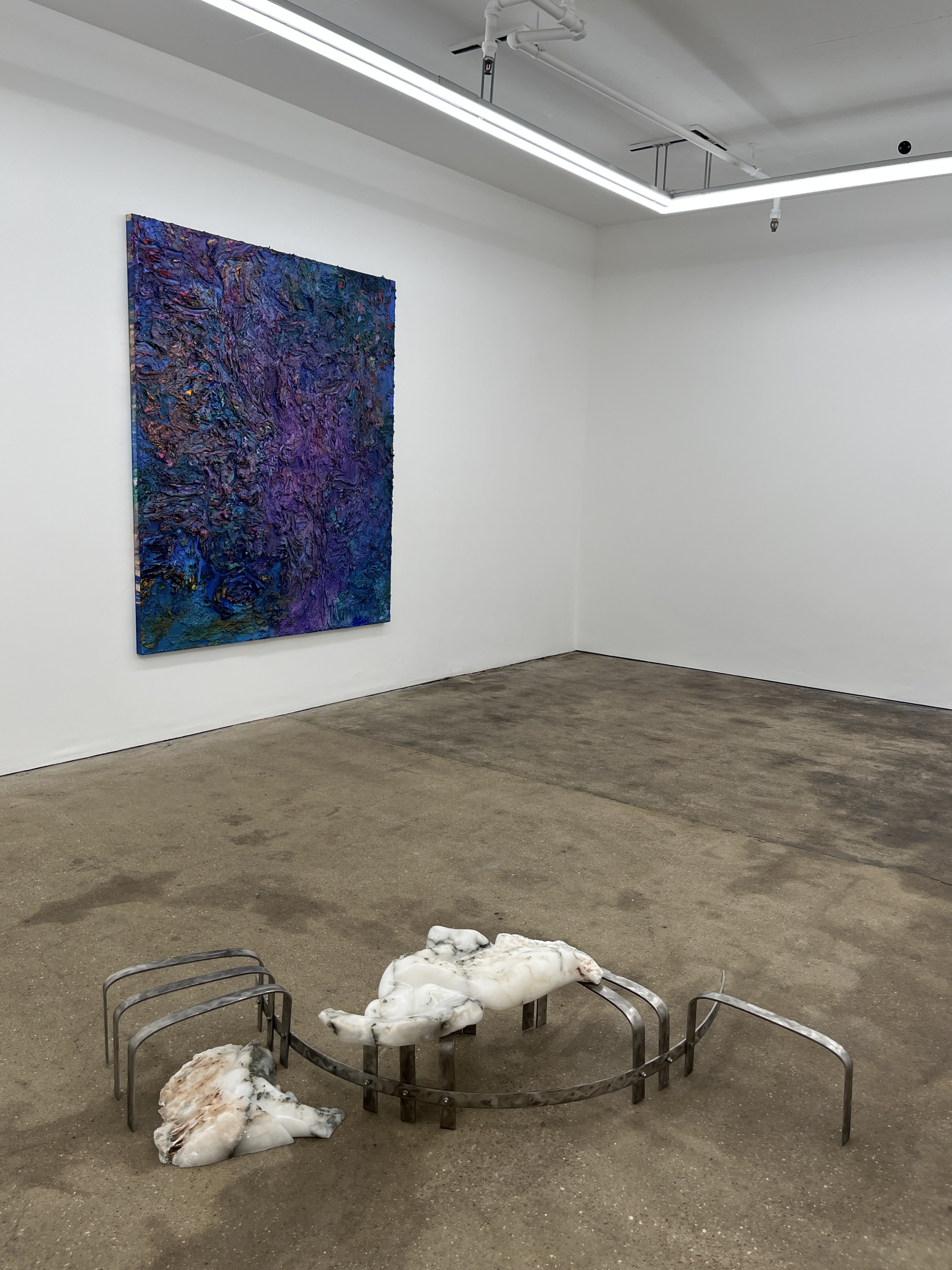 Installation view of Fault lines.
Each artist’s work unsettles the other, pushing paint and stone beyond their expected material qualities until they become strangely bodily and alive, or inversely, eerily synthetic and off-kilter. It is a pairing that rewards slow looking, with new connections emerging as you move between the gallery's three floors.
Fault lines runs from June 18 — July 25, 2026 at Public Gallery in East London.

Margaret Rand
Margaret Rand is a New York–born art advisor, researcher, and writer currently based in East London. She moved to the UK in 2023 to pursue a Master’s degree at the Courtauld Institute of Art after earning a BA in Art History and Journalism from Georgetown University. Her academic research focused on the materiality of postwar and contemporary painting, with particular attention to the practices of artists such as Carla Accardi, Julie Mehretu, Cecily Brown, and Firelei Báez. Today, she continues to explore the material practices of emerging artists across the London and New York art scenes, while working as a researcher for an art advisory firm.
view all articles from this author