Whitehot Magazine
October 2026
"The Best Art In The World"
"The Best Art In The World"
October 2026
Wanda Koop’s recent paintings are on view in conjunction with Night Gallery at Arsenal Contemporary NYC
By RIAD MIAH September 25th, 2025
Wanda Koop’s recent paintings are on view in conjunction with Night Gallery at Arsenal Contemporary NYC, the Canadian’s own American venue. Koop, an interdisciplinary artist who has worked with video, installation, and performance art throughout her forty-year career, is best known for her large-scale plywood paintings and her restless engagement with media and form. The current exhibition, Magnetic Field, on view through November 1, centers on two to three dominant motifs: the moon and the natural environment surrounding her summer studio in Riding Mountain, Manitoba. Koop’s reach is global: she has held sixty solo exhibitions worldwide, and a historical survey of her early paintings was presented at Frieze New York in May 2025 by Night Gallery.
Magnetic Field consists of several large-scale paintings, ranging from 119 by 159 inches to more intimate works at 40 by 30 inches. All the paintings move freely between abstraction and representation, bound by an elusive sense of space and light. Many share a deceptively simple structure—a circle within a square canvas—as seen in the eight-piece installation titled Moon Walk. Yet the apparent simplicity of format belies the complexity of their execution. Spend time with these works and their sophistication becomes evident: like all paintings worth lingering over, they demand extended viewing to reveal their intricacies. On first encounter, Magnetic Field might seem almost too direct: a modernist gesture repeated across multiple scales. But beneath that surface, familiarity is a sly criticality. The circle-in-square motif evokes the rigor of Kazimir Malevich’s Suprematism and Josef Albers’s chromatic investigations, yet Koop’s canvases are less about pure geometry than about perception and emotion. The works oscillate between celestial suggestion and earthly reference, between formal reduction and sensory richness.
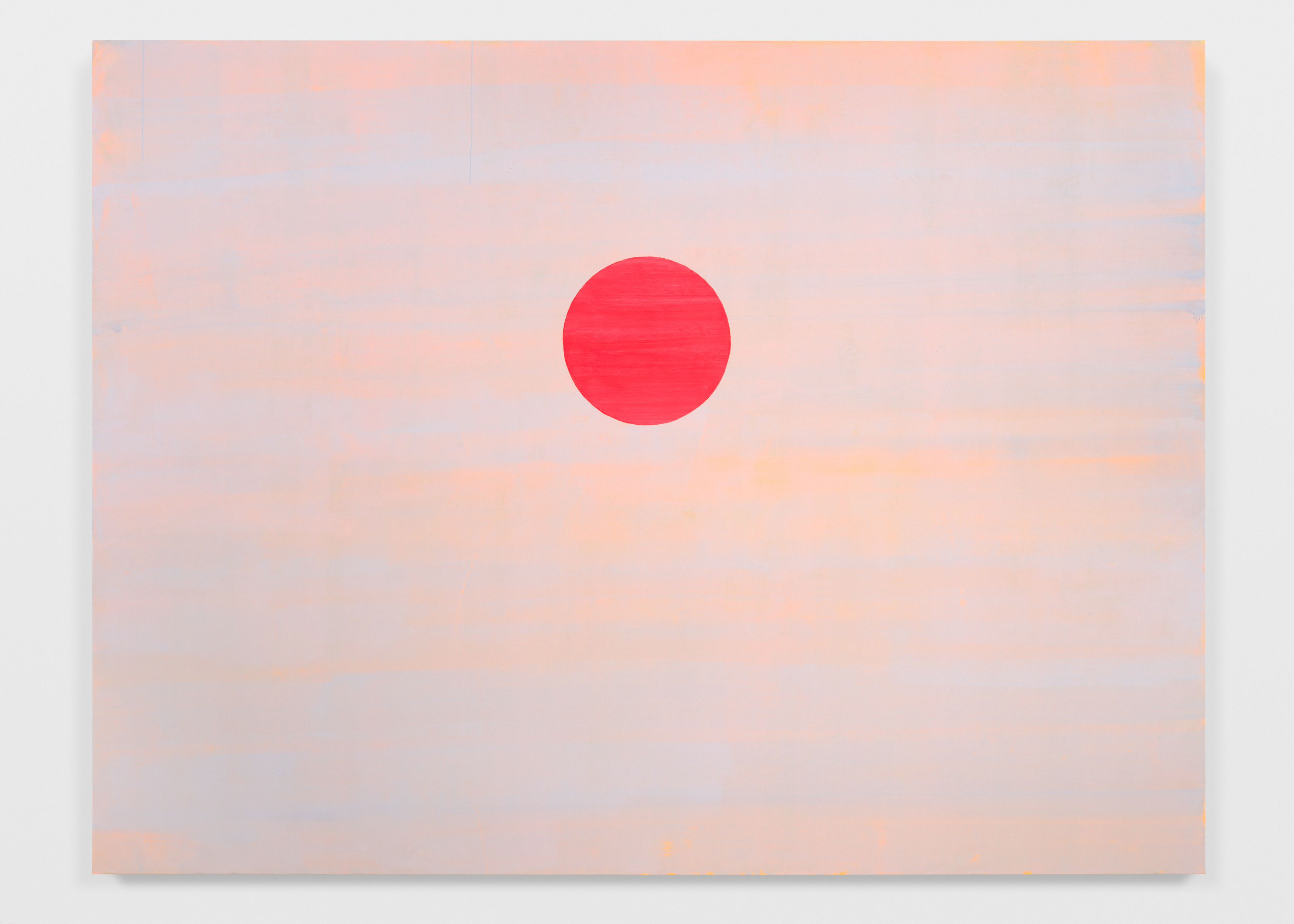 Wanda Koop, Evacuate, 2025, Acrylic on canvas, 119 1/2h x 159 1/2w in
The Moon Walk series acts as the exhibition’s fulcrum. Its distilled geometry risks cliché, but Koop uses that risk strategically. Subtle shifts in edge fidelity and color temperature destabilize the image as you look longer. The circles cease to be mere shapes and begin to pulse like moons, suns, or distant orbs—an effect heightened by her masterful control of color and value. The minimalism becomes a Trojan horse: behind the format’s restraint lies a dense perceptual experience.
Koop’s surfaces are equally deliberate. The ultra-matte, chalky finish rejects the seductive glare of varnish or the gestural bravado of brushwork. In absorbing light rather than reflecting it, the paintings exert a quiet gravity. The viewer’s gaze is drawn inward, encouraged to dwell in the subtle shifts of tone and hue. In an art world increasingly dominated by spectacle and speed, this insistence on slow, attentive looking is itself a provocation.
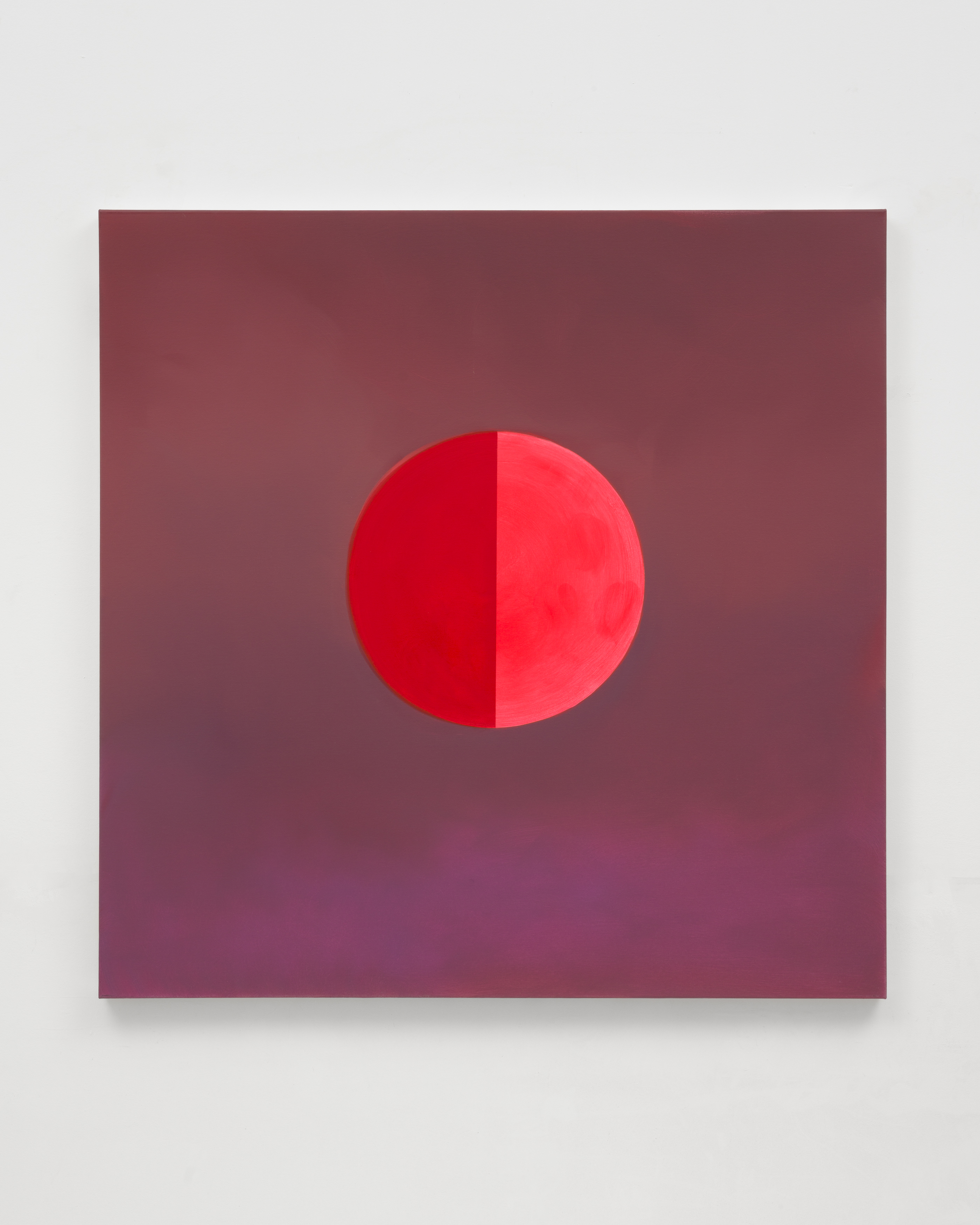 Wanda Koop, Moon Walk #3, 2024, Acrylic on canvas, 48h x 48w in
Evacuate, painted in remembrance of Canada’s devastating 2024 wildfires, epitomizes Koop’s ability to fuse formal rigor with urgent content. A searing fluorescent orange-pink sun dominates the canvas, its heat palpable. The color seems to sear the retina without inflicting harm—a reminder of nature’s dangerous beauty transformed into aesthetic pleasure. The painting doesn’t moralize or sentimentalize the catastrophe; instead, it uses color and form to hold beauty and threat in unresolved tension.
Throughout Magnetic Field, Koop plays with the collision of spiritual and pop-cultural registers. The circular forms can be read as mandalas or celestial bodies, but they also evoke images of vinyl records, corporate logos, or even emojis. This ambiguity undercuts any temptation to treat the work as purely devotional or purely ironic. Instead, Koop acknowledges the fluidity with which symbols migrate between sacred and commercial contexts. Her paintings become sites where reverence and kitsch intermingle—an acknowledgment that contemporary spirituality is inextricably linked to mass culture. It appears that the artist aims to remind the viewer of the ambiguity inherent in one's perception.
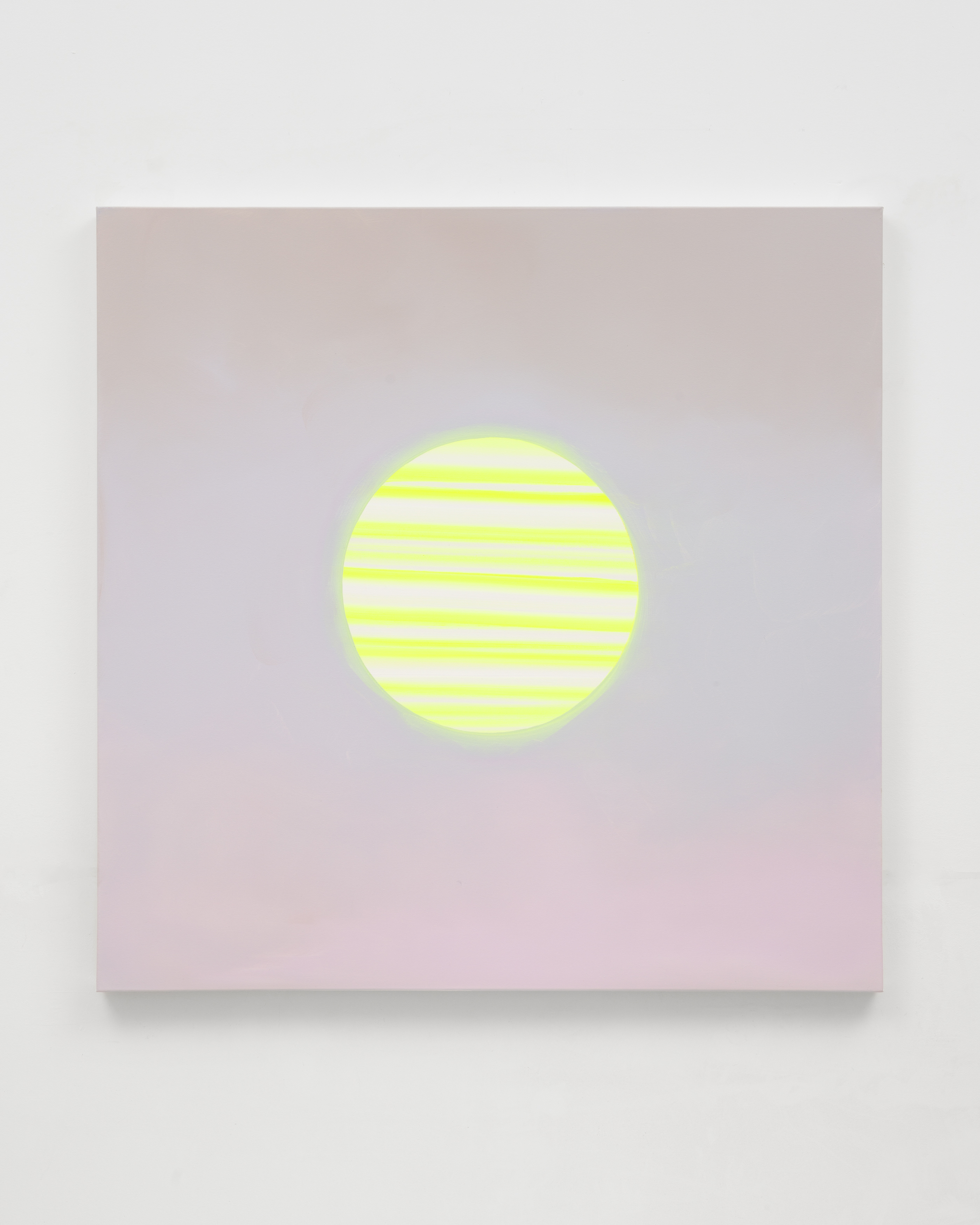 Wanda Koop, Moon Walk #10, 2024, Acrylic on canvas, 48h x 48w in
This dynamic—between reverence and critique—appears again in works like Ghost Tree AI. The piece grew from a personal encounter on Koop’s Manitoba property, where fallen trees coincidentally formed the letters “AI.” Initially read as organic remnants, the shapes slowly reveal their artifice. Recognition of the hidden letters jolts the viewer into awareness: what seemed natural is shown to be constructed, almost theatrical, like stage props. Koop uses this moment of recognition to comment subtly on artificial intelligence and the broader question of mediation in contemporary image-making. It’s a gentle but pointed reminder of how easily perception can be manipulated.
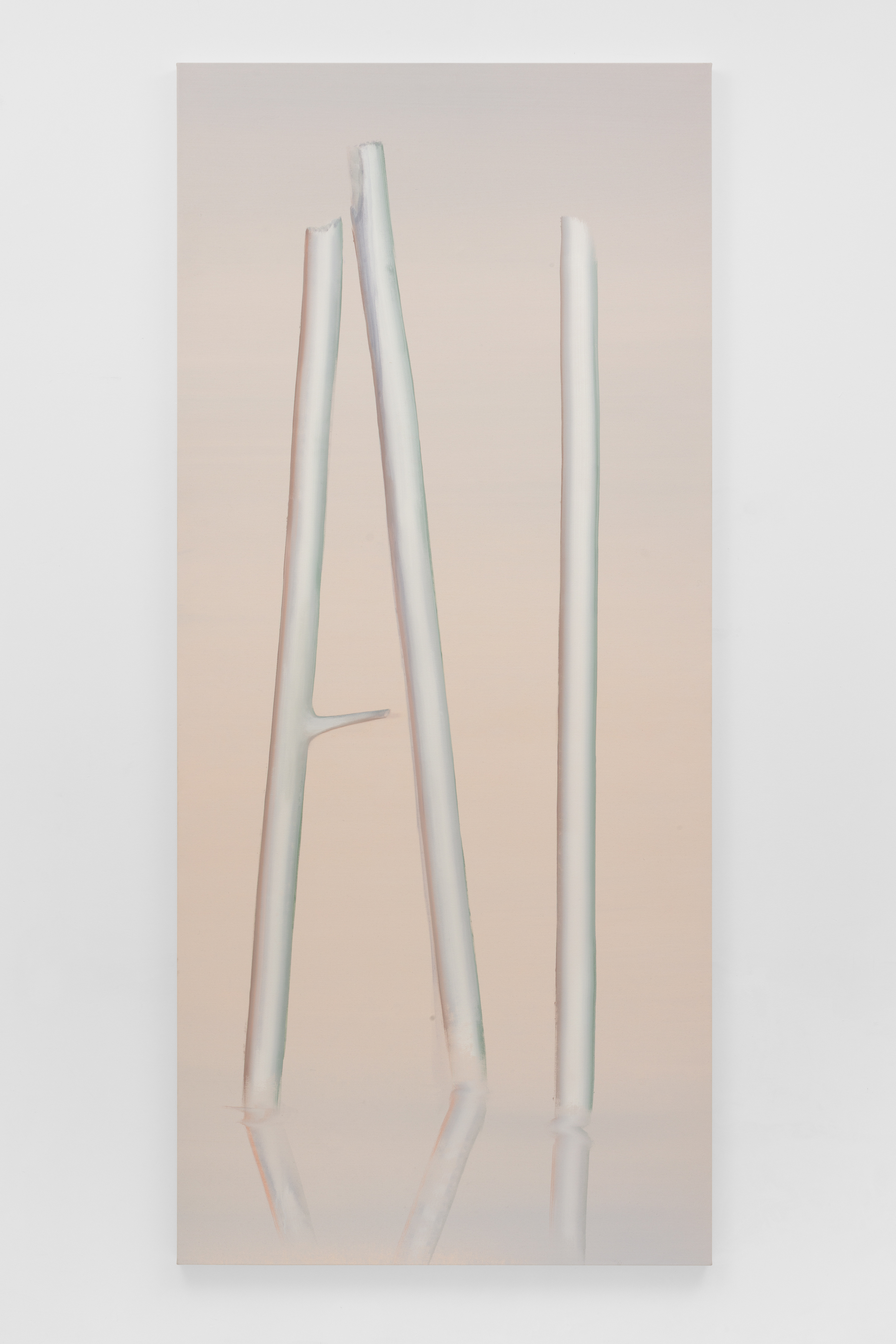 Wanda Koop, Ghost Tree AI - Soft Pink, 2024, Acrylic on canvas, 108h x 48w in
Koop’s command of color is especially noteworthy. Rather than relying on expressive brushwork, she crafts meticulously calibrated relationships—subtle temperature shifts, razor-thin contrasts—that cause her hues to vibrate against each other. This precision could risk sterility, but in her hands, it generates latent energy. The paintings feel charged, as if storing light to release later. Yet the discipline of Koop’s approach is not without risk. At times, the exhibition’s adherence to the circle-in-square motif feels almost too strict, threatening to narrow the conversation. A viewer might wish for a disruption, a formal break, or an unexpected gesture—that would jolt the series into new territory. But this restraint may itself be a test: how much can be said within severe limits? Koop’s answer is considerable. By exploring nuance rather than novelty, she argues for the continued relevance of formal exploration in contemporary painting.
 Wanda Koop, Moon Walk, Installation view at Arsenal Contemporary Art Gallery
Magnetic Field also situates itself within a broader historical discourse. Its echoes of Malevich and Albers are tempered by affinities with Hilma af Klint’s spiritual diagrams or Agnes Martin’s meditative grids. Koop acknowledges these lineages without capitulating to them. Her paintings do not feel like homage or pastiche but like extensions of a conversation—one that insists on painting’s ability to remain urgent, even after decades of critical doubt about its viability.
This urgency is evident in the work’s demand for time. They resist the accelerated rhythms of both digital culture and the art market. Koop’s matte surfaces, slow color transitions, and subtle perceptual shifts challenge the expectation of immediate legibility. In doing so, they critique the scrolling, distracted gaze that so often defines our encounters with images today. Ultimately, Magnetic Field is magnetic precisely because it refuses resolution. It hovers between abstraction and representation, reverence and pop play, seduction and critique. Its beauty is not decorative but destabilizing: a field of forces that pulls the viewer in, holds them, and leaves them changed. Koop shows that even the most familiar shapes—the circle and the square—can, in the right hands, open onto vast and unexpected terrain. WM

Riad Miah
Riad Miah was born in Trinidad and lives and works in New York City. His work has been exhibited at the Baltimore Museum of Contemporary Art, Sperone Westwater, White Box Gallery, Deluxe Projects, Rooster Contemporary Art, Simon Gallery, and Lesley Heller Workshop. He has received fellowships nationally and internationally. His works are included in private, university, and corporate collections. He contributes to Two Coats of Paint, the Brooklyn Rail, and Art Savvvy.
view all articles from this author