Whitehot Magazine
October 2026
"The Best Art In The World"
"The Best Art In The World"
October 2026
Investigating the Elsewhere: Freya Tewelde at Gallery 1957
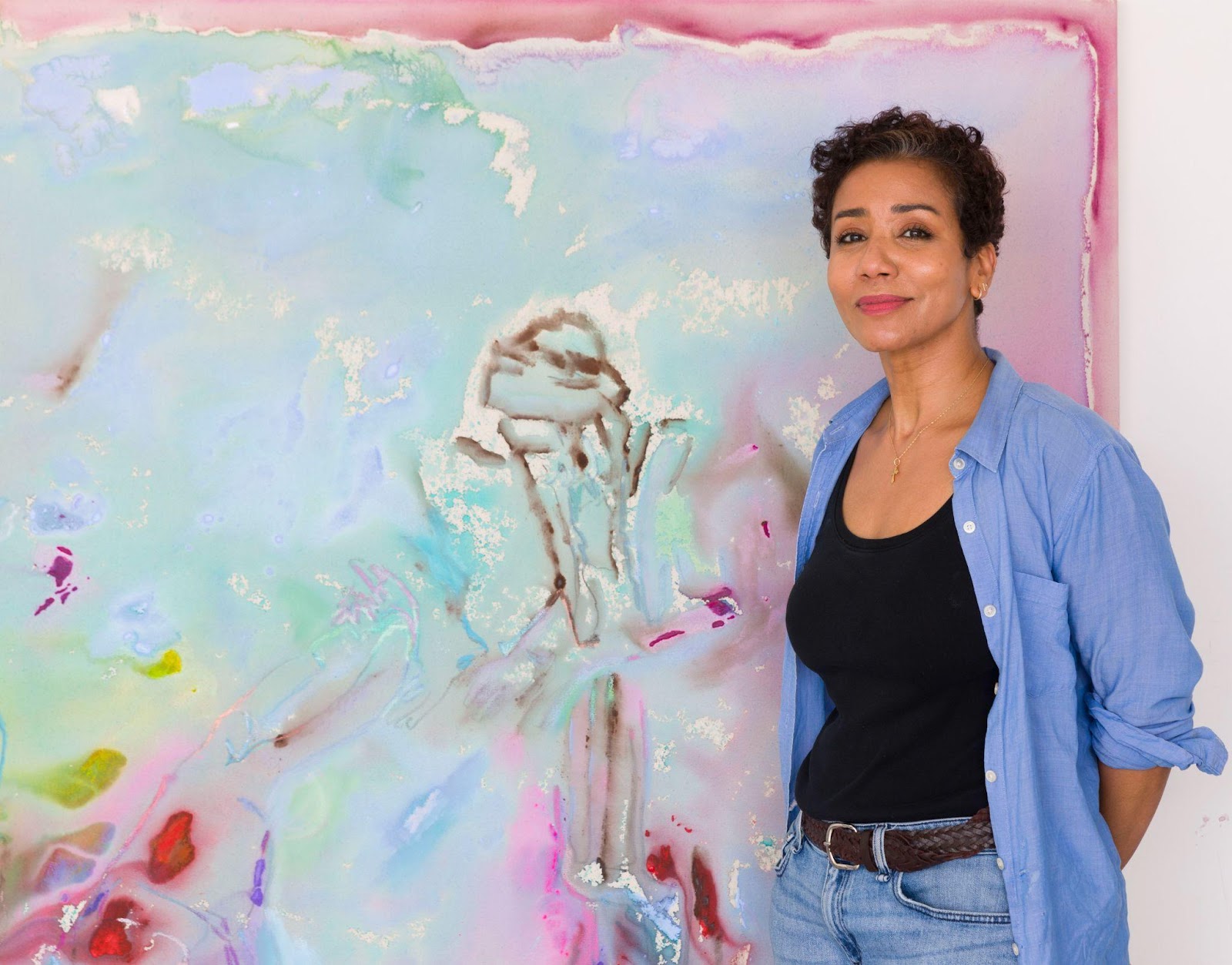
Portrait of Freya Tewelde (2026), Courtesy of Gallery 1957.
By GRACE PALMER July 8th, 2026
“I speak of something not in this world. I speak of someone whose purpose is elsewhere.” Alejandra Pizarnik’s enigmatic poetic refrain encapsulates the spirit of Freya Tewelde’s latest exhibition, ‘Geometry of Elsewhere’ at Gallery 1957, London. Organised as part of London Gallery Weekend, Tewelde’s solo show is a riotous celebration of colour’s possibilities. Her paintings, displayed in the gallery’s white-plastered Victorian interiors, are rhythmical explosions that command one’s attention. Departing from the semi-representational style that defined her earlier work, ‘Geometry of Elsewhere’ ventures boldly into abstraction, travelling into the unknown, or in the case of Tewelde’s work – the elsewhere. In conversation, Tewelde discussed her recent attraction to abstraction, her psychospiritual influences and the tension between routine and liberation that shapes her latest pieces.
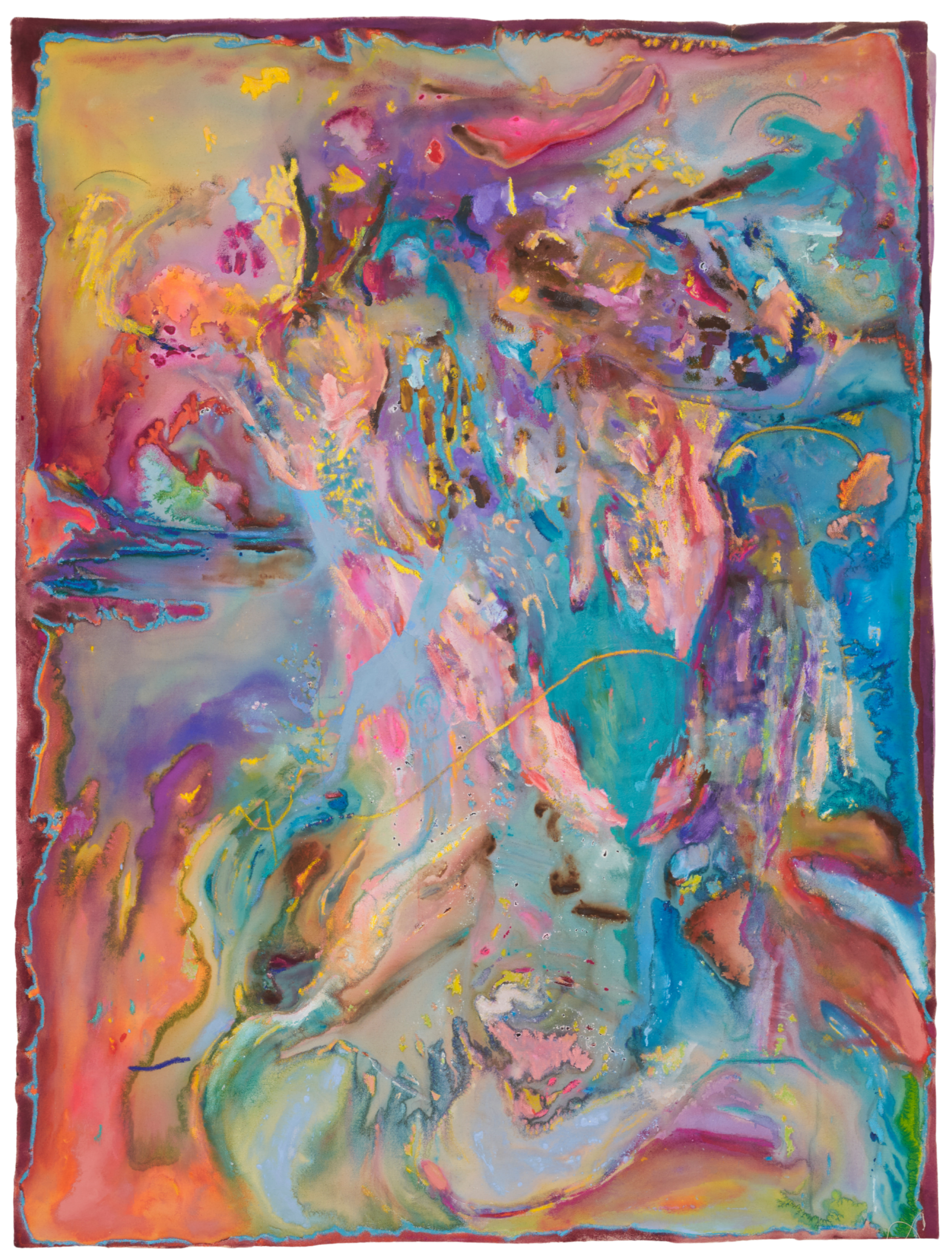 Freya Tewelde, Toward the Unseen (2024-35), powdered pigment, oil, oil stick and acrylic on canvas, 160 x 130cm. Courtesy of the artist and Gallery 1957.
In ‘Geometry of Elsewhere’, every corner and wall reveals these dynamic collisions of colour. In works like Passage (2026), turquoise and orange intermingle to create verdant abstract landscapes, while Sky Beneath the Skin (2026) erupts with delicate lilac and blue. Despite this exuberant palette, Tewelde’s oeuvre has not always been this luminous. During her MA at Chelsea College of Art, her video performance art explored black-and-white monochromacy: “I found more colour in black and white than colour itself.” Her 2019 performance piece, Suffocation, is rich in chiaroscuro. Cloaked in darkness, her figure is highlighted only by white linen trousers and the pile of clothes beneath her. Evidently, Tewelde’s work has long interrogated the dichotomies, constraints, and possibilities of colour. This new embrace of expressive hues stems less from a changed philosophy of colour and more from her adoption of new materials, particularly powder pigments. On canvas, these pigments merge, flow and transform, producing a sense of unfixity, motion and effervescence that shifts before the viewer’s eyes. In her studio, Tewelde animatedly described the process behind these paintings, a process that generates this rhythm and movement:
“So the work initially begins on the floor. As you can see, I stretch the work, and then it goes on the floor. I tend to use powdered pigments. And it's rather performative, although I'm not performing to anyone, but I'm walking around, I'm moving the canvas, I'm pouring, I'm spraying, I'm painting onto the floor. So weirdly everything's intuitive. So this is the initial format for presenting the work on the floor. And then it goes up. And that is sort of like halfway into being on the wall. But the work is very layered, very much process-led. So maybe this might come back onto the floor again and then go back.”
Gesturing to the floor, the wall, and all across her studio, it is clear that Tewelde moves alongside her work – they are in continued harmony, choreographing an intimate dance. Combining powder pigments with this tactile engagement with her painting, Tewelde explains how this has afforded “more mark-making and opacity to take place,” and perhaps, in part, shifted her practice towards abstraction.
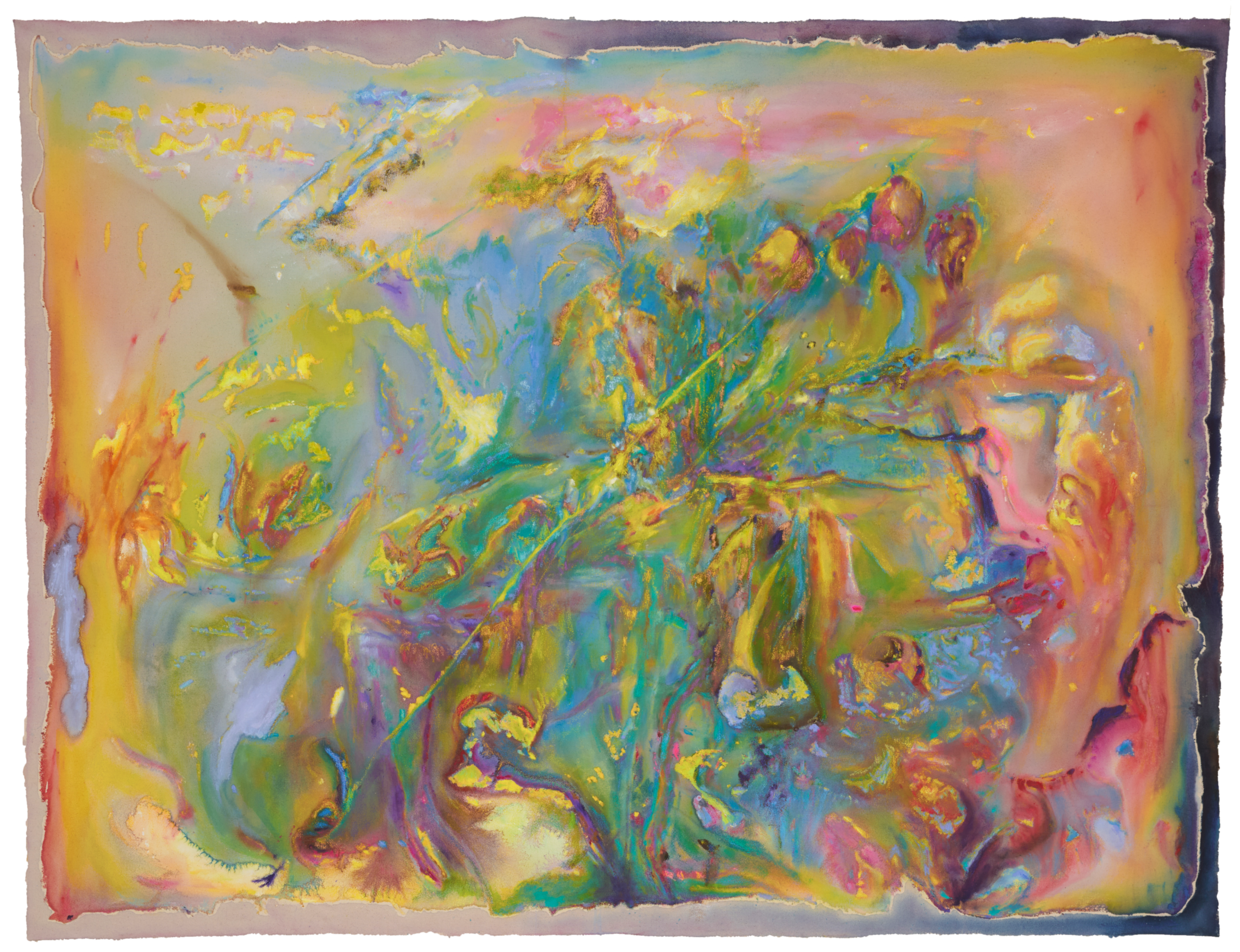 Freya Tewelde, The Weight of Light (2025), powdered pigments, oil and acrylic on canvas, 130 x 170cm. Courtesy of the artist and Gallery 1957.
Although Tewelde’s paintings have always contained elements of abstraction, ‘Geometry of Elsewhere’ abandons the figurative in favour of a purely abstract approach. While her physical engagement with materials may contribute to this non-figurative style, Tewelde attributes this transition largely to her diasporic experiences. Born in Eritrea, raised in Saudi Arabia and now living in London, she describes herself as “inhabiting multiple cultural spaces at once”. Rather than exploring heritage as a fixed identity, her work approaches it more as an evolution, a memory, an act of imagination. In investigating the nuances of her diasporic experiences, Tewelde draws upon the Negarit; an Eritrean kettledrum traditionally used in proclamations and ceremonies, whose rhythmic patterns gathered communities and transmitted information. Even in her earlier semi-representational works, notably her ‘Roots of Resonance: Baobab Tree’ (2023) series, she sought to capture this sense of listening, rhythm, and gesture. In her current abstract practice, this gestural responsiveness has found new vitality, enabling her to “dip in much more where language fails me.” As Tewelde explores her own sense of identity through her art, she emphasises that the essence of these paintings is to invite the viewer “to enter the image”. These portals or entryways offer a subjectivity to the work – “you take away whatever your own memory, heritage, wherever your interest lies.” Just as the Negarit gathered and transmitted, ‘Geometry of Elsewhere’ provides a space for open, fluid investigation. Tewelde does not attempt to resolve tensions between place, identity, and heritage; instead, she allows her paintings to remain “both an inquiry and a form of listening.”
Freya Tewelde’s paintings are optical discoveries. They are expressive in their gestures, full of dimensionality and energy. Yet for Tewelde, these visual qualities are secondary to her psychospiritual engagement with the work: “that space where no one can tap into except you.” Works like A River Inside the Blue (2025) and Vital Currents (2025) are not merely visual stimuli; they are immersive journeys toward “finding peace, harmony and dissolution.” Even in her preliminary sketches, Tewelde’s practice is guided more by emotion than by strict routine or visual rhetoric. Tewelde is a rarity amongst painters for her ability to probe the relationship between inner experience and artistic creation. As she shares, “my best time is when I can get lost in the work – when I have no control over the process.” This liberatory approach and “relying intuitively for whatever it is to take place” is reciprocal. Not only does it grant Tewelde the freedom to surrender to the painting, but it also invites viewers to enter her work, impart their own experiences and “tap into our own psyches.”
‘Geometry of Elsewhere’ is as much an expression of Tewelde’s intuitive approach as it is an offering of self-assurance, liminality and interconnectedness with viewers. For her, the exhibition title encapsulates the investigative nature of how her paintings relate to their environment. The seemingly oxymoronic phrasing – where geometry signifies precise, mathematical structures and elsewhere represents an elusive, intangible force – comes together within Gallery 1957. She describes this connection as “emotional geometry, a framing within the framing.” Elsewhere can be somewhere or nowhere at all; her work occupies this ambiguous space. As you explore the exhibition, you fluctuate between works that invite entry and others that “leave you hanging.” This navigation of elsewhere is deeply personal, offering endless subjectivity rarely found in abstraction.
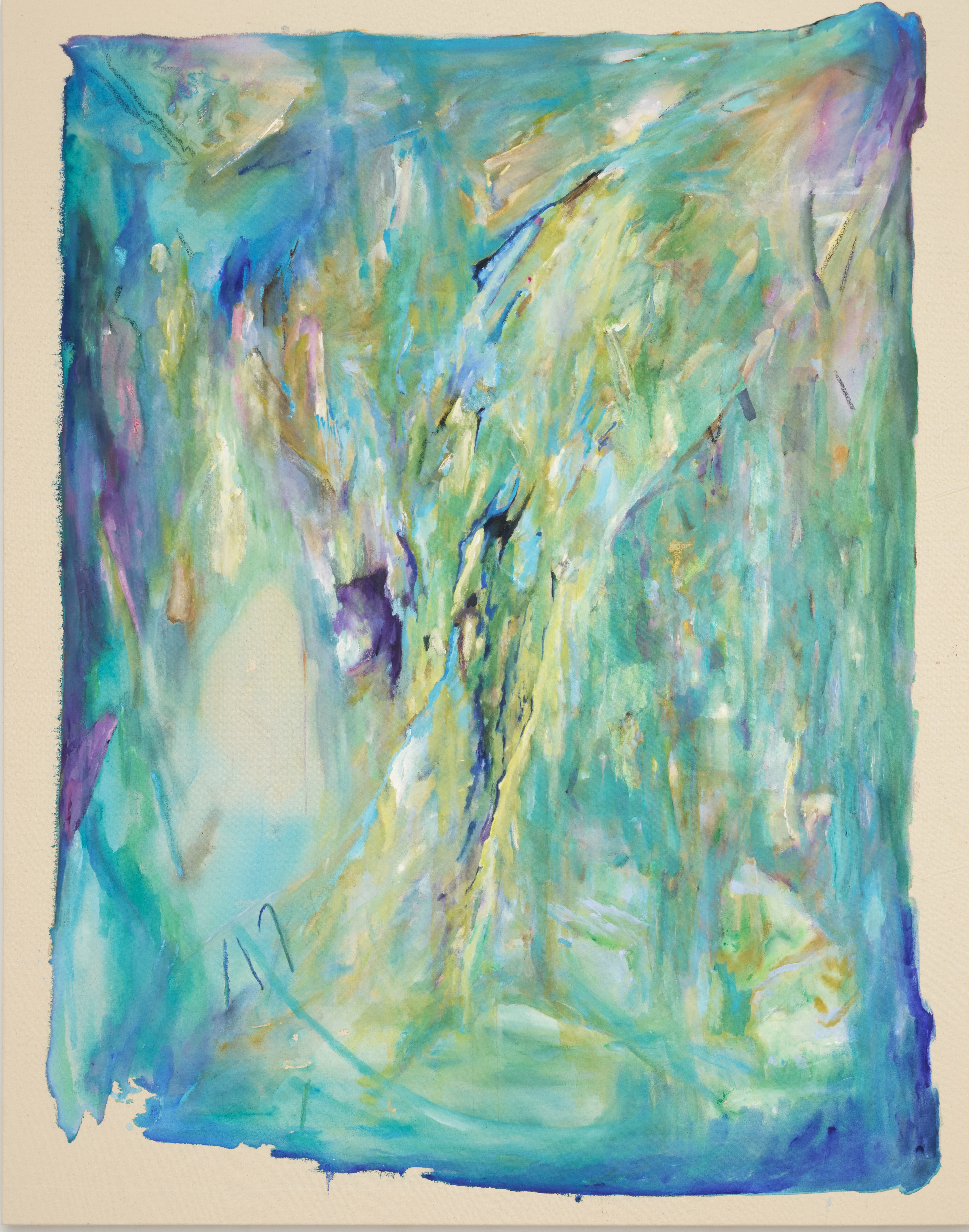 Freya Tewelde, Her Rising is a River (2025), powdered pigment, oil and acrylic on canvas, 130 x 165cm, Courtesy of the artist and Gallery 1957.
As her second show in London, ‘Geometry of Elsewhere’ marks a pivotal point in the artist's journey, aided by “the generous and genuine support” of Marwan Zakhem and Gallery 1957. Tewelde emphasises that the curatorial decision to “respond first and foremost to the work” afforded her the independence to develop these new abstract paintings. Though she entered the art scene later in life, ‘Geometry of Elsewhere’ reflects an artist deeply embedded in her craft, honed through years of self-development and introspection. For Tewelde, making art is a way of life: “I come to the studio five days a week – I have this burning desire to be here and make.” Her studio functions both as a sanctuary and an ever-changing hub of innovation, “where the various strands of research are tested, transformed and allowed to evolve.” With ideas percolating, canvases being stretched, stored, or moved, and sketches scattered, the studio has become her ‘elsewhere’. Freya Tewelde is an artist intimately involved in her practice, but unafraid to relinquish herself to the process of creation. Pizarnik’s poetic muse of one whose purpose is elsewhere comes alive within Tewelde’s work, for, as Freya reveals, “painting remains one of the few spaces where I feel uncertainty can be productively held rather than being solved.”
My thanks go to Freya Tewelde for taking the time to speak so openly with me about her practice and to Pelham Communications for facilitating this meeting.
Freya Tewelde: ‘Geometry of Elsewhere’ runs between June 5 – July 25 2026, at Gallery 1957, London.

Grace Palmer
Grace Palmer, an art historian and writer, specializes in the history of contemporary art and 1960s New York performance art. She contributes to Whitehot Magazine and is currently located in London, England.
view all articles from this author