Whitehot Magazine
October 2026
"The Best Art In The World"
"The Best Art In The World"
October 2026
Fredrik Værslev: The Joy of Painting
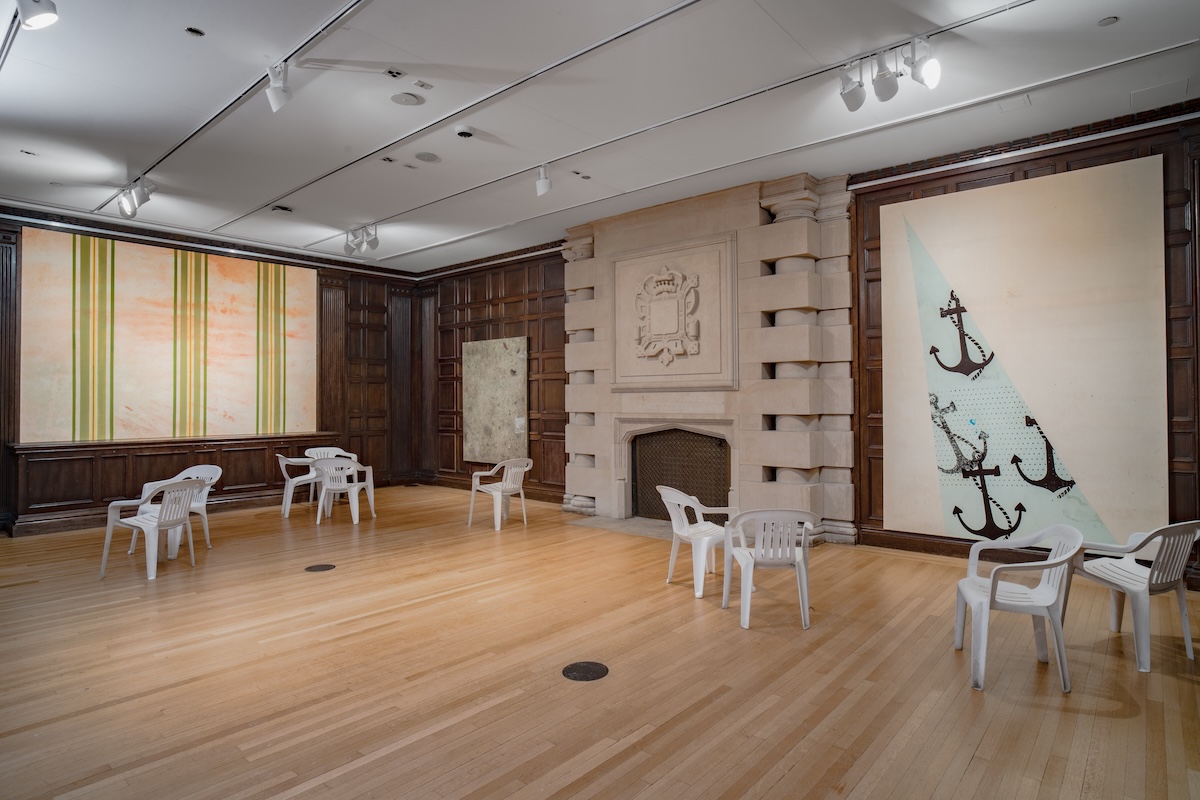 Installation view of Fredrik Værslev: The Joy of Painting at the Neubauer Collegium, 2026. Photos by Bob
By ESME GRAHAM March 6th, 2026
The exhibition title “The Joy of Painting” may sound familiar to many, likely because it was the title of Bob Ross’ long-running PBS series. The program provided step-by-step instructions on how to paint idyllic landscapes. Ross was soothing and unpretentious in his instruction, teaching viewers that each individual brushstroke could contribute to a cohesive whole. In Fredrik Værslev’s exhibition, curated by Dieter Roelstraete at the Neubauer Collegium, he performs the reverse. Each canvas invites the viewer to read against illusion and to investigate how abstract painting is formed. Signs and symbols peek out from brushstrokes, canvases vary in size or dissolve into curtains. While the viewer may try in vain to identify a definition of abstraction, the paintings stubbornly resist. The act of looking at the paintings through a taxonomic lens gives way to the act of simply looking at the paintings, which is, indeed, a joy.
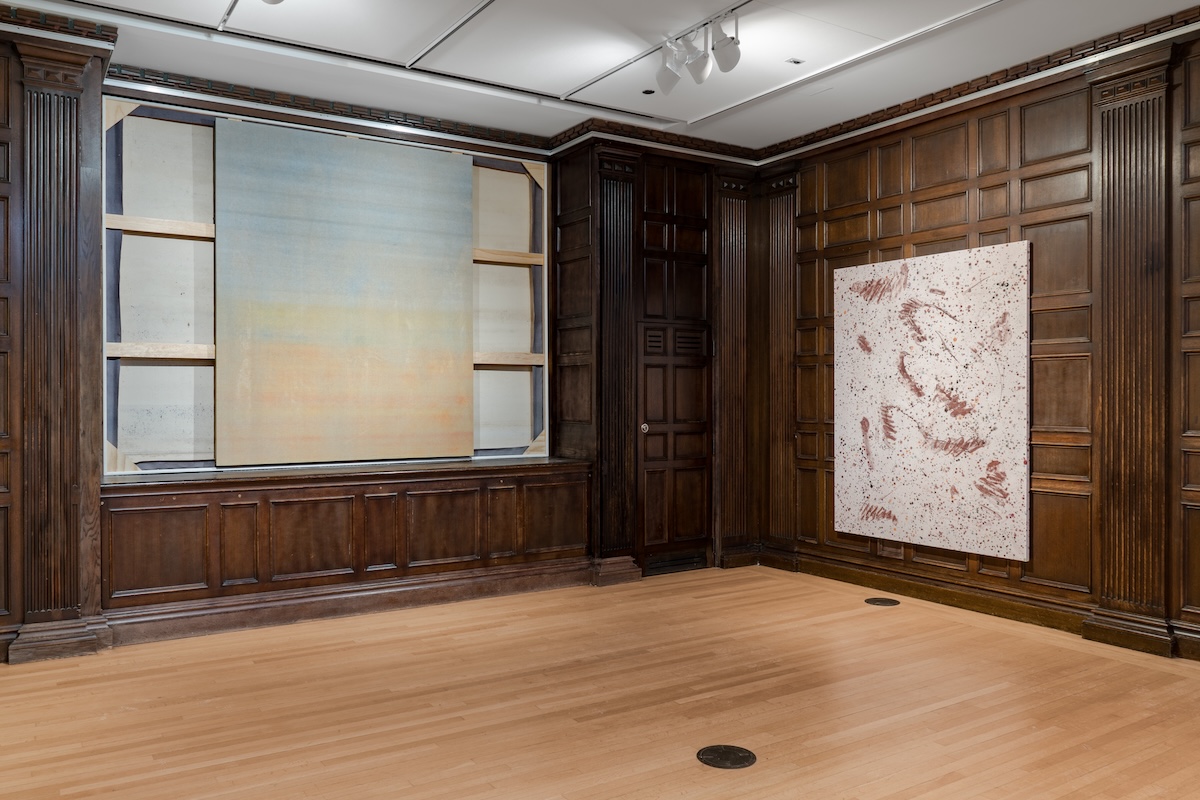 Installation view of Fredrik Værslev: The Joy of Painting at the Neubauer Collegium, 2026. Photos by Bob
Throughout the exhibition there are winking art historical references, as Værslev places himself in conversation with abstract canvases that have come before. His clearest inspiration is Jackson Pollock, whose action paintings are evoked especially in Untitled (2022), which is a white canvas splattered with colorful “drips” and rust-red motifs. Værslev’s use of spray paint instead of Pollock’s typical oil and enamel paint subverts the expected conventions of how such an image was made: it is certainly possible that Værslev’s canvas was laying on the ground when it was painting, but it also may not have been. Beyond exploration of the two-dimensionality of the canvas, he undermines the expected conventions of abstract art-making.
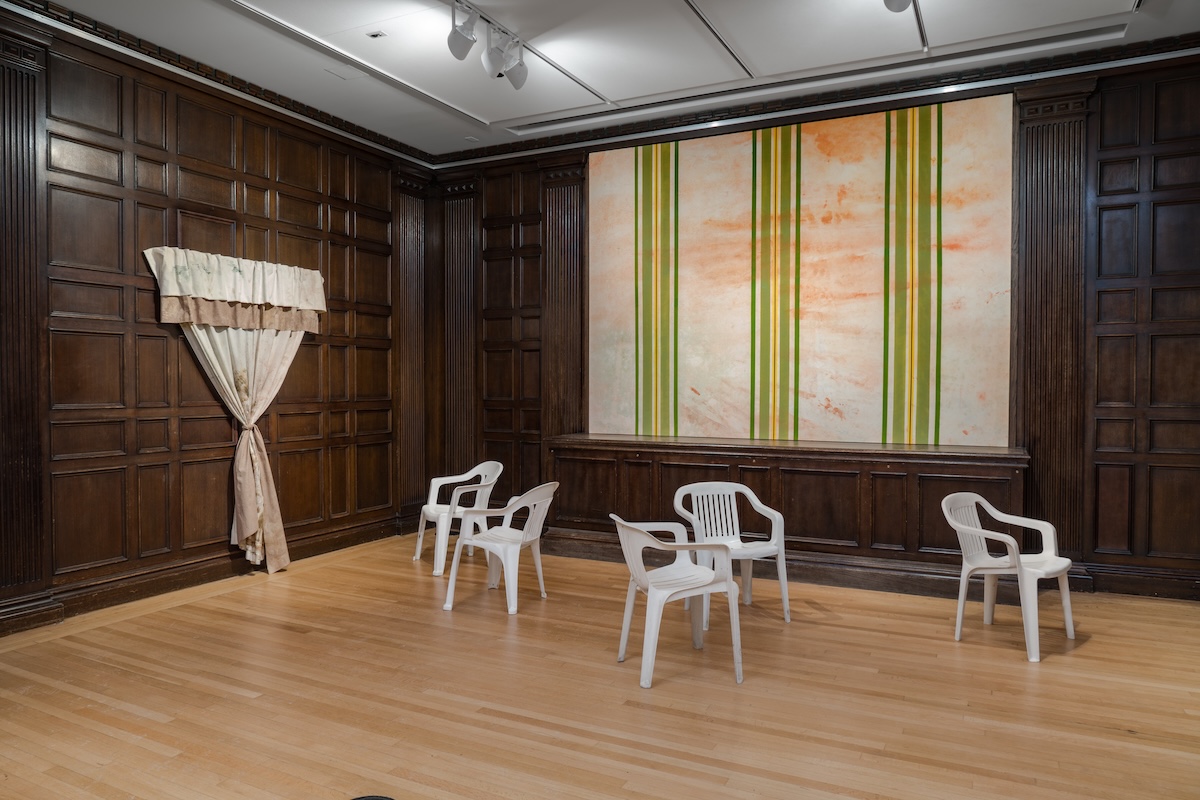 Installation view of Fredrik Værslev: The Joy of Painting at the Neubauer Collegium, 2026. Photos by Bob
Værslev’s paintings investigate the ways that paint can appear, both on the canvas and in the exhibition space. When walking through the Neubauer space, it is easy to miss Untitled (Japan) (2025), or, more accurately, it is almost impossible not to miss it. That is because it is placed behind another painting, Untitled (2025), which is situated in front of a window and depicts green and yellow vertical stripes with washes of pink. However, when the lights are turned off—an act that feels illicit in the already dark exhibition space—a red circle glows from the window, faintly illuminated from the light outside. The red circle could be blood seeping through fabric from a wound, or an evening sun. However, this is a rare work where Værslev’s title provides guidance, and frames this startling moment around a national signifier.
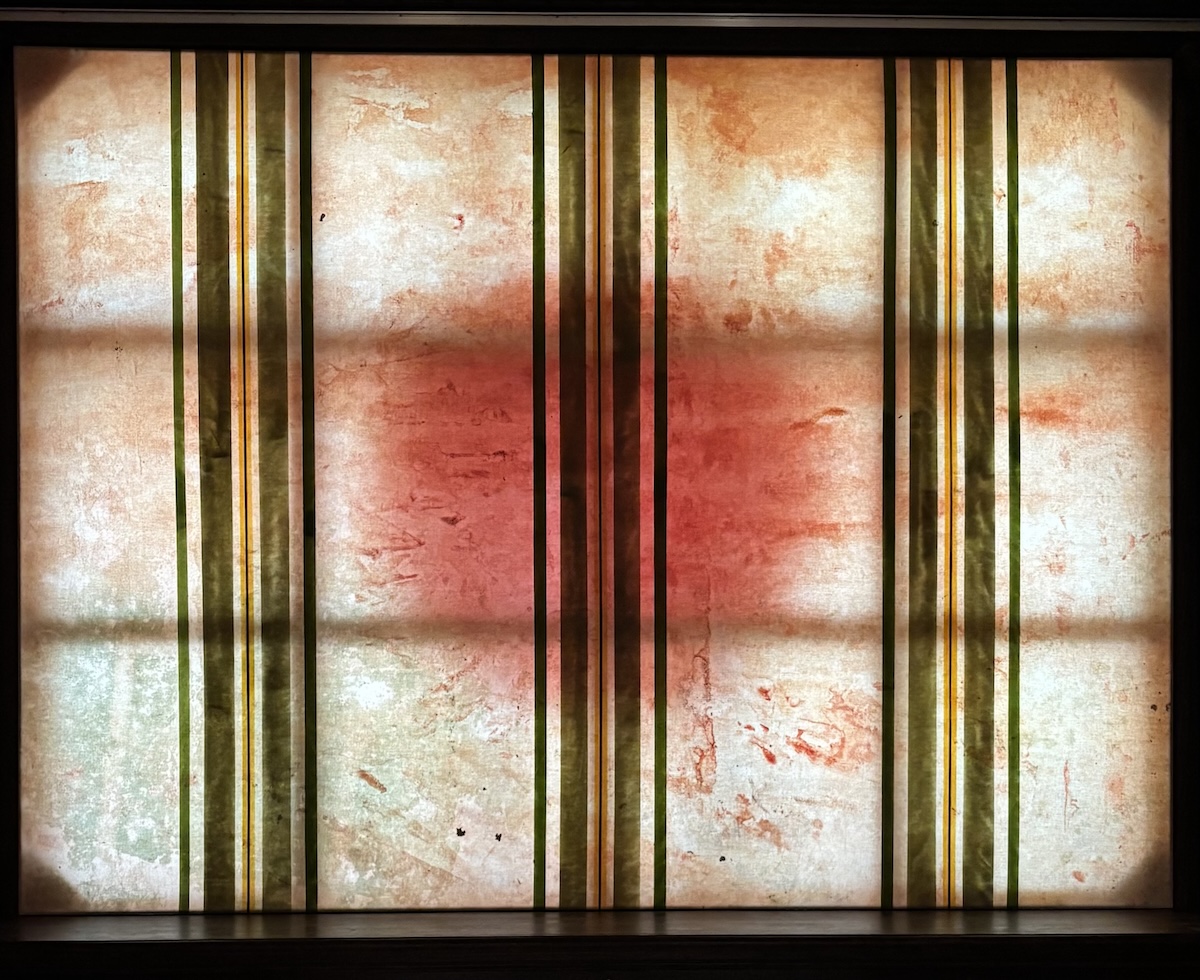 Installation view of Fredrik Værslev: The Joy of Painting at the Neubauer Collegium, 2026. Photo by Esme Graham
If, as Clement Greenberg famously argued, the condition of modernist painting was to investigate the flatness of the canvas, this exhibition deconstructs it. Throughout, Værslev turns the canvas into a granite-like surface, a translucent window-shade, and, ultimately, into a curtain. The curtain, Untitled (Neubauer Curtain Bang) (2025) made out of two deconstructed canvases, is, like a smock, smattered in paint and cinched at the waist. Værslev seems to be humorously calling “curtains” on the historical restrictions of formalism.
Fredrik Værslev
The Joy of Painting
The Neubauer Collegium for Culture & Society
January 29 - March 27

Esme Graham
Esme Graham is a writer and critic based in Chicago. A graduate of Carleton College, she is currently studying Art History at the University of Chicago with a focus on Modern and Contemporary Art.
view all articles from this author