Whitehot Magazine
October 2026
"The Best Art In The World"
"The Best Art In The World"
October 2026
Fred Borghesi: dissolution and construction of reality
By MANUELA ANNAMARIA ACCINNO February 26th, 2026
Borghesi's reflection on form and reality lies on the cusp between phenomenology and creative negation: form here is not a static appearance, nor simply content, but a field of tension where the self and the world question and dismantle each other. His work investigates form as a dynamic structure — something that is constructed and dismantled in the same gesture — and reality as the provisional result of continuous acts of reduction and recompositing. This perspective stems from the idea that perception is always an operation of refinement: we select details, separate them, and enclose them within boundaries. Borghesi reverses this operation: he applies a counterforce which, inspired by Weil's notion of decreation, aims to undo formal certainties in order to restore to the gaze a space in which reality re-emerges more naked and uncertain. Taking Simone Weil's decreation not as mere destruction, but as a moral and ontological tension to dissolve the calcified core of the ego, Borghesi translates it into a visual practice.
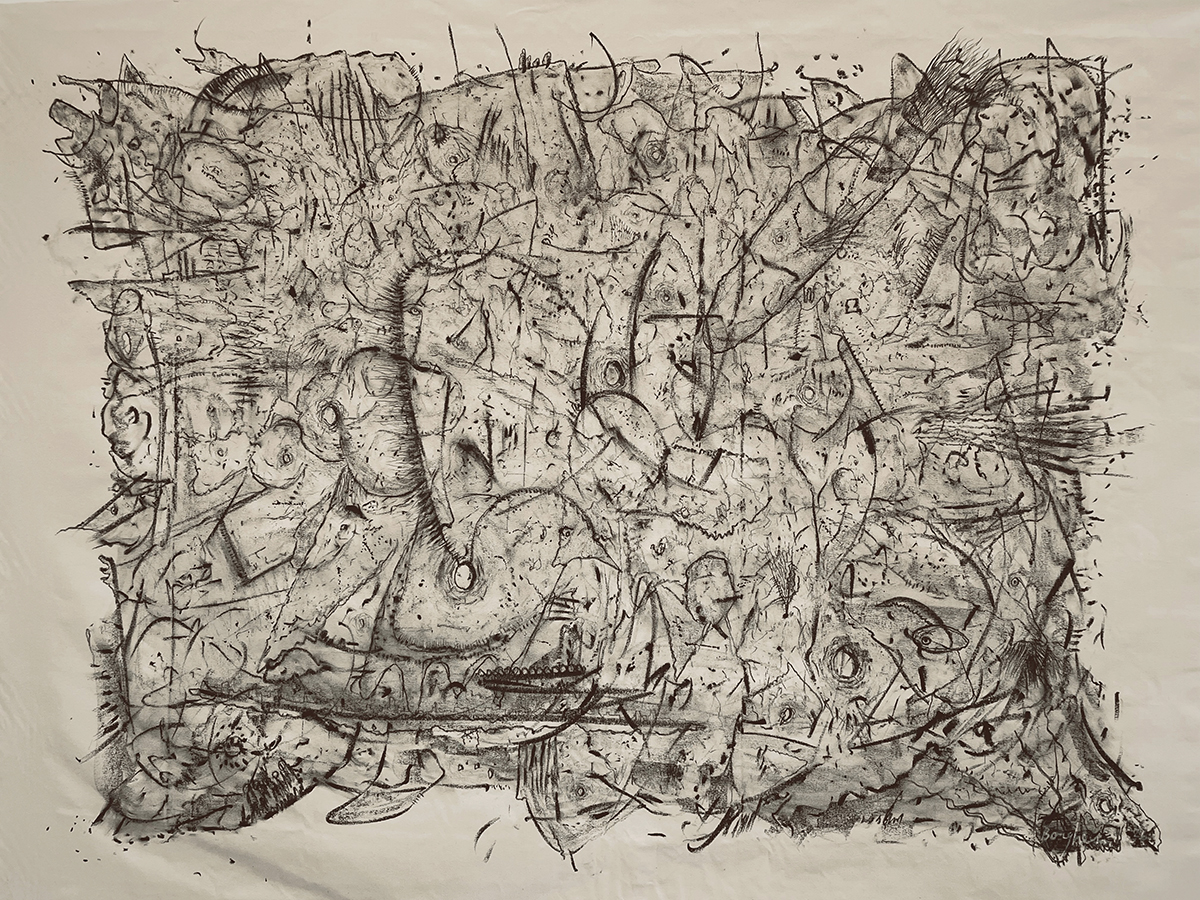
"Biosphere", Oil stick on canvas, 200x300cm, 2026
In his works, decreation is twofold: directed towards the figure — the face, the body, the human presence — and towards the object-form that constitutes the universe of the representable. For the artist, undoing the creature that man has inside means dismantling the identity established by the self, showing what remains when masks, perceptual habits, and narrative conventions are removed. But the artist goes further: this process is not just the annulment of the self; it is the dismantling of the formal laws that dictate how the world presents itself. Thus, surfaces flake away, silhouettes dissolve, volumes open up in unexpected tensions; reality is not lost, it is decanted.

"Good virus", Ink on paper, 55x70cm, 2026
The apparent contradiction between abstraction and figuration in Fred Borghesi's works becomes their strong point. When faces appear, they are not canonical portraits but borderline presences: fragments of gazes, maps of flesh, memory cells that resist the effort to be named.
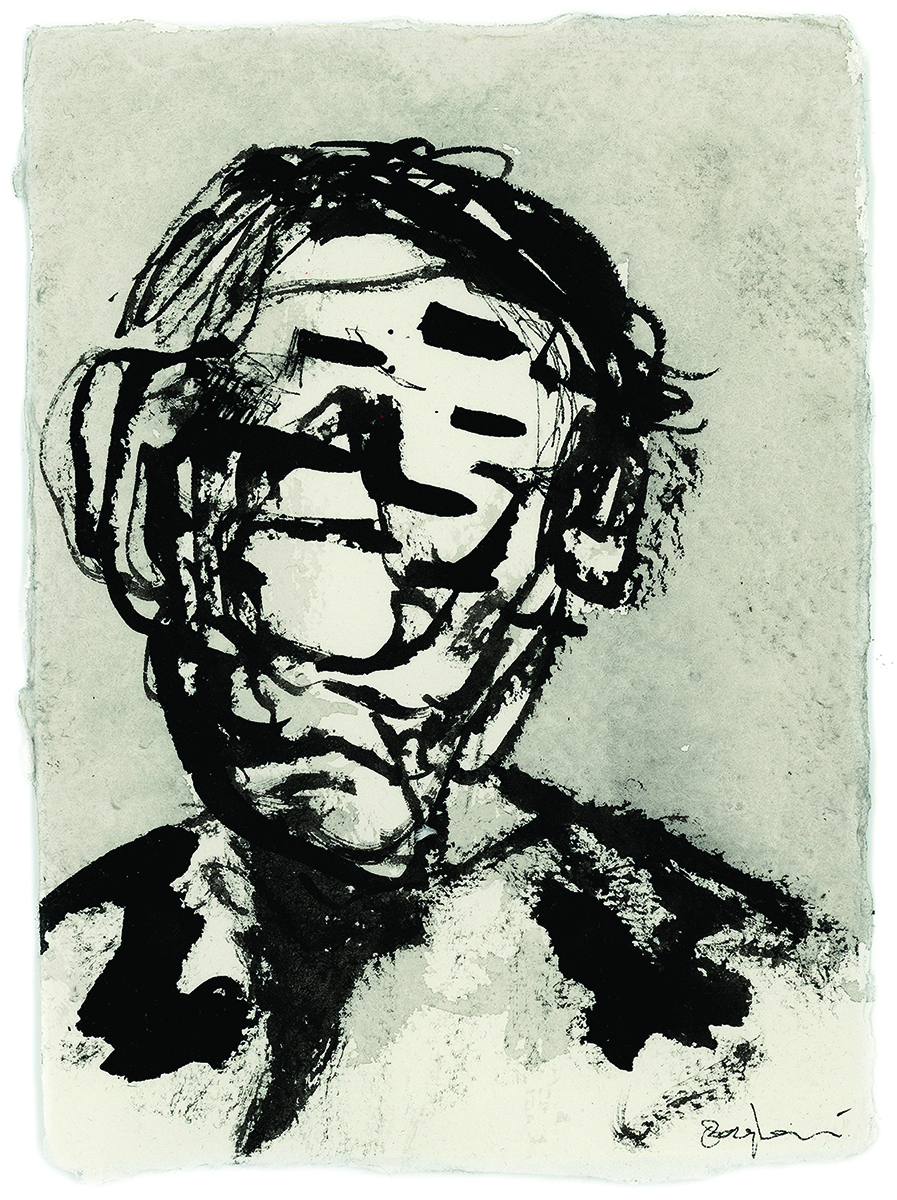 "Maybe another time", Ink on paper,10.5x14.8cm, 2025
Abstraction does not trample on the recognizable in order to erase the human, but to restore it in a version that has lost the clear boundaries of the self. Broken lines, layered backgrounds, material inserts, and empty spaces constitute a grammar that deconstructs the psychological unity of the subject and at the same time lays bare its fragility and residual power. The Borgesian face is therefore a “dissolved face”: witness to a humanity that survives its own bewilderment.

"Turbulence", Ink on paper, 14x21cm, 2025
Every mark, every glaze, every insertion of material is an act aimed at dismantling the usual modes of vision. The surface behaves like geological terrain: excavation and deposition alternate, revealing layers of temporality and membranes of experience. In some works, light seems to pass through the medium rather than engrave itself upon it, suggesting that reality is not merely a superstructure but a permeable fabric of memories and tensions. In this context, de-creation opens up a particular temporal dimension: it is not an instantaneous event but an extended, almost liturgical process.

"Evening optimist", Ink and watercolour on paper, 21x29.7cm, 2025
The time of the work is a time of subtraction and listening. As in a spiritual practice, the dissolution of the self and of forms creates a space of silence in which unexpected residues emerge—traces of pain, grace, collective memory. Thus emerges a relationship with transcendence that is not consolatory but interrogative: the work does not respond, but rather bears witness to a threshold.
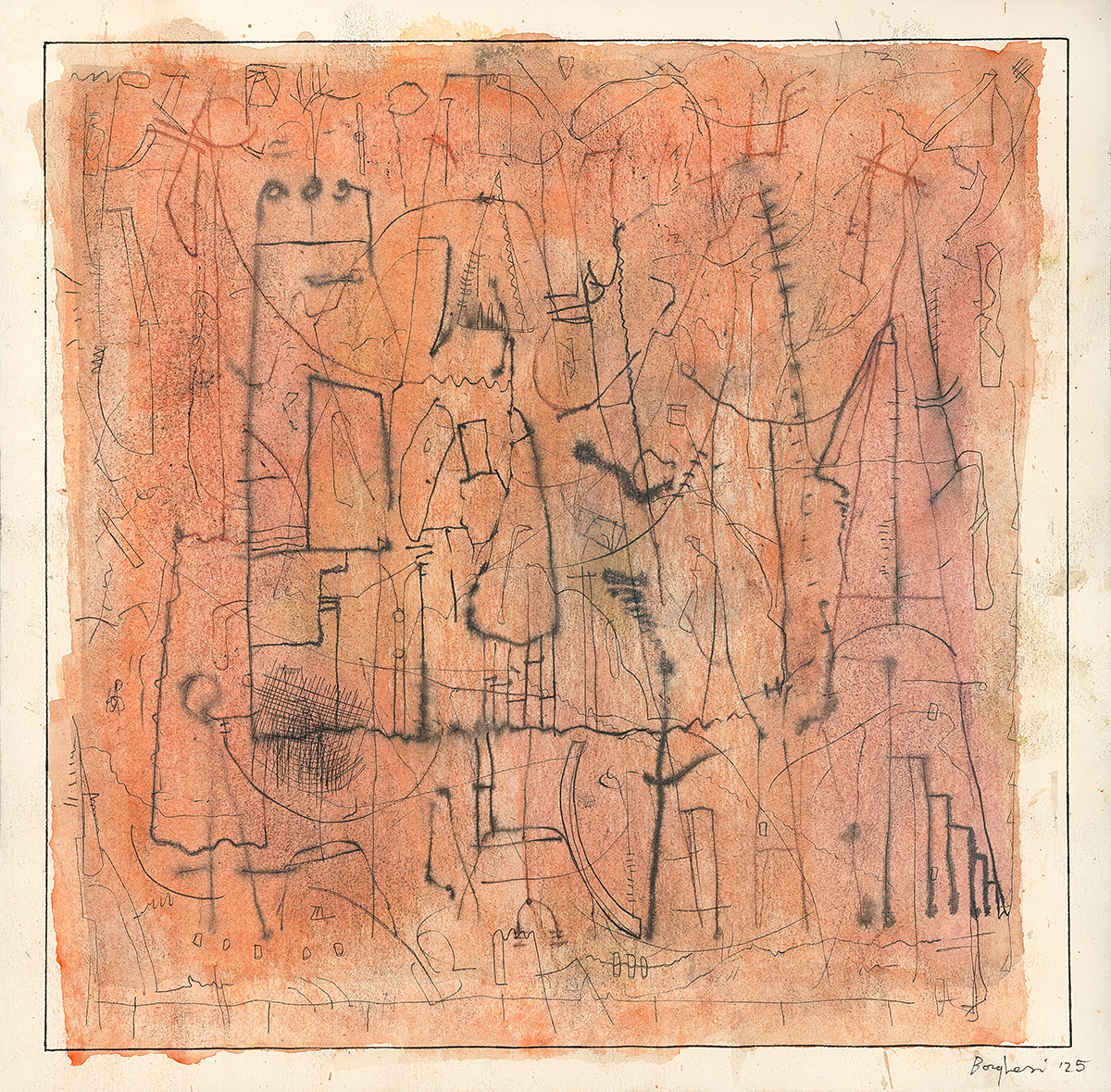
"Get around to it", Ink, watercolour and graphite on paper, 25x25cm, 2025
When viewing a work by Borghesi, the viewer is called upon to actively engage: to recompose, tolerate indecision, inhabit suspension. Viewing becomes an exercise in patience and perceptive humility; the eye learns to renounce rapid recognition and to welcome the mixture of forms and non-forms. While Borghesi's de-creation dismantles the self and the forms of the world, it does not lead to a definitive void. On the contrary, undoing opens up the possibility of a recompositing that is freer from premises and perceptual idols. Borghesi's artistic gesture thus appears as a work of intellectual love: it subtracts in order to restore, dissolves in order to allow reality to reappear in its precariousness and truth. Form, freed from the tyranny of the self and categories, regains its ability to speak, and the face that emerges is that of a humanity that is truer because it is less sure of itself.

Manuela Annamaria Accinno
Manuela Annamaria Accinno, born and raised in Milan, is an art historian and critic with a degree from the University of Milan. She has been actively collaborating for several years with radio stations and magazines specializing in the field of art.
view all articles from this author