Whitehot Magazine
September 2026
"The Best Art In The World"
"The Best Art In The World"
September 2026
Frank Hutter and the Immediacy of the Mark
By RAPHY SARKISSIAN | June 8th, 2026
It is fitting that Paul Klee's Angelus Novus of 1920 has only just arrived in New York for the first time. A modest monoprint possibly made to entertain the artist's young son, it was acquired by Walter Benjamin in 1921 and remained in his possession for nearly two decades. In the summer of 1940, Benjamin removed the sheet from its frame to entrust it to Georges Bataille, who hid it in Paris before Benjamin's final flight to Portbou. Now on view at The Jewish Museum in New York as part of Paul Klee: Other Possible Worlds, it brings with it the persistent resonance of Benjamin's reading: the angel who sees history's catastrophes accumulating but cannot intervene. Frank Hutter's Malerei at 447 Space opens at precisely this moment, presenting its own negotiation with that angel.
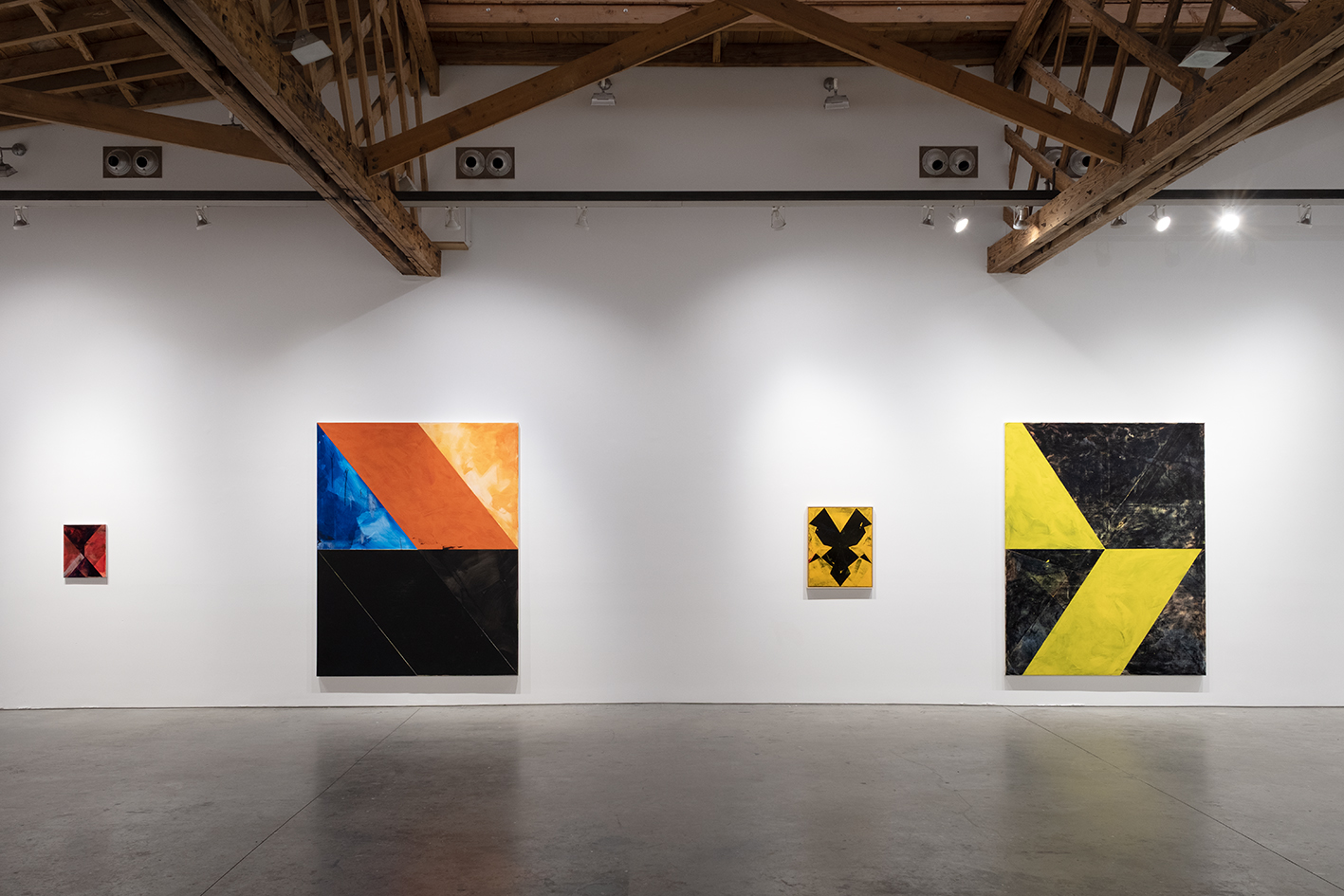
Frank Hutter, Installation view of the exhibition Malerei. © Frank Hutter. Photo: Torsten Hink/UTOUP Studio. Courtesy the artist and 447 Space.
In this exhibition, which veers toward the resolutely abstract, Hutter carves out a distinct position within the pluralist landscape of contemporary German painting. Simultaneously, he moves away from both the associations of Leipzig's narrative tradition and the analytical detachment historically tied to the Düsseldorf school. If Benjamin's angel has become a dialectic between the promise of technological progress and its historical negation, Hutter's response is found in a Hegelian tension between the freedom of the mark and a rhythmic subterfuge of the layout. Here the liminality of a gestalt perpetually oscillates: now pure geometry, now cunningly referential, now pure geometry again. If Hutter focuses on the pure materiality of paint upon a flat surface, a single title within the exhibition, Angelus Novus, seems to anchor the viewer in a present reality, with the social, historical, or personal weight of its own. Through the chromatic play of its gestalt, here is a formalism that invites the onlooker to contextualize it from within.
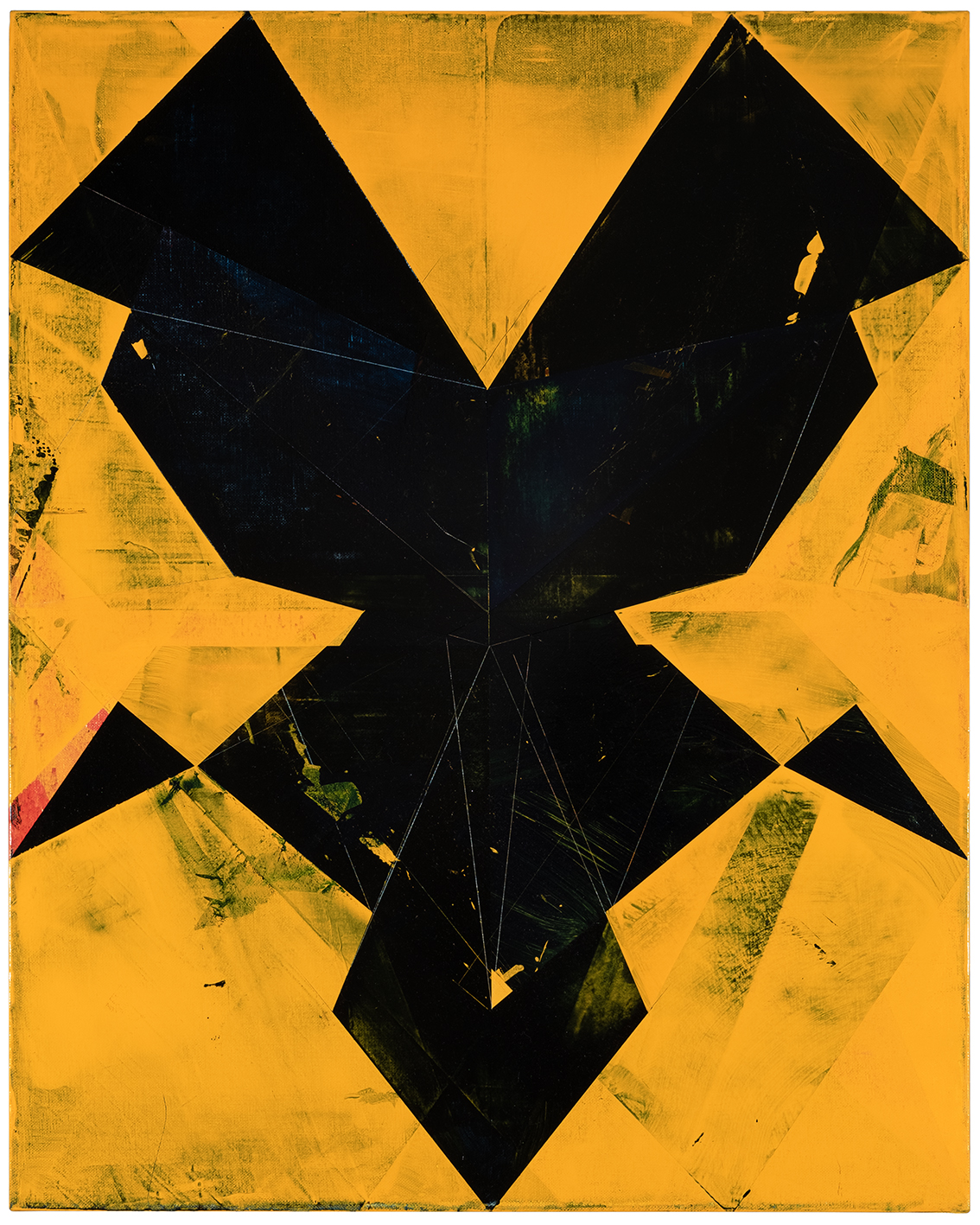 Frank Hutter, Angelus Novus, 2025. Oil on linen, 29.5 by 23.6 inches. © Frank Hutter. Photo: Torsten Hink/UTOUP Studio. Courtesy the artist and 447 Space.
Hutter's work does not mirror Benjamin's "straggly" angel, as Deborah Solomon described Klee’s oil transfer in The New York Times. Rather, Hutter’s painting internalizes Klee's figurative ghost. In Angelus Novus (2025), his direct response to Klee, this invocation is rendered through a symmetrical central figure in black, a Rorschach-like form of contained and internally stained presence. The figure is set against a saffron ground that is radically unsettled, blurred, and process-exposed, as if the linen itself were still absorbing the terms of its own making. Here the composition abstracts and realigns the spectral silhouette of Klee's original, opting for a spatial tension where the angel is felt only in a liminal, unconscious mode. Glimpsed from a distance as two profiles facing in opposite directions, noses and mouths implied by bilateral symmetry, the forms collapse back into geometry and accidental mark. The saffron traces that suggest eyes appear as mere happenstance. In this sense, abstraction submits itself to a form of self-reflexivity: what can painting still hold of the figure it has consumed?
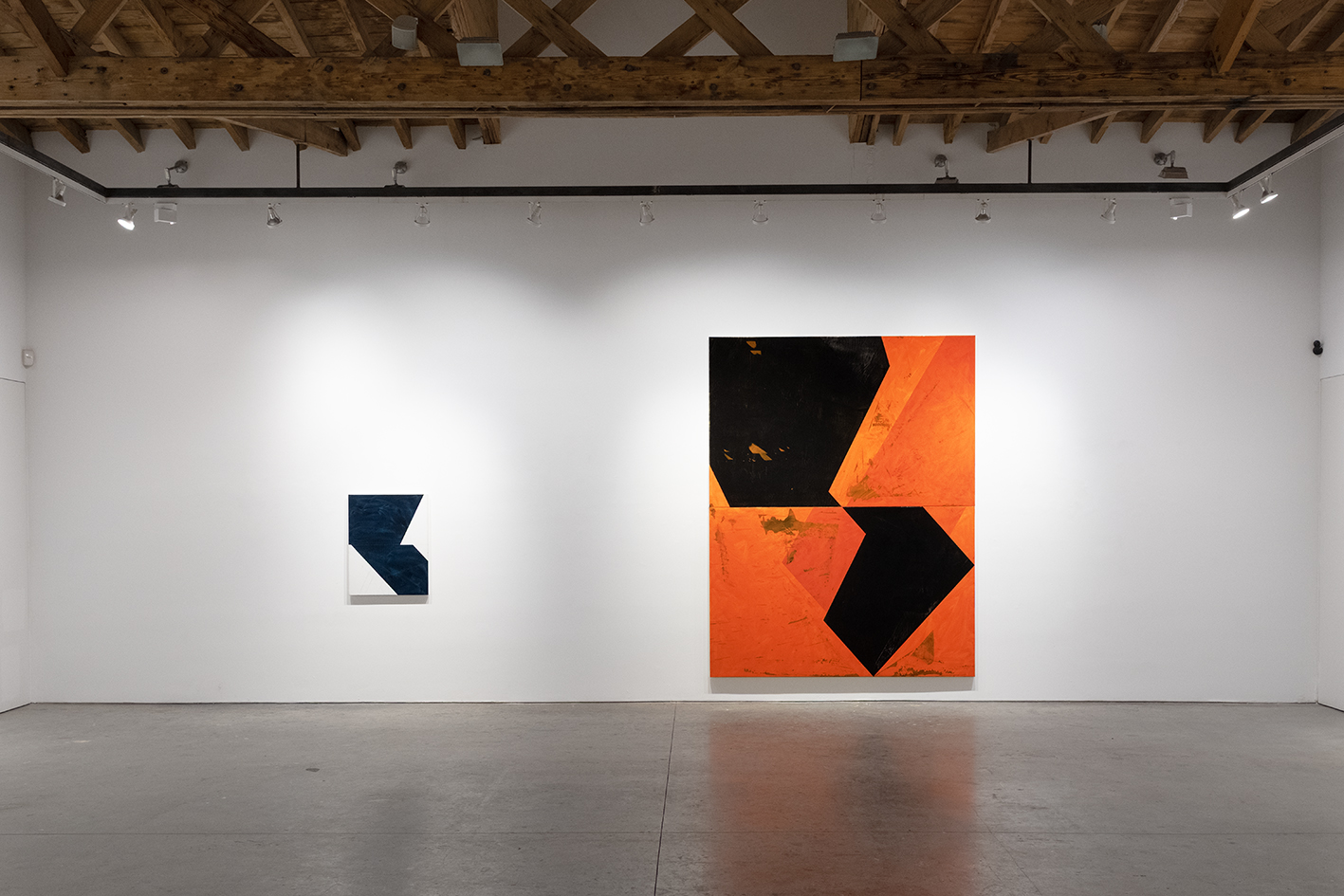
Frank Hutter, Installation view of the exhibition Malerei. © Frank Hutter. Photo: Torsten Hink/UTOUP Studio. Courtesy the artist and 447 Space.
Born in Freising, a small Bavarian town north of Munich, Frank Hutter studied painting at the Academy of Fine Arts under Sean Scully and Gerd Winner, two painters whose formal and temperamental differences already suggest the breadth of his practice. The exhibition Malerei is presented in the former New York studio of Scully and Liliane Tomasko, a space charged with an aesthetic inheritance Hutter has quietly, decisively moved beyond. Fifteen works are arranged with handsome sparseness: three large-scale paintings anchoring the room, the remaining works ranging from medium to small. The title itself is theoretically charged: Malerei, the German word for painting, invokes the century-long dialectic between the linear and the painterly. This discourse is at the heart of Heinrich Wölfflin's pivotal book Principles of Art History, first published in Munich in 1915. In her critical essay for the Getty edition, Evonne Levy calls the book “art history's crucible and its Pandora's box,” a tension Hutter often compresses upon a given surface.
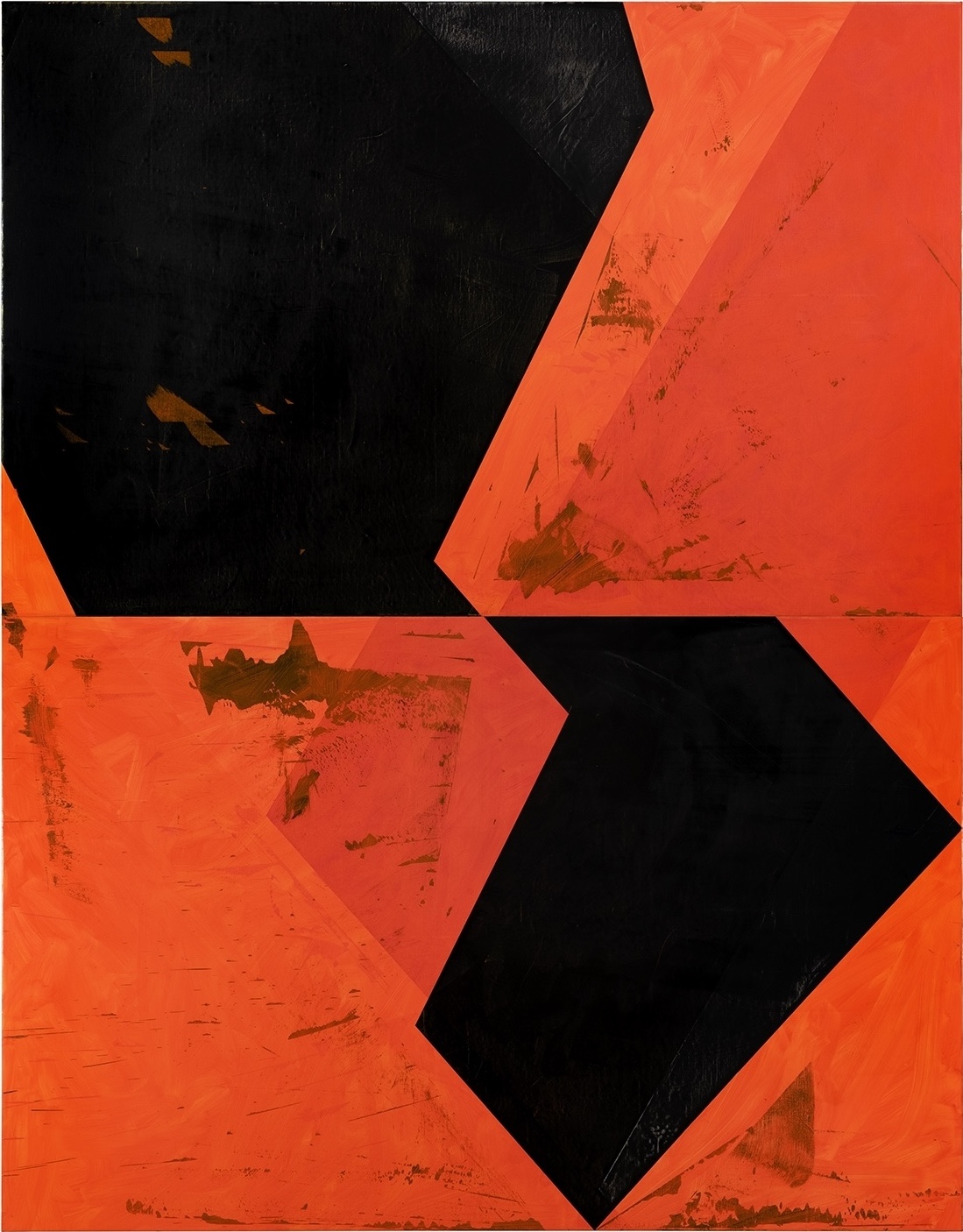
Frank Hutter, Untitled Painting (Black Shape Red Ground), 2025-26. Oil on linen, 126 by 98.4 inches. © Frank Hutter. Photo: Torsten Hink/UTOUP Studio. Courtesy the artist and 447 Space.
Geometric language is what connects Hutter to Sean Scully, whose own lines have traveled from hard-edged precision to an open painterliness. However, Hutter has taken the methodical line off the grid and submitted it to a shifting compositional logic. Nowhere is this more apparent than in the exhibition's largest work, Untitled Painting (Black Shape Red Ground) (2025-26), a canvas over three meters high. Two semi-geometric black forms occupy the field: one descending from the upper left toward the center, the other smaller, suspended in the lower right, floating rather than anchored. Both abyssal forms hover in a fierce, apocalyptic field of orange-reds, with black ghosts dissolving into the fire. The linear edges of the black forms hold, crisp and decisive, while the red ground burns with a painterly intensity that finds a precursor in Delacroix's Death of Sardanapalus (1827) of the Louvre: that pictorial space where chromatic rapture overflows. In Hutter’s monumental canvas, Wölfflin's dialectic between the linear and the painterly finds a visceral contemporary revelation. Through this lens, Hutter’s painting reveals what Levy foresees: that Wölfflin’s Principles will continue enacting discourses “about the desirability of an art historical discourse transcending time and place; about the postdisciplinarity of visual studies; and about the shaping-power of media on how we learn to see.”
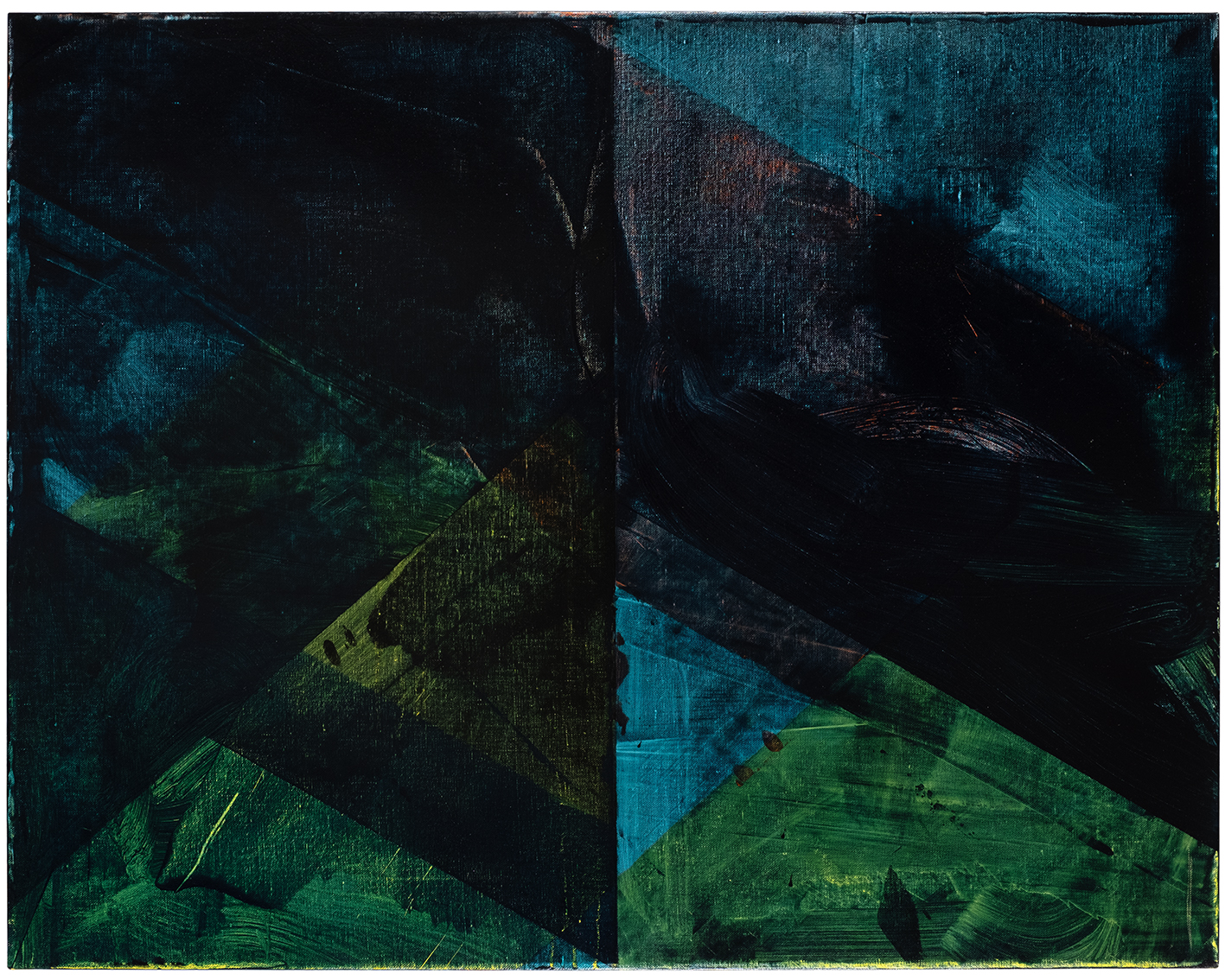
Frank Hutter, Untitled (Landscape), 2025. Oil on linen, 29.5 by 37.4 inches. © Frank Hutter. Photo: Torsten Hink/UTOUP Studio. Courtesy the artist and 447 Space.
Caspar David Friedrich is traditionally tethered to Kant's notion of the sublime, and rightly so. But Friedrich's work also operates as something more precise: an investigation into the act of seeing before phenomenology had its current name. What Gerhard Richter and Hutter inherit from Friedrich is not the landscape's totality but perceptual instances of vision as such—at times fragmented and momentary, at times fully coherent, at times purely abstract. Through this phenomenological reading, Richter and Hutter can also be encountered on purely formal terms, where color and shape function as sufficient ends in themselves. In Untitled (Landscape) (2025), darkness is not depicted but enacted. To the left of a vertical division at the canvas's center lies a dense nocturnal field. To the right, a transverse band descends from upper left to the canvas edge, pressing down upon a field of mysterious, buried luminosity. This green and blue impression of light operates entirely without a visible source. One thinks of Richter's Forest (5) (2005) of the Museum of Modern Art in New York. In this painting the traditional trope of the German landscape has been drained of its historic weight, leaving pure pictorial darkness where light survives only as a residue of process. Hutter arrives at a veiled darkness through comparable means, employing the squeegee's ghost, the pressed mark, the pigment that reveals as it conceals. What emerges is a window onto corporeality and perceptual interiority.
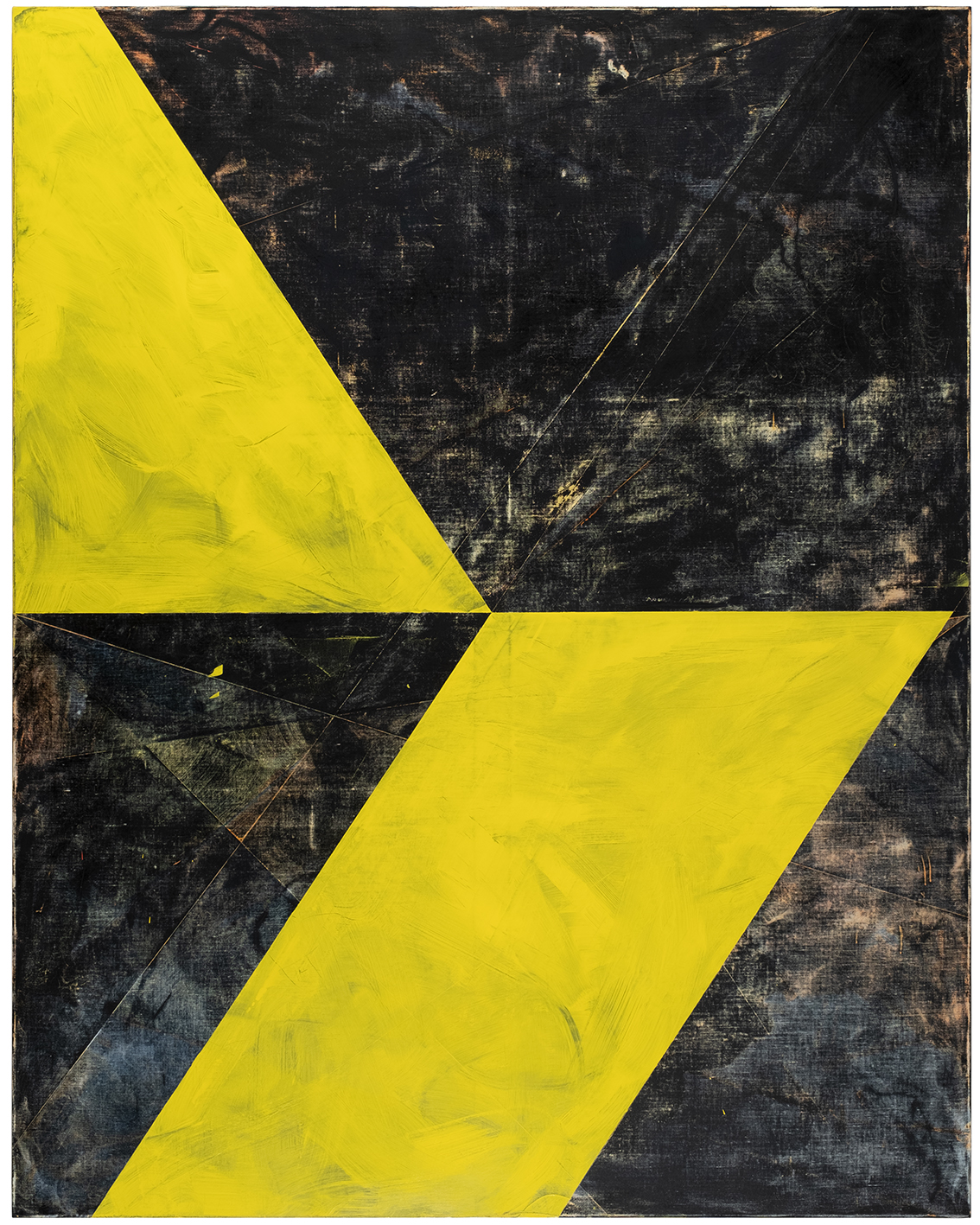
Frank Hutter, Untitled Painting (Two Shapes, Yellow), 2020-22. Oil on linen, 94.5 by 74.8 inches. © Frank Hutter. Photo: Torsten Hink/UTOUP Studio.Courtesy the artist and 447 Space.
Painted between 2020 and 2022, Untitled Painting (Two Shapes Yellow) makes its argument as much through color as through its gestalt-driven geometric composition, where figure and ground destabilize one another. Acid yellow and impure black appear at once as complements, contraries, and combatants. Shadowed from inside, the yellow is a luminous field where murkiness resides within the very phenomenon of intrinsic brightness. The black zones reveal an arresting chromatic turbulence ruptured through linear marks. Within these fields, luminosity operates ceaselessly: less as a color than as a material condition. What emerges is heavy and viscous, in unyielding dialogue with AbEx and Tachisme. Compositionally, one thinks of Carmen Herrera and Ellsworth Kelly, sharing that same economy of geometric means and faith in color as structural force. Here, however, that language is reinvented through the aesthetics of German Expressionism, where the impurity of the mark allows form to be infiltrated by process and physical exertion. Hutter filters Turner's acid yellows and Whistler's Nocturne in Black and Gold (1875), that other Ruskinian scandal of paint flung against the dark, through Friedrich's northern light. The geometry is the armature. What unfolds within it is a chromatic event the armature can contain but never fully rationalize. This is what abstraction continues to interrogate.
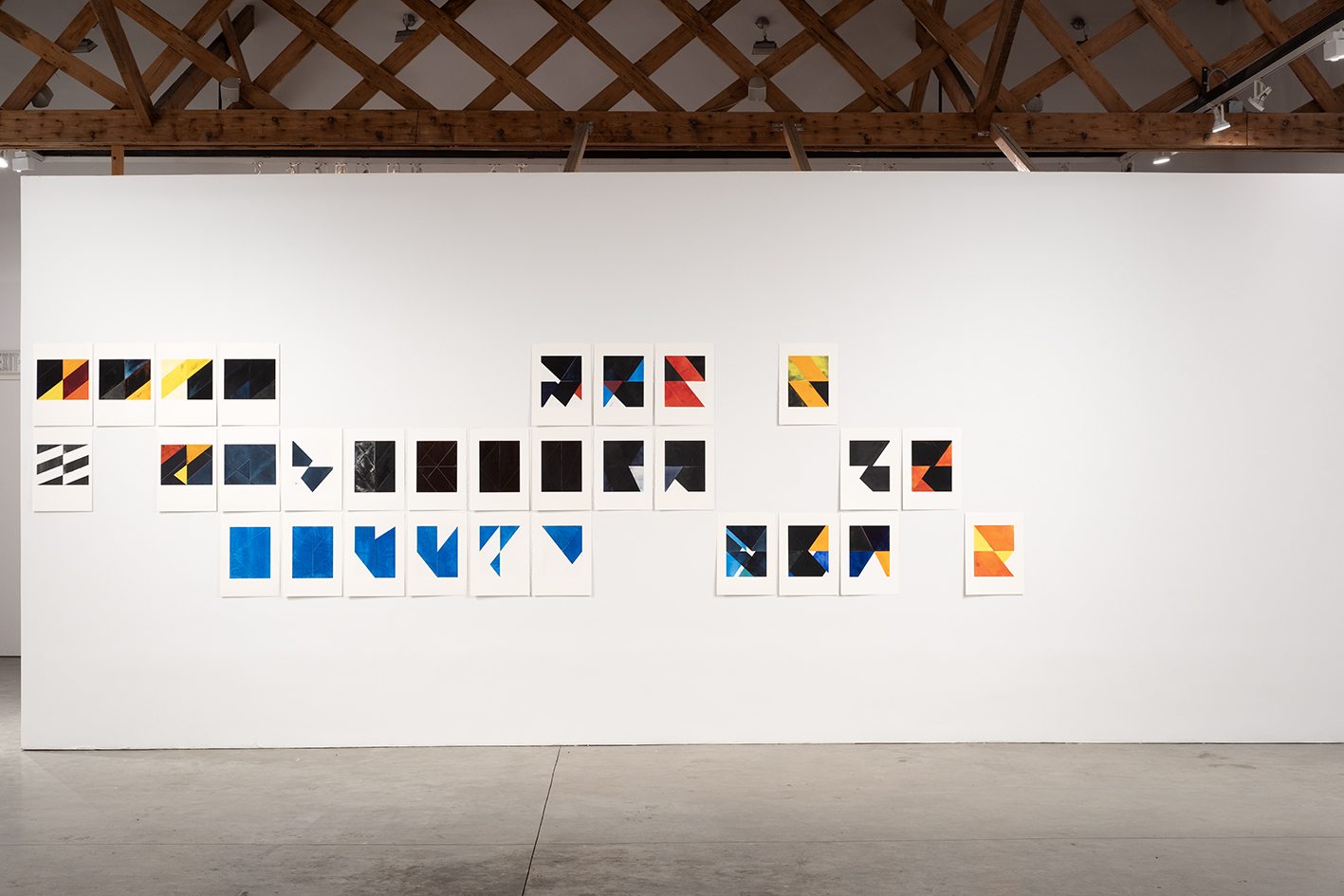
Frank Hutter, Installation view of the suite Untitled, 2018-ongoing. Oil stick on paper, 10.2 by 13 inches or 13 by 10.2 inches each. Photo: Torsten Hink/UTOUP Studio. © Frank Hutter. Courtesy the artist and 447 Space.
Malerei opens, and quietly reopens, with a prelude: Untitled Study (Cactus for Kazimir) (2022-23), a small, unframed oil stick on paper hanging in the narrow entrance corridor. Its title is a dedication to Kazimir Malevich, radical reducer of form, working in another century to reconstruct a fractured world. If Malevich’s Suprematist planes relied on a sense of autonomy to signal a new, ungraspable reality, Hutter’s forms operate through a different tension: one defined by formal permeability and chromatic layering. On the south wall, the works on paper continue the conversation. Arranged in three horizontal rows, their intervals of empty wall are as compositional as the sheets themselves. These voids function as silences between notes, as if each mark were part of a score not yet fully written, in the manner of John Cage, for whom silence was more of a presence than an absence. Simple geometric motifs are then conjugated, rotated, tested in different pictorial cases, closer in spirit to Karlheinz Stockhausen's Studie II, where clean geometric parameters are tested before they dissolve into raw acoustic noise. This is fundamentally a form of study, an étude, a solfège.
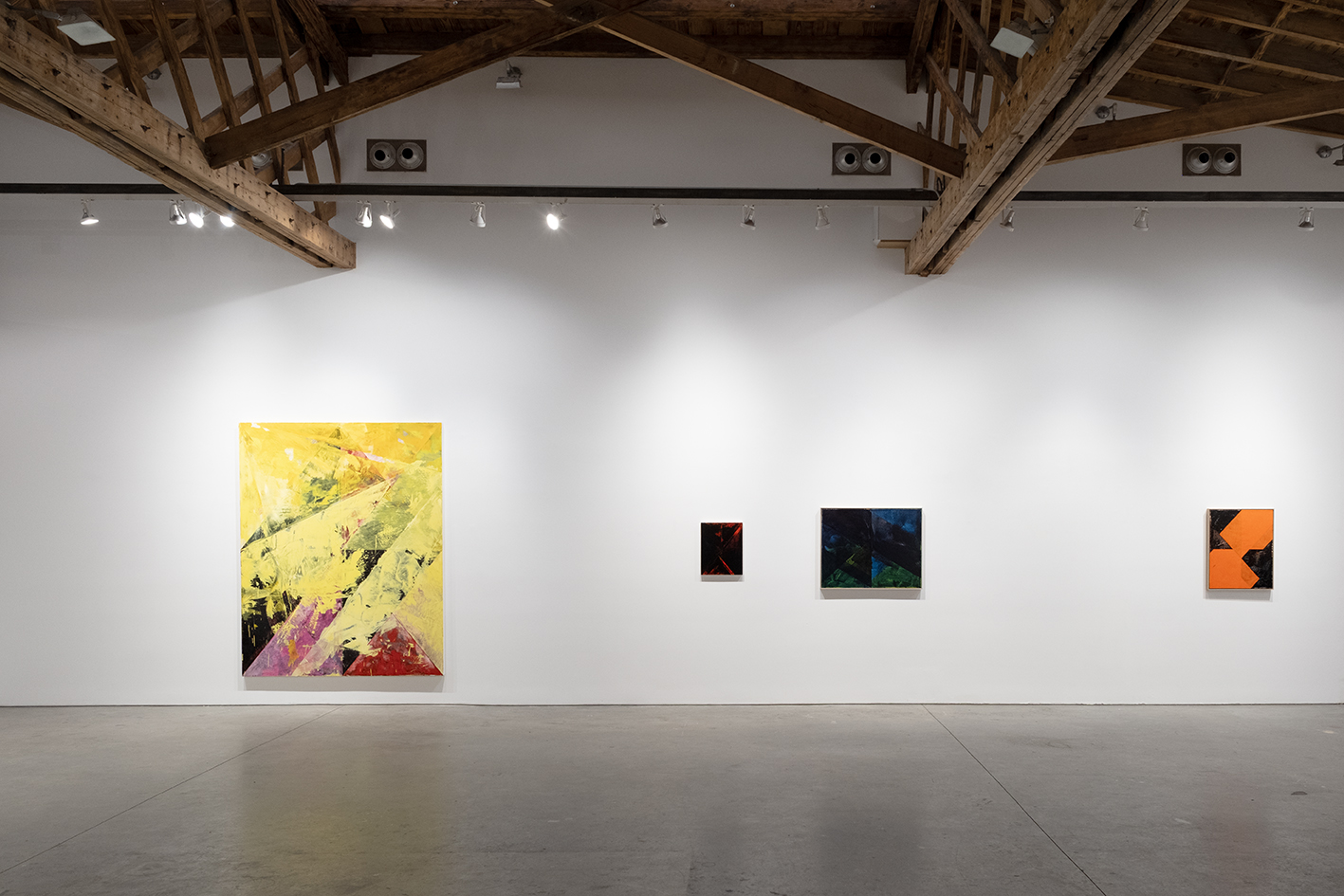
Frank Hutter, Installation view of the exhibition Malerei. © Frank Hutter. Photo: Torsten Hink/UTOUP Studio. Courtesy the artist and 447 Space.
If the drawings wall proposes something more methodical, the paintings carry a weight of historicity: Benjamin's angel, Wölfflin's dialectic, Friedrich's phenomenology pressed into abstraction. While Benjamin's reading of Angelus Novus was anchored in the figurative, Hutter's response is primarily abstract. Here agency begins to replace aura as a critical term. Whereas aura is the irreplaceable presence of an original work that reproduction is incapable of capturing, agency is the painting's capacity to activate its historical references in the present encounter with the viewer. This methodology is Frank Hutter's current solfège: a relentless rehearsal that converts prior moments into the sheer immediacy of the mark. What emerges is an aesthetic anchored in the past yet paradoxically singular.
Frank Hutter: Malerei
447 Space
447 West 17 Street
New York, NY 10011
May 8 – June 19, 2026

Raphy Sarkissian
Raphy Sarkissian received his masters in studio arts from New York University and is currently affiliated with the School of Visual Arts in New York. His recent writings on art include essays for exhibition catalogues, monographs and reviews. He has written on Rachel Lee Hovnanian, Anish Kapoor, KAWS, David Novros, Sean Scully, Liliane Tomasko, Dan Walsh and Jonas Wood. He can be reached through his website www.raphysarkissian.com.
view all articles from this author