Whitehot Magazine
September 2026
"The Best Art In The World"
"The Best Art In The World"
September 2026
Role Reversal interview between Fawn Rogers and Franck Gautherot from Le Consortium Museum
By FAWN ROGERS June 2nd, 2026
Franck Gautherot of Le Consortium Museum, pretending to be artist Fawn Rogers, asking questions in Fawn’s voice. And Artist Fawn Rogers pretending to be Franck Gautherot, responding to the questions in Franck’s voice
Q: You were born in the 1950s, and you are still in charge. Do you think you are still able to understand what’s going on in the art world?
A: Born in the fifties and still here? Yes, guilty as charged. The day you think you “understand” what’s going on is the day you may as well go fishing. So hopefully not, and that’s perfect. Because what’s really “new”? New issues, new topics, new geographies. They’re not mine, they’re yours. I keep my antenna up, let the static hit me, and see what sparks. Do I need to “understand” VR, AR, and MR? Maybe not. But do I feel it when something cracks open? Always.
Q: Is sex in art a topic to be explored? Do you have groupies?
A: Sex in art? Always. From prehistoric caves to Pornhub, it’s not just a theme. It’s in the bloodstream. Curators don’t get groupies. We get stalkers, ulcers, interns, and unpaid invoices. But eros, yes. It seeps through everything, whether Sandback’s taut lines or Morellet’s dirty geometry. Sarah Lucas’s huge boner in Not Now Darling to Kusama’s orgies. It’s all there. The question is: are you still wet enough to feel it, or are you just dryly curating catalogues?
Q: Everybody keeps talking about “emerging artists.” Emerging from where exactly, out of every crack, the supermarket, or Instagram? And when do they stop emerging? When they hit Sotheby’s?
A: They emerge from these high-rise buildings turned into art studios, stacked by the hundreds on every floor. Good real estate business. Emerging, then mid-career, then forgotten, only to be rediscovered. And so on. But I am not bitter or sad or complaining about the situation today. Was it better before? For sure, naming has been the American way of qualifying: video artist, installation artist…Listen, do you remember the heroic show organized by the hero Harald Szeemann in 1968 at the Bern Kunsthalle, When Attitudes Become Form? A legendary exhibition of the century (I mean the 20th). All the artists were in their thirties. Was it an exhibition of emerging artists? Nobody ever qualified the show like that.
They have to start at some point. Emerging, and then they sneak around, dating curators or collectors, gallerists? I once wrote about pairing artists sexually according to their style! Do conceptual artists date Neo-Geos? German artists with radical monochromists? French artists, a bad-luck genre, going into romance with quit-smoking Belgian neo-surrealists? Then Sotheby’s for good luck and Rolex! Did you know that Che Guevara also wore a Rolex?
Q: We once shouted, “Ne travaillez jamais!” But now artists work like Uber drivers, 24/7, to keep their galleries happy. Do you still call that radical, or just a typical machine in cool sneakers?
A: You stole my line. As I said, it has been our motto since we started in this lifelong business! Working 24/7 is your destiny, because nobody ever asked you to do what you do. I mean, to make art! So if you need to be on board day and night, that’s on you, my friend.
Keeping the gallery happy is like giving your tax inspector a deep throat, a temporary compensation. Cool sneakers are no longer a trend; you just have to buy a pale copy of any brand made in Vietnam. I once bought a pair at a night market in Dongdaemun, Seoul. They looked like a great pair of New Balance, but the “N” was upside down. Even better. And the name on the back was spelled “New Balenciaga.” Creativity is everywhere, not only at art fairs.
Q: Death is always in the room. I’ve buried half my friends: artists who overdosed, shot themselves, drank too much. Do you think art is a survival kit, or just a nice excuse to make your tombstone more glamorous?
A: Your friends are so 20th century! Mine died from cancer, senile dementia, or Alzheimer’s. Tombstones have been a great subject for artists throughout history. Funerary art is a neglected subject these days. It needs to be resurrected as a great commission for daring collectors. Go to Strasbourg to see the Cenotaph of Maréchal de Saxe by the 18th-century French sculptor Jean-Baptiste Pigalle, installed in St. Thomas Church. Hundreds of extraordinary funerary monuments can be seen there. Art helped people through life to gain immortality, the real one, and to deliver glamorous tombstones. Not so bad for a brief.
Q: You mentioned that you pictured modernism as no longer a Western business. Some people consider modernism neo-colonialist and say it should be banned. Do white, old, heterosexual Western men still have the right to talk?
A: Modernism as a neo-colonial racket? Maybe. Of course, it wore a Western suit. But then everything did. Your coffee, your sneakers, your Netflix. I’m a white, straight, old Western male, guilty, guilty, guilty! Should I apply for silence? I see that you don’t think so. “Ne travaillez jamais!” doesn’t mean “ne parlez jamais.” I talk, you talk back, and maybe something happens in between. I speak, you contradict, someone else screams louder. That’s how culture moves. I don’t claim ownership; just the right to stay noisy.
Q: I see many women artists in your program from the early years, but I don’t see many non-White artists on your list. Do you have a problem with the Global South?
A: In the early years, it was mostly white, Euro-American, male. We were local boys staring across the Atlantic, worshipping New York minimalists as if they were gods. That’s what we could reach.
Then my partner Seungduk arrived. She cracked the window open, and the world blew in. Asia, Africa, and other geographies we had ignored. Kusama, Lee Bul, Kimsooja, Han Mook, Tschabalala Self, and younger artists from Beijing, Lagos, and Rome. Suddenly, the diet wasn’t just Katz’s deli and Bourgogne anymore. Museums are guilt machines, but at least we confess. The statistics still sting: 66% men, 33% women. A lousy democracy, but that’s the art world’s math. Do we keep correcting? Yes.
Q: You believed that progress in art has been an issue. Do you still think that?
A: I was culturally raised to believe so. The glorious fight for abstraction, the utopian merger between art and architecture for a better urban world? I bought it, for sure! But quite rapidly, the virus of irony, the punkish attitude, blew those norms away. Incorrectness, sarcasm, non-belief. And then, you reconsider the big myth: each decade better, each movement smarter, the march of civilization with a white cube at the end. Nonsense. Progress is a disease of engineers. Art is messy, sideways, regressive, prehistoric, and sometimes horny. I still think that, maybe more than ever. The only progress is that we are still alive to make a mess. That word belongs to engineers, not artists. Art goes in circles, falls back, mutates, regresses. We still scratch walls like cavemen, still obsess about sex and death. I said it decades ago, and I’ll repeat it: progress is no longer our business. Survival, mutation, and irreverence. That’s closer.
Q: The Global South is suddenly the “new frontier” for curators. It’s colonialism with cocktails. Do you think it’s a real shift of power, or just another stopover for the art-fair jet set?
A: Art jet-setters are keen to move to nicht versöhnt places, to stop over in Bangladesh but not in the Alleghenies, and neither in Pont-à-Mousson nor in deep France. Are hillbillies Global South kids? But for sure, it’s a real shift of power. Everything but the West. K-pop is an industrial success and a great alternative to Western rock ’n’ roll; it can be adapted into J-pop, and so on. When I once saw a world map in a Korean office in Gwangju some twenty years ago, I was struck by its center: Russia, India… Not Europe, like in my primary school nostalgia map. Of course, it’s somebody else’s momentum. No shit, it’s an agenda, a rewritten historical narrative. For good or bad? The survivors, these Chinese billionaires, will tell. Go to biennales. They will teach you what to think.
Q: Why do you think I, Fawn Rogers, wanted to interview you? I am in LA, of German and Native American origins. Why should I question you? Can you tell me things that could be useful to me, as a self-taught artist and a bit of an outsider?
A: Why should you interview me? Because you’re curious, and because I’m still here. German and Native American, Los Angeles, self-taught outsider. That’s perfect! You’re not supposed to ask me these questions, but you do because you’re curious and because I’m still here. And I am curious too. Can I tell you something useful? Maybe a fragment sticks, like a splinter. Art is not pedagogy; it’s infection. If I infect you, I’ve done my job. Maybe you’ll find a shard that sticks. That’s how it works: I don’t teach, I infect. Maybe you smell a contradiction. Did I answer your question?
Q: Let’s be stupidly honest: does art still have the power to turn you on, sexually, politically, spiritually, or is it just another lifestyle accessory, like a Louis Vuitton dog leash?
A: I have been stupidly honest all my life. For what? Good times and fun, sadness and melancholia, but also great moments of enlightenment. Artwork may become an accessory, the leash of the I-Wanna-Be-Your-Dog. Art will turn me on, tune in, drop out, and pray for Timothy Leary gargling mantra words in limbo.
I’ve been dealing with art, artists, and artworks for almost 50 years. I still feel the excitement when I open a crate and pull away the bubble wrap to discover the newest painting that has just reached me.
You know what? I’m happy.
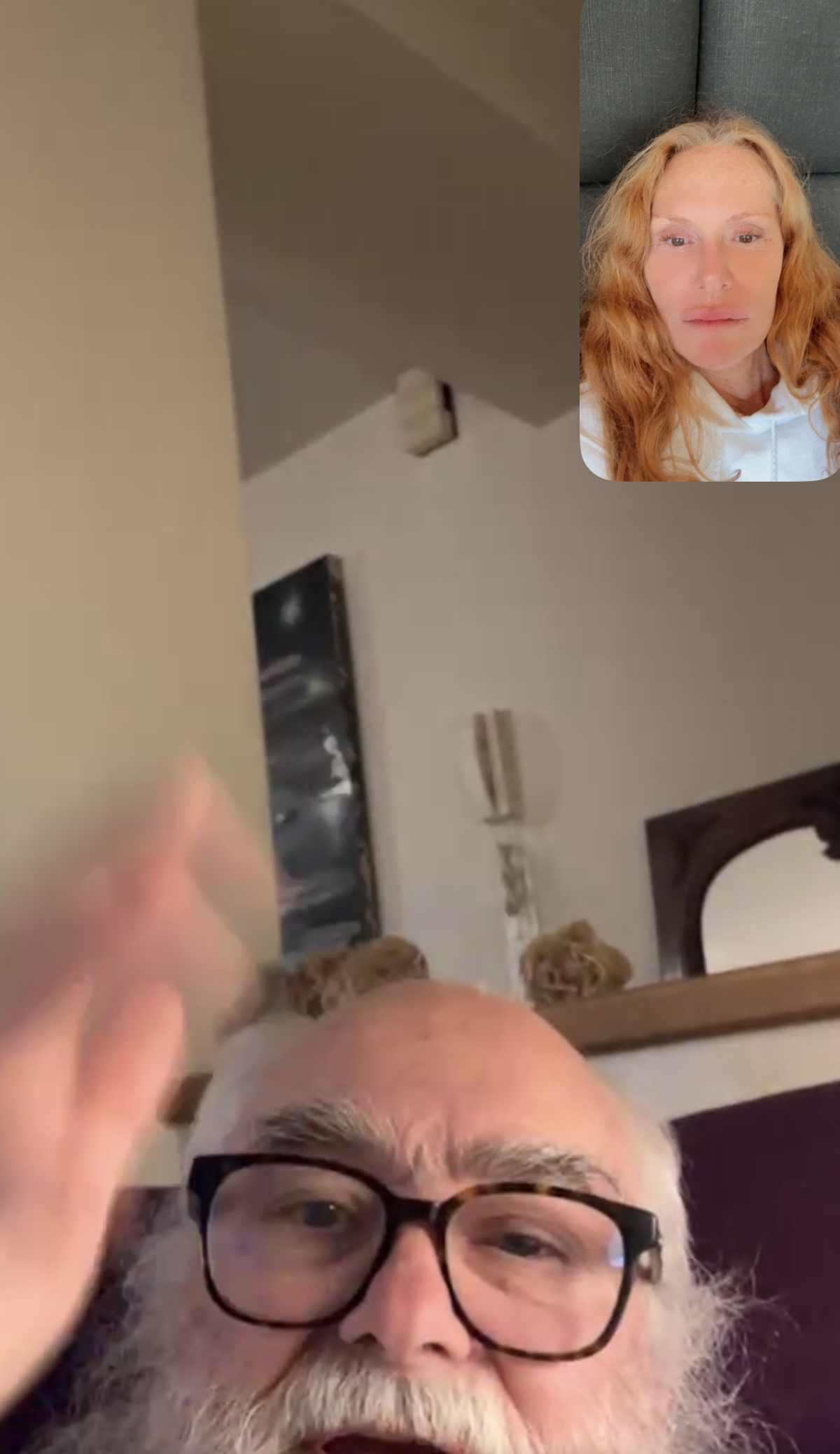 (Video call screenshot between Fawn Rogers and Franck Gautherot, 2025)

Fawn Rogers
Fawn Rogers is a Los Angeles-based multidisciplinary artist, exploring the unstable territory between desire, erosion, mortality, and systems of power. Combining visceral materiality with conceptual inquiry, her practice draws from environmental collapse, intimacy, consumer culture, and the psychological residue of contemporary life. Rogers has exhibited internationally at venues including K11 MUSEA in Hong Kong, Sotheby's New York, PHILLIPS Los Angeles, Nino Mier Gallery, Wilding Cran Gallery, Make Room Los Angeles, COHJU Contemporary Art in Japan, Wallis Annenberg Center for the Performing Arts in Los Angeles, Nicodim Gallery, and Galerie Marguo in Paris, among others.
view all articles from this author