Whitehot Magazine
September 2026
"The Best Art In The World"
"The Best Art In The World"
September 2026
An Age-Old Warning: Three Artists Look to the Biblical Flood Amid the Climate Crisis
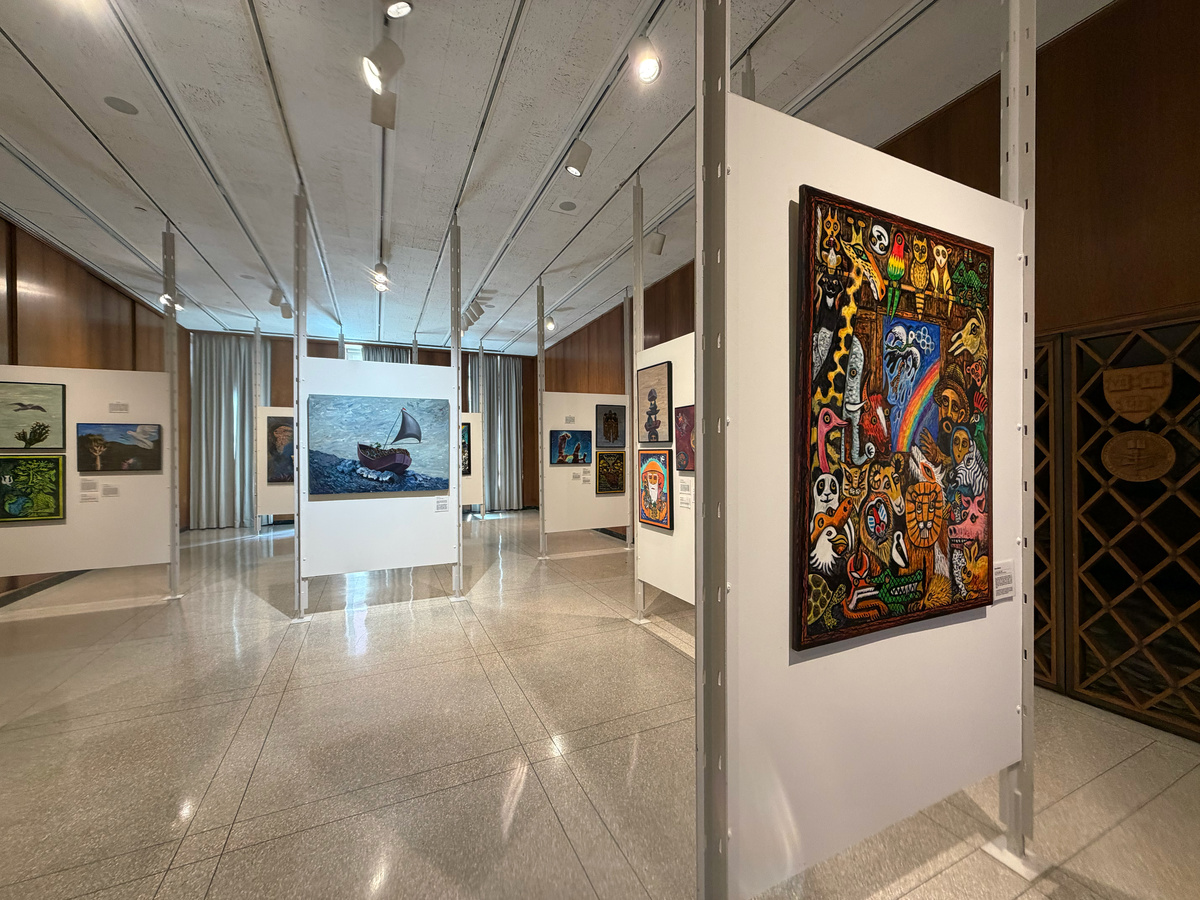 Installation view, NOAH: A Future Hope at the Interchurch Center, New York City, 2026.
By HANNAH ROTHBARD August 11, 2026
When I hear the word “flood,” my mind goes first to the thunderstorms in Brooklyn just a few weeks ago— the “do not travel” alert on my phone—and worse, to the Guadalupe River tragedy last year in Texas. Severe weather has become the new normal, but long before we could feel the destructive effects of human-made climate change, there was another catastrophic weather event mythologized since ancient times to reveal the consequences of bad behavior. A narrative shared by the three Abrahamic faiths, Noah’s Ark and the flood tells of God’s retribution for humanity's corruption, and the story’s lessons resonate today with the environmental crisis, political turmoil, and the need for collaboration in a time of heightened division. Three artists explore exactly that in NOAH: A Future Hope at the Interchurch Center.
Working within the framework of their respective faiths and artistic approaches, Yona Verwer, Brian Whelan, and Hady Boraey use the story of Noah’s Ark and the flood as a departure point. They grapple with climate change and human responsibility, as the exhibition’s premise suggests, yet their interpretations and inquiries extend far beyond that. Prompted by lessons drawn from the flood story by curator Paul G. Chandler, the artists created new works for the exhibition. Each wall of the gallery displays one of seven lessons and the painting each artist made in response. In addition to generating a multi-faceted interfaith dialogue, each work is a portal into the artist’s worldview, formed by a confluence of factors from spirituality and introspection to global events and art historical tropes.
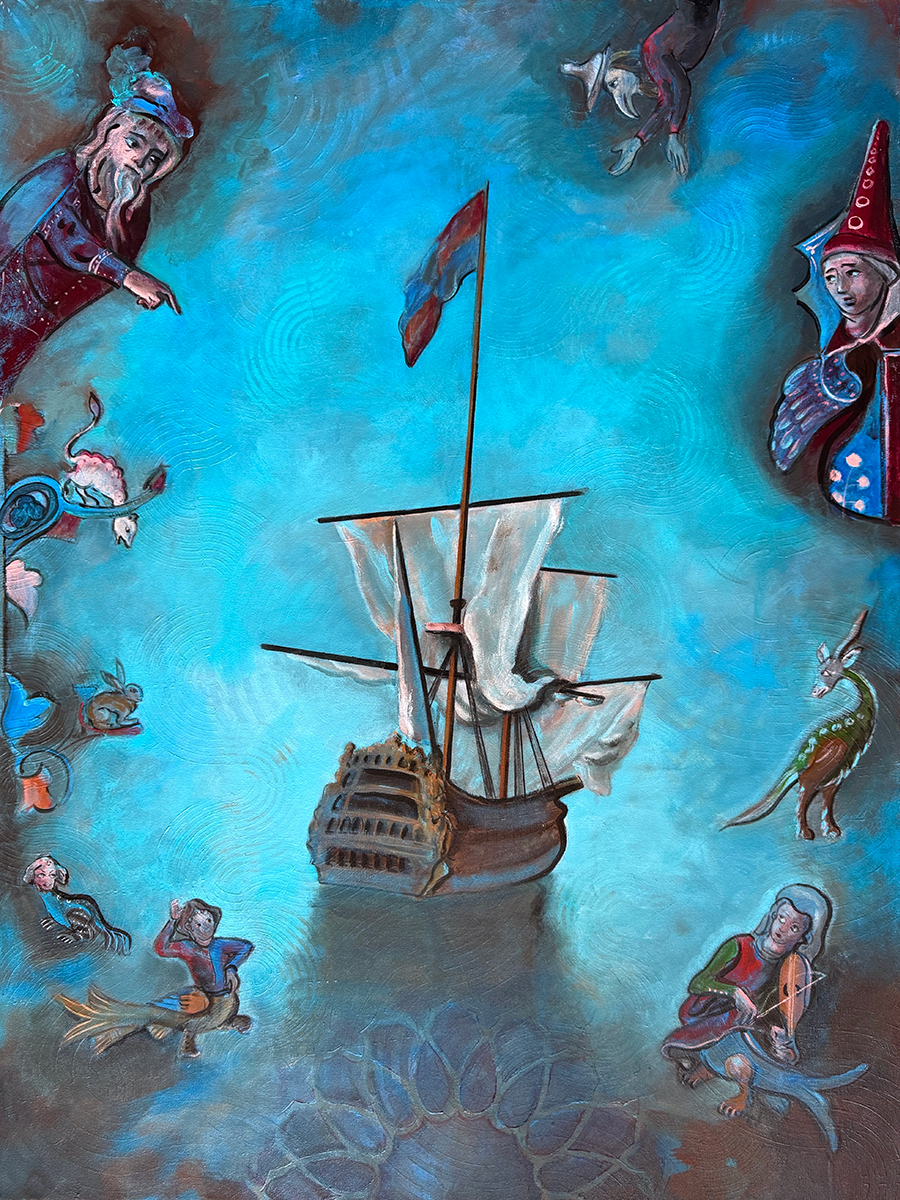 Yona Verwer, A New Beginning, 2025, Acrylic on canvas, 48 x 36 in.
Yona Verwer’s watery, dream-like paintings feel like narratives submerged, suspended in water and in time. Ideas, characters, and symbols pulled from European art and Jewish texts and traditions float against backgrounds that are stenciled, airbrushed, and painted in layers, forming subtle patterns that fade into fields of color. Referencing narrative arts from various time periods, such as medieval illuminated manuscripts and 16th-century Dutch painting, her contemporary call to action builds upon the multitude of sources that have professed similar lessons in the past.
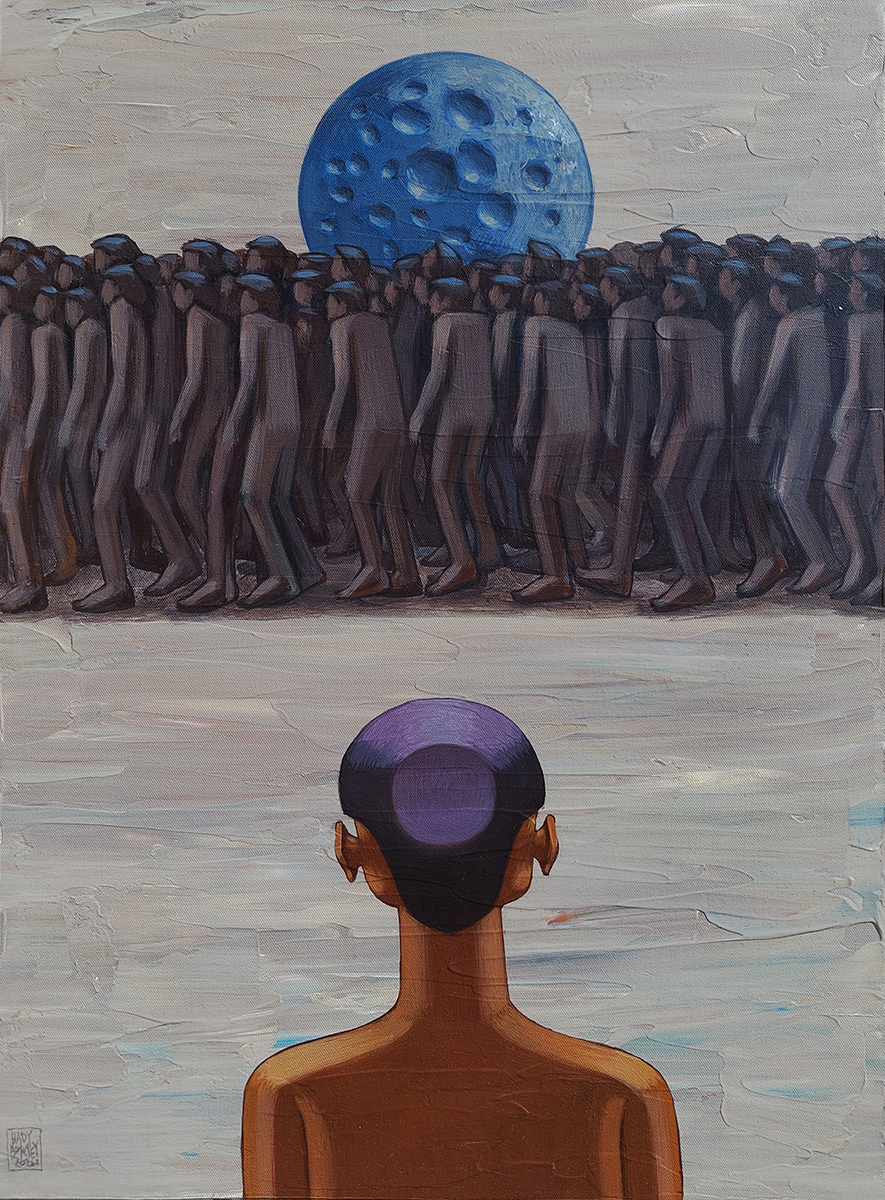 Hady Boraey, The Great Collapse, 2024, Acrylic on canvas, 24 x 18 in.
Hady Boraey’s work feels quiet and contemplative; he approaches the subject of climate change mainly by turning inward to the self and the psyche. Raised in Egypt and of the Muslim faith, Boraey combines specific religious teachings with the timeless and placeless essence of humanity, represented through his primal figures and poetic use of symbolism. He uses the nondescript human figure as a representation for anyone and everyone, for the individual and the collective.
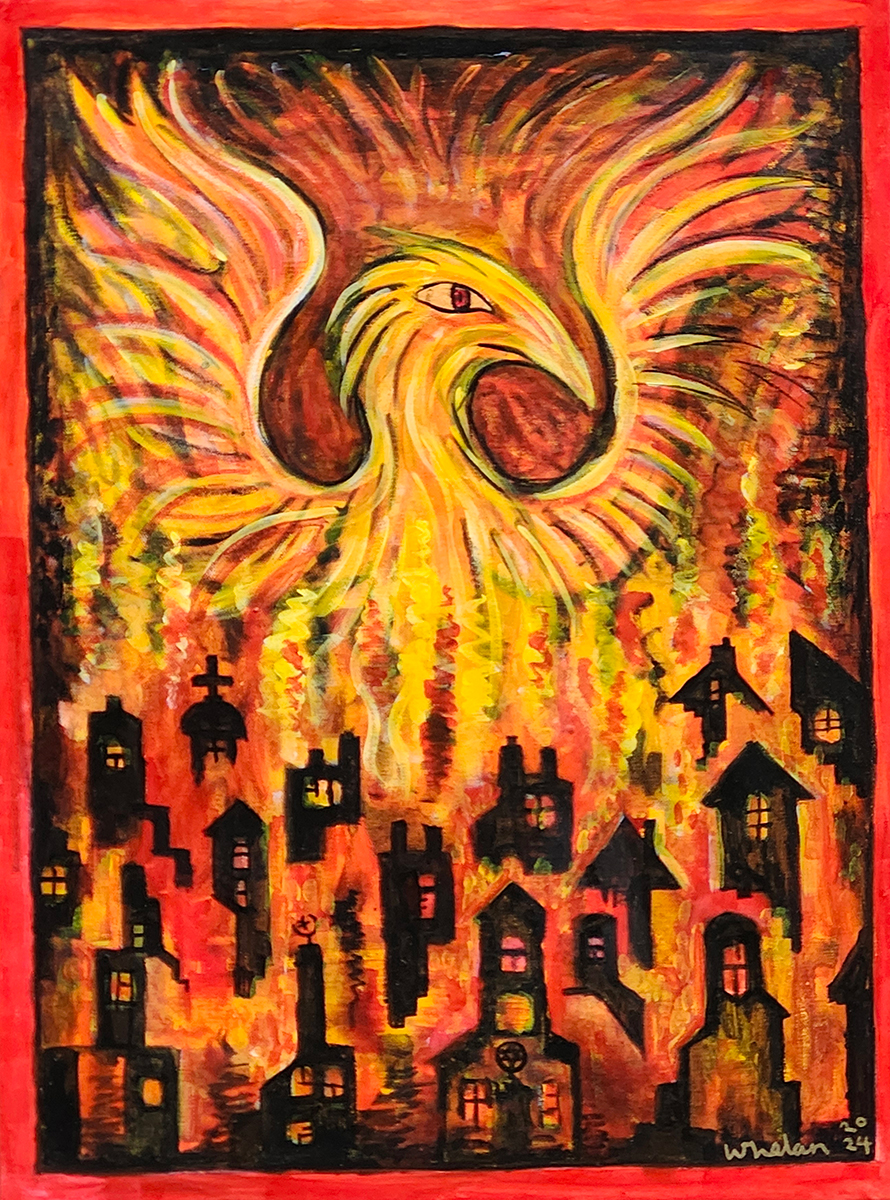 Brian Whelan, Global Warming, 2024, Mixed media on panel, 24 x 18 in.
Brian Whelan’s graphic, high-contrast style lends itself to polarity. He depicts the harmony of humans and the natural world with vibrantly colorful scenes of thriving flora and fauna that express levity but must be taken with gravity. A happy, almost too-happy painting hangs across from a hellish scene of red and black, invoking the fear and consequences associated with the climate crisis. Whelan, an artist with Irish Catholic roots and raised in England, draws upon the tradition of East Anglican medieval painting. Through narrative and composition, including decorative borders, each work feels like a modern-day altarpiece.
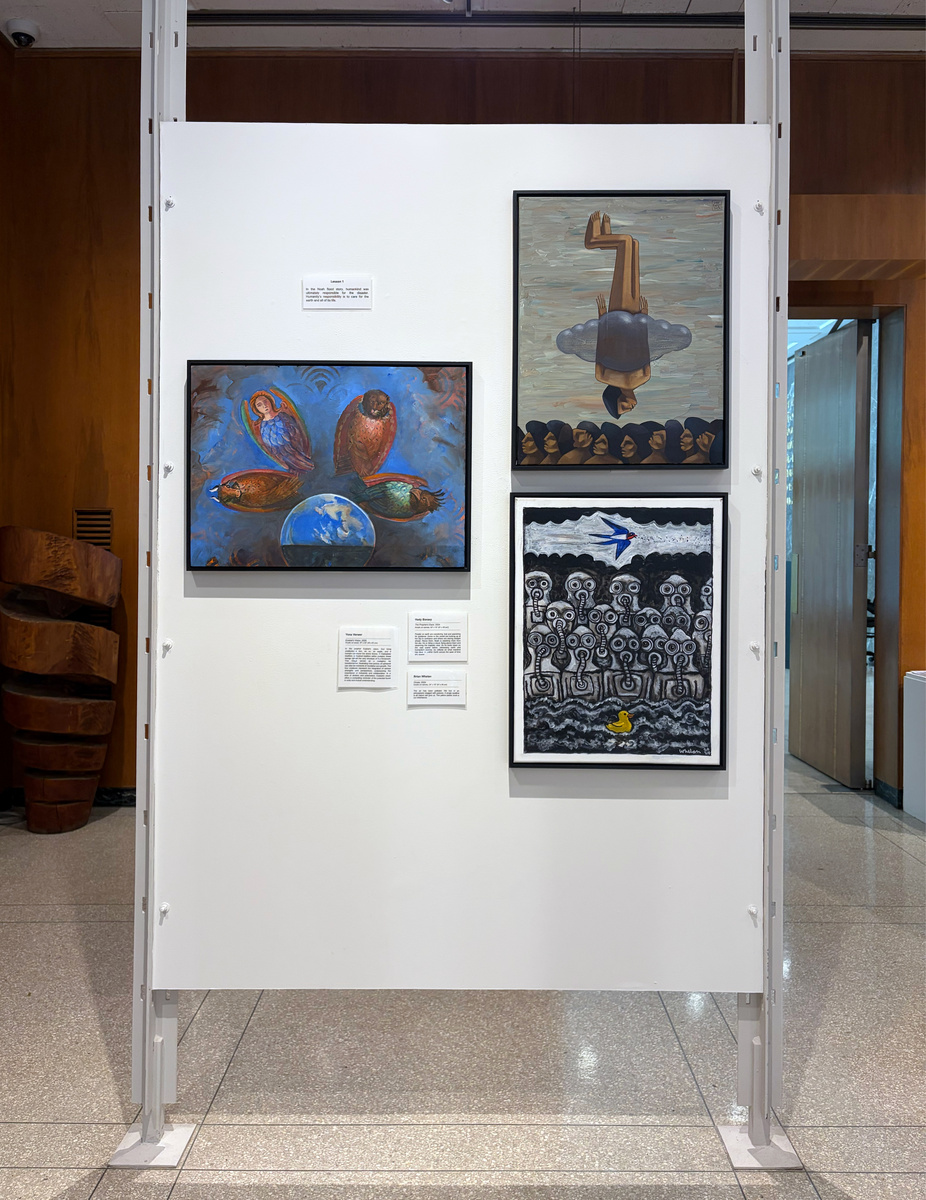 Installation view, NOAH: A Future Hope at the Interchurch Center, New York City, 2026.
Lesson one reads “In the Noah flood story, humankind was ultimately responsible for the disaster. Humanity’s responsibility is to care for the earth and all of its life.” Verwer’s painting Ezekiel’s Vision made in response comments on the inevitability and importance of different perspectives among earthly inhabitants. Boraey’s painting The Prophet’s Gaze portrays people as wanderers looking for spiritual guidance. Whelan’s painting Choke is a dismal warning with a crowd of gas mask-wearing figures that appear more robot-like than human, an especially unsettling sight as we find ourselves, willingly or not, in the throes of AI revolution.
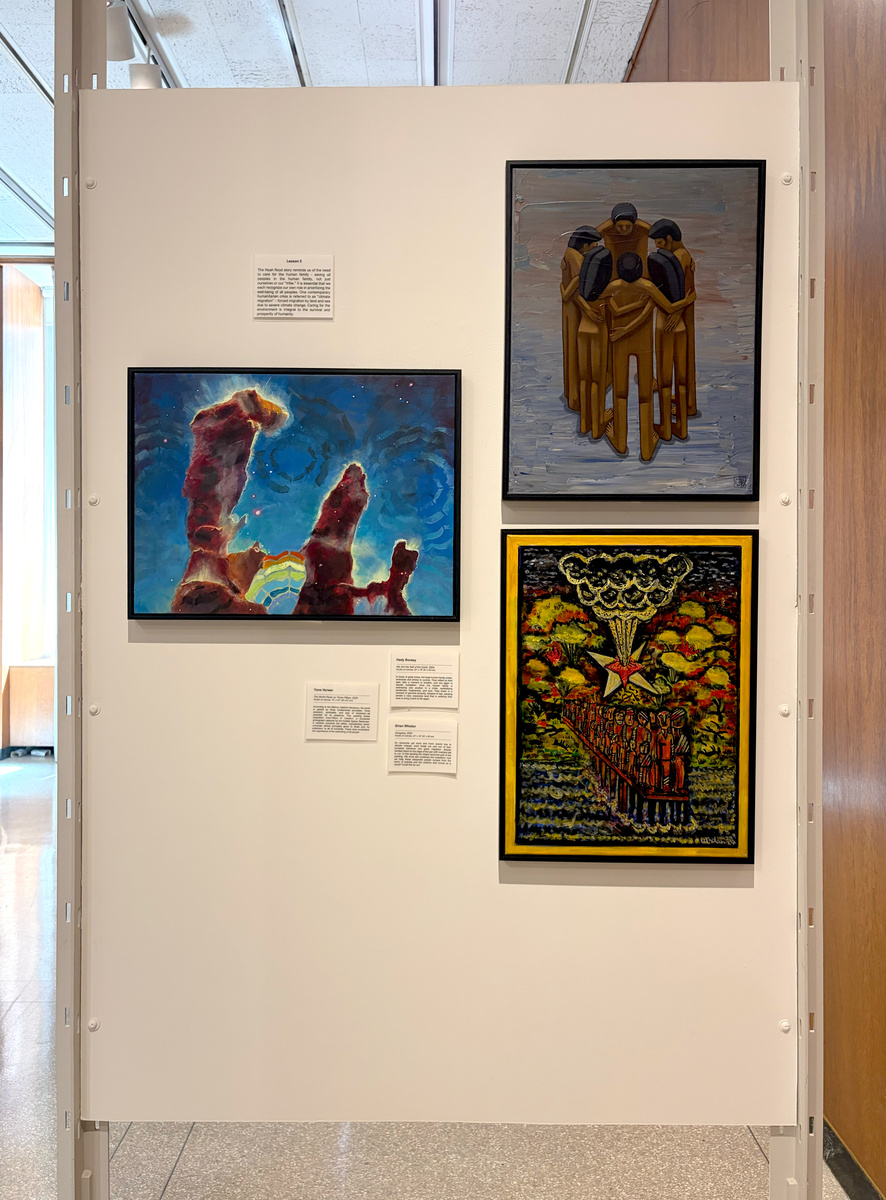 Installation view, NOAH: A Future Hope at the Interchurch Center, New York City, 2026.
Lesson five is about “saving all peoples in the human family, not just ourselves or our ‘tribe.’” In Boraey’s painting We Are the Salt of the Earth, the figures form an impenetrable circle of embrace. The piece is optimistic in its simplicity, surmising that it should really be this uncomplicated to love thy neighbor. Verwer’s work identifies the unexplainable as a unifying force. The World Rests on Three Pillars merges photographs captured by the Hubble Space Telescope with ideas from rabbinic literature. Rocky yet life-like forms appear in a state of gestation, radiating light and the energy of shared origins and ethics. Whelan approaches this lesson with a lens on contemporary events related to climate displacement. In his painting Gangway, bandaged and broken families ascend along a foreshortened pier right up to the edge, where the viewer must meet their gaze not just with sympathy, but with shared vulnerability.
All three of the artists draw upon widely recognized symbols and references, from the dove and olive branch to Hieronymus Bosch's The Garden of Earthly Delights, reinforcing humanity's collective obligation to act and our shared fate should we fail to work together. Through their different backgrounds, rather than in spite of them, the artists in NOAH: A Future Hope underscore how much we share, how much we have to lose, and how important this age-old conversation is right now.
NOAH: A Future Hope is organized by CARAVAN, an international arts non-profit whose mission is to build bridges through art. The exhibition is traveling to venues across North America, Europe, and the Middle East until 2028. Its New York iteration is presented in partnership with Jewish Art Salon, a non-profit that builds community around Jewish visual culture, and is on view at the Interchurch Center through August 26th, 2026.
Hannah Rothbard
Hannah Eve Rothbard is an artist, curator, and writer from South Florida and based in New York. She holds a BFA in Studio Art from New York University and has exhibited at venues including 80 Washington Square East Gallery (NY), High Line Nine Galleries (NY), the New York City Poetry Festival (NY), Soft Times Gallery (CA), the Jerusalem Biennale (IL), and Halfsister (Berlin, DE). She has held residency at the Materia Prima Foundation (Italy), was awarded a Fulbright grant to Germany, and is the recipient of a Puffin Foundation Award. She is the Director at 81 Leonard Gallery, an artist-run space in Tribeca, NYC.
view all articles from this author