Whitehot Magazine
October 2026
"The Best Art In The World"
"The Best Art In The World"
October 2026
House of Criticism Premiers at Tribeca Film Festival’s 25th Edition
 Courtesy of Tribeca Film Festival/Voyeaur Films
By BIANCA BOVA June 17, 2026
Debuting at the Tribeca Film Festival this past Friday evening, House of Criticism is framed as blending "art history with rom-com conventions," an unusual, if accurate premise for the documentary. The film, directed by Alison Chernick (Itzhak; Matthew Barney: No Restraint) follows married couple and legendary art critics Jerry Saltz and Roberta Smith, providing a look at their tandem practices and domestic life together.
Saltz is a Pulitzer Prize-winning critic who has held his post as the senior art critic for New York Magazine for the past twenty years. Previously he served as senior art critic for the Village Voice, and prior to that spent over a decade working as a long-haul truck driver. Meanwhile Smith spent thirty-two years at the New York Times, retiring from her role as co-chief art critic two years ago. Prior, she served as Donald Judd’s secretary and archivist and had brief stints working both for the Museum of Modern Art and for Paula Cooper Gallery. The two met in New York in the late 1980s, and married in 1992 when Saltz was 41 and Smith was 44.
Chernick had a mind to make the film for several years, finally securing the couple's cooperation in 2020. Saltz, by his own admission, didn’t take much convincing, but Smith was another story.
“I would say that I was a fine subject, but Roberta had to be dragged into this,” Saltz noted in a red carpet interview with Whitehot. As for who did the dragging, the answer is Chernick.
“I never, ever interceded,” he added, “If she [Roberta] didn’t want to do it, fair enough.”
Ultimately Chernick prevailed.
“Jerry’s quite a natural on camera, and I liked Roberta’s vulnerability.” she divulged to Whitehot at the premier, "As a married couple they knew themselves so well. That added this extra layer of intimacy. Everything was stripped down, nobody can fool anybody. So that brought an extra authenticity to the film. That there were just sort of no walls up.”
While the authenticity of Saltz and Smith’s devotion to one another is unquestionable, the film itself feels, at times, less so. Portions of the film depict the couple—though mostly Saltz—going through the motions of their daily routine: gathering a tray full of deli coffees, buying pre-cooked chicken at Gristedes and microwaving it later at home, running out in the middle of the day to meet fellow critics for coffee (the lattermost a practice Smith openly condemns). These sequences are full of charm, from Saltz’ quick wit to the quintessentially New York locales in which they are filmed, but they’re nothing anyone who follows Saltz’ practice (or just his Instagram account) hasn’t already seen. Ditto him kneeling in beatific supplication in front of Picasso’s Les Demoiselles d'Avignon at the Museum of Modern Art. A great and visually compelling, if by now overly familiar, image.
 Jerry Saltz on the red carpet at the premier of House of Criticism. Courtesy of Bianca Bova.
When the film follows the couple in their professional routine, discussing art as they go about seeing shows at galleries and working in parallel spaces in their apartment, it begins to feel slightly performative. Given what sincere people its subjects are, this comes as no surprise. Worse are the moments that are truly staged: Saltz shouting to Smith for suggestions of the right word for what he’s writing, the couple reduced to caricatures of art critics as people who labor torturously in quiet isolation at their desks. One can never know exactly what goes on behind closed doors in a marriage, but certainly it can’t be this.
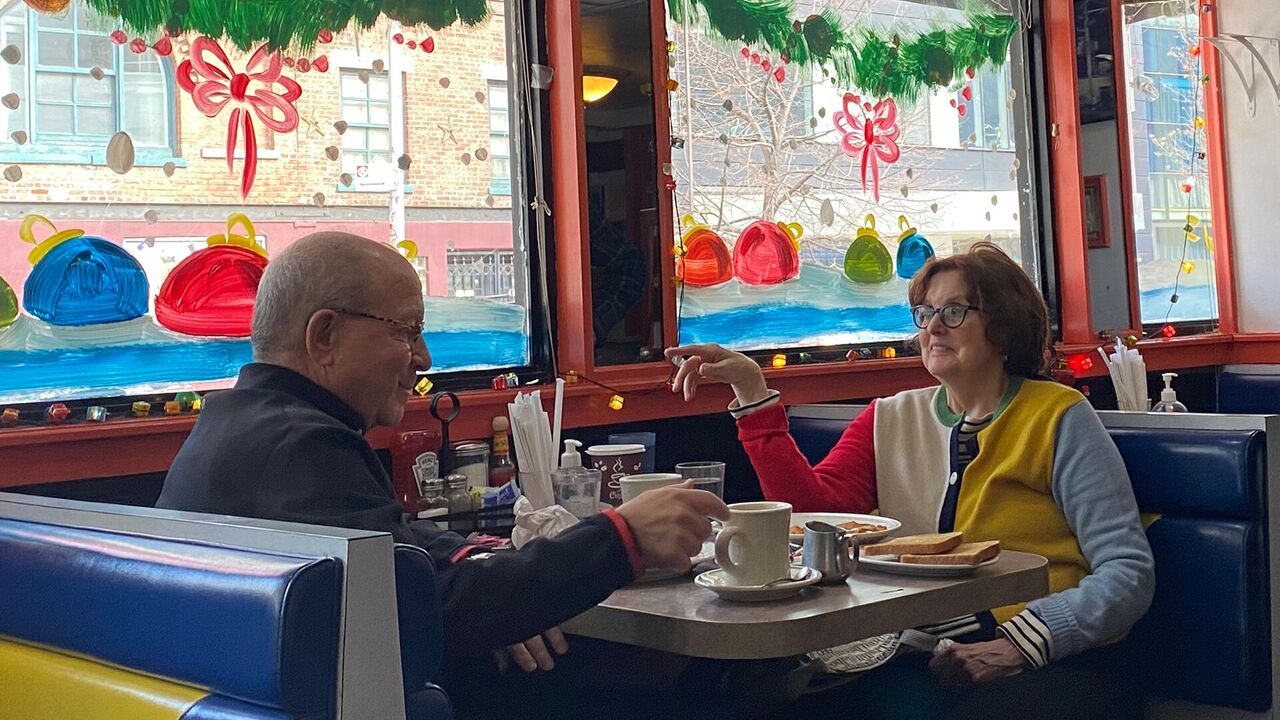
Fortunately this is offset by lengthy conversational exchanges between the two while sharing a meal at the now-defunct Chelsea diner Star on 18, then located at West 18th Street and 10th Avenue. It is during these sequences that Saltz and Smith both seem the most relaxed, the most candid, and the most open to discussing the development of their relationship and their respective personal backgrounds.
In the pursuit of these topics, the film once again becomes uneven. An excursion is made to Saltz’ boyhood home in a near-suburb of Chicago. While there are moments when he tours through the house with its current occupants that are played off as lighthearted childhood remembrances, the biographical narrative he offers up about his young life in the house following his mother’s suicide paint a more somber, unpleasant picture that the film does not pursue any further. Neither, unfortunately, does it devote more than a passing acknowledgement to his early years in Chicago as a co-founder of the highly influential N.A.M.E. gallery.
For Smith’s part, no travel is undertaken, and very little regarding her familial background is disclosed, beyond the great and formative value her mother placed upon her opinions at a young age. For as rich a subject as it is, it feels like only a spare amount of detail is given regarding her early career, before taking her post at the Times, including the years she spent under the wing of Donald Judd. In fact, the focus seems to settle more on her departure from the Times than anything else.
“It was a hard movie to make, I’ll say that,” noted Chernick during a Q&A session with the audience following the Tribeca premier, “My last one, on Itzhak Perelman, had a more organic story. He was famous, he had struggled as a child, he had polio, and became a very famous violinist. With this story, our team, we really had to craft a narrative. We had to find a structure: beginning, middle, and end. Roberta happened to have retired randomly in the middle of the film, which was convenient. It gave us that ending.”
This strategy, while effective (especially given that the film comes in at a compact eighty-three minutes) in the end suggests Chernick was perhaps intimidated by the task of crafting a film that paid respect to the full complexity (and by their own admission, damages) of her subjects. By reducing Smith’s decision to a narrative device, Chernick is able to neatly avoid making any definitive statement regarding the couple or their respective places in the culture that isn’t purely laudatory. Even this she outsources to famous faces: Larry Gagosian, Paula Cooper, Cindy Sherman and others make brief appearances late in the film to pay homage to Smith and her career. After how much of themselves Saltz and Smith have given, how radically willing to acknowledge one another’s accomplishments and their own flaws both have been, to end on such a pat note is a disappointment.
 Jerry Saltz and Roberta Smith on the red carpet at the premier of House of Criticism. Courtesy of Bianca Bova.
Still and all, House of Criticism makes for a compelling introduction to the careers and personalities of Saltz and Smith for the uninitiated, and a nice piece of work for the general art historical record. Though it is unlikely to satisfy anyone who had hoped to walk away with a significantly deeper understanding of two figures who have long been such prominent voices in the art world, it still delights and entertains at every turn.
In an age when most biographical documentaries have become in essence commercials for their subjects, it was especially refreshing to learn in a conversation with Saltz on the red carpet just minutes before the premier that neither he nor Smith had seen the film yet.
“It’s not our work anymore. It’s Alison Chernick’s work. And I hope I like it.”
Support for this article was furnished by a Travel Grant for Visual Arts Journalism from the Dorothea and Leo Rabkin Foundation.

Bianca Bova
Bianca Bova is a Chicago-based curator and cultural critic. As director of her eponymous gallery, she exhibits the work of conceptual artists who utilize research and art historical content in their work.
view all articles from this author