Whitehot Magazine
August 2026
"The Best Art In The World"
"The Best Art In The World"
August 2026
Notes from a walkthrough of “A Partial Refusal” at Field Projects
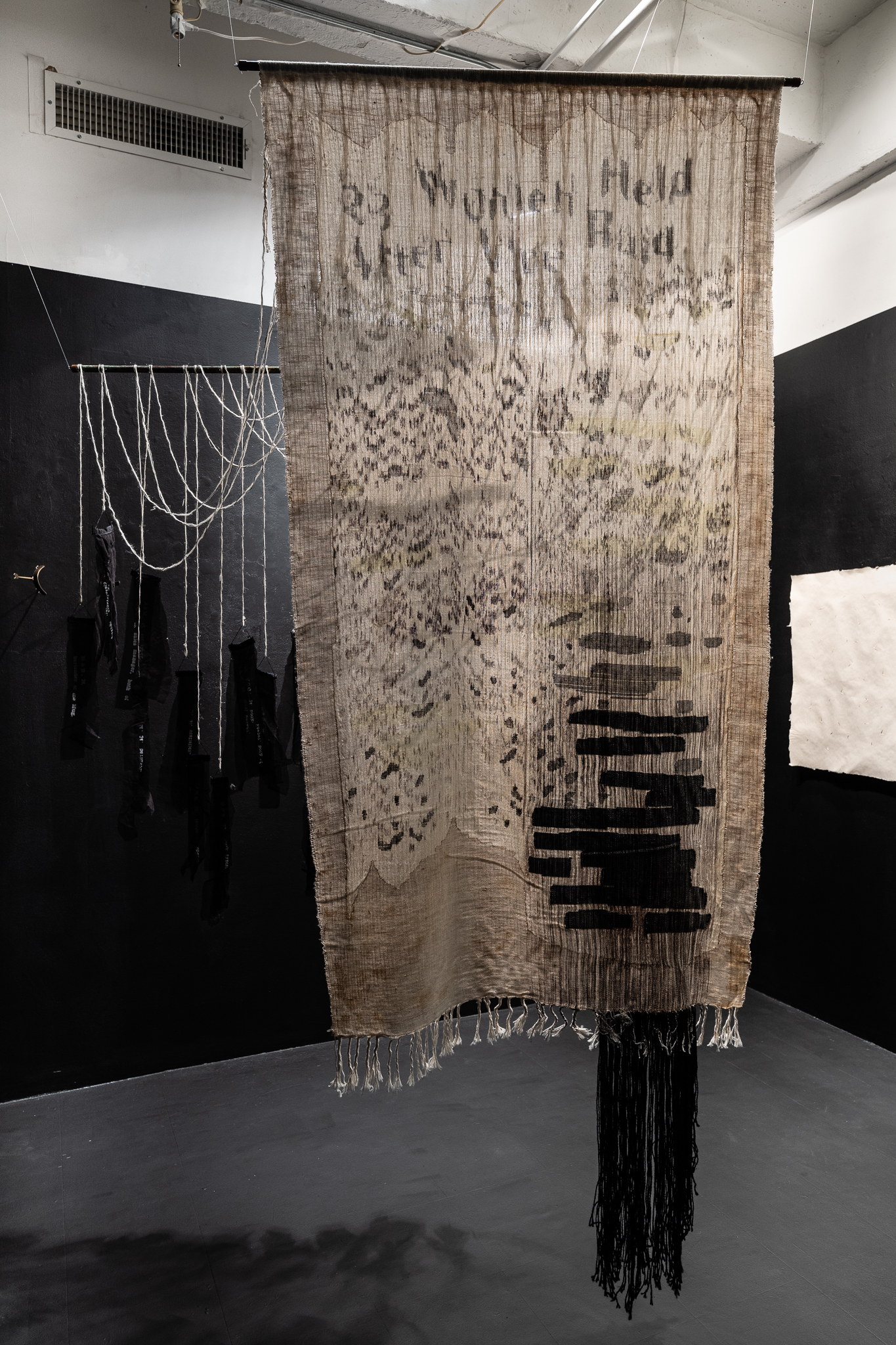 Installation view featuring works by Rowan Renee.
By ADDISON BALE March 17th, 2026
Rowan Renee’s two banners float centrally, perforating the space with the airy, gauze-like film of handwoven fibers. What does it say? Along the upper edge of the white piece, I can’t quite make out the letters that I learn later form “23” “after” and “vice.” Their suggestion does something regardless and this is echoed in what I was already onto: the black bars that signal redaction, and which double as suggestions of inky brushstrokes, now seem to be the source of the blot that consumed Renee’s other piece, the all-black weaving. One massive redaction in the center of the show.
I happened to be reading Exophony: Voyages Outside the Mother Tongue by Yoko Tawada in early February when I visited Weihui Lu at Field Projects a day after the opening of “A Partial Refusal.” Tawada, a writer and translator from Japan who has spent her career in Germany, writing in both Japanese and German, describes that, in her practice, there is more potential in gaps than in bridges between languages. (Gaps being those moments where a word in one language finds no significant parallel in another language. When there is no easy bridge, the meaning in translation is met by a void or a work-around.)
Refusing to be impassive, the black walls play a pivotal role in the curation. And as if doubling down on their activity, SaraNoa Mark’s little rubberband-like museum armatures spread across the black paint, brandishing their bronze limbs like metal alphabets springing off the wall. Their appearance is first subtle, then glinting, and then animating. Somehow, a personality is being evoked in their leggy forms. Their arcs and angles come off as playful. It’s funny too because as a viewer you know these armatures must have been abandoned or stolen before Mark took over. Their collective title, Guarding Invisibility, tells you what Mark must know: disuse is only an illusion. These armatures may have been meant to hold museum artifacts, but function is malleable and what was once a tool within an institutional setting is now liberated into the curved reappropriations of something that appears to me like a metallurgic animism. Like Patton’s porcupine quills, here’s a language I may not know how to read, but feel a verby intent nonetheless.
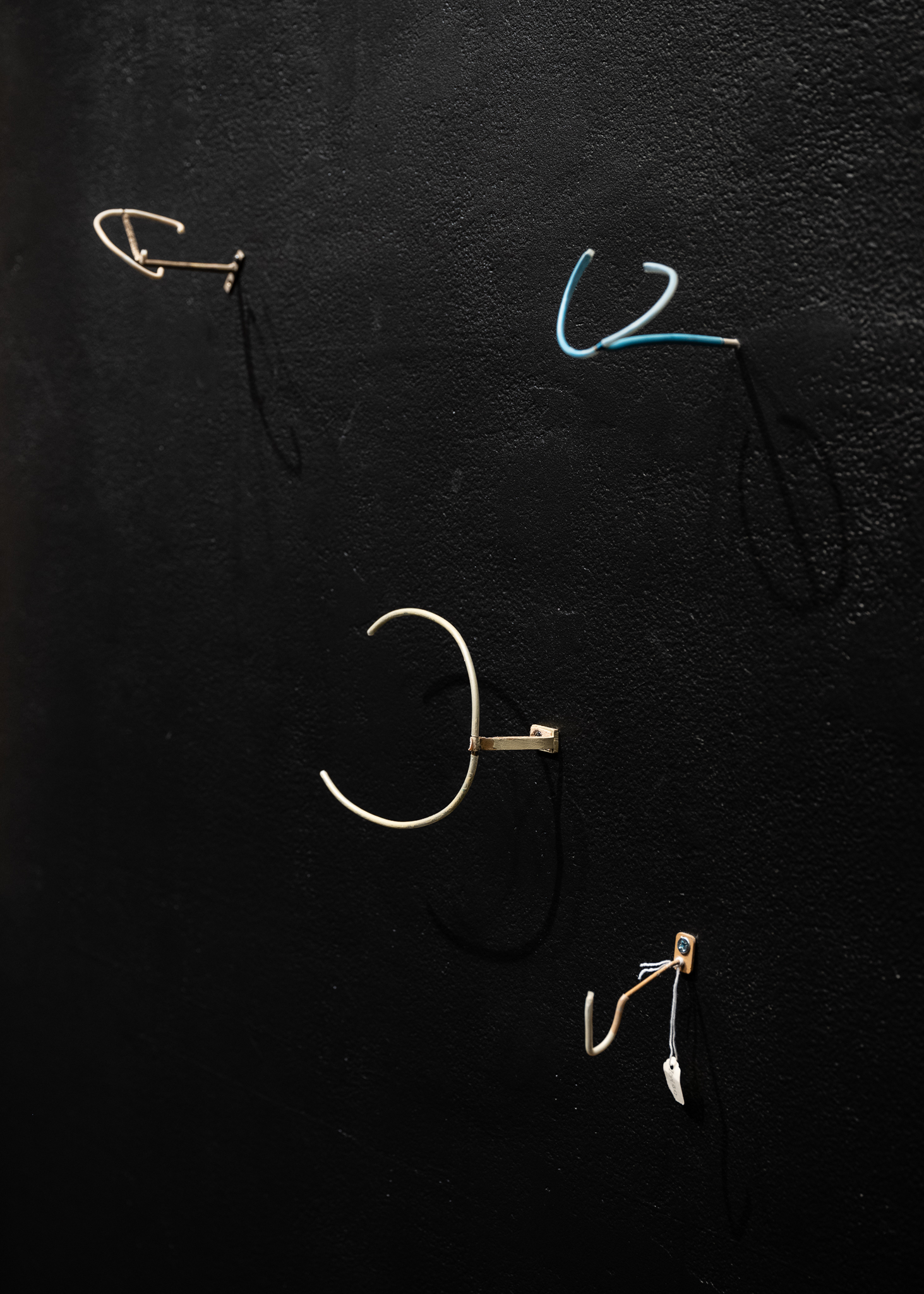 Installation view featuring works by SaraNoa Mark.
Six artists’ works could easily overburden such a tight gallery space. The show is nonetheless thoughtful and feels bigger than its square footage would suggest. Maybe this is owing to the black walls which seem to expand the mental perimeter. Thoughtful and maybe also representational of thought itself: dark, ambient, ominous, springy, and only partly legible. Like a dream of a keyboard and being unable to find the right sequence of letters at the right moment to form the word. Or I pull up a message on my phone and— besides the lightswitch which doesn’t seems to do the light, counter to expectation— the message in the phone reads one thing before being cannibalized and reappearing as a new phrase or a vacancy. Yet I would be asleep in dreamland trying to ascertain the words as they slip or shift. So if Lu’s point is to highlight what we may want to ascertain without simply giving it to us, we risk the possibility of not getting it. So what? Perhaps in not getting it, something closer to dreaming replaces domination.
Lu begins to explain Renee’s source material but holds back and lets me look at what it is, as it is without context. Whatever I’m not supposed to read— and that perhaps Renee is also not supposed to read— is giving me, on that opaque rejection, a surface in and of itself to behold.
So I like Édouard Glissant and his Poetics of Relation which is cited by the curator, Weihui Lu to illuminate this show’s attitude: look and feel at the art unencumbered by didactic wall texts (or over-wordy press releases). The binary of correct/incorrect has been left at the door. The language that is evoked in form and image is as much about its oblivion as it is legibility. “A Partial Refusal” is synthesized through this flexibility of slant-signifiers, almost alphabets, funny translations, and redactions, which like silhouettes form an impenetrable foreground that delineates without explaining the language that you won’t read and makes us beg to know, What does it say?
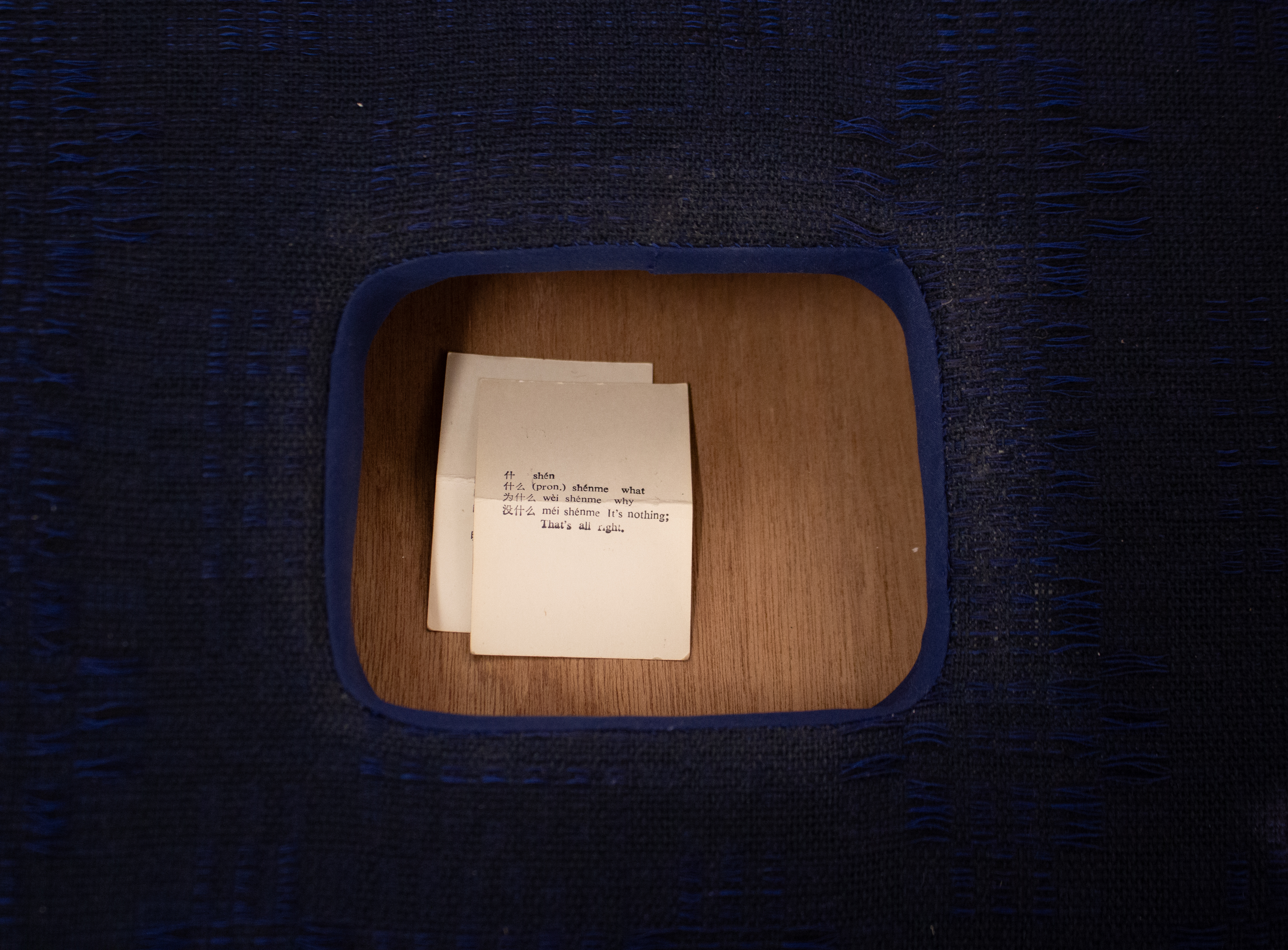 Claire Hu, Catalpa. Courtesy of Claire Hu.
After Hu’s work titled Catalpa, I google “catalpa,” which I understand is a plant but nothing else and I learn what Lu had already told me. Catalpa, after the flower, is the name of a traditional weaving pattern from North Carolina. (Lu also informed me that the pattern is notable for its independent development in Appalachian and Chinese weaving traditions.) Hu’s weave-wrapped wooden wedge has an opening reminiscent of a guitar’s sound hole and is installed at the foot of the wall, compelling me to squat and pick up the cards inside. What do they say? Vocabulary cards of Chinese translations, rendered in a pre-standardized pinyin (I think?). The demand to look at the cards is activated by this lowness. Like flower picking, I lift another translation out of the catalpa sound hole.
Seek out the gaps (between language, between signifier, between sources and associations) and work with them; not necessarily towards a monoculture of development— not towards an arithmetic of logical outcomes or policing— but towards a cohabitation therein that’s allowed to become a way in which we let each other know the gap exists and that it is not deadly. You can swim in it.
What does it say? becomes a refrain as I revisit “A Partial Refusal,” even as the question lands on the nonverbal.
Respectfully, to want to know is to want to dominate. It does come down to that. If the gallery or the museum is the knower and therefore, marketplace of the art, then it has already dominated the artist and relayed this power to the viewer. We are after all, to quote the press release, “in the era of didactic wall texts and large language models.” I don’t think all that institutional text empowers the artist altruistically, though it has become a built-in expectation to the art-viewers experience. I would argue that a total knowing— to have all the intel, all the context, all the process exposed— is not beneficial to the spirit of looking, and even less so the spirit of making. I don’t think a total knowing, which is intellectual and calculating, can jive with intuition/instinct and therefore, potential for soul. It does better to not know completely what the artist’s gut-flora was directing, let alone their intellectual project.
Automatically, if only geometrically, the V and L shaped spines register like a scattered code across the unruled surface of Mikayla Patton’s handmade paper. What does the porcupine say through lost quills? Ah— I don’t know but it feels like Patton arranges the undyed quills so their form is preserved as a potential for mark-making; for communicating. A quill-speak I don’t read. So what am I looking at if all this armor is no longer used for protecting the animal? Patton’s piece is titled Iyápi. I google the word. It is Lakota and translates into English as “language.” WM
Addison Bale
Addison Bale (b. 1994, NYC) is an artist and writer. Bale’s paintings have featured in group shows around NYC and Mexico City. His poetry chapbooks, GALIMATíAS (MX) and Snakeskins (NY) were published in 2022 and 2018 respectively. A solo exhibition, “The Decline in Reading,” was held at D.D.D.D. gallery (2025, NYC). Bale is a recipient of the Rema Hort Mann Foundation Emerging Artist Grant in 2024.
His essay, “On Translation, Codification, and Something in Between: Language in the Paintings of Martin Wong,” on hopscotchtranslation.com, 2025.
view all articles from this author