Whitehot Magazine
October 2026
"The Best Art In The World"
"The Best Art In The World"
October 2026
Fractured Horizon: Light, Perception, and the Developing Field of Experience at THE ELEMENTAL
Palm Springs, February 13 to May 16, 2026
By Lorien Suárez-Kanerva
At THE ELEMENTAL in Palm Springs, the exhibition Fractured Horizon: Explorations in Light and Atmosphere, curated by Cristopher Cichocki draws from the lineage of California Light and Space while extending it into a broader inquiry—one that considers how landscapes are constructed and experienced through material, chromatic nuance, form, and technological mediation. Light is approached here not only as an artistic medium, but as an environmental condition—something that shapes perception rather than simply illuminating it.
As Maurice Merleau-Ponty writes, “The world is not what I think, but what I live through.” The distinction lingers here—perception unfolding as experience rather than image. The exhibition shifts attention away from optical precision and toward perceptual awareness. It encourages a slower kind of looking, where subtle changes register over time. What comes forward is not a fixed image, but an ongoing adjustment—perception catching up with itself, then slipping just beyond.
The ambient conditions are central to this experience. The darkened interior—carefully calibrated to heighten contrast—does more than frame the work; it allows light to emerge with a particular clarity, almost a presence. Light does not simply exist within the gallery—it appears through its relationship to darkness. The space feels composed in that way. Not neutral, but tuned. Attention moves between what reveals itself and what recedes, between surface and depth, material and something less tangible that hovers just beyond it. Rather than offering a single experience, the exhibition unfolds as a field—something that develops through movement, duration, and small perceptual shifts that accumulate. The works in the installation operate relationally, each contributing to a shared atmosphere rather than standing alone. The viewer moves through it, but also completes it, whether consciously or not.
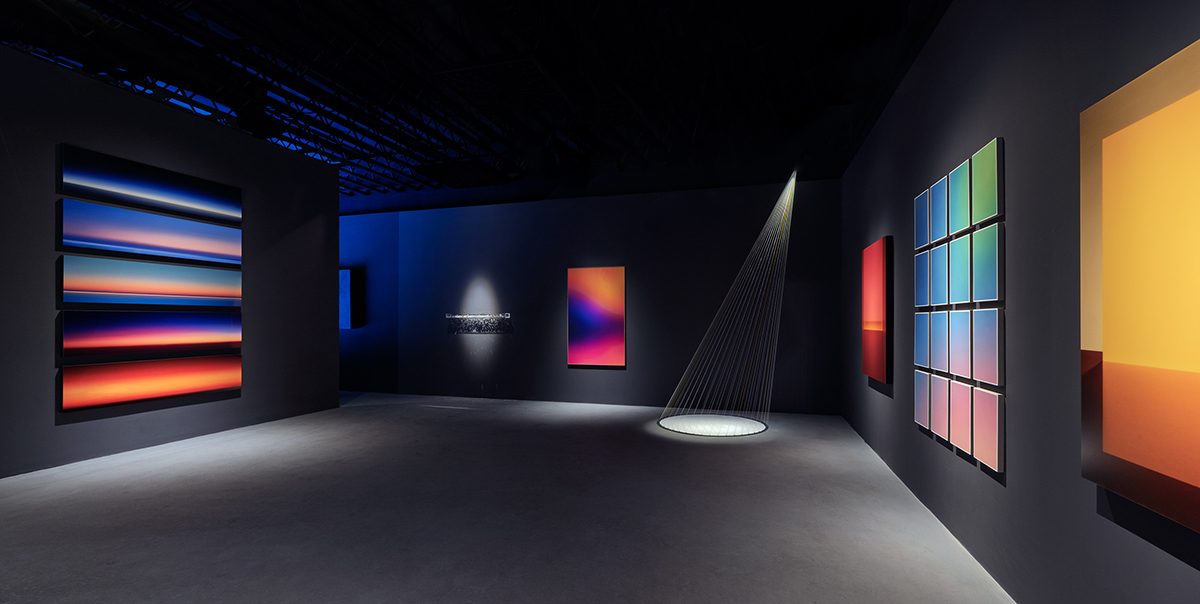
Glen Wexler, Ascension: Fragmented Memories, 2025, 18 x 70 in. per individual work, Edition of 10 +1 AP; Richard Twedt, Untitled (Refraction Wall), 2025, Crystals, plexi-glass box, 3 x 48 x 6 in., Unique; Raul Rebolledo, Secula Seculorum (10.576), 2025, Archival pigment print, 64 x 39 x 2.5 in., Unique; Guillermo Celis, Inner Light (Constellation), 2026, Steel, string, crystal flake, Dimensions variable; Sebastiaan Knot, N48205, 2023, Archival pigment print, face mounted acrylic, mounted in Dibond, box frame, 55 x 40 in.; Javier Peláez, Extracto #3 (Green Sun), 2026, Oil on canvas mounted on board, Polyptych of 16, 69 x 53 in., Unique; Sebastiaan Knot, N52777, 2023, Archival pigment print, face mounted acrylic, mounted in Dibond, box frame, 55 x 40 in., Unique.
Glen Wexler’s Ascension: Fragmented Memories establishes a temporal structure for the exhibition. The five vertically stacked panels—Transcendence, Weightlessness, Threshold, Transformation, and Ignition—draw from decades of observing twilight horizons. Yet what is presented is not landscape as such, but its distillation. The horizon becomes a sequence of chromatic states—measured, held, and slightly suspended. There is a quiet exactness to the work, though it never feels rigid. Transition itself becomes the subject, and remains just open enough to be felt rather than defined.
Richard Twedt’s Untitled (Refraction Wall) introduces a more materially grounded encounter with light. His crystalline formations, contained within a transparent enclosure, hold illumination in a state of quiet accumulation. The enclosure doesn’t close the experience so much as bring it into focus. Light gathers, refracts, settles—never entirely still. Twedt’s reflection that “light is an art medium and is eternally appreciated by humans” lands simply, but carries a certain weight here. The encounter feels direct, though layered—something familiar, but not fully resolved.
Guillermo Celis’ Inner Light (Constellation) offers a more permeable structure. The vertical cone, composed of slanted fibers, allows light to pass through rather than settle on its surface. It shifts with the viewer’s position—density and transparency in quiet negotiation. There is an openness in its construction, a subtle tension held between structure and atmosphere.
Raúl Rebolledo’s Secula Seculorium (10.576) operates through thermal traces extracted from surveillance footage, rendering not the figure itself but its afterimage—heat dispersed into chromatic field. What remains is a form of residue: a presence already receding, held momentarily at the threshold of disappearance.
Sebastiaan Knot’s photographic works N48205 and N52777 extend this inquiry into the mediated image, where color fields appear painterly yet originate from constructed or captured realities. Javier Peláez’s Extracto #3 (Green Sun), a polyptych of gradients, initially reads as digitally produced but reveals itself as oil on canvas—its technical rigor underscoring a reversal of assumed processes. Its modular structure permits reorganization into a multivariable sequence, in which shifting permutations remain harmoniously resolved, bridging systemic order and perceptual experience. This perceptual inversion finds a parallel in Knot’s practice, where small hybrid maquettes, recalling Light and Space sensibilities, are constructed and installed in the studio, then translated into photographs that evoke a chromatic depth of light as material reminiscent of Mark Rothko’s color field painting.
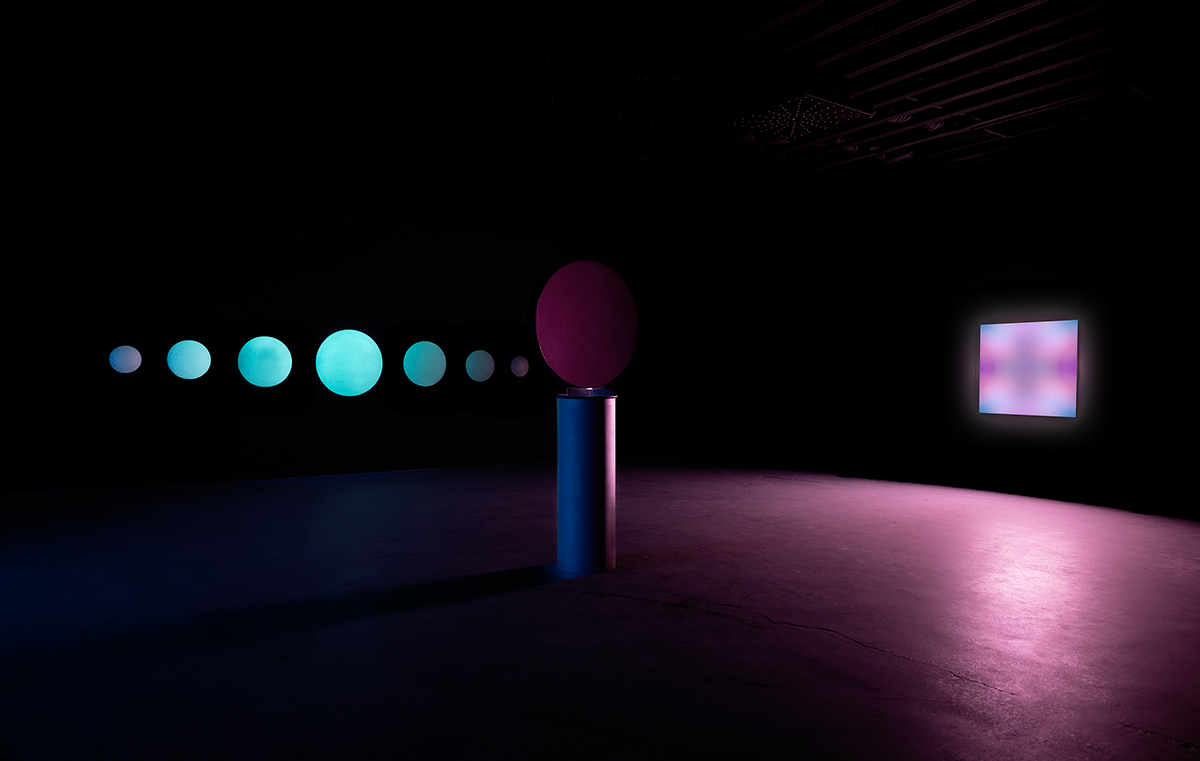
Cristopher Cichocki, Cyclic Rotation, 2026, Iridescent pigment, phosphorescence, polymer, architectural foam, desert sand, UV light program, variable dimensions; Shana Mabari, Diametros Petal (Red | Pink), 2016, Acrylic mirror, 36 in. diameter x 6 in.; Phillip K. Smith III, Luminous Field 8, 2024, Aluminum, glass, LED lighting, electronic components, unique color choreography, 45 x 45 x 9 in.
Shana Mabari’s Diametros Petal engages reflection, though it resists functioning as a mirror. The work gathers fragments of the surrounding environment and reconfigures them across its surface. What appears is never fully stable. It shifts with angle, movement, and light—folding the viewer into the field of the work, though not as a central figure.
As Merleau-Ponty writes elsewhere, “Vision is not a certain mode of thought or presence to self; it is the means given me for being absent from myself.” A subtle displacement enters here—the viewer is no longer outside the work, but drawn into its shifting conditions.
Cristopher Cichocki’s Cyclic Rotation introduces rhythm into the exhibition’s perceptual field. The sequence of circular forms extends across the wall, creating a cadence that unfolds as one moves through the space. Light is activated through material systems—phosphorescence, UV programming—yet the experience remains spatial, grounded in movement.
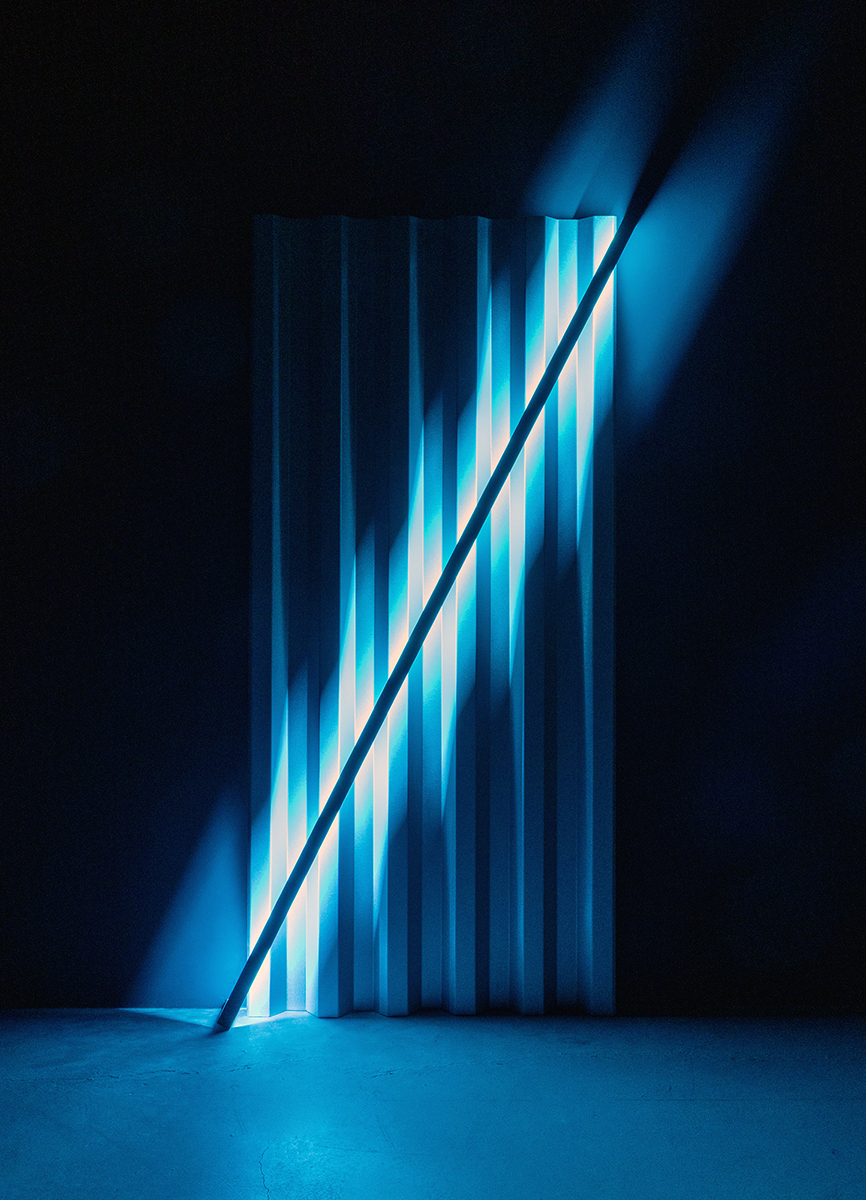
Chris Sanchez, Infinite Structure (Eclipse Blue), 2026, Corrugated steel, wood, steel, LED, 40 x 28 in., Edition of 3.
Chris Sanchez’s Infinite Structure (Eclipse Blue) shifts the dialogue toward structure and environment. Drawing from industrial forms and desert infrastructures, the work engages light as part of its construction. Shadows and illumination articulate the surface rather than dissolve it. Light reveals, though never completely.
Phillip K. Smith III’s Luminous Field 8 extends this engagement through technological modulation. Color unfolds across the surface in a measured sequence, introducing a temporal dimension that feels both controlled and immersive.
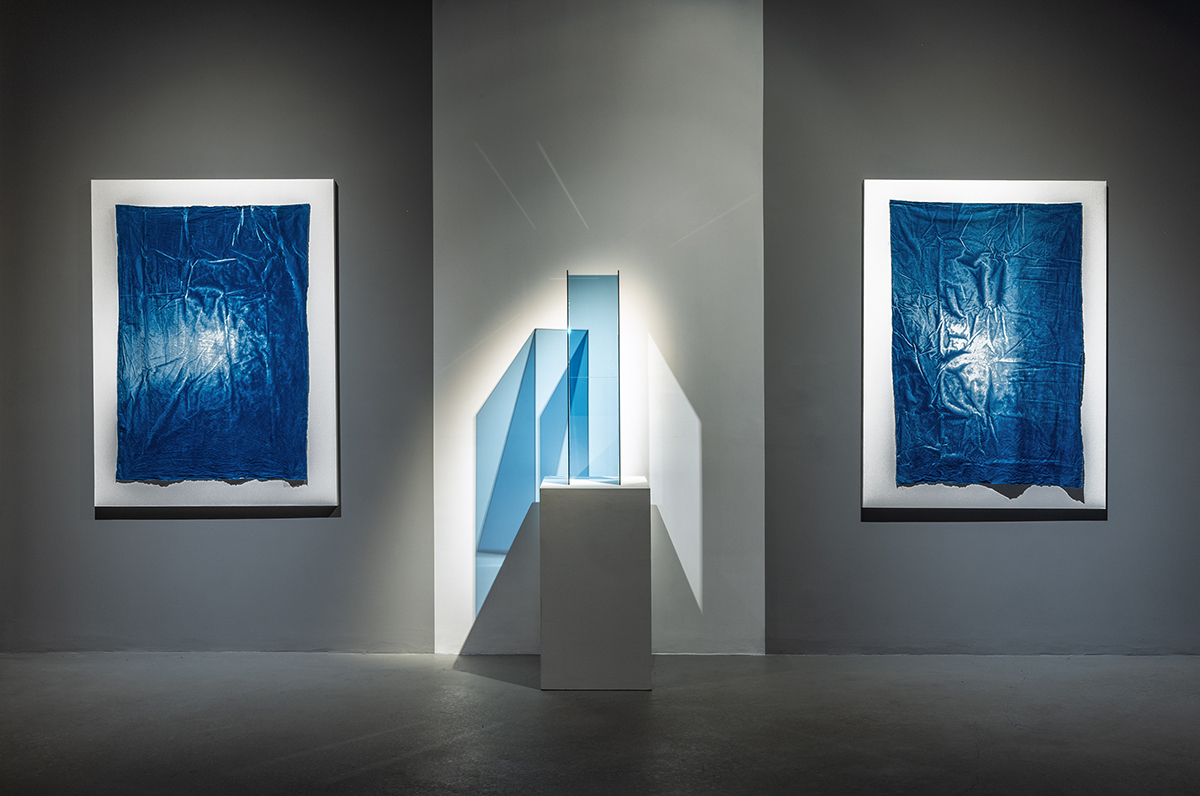
Cameron Gainer, Temporal Dispersion: Sonoran Landscape #24, 2025, Cyanotype on cotton, trace silica, desert elements, 62 x 46 in., Unique; David Wallace Haskins, Volumetric Glass (Blue), 2025, Architectural glass, 10 x 10 x 40 in.; Cameron Gainer, Temporal Dispersion: Sonoran Landscape #23, 2025, Cyanotype on cotton, trace silica, desert elements, 62 x 46 in., Unique.
In the adjacent works, Cameron Gainer and David Wallace Haskins approach the chromatic field of blue through differing material sensibilities. One allows light to pass through; the other absorbs and diffuses it. Together, they trace a range of interaction—light as passage, light as retention.
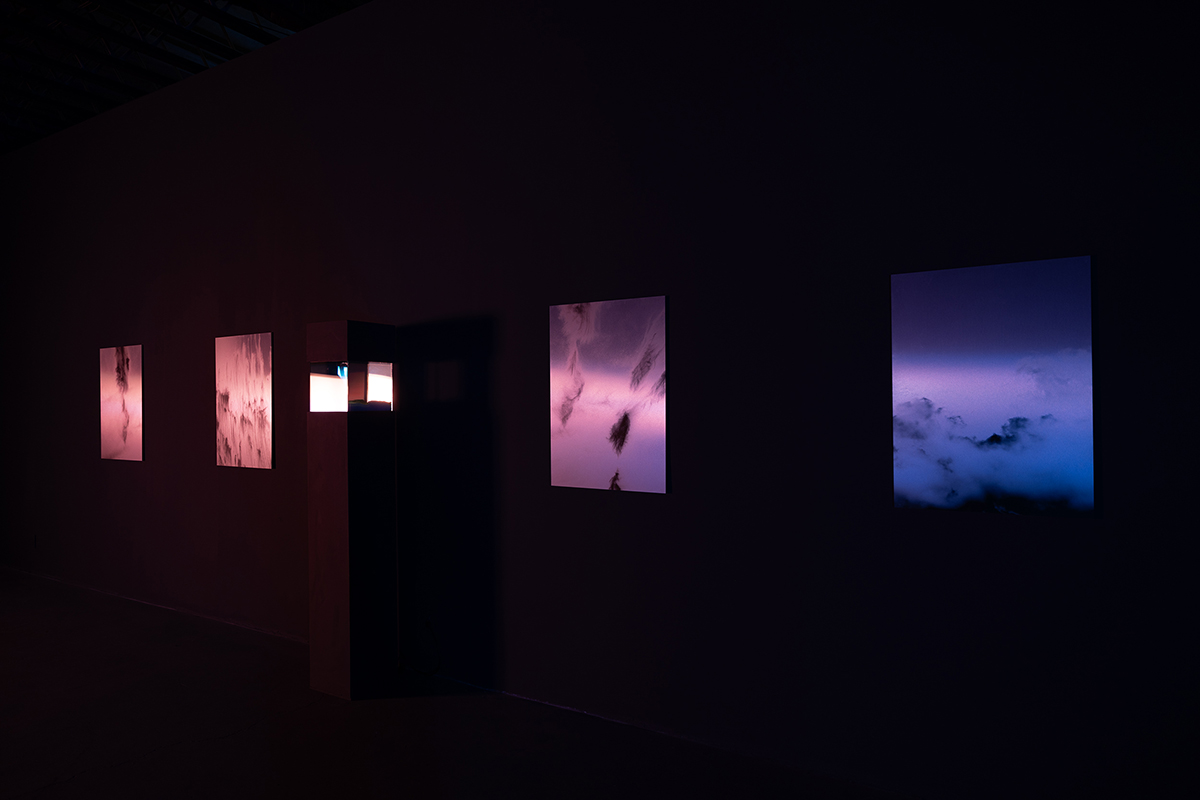
Marie-Luce Nadal, Sof la-Sipur, 2023, Glass tank, heater, electronics, calcium hydroxide, cloud extract, 12 x 12 x 12 in.; Cloud Studies (1–4), 2017, Photosensitive ink on aluminum plate, 35.5 x 25 in., Editions of 3 + 2 AP.
Marie-Luce Nadal’s works introduce an atmospheric dimension grounded in process. Through condensation and chemical transformation, the work evolves in response to environmental conditions. Light is not fixed—it emerges, shifts, disperses.
Here, materialist philosopher Jane Bennett’s notion that “matter is not passive… but active, vital, and already in motion” feels particularly resonant. Light, material, and environment act together—less as stable forms than as active participants in what is perceived.
Within the darkened interior, these distinctions become more perceptible. Contrast sharpens awareness of edge, surface, transition—where light begins, where it fades. The installation subtly repositions the viewer, encouraging a slower mode of attention.
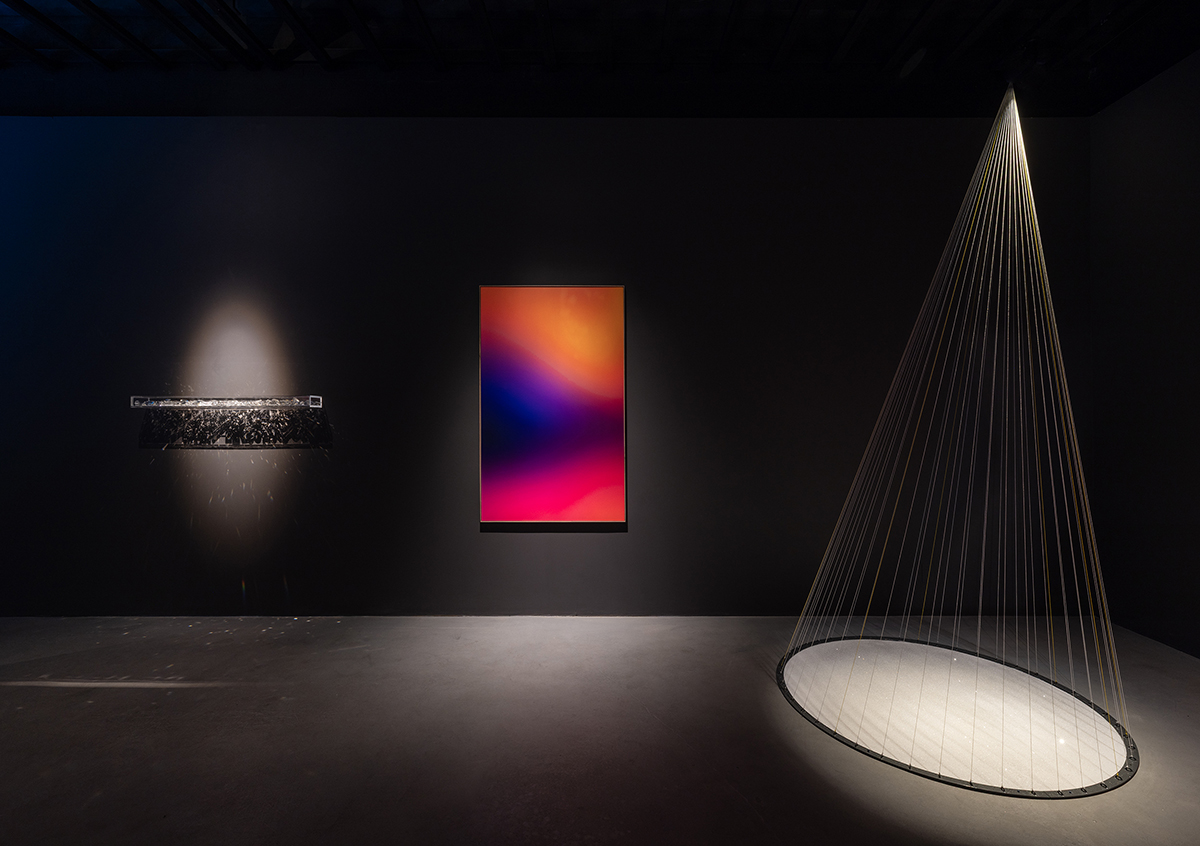
Richard Twedt, Untitled (Refraction Wall), 2025, Crystals, plexi-glass box, 3 x 48 x 6 in., Unique; Raul Rebolledo, Secula Seculorum (10.576), 2025, Archival pigment print, 64 x 39 x 2.5 in., Unique; Guillermo Celis, Inner Light (Constellation), 2026, Steel, string, crystal flake, Dimensions variable
Across Fractured Horizon, the horizon itself begins to loosen. No longer a singular line, it becomes a condition—fragmented into gradients and intervals.
Light here is not purely optical—it registers as psychological, temporal, something sensed as much as seen, almost before it is named.
The exhibition does not resolve. It lingers.
And in that lingering, perception recalibrates—quietly, almost without notice—until seeing folds back onto itself.
The horizon is never fixed. It is something we arrive at, lose, and find again—each time seen differently.
Palm Springs, February 13-May 16, 2026

Lorien Suárez-Kanerva
As a Geometric Abstract artist, Lorien Suárez-Kanerva explores the dynamic interplay of color, light, and geometric patterns found in nature and the cosmos. A Retrospective of Lorien’s work titled “Coalescing Geometries” won First Place in Non-Fiction at the 2019 International Latino Book Awards. She has exhibited in several curated solo and group shows in NYC, Los Angeles, and Miami. Her artwork appears at International Art Fairs and educational centers including Florida Atlantic University, Boca Raton Museum of Art, and UC Berkeley’s Engineering Department. Lorien resides in Palm Desert, California.
view all articles from this author