Whitehot Magazine
October 2026
"The Best Art In The World"
"The Best Art In The World"
October 2026
“Ritual of self creation:” Monique Poisson-Fast’s divine trans triptych
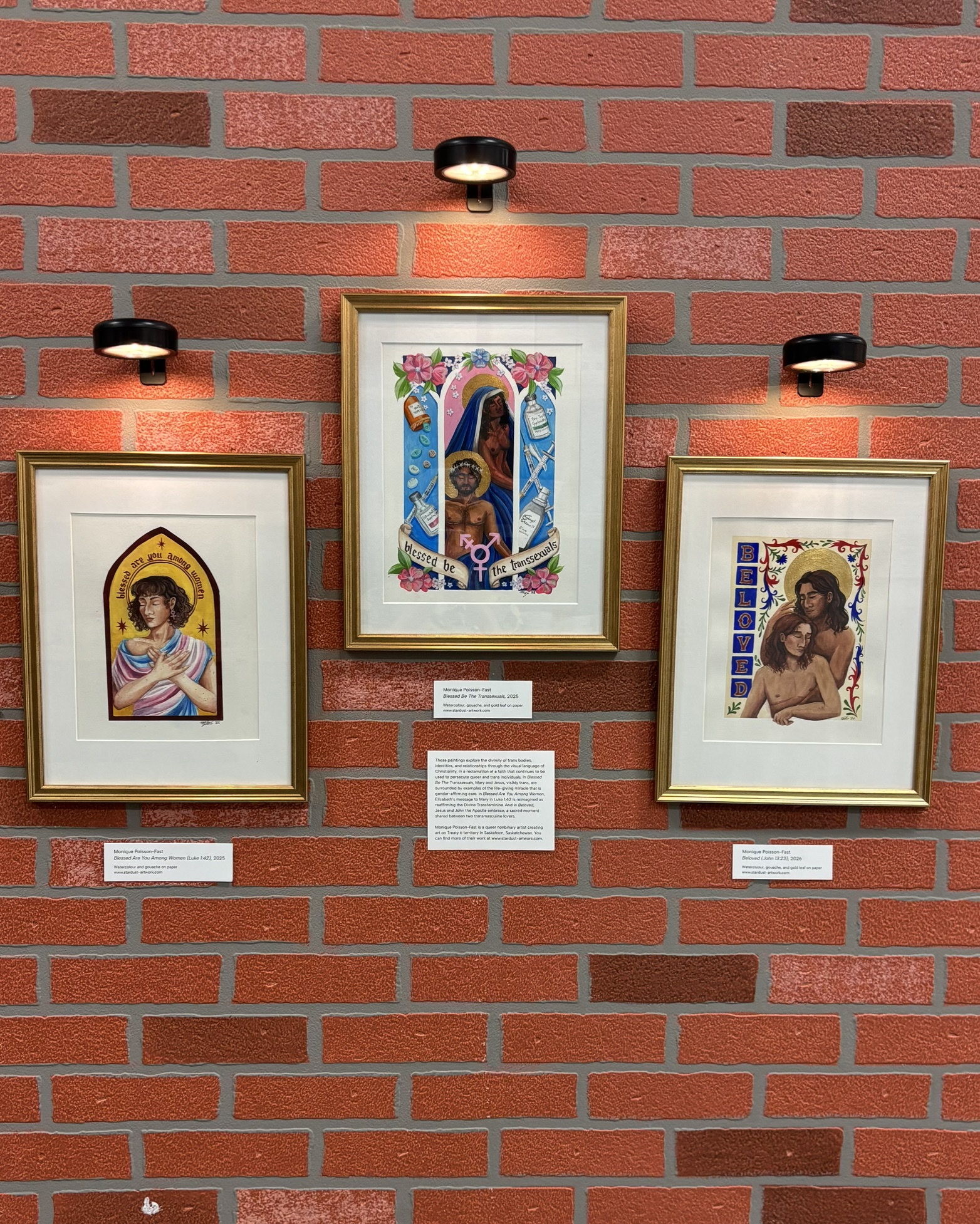 All three paintings on display at the Saskatoon Makerspace.
BY EMMA CIESLIK June 28th, 2026
Monique Poisson-Fast is a queer nonbinary artist also known as Stardust Artwork. Living and creating art in Saskatoon, Saskatchewan, they are well known for their digital, polymer clay, and watercolor work. This past month, they exhibited three paintings--a deconstructed triptych--at a non-profit artist collective called Saskatoon Makerspace exploring the divinity of trans bodies, people, and relationships through the language of Christianity, specifically Catholic and Orthodox iconography.
After their work went viral, part of a growing movement of visualizing queer and trans bodies as not just holy but at and of the crux of Christian divinity, I interviewed Monique about the power of reclaiming a Christian visual lexicon as affirming not only queer love but also the beauty and necessity of trans people and their bodies.
Emma Cieslik: What inspired you to create art exploring the divinity of queer and trans bodies?
Poisson-Fast: I feel like we all know that the United States and Canada are becoming--and many parts of the world are becoming--less and less safe for trans individuals with the rise of anti-trans legislation, and a lot of that legislation is being backed by right-wing Christian ideology. This is very frustrating to me because the version of Christianity I was raised with is just so removed from what is being used to justify these horrible removals of freedom.
So I was having a lot of these feelings of frustration and anger and fear, but instead of making art from that space, I wanted to make more positive pieces that celebrate trans existence and trans bodies and experiences and relationships, and the miracle of transition through the lens and the visual language of Christianity. Partly as a way to reclaim that language from the hateful ways it’s being used, but also because I was raised Christian, that language is the way that I know how to depict things as divine and as sacred, so it just feels natural to depict things in that way.
Cieslik: If you feel comfortable sharing, what is your religious background and what is the power of depicting queer and trans bodies as divine in the visual language of Christianity?
Poisson-Fast: I was raised Christian in the United Church of Canada, which is a very progressive Protestant denomination in Canada, and unlike a lot of other queer people, I was actually very lucky to have quite a positive experience with the religion growing up. Some members of the congregation obviously were less than supportive and some pushed back against inclusion, but the messages that I received from the pulpit were always about radical love and acceptance and the coming together of different faiths and communities and beliefs.
I was lucky to have a very progressive and accepting minister at my church most of the time growing up, and that really helped shape my experience with Christianity as a queer person. I never had an issue reconciling my queer identity with those things I was taught, and I feel very grateful for that.
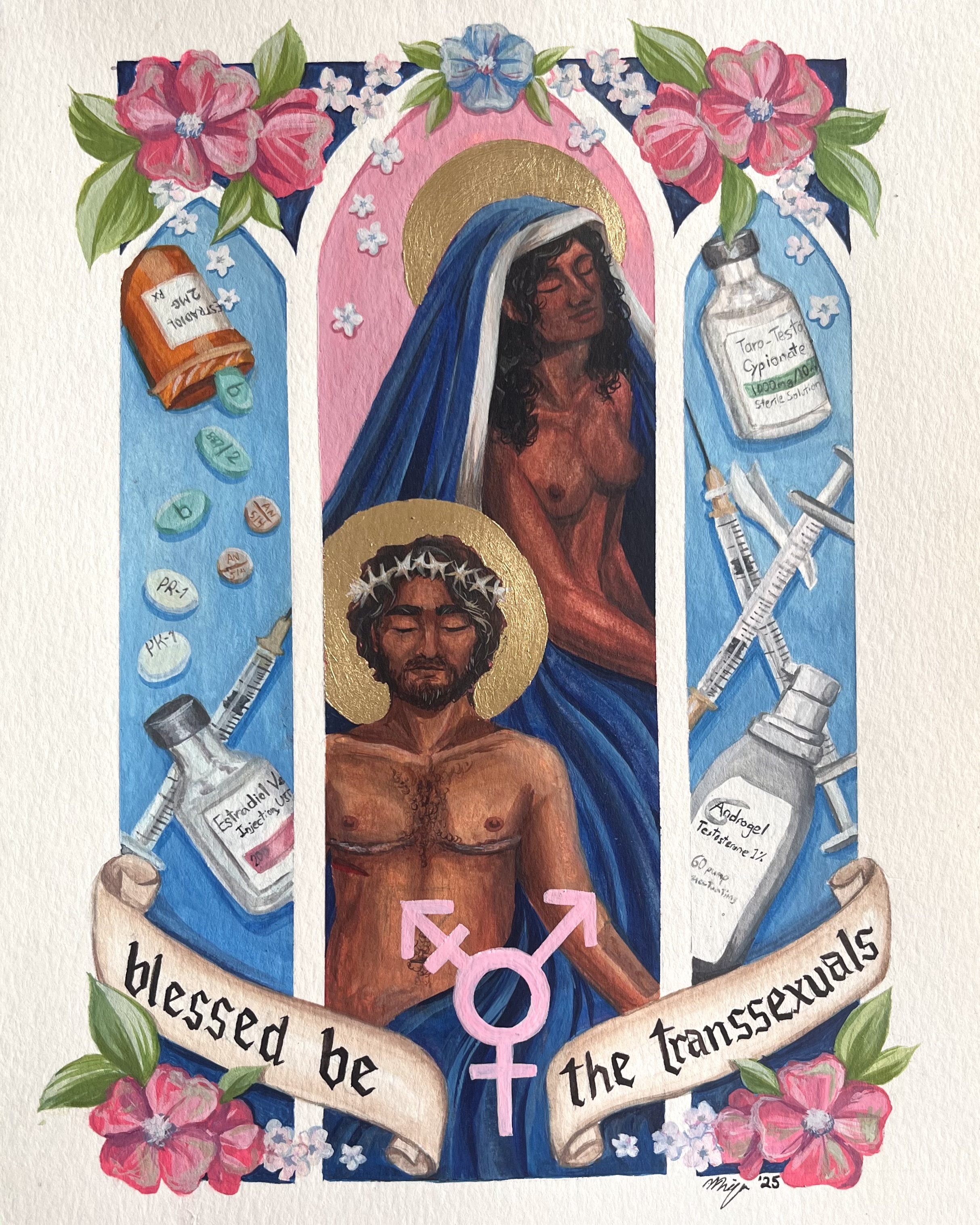
Blessed Be the Transsexuals (2025), by Poisson-Fast. Permission from the artist.
Cieslik: I want to specifically examine the three paintings you recently displayed. In Blessed Be The Transsexuals, Mary and Jesus are depicted as visibly trans surrounded by the lifegiving material culture of gender affirming care. What is the power of depicting Mary and Jesus--figures who have been used before to enforce stringent gender identities and bodies within Christianity--as trans?
Poisson-Fast: I think it’s powerful to depict Mary and Jesus as trans because it’s kind of going a step further than saying “God is okay with you being trans”. It’s saying “what if God is trans? What could that look like?” And again, growing up in sort of more progressive Christian circles, there were discussions about the feminine gendering of God, exploring God as the mother instead of God as the father. Those were the sorts of discussions that were happening around me, and so for me, God as trans sort of just seems like the logical next step in that exploration of the gendering of God and the divine. I think it is powerful.
Cieslik: Yes, an all-encompassing understanding of transness is part of a humanity reflected in and of God.
Poisson-Fast: Yes, and I also feel like the Christian faith is full of holy transformation. That’s kind of the cornerstone of faith--name changes, versions of the self dying and then being reborn, that’s kind of the whole thing, and so I feel like a trans Jesus, a trans Mary, they fit in with those broader themes of transformation and rebirth.
Cieslik: Yes, and I love that this work surrounds the pair with hormone pills, creams, and liquid vials and syringes. What spoke to me in this art is how you codify gender affirming care--and the objects that surround it--as part of a religious ritual, as part of a process of affirming the dignity of trans people. I see your work as affirming gender affirming care as a form of religious ritual. Does that resonate with you, and how does divinity overlap with gender affirming care and the call to protect queer and trans peoples’ access to it?
Poisson-Fast: Yeah, that really does resonate with me, the idea that gender affirming care is a religious ritual, I love that you said that. I don’t think every trans person thinks of it that way, I think for a lot of people, it’s kind of just like taking your vitamins. It’s just something you do. But I am more spiritually included, and I do think of it as this ritual of self-creation, of transformation.
In terms of protecting access to it, if we are viewing it through the lens of a religious ritual, people should be able to practice whatever religious rituals they choose as long as they are not hurting others. I think there’s a parallel there to the fight for ensuring access to gender-affirming care for all people.
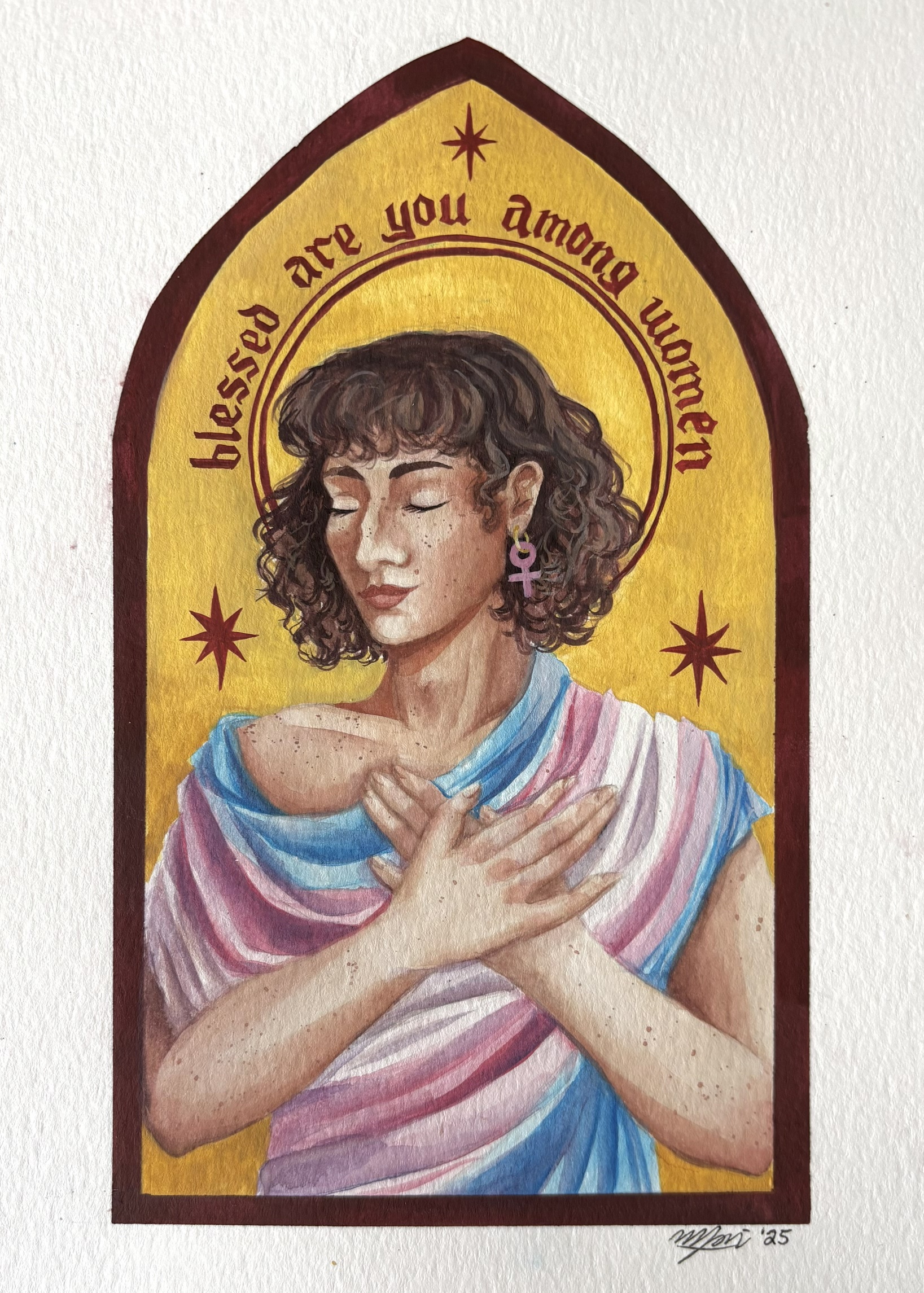
Blessed Are You Among Women (2025), by Poisson-Fast. Permission from the artist.
Cieslik: In Blessed Are You Among Women, a trans Elizabeth calls out to a trans Mary, recreating and reimagining the passage described in Luke 1:42 as celebrating and consecrating the Divine Transfeminine. What inspired this work? What is the power and potential of visualizing transness and trans bodies and people as divinely ordained?
Poisson-Fast: In terms of inspiration, I have some really amazing trans women in my life who are very close friends of mine, and so a lot of the inspiration for this piece comes from admiration and love for them, but also as someone who was raised as a woman but no longer identifies with that gender, it brings me great joy that there are people out there who, against all odds, choose to embrace their womanhood and live it fully, no matter the cost or the risk or anything. I think that’s incredible.
So by using the phrase “blessed are you among women,” I wanted to affirm that it’s not just “okay” that you’re trans. It’s blessed. It’s not just okay that you’re a woman. It is sacred. It is a blessing. It is wonderful that you are a woman, whatever that form takes for you. Obviously this piece is targeted towards affirming trans women and transfeminine people, but I also think that’s a statement that all women and girls need to hear today in this incredibly anti-feminist world we find ourselves in.
Cieslik: Are there any other passages that you would like to visualize, or any that call to you to be illustrated?
Poisson-Fast: There’s nothing immediately that comes to mind. This was sort of always meant to be a bit of a triptych, but I absolutely do want to continue exploring queer and trans identity and Christianity through my art. I think, whether or not you view it as a sacred text, the Christian Bible is an incredibly rich source of inspiration, so I look forward to exploring more of it through my art and through this lens.
Cieslik: I am most excited for The Queer Museum’s forthcoming illustrated work Queer Bible. Featuring contributions from contemporary queer and trans artists, this project aims to “reclaim the eroticism of religious art within the sphere of sexual dissidence.”
The Queer Museum, the first Chilean museum of LGBTQIA+ art and culture, also shares another wonderful digital exhibition of Douglas Blanchard’s “The Passion Series” which depicts a modern queer Black Christ attacked by conservative Christians touting far-right signs. Tortured by police and military agents leering guns at and kicking Jesus, the gay man is once again crucified before rising from the dead to unite in homoerotic fashion with an angel.
The Queer Museum also features Chilean artist Zaida González Ríos’s exhibition “The Final Judgement: Tarot Trans” where the people and bodies that are often invisibilized--the elderly, disabled, and transgender--exist at the center of a divination lexicon.
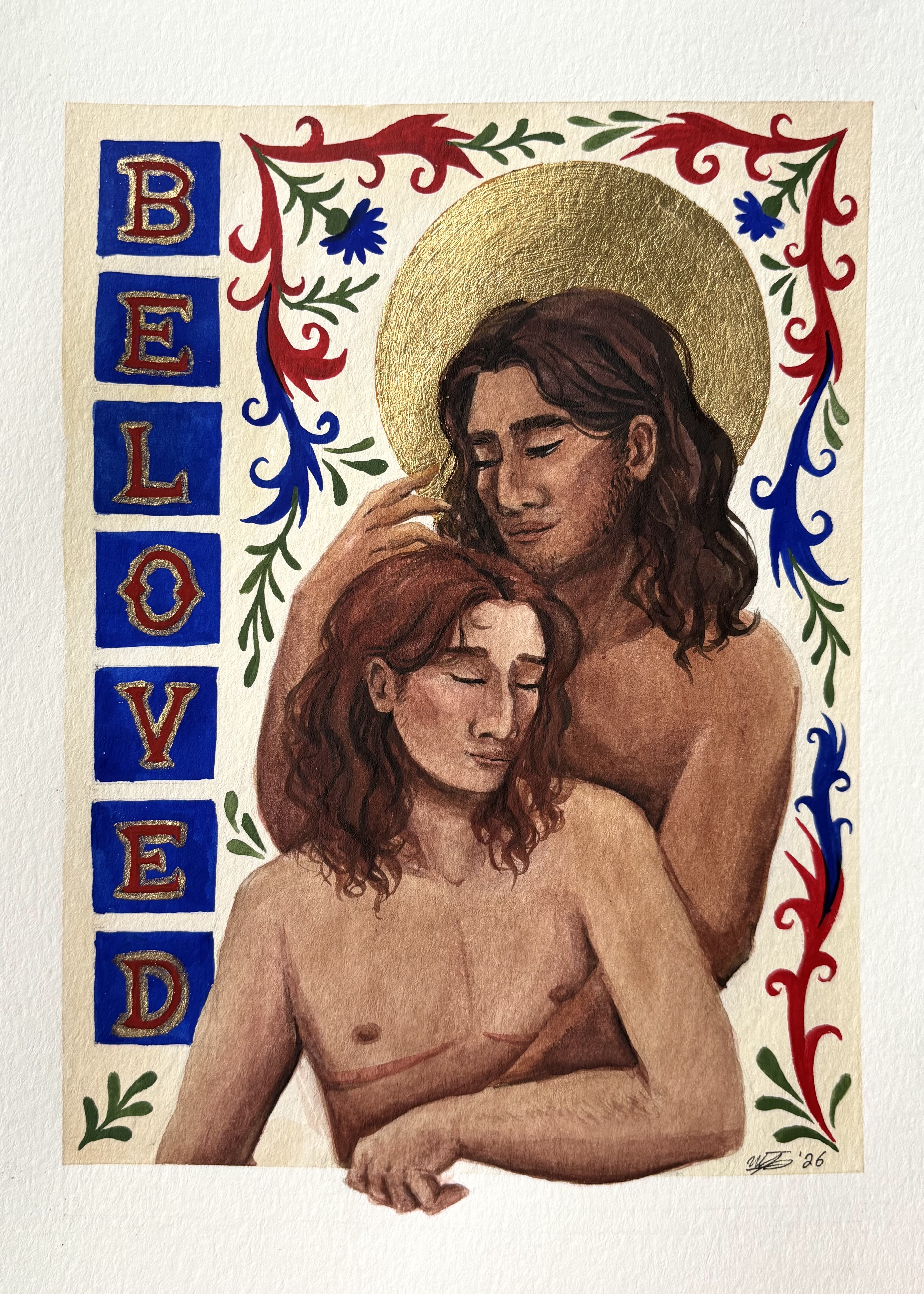
Beloved (2026), by Poisson-Fast. Permission from the artist.
Cieslik: And finally in Beloved, a trans Jesus and John the Apostle embrace, not only affirming a homoerotic relationship that many queer Biblical scholars have pointed out but also the divinity of transmasculine love. What is the impact of visualizing and celebrating queer love in the Bible, and t4t love?
Poisson-Fast: A lot of the inspiration for this piece comes from Anthony Oliviera’s incredible book Dayspring. It’s a reimagining of the Gospel from the perspective of John the Apostle, the beloved disciple, and it depicts his relationship with Jesus. It’s a beautiful book. It’s very moving and has a lot of interesting theology, and it very explicitly depicts a sexual relationship between Jesus and John. I really like the idea that a queer relationship didn’t have to be chaste, innocent, and pure in order to still be sacred.
In my painting, I wanted to portray this relationship, and I also decided to portray the figures as transmasculine, partially because it’s a bit of a companion piece to Blessed Are You Among Women, which features a transfeminine subject, but also my partner is transmasculine and our relationship is T4T. Being able to explore our genders alongside each other and support each other through that has been a really beautiful experience for me, and so I wanted to depict that same type of relationship and show that it is beautiful and holy.
Cieslik: What do you hope people walk away with from your work? How do you hope it will evolve and expand--and challenge heternormative, cisgender bigotry that is often shared by far right Christian individuals?
Poisson-Fast: I hope that people walk away with different things depending on who they are. For queer and trans people who were raised in Christianity, who never got to see themselves represented as sacred and never thought that they could be, I hope that maybe they might find some joy and maybe even some healing from these pieces.
But I also hope that Christians might see these works, and they might sort of spark some self-reflection. If it makes you uncomfortable to see Jesus depicted as transgender, why is that? These pieces aren’t meant to be blasphemous. They’re not meant to be disrespectful to Christianity in any way. I’m not demeaning Mary by painting her as a trans woman, and if someone feels that it is demeaning or disrespectful or blasphemous to paint her that way, I would implore them to do some soul searching, do some internal work, and think about why they feel that way.
Cieslik: What is the power in reclaiming and celebrating queerness in the visual lexicon of Christianity, especially as the traditions where icons like these are most popular are the very ones that continue to hold the line against inclusion?
Poisson-Fast: For me, using the Christian visual tradition in this sort of way is saying that you [far right Christians] don’t have a monopoly on the divine. Right-wing Christianity is not the sole arbiter of what is beautiful and sacred and good in this world, and we can create and define our divinity, and we can use your language while doing it.
Cieslik: Is there anything else that you would like to add?
Poisson-Fast: I feel called, as a queer person who has had an overall surprisingly positive upbringing and relationship with religion, to try to bridge the gap a little bit and create art that celebrates transness and divinity, and also is faithful, I believe, to these texts and the teachings of Jesus and these figures that a lot of us feel very connected to.

Emma Cieslik
Emma Cieslik (she/her) is a queer, disabled and neurodivergent museum professional and writer based in Washington, DC. She is also a queer religious scholar interested in the intersections of religion, gender, sexuality, and material culture, especially focused on queer religious identity and accessible histories. Her previous writing has appeared in The Art Newspaper, ArtUK, Archer Magazine, Religion & Politics, The Revealer, Nursing Clio, Killing the Buddha, Museum Next, Religion Dispatches, and Teen Vogue
view all articles from this author