Whitehot Magazine
October 2026
"The Best Art In The World"
"The Best Art In The World"
October 2026
Unseen Layers, Edwin Schlossberg’s fifteenth solo exhibition at the Ronald Feldman Gallery
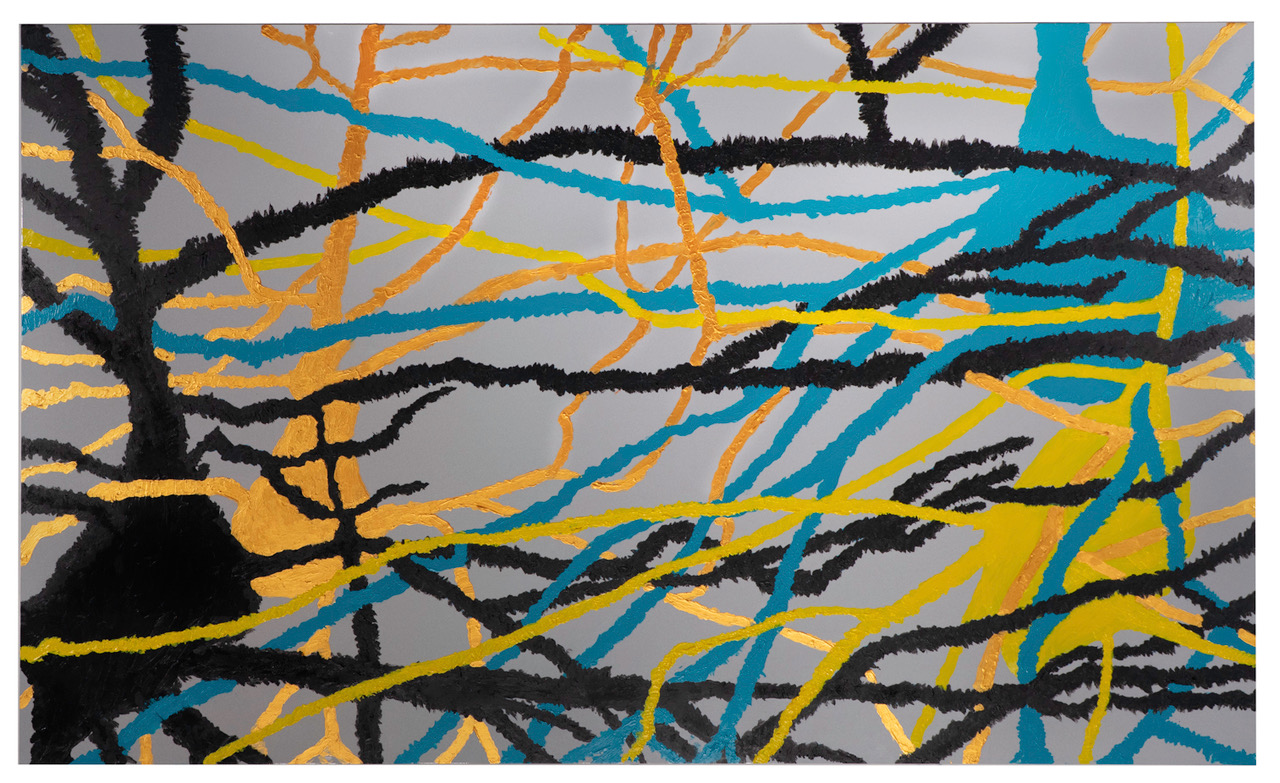 Edwin Schlossberg, Portrait of Brain Cells, 2024, 36 x 60 in, aluminum with scotchlite and acrylic © Edwin Schlossberg Courtesy the Artist and Ronald Feldman Gallery, New York
By JOSEPH NECHVATAL March 28th, 2026
As humans, we practice a sort of temporal aberration, inhabiting the fallacy that our here and now is disconnected from our before or after. When we think of our body, rarely do we think of interior images rendered by technology: images that often carry visual memories of our record of self-destruction. That is until we reach a certain inevitable advanced age and are forced to consider such abstract-looking medical imagery to understand its specific meaning to our life.
This consideration pertains, for me, to Unseen Layers, Edwin Schlossberg’s fifteenth solo exhibition at the Ronald Feldman Gallery. Its abstract art look is one of those times that has me recalling when Toni Morrison wrote in Beloved not of remembering, but “re-memory,” that is, the act of remembering a memory. For Unseen Layers is Schlossberg’s expansive abstract “portraits’ (of whom? everyone?) rendered from cutting-edge scientific techniques based in biological processes, cosmic processes, cellular emergence, and neural phenomenon, among others. Its abstract-looking imagery connects art, science and humanity in a crosspollination of the beautiful that includes within it unseen (but eventual) destruction.
Using his Paul Klee’s 1920 Angelus Novus mono-print as an illustration, Benjamin wrote: “This is how one pictures the angel of history. His face is turned toward the past. Where we perceive a chain of events, he sees one single catastrophe which keeps piling wreckage upon wreckage and hurls it in front of his feet. The angel would like to stay, awaken the dead, and make whole what has been smashed. But a storm is blowing from Paradise; it has got caught in his wings with such violence that the angel can no longer close them. The storm irresistibly propels him into the future to which his back is turned, while the pile of debris before him grows skyward. This storm is what we call progress.”
So with Unseen Layers, I found my way into many within and without worlds that would not release me from myself, except that it brought me back to what Walter Benjamin suggested with his last written words in 1940 (published as Theses on the Philosophy of History): that history compounds by piling wreckage upon wreckage. In his Theses, Benjamin wrote of the failures of so-called “progress,” citing the marginalized histories that we cannot remember because victors inspire a collective amnesia that preserves dominant narratives.
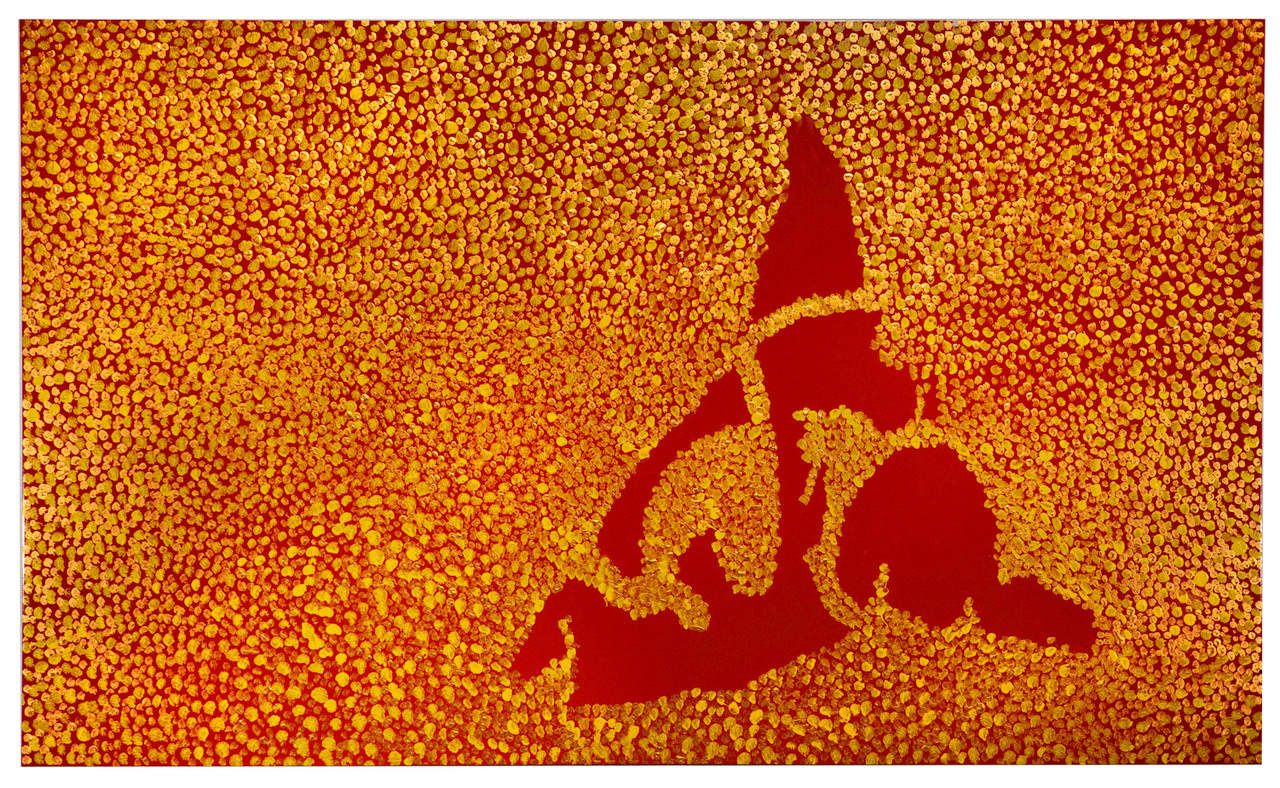 Portrait of Photons Gathering, 2023, 36 x 60 in, aluminum with scotchlite and acrylic © Edwin Schlossberg Courtesy the Artist and Ronald Feldman Gallery, New York
Like in Benjamin’s These, Edwin Schlossberg’s techno-portraits manifest body-cultural fault lines that may rupture at any time under the care of techno-medical-capitalism: the de facto abstraction that mediates bodily relations in the United States.
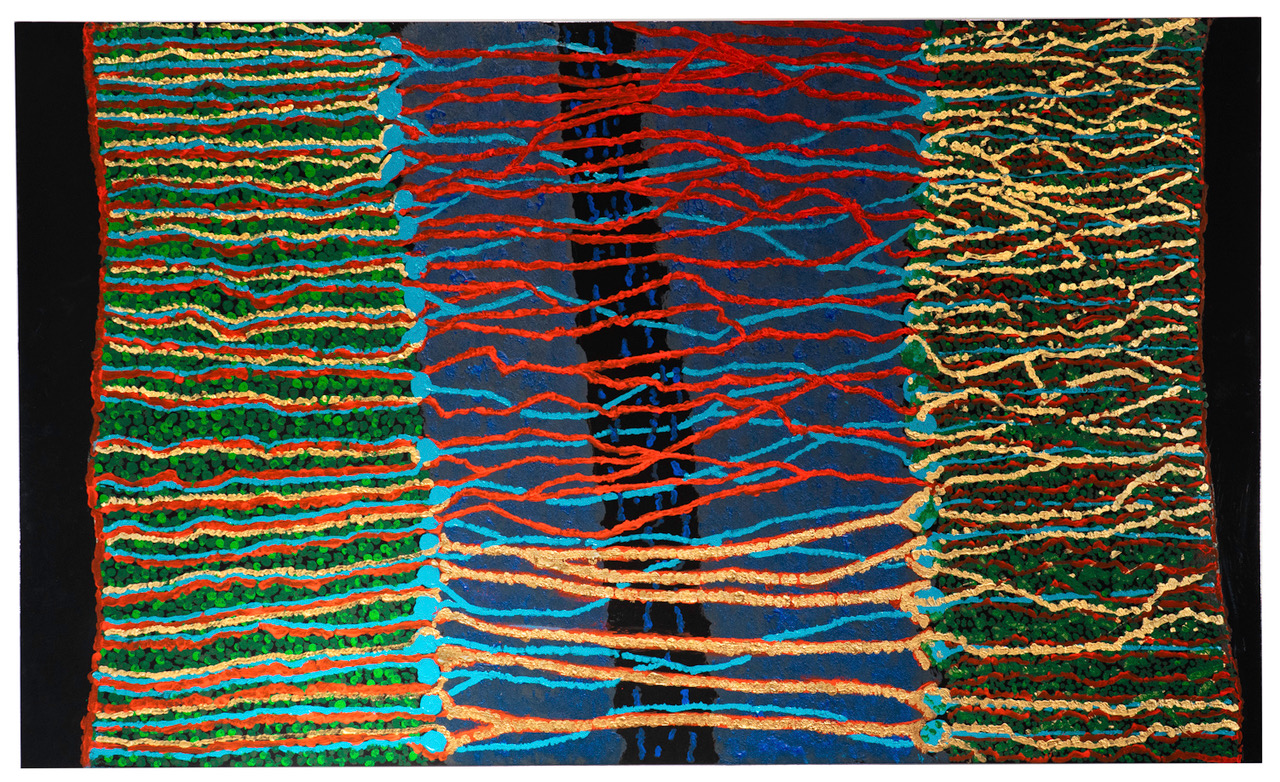
Portrait of Neurons Bridge, 2025, 36 x 60 in, aluminum with scotchlite and acrylic © Edwin Schlossberg Courtesy the Artist and Ronald Feldman Gallery, New York
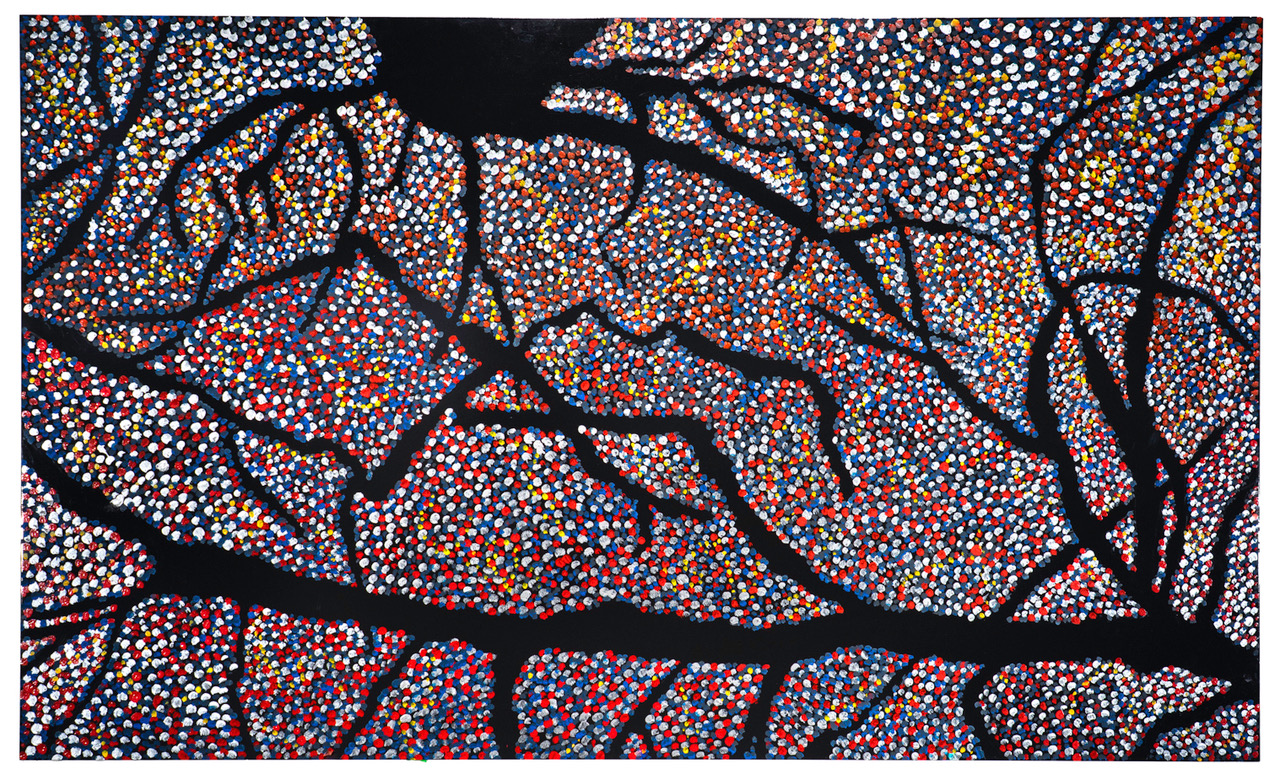 Portrait of Mouse Brain, 2023, 36 x 60 in, aluminum with scotchlite and acrylic © Edwin Schlossberg Courtesy the Artist and Ronald Feldman Gallery, New York
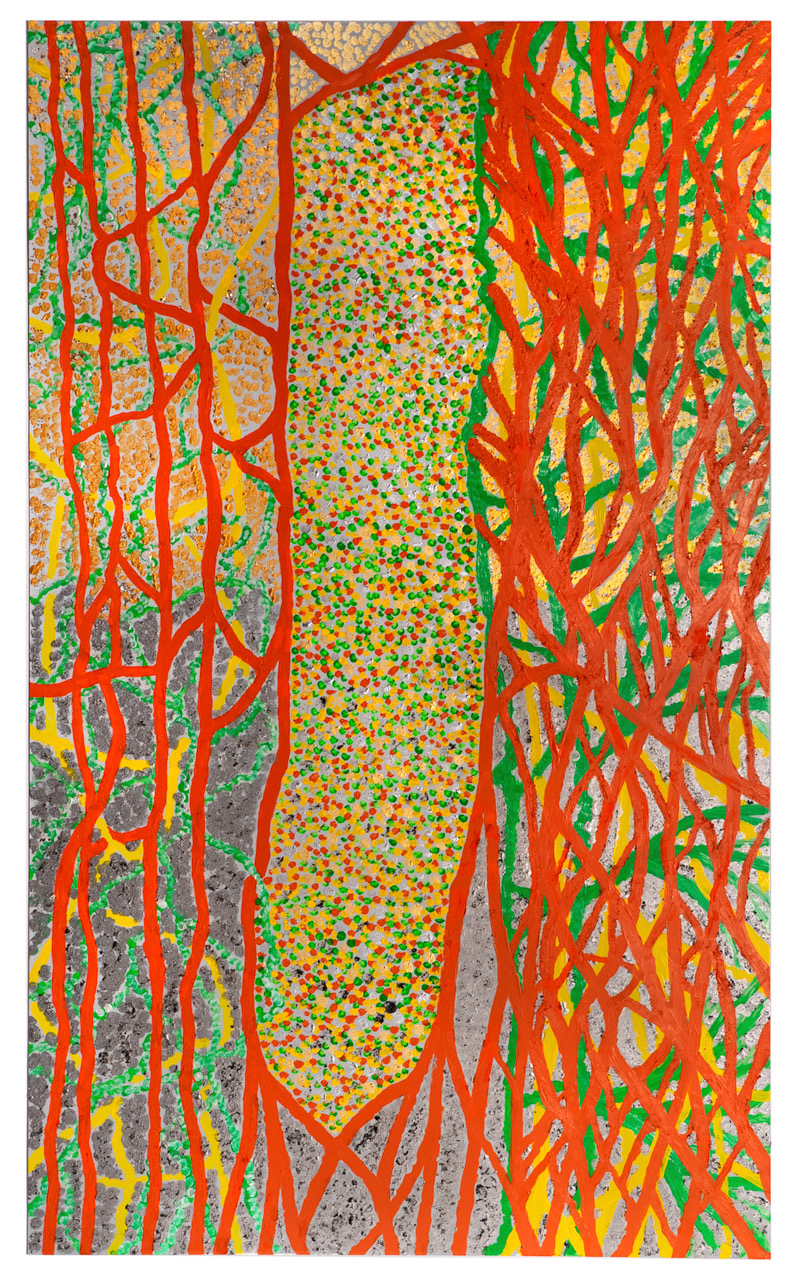 Portrait of Delight in a Section of Neurons, 2025, 60 x 36 in, aluminum with scotchlite and acrylic © Edwin Schlossberg Courtesy the Artist and Ronald Feldman Gallery, New York
But if we put that aside for one moment (if only we could) Unseen Layers can provide a more unified vision of humanity through a journey that includes the microcosm and the macrocosm. As such, it is a visual journey from the smallest units of existence to the vastness of infinite cosmic space.
In the hanging, Unseen Layers presents many of these images that juxtapose in unanticipated ways, so that they reflect upon one another. Even the more familiar images, such as of neurons, can take on new meaning when presented alongside something surprising, like the brain of a mouse. At the same time, these paintings are pleasing and charming and delight the intellect and the eye. Unseen Layers reminds me that the fullness of my bodily history is within me.
In that sense, Unseen Layers create something that is non-hierarchical, as it presents the multiplicity of everything and the extraordinary rich strangeness of everything as individual parts of a whole, rather than disparate discrete elements. Finding connections and correspondences in Unseen Layers is enjoyable and can express ideas that might take thousands of words to convey.
The exhibition is accompanied by a catalogue to be launched in April, featuring contributors invited by Edwin Schlossberg and curator Lara Pan. The publication brings together texts and reflections by Bill Seaman, John Alexander, Arnold Dreyblatt, Dr. Dieter Buchhart, Céline Fribourg, Steven Heller, Eleanor Heartney, Brett Littman, Debbie Millman, George Musser, Hans Ulrich Obrist, Rose Schlossberg, Sasha Stiles, Noah Becker, Sacha Wade, and Kevin Wade.
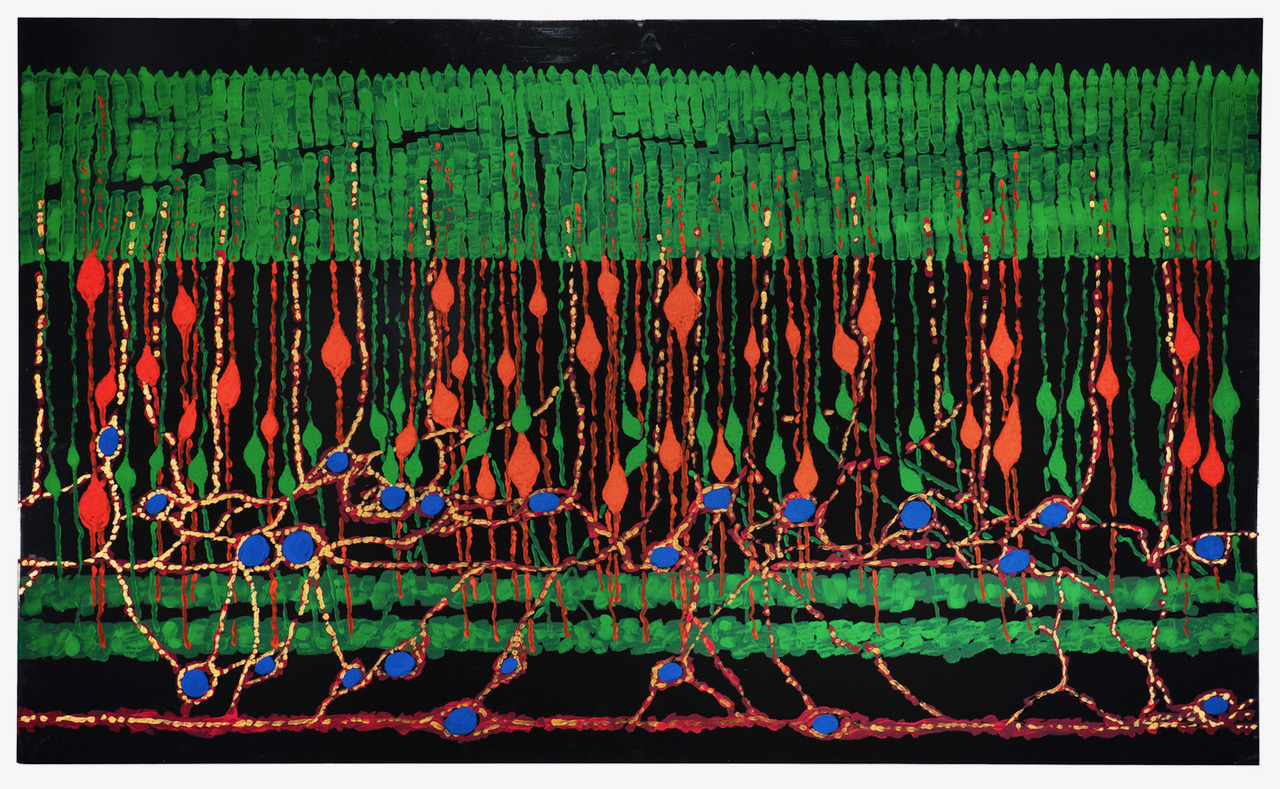 Portrait of a Retina, 2023, 36 x 60 in, aluminum with scotchlite and acrylic © Edwin Schlossberg Courtesy the Artist and Ronald Feldman Gallery, New York

Joseph Nechvatal
Joseph Nechvatal is an American painter/writer currently living in Paris. His book of essays Towards an Immersive Intelligence (2009) was published by Edgewise Press. He has also published three books with Punctum Press: Minóy (ed.) (2014), Destroyer of Naivetés (poetry, 2015) and Styling Sagaciousness (poetry, 2022). His book of art theory, Immersion Into Noise, was re-published in 2022 in a second edition by Open Humanities Press. In 2025, Venus Voluptuous in the Loins of the Last God, his sequel novella to ~~~~~~~~~~~~~~~~~venus©~Ñ~vibrator, even (1995/2023) was published by Orbis Tertius Press. In 2025 his art exhibition Information Noise Saturation was presented at the Magenta Plains in New York City and in 2026 he exhibited a series of new paintings called Le Bateau ivre (The Drunken Boat) at Galerie Richard in Paris.
view all articles from this author