Whitehot Magazine
November 2026
"The Best Art In The World"
"The Best Art In The World"
November 2026
Rashid Johnson's ‘Birthday Boys’ Examines the Evolving Father-Son Relationship
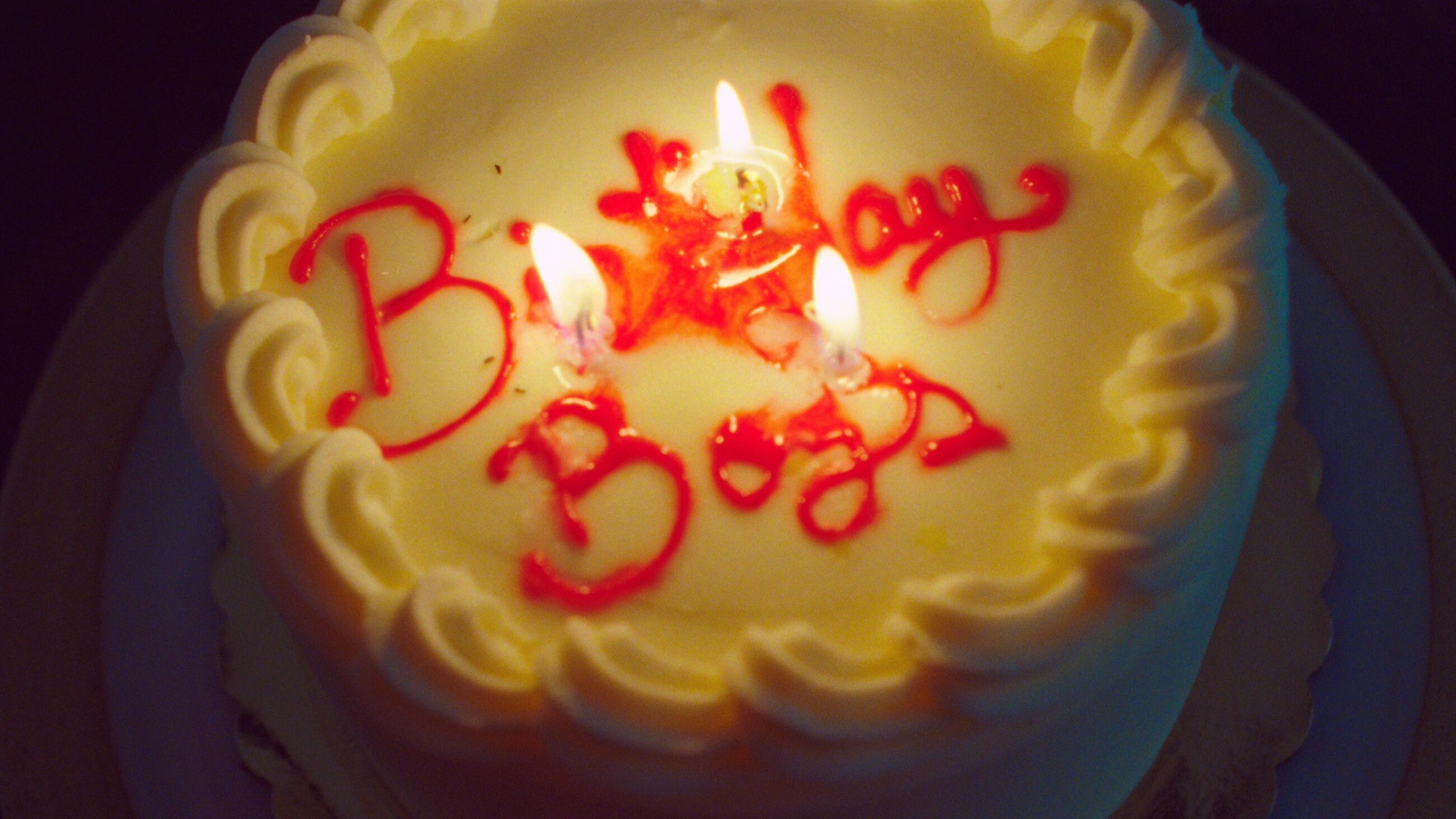
Still from 'Birthday Boys,' 2026. Color video with sound, transferred from 35 mm film. Duration: 4:43 min. Rashid Johnson © Rashid Johnson. Courtesy the artist and Hauser & Wirth
By MADELEINE CRONN, November 10, 2026
Opened on November 3rd, 2026, at Hauser & Wirth’s New York City Wooster St. location, renowned contemporary American artist Rashid Johnson's latest multi-medium exhibition ‘Birthday Boys’ examines the complex dynamic between fathers and sons. Exploring the push and pull between inheritance and self-determination, Johnson's work asks: How can individuality begin to recognize itself?
Known for using a wide range of media to convey ideas about critical history, cultural identity, and personal narrative, Rashid Johnson has built an artistic practice for modern-day societal reflection. Through a series of five new mosaics titled ‘Broken Soul’, sculptures known as the ‘Exhausted Figures’, and a short film component, additionally titled ‘Birthday Boys’ (2026), Johnson illustrates the quest to grow up and what it means to self-actualize within the context of history, learned behavior, influence, and family: cultivating personal autonomy alongside togetherness.
Upon entry, viewers see a large Persian rug painted with palm trees and circular symbols, invoking the image of a home’s front room. A place where memories are made, and connections are fostered. Titled ‘The Gathering’, this work places two rectangular mustard-yellow slabs of shea butter in the center of the rug, positioned directly opposite one another. Both blocks are visibly impaled, broken, and marked with grooves spiraling at the center. One of the shea butter blocks is broken down and chipped away, with a few of its pieces piled on top of itself and a few others atop the opposite block. This display calls upon Johnson's idea that in an effort to relate to others, we can lose parts of ourselves, and through family ties, one’s identity projection may weigh another down.
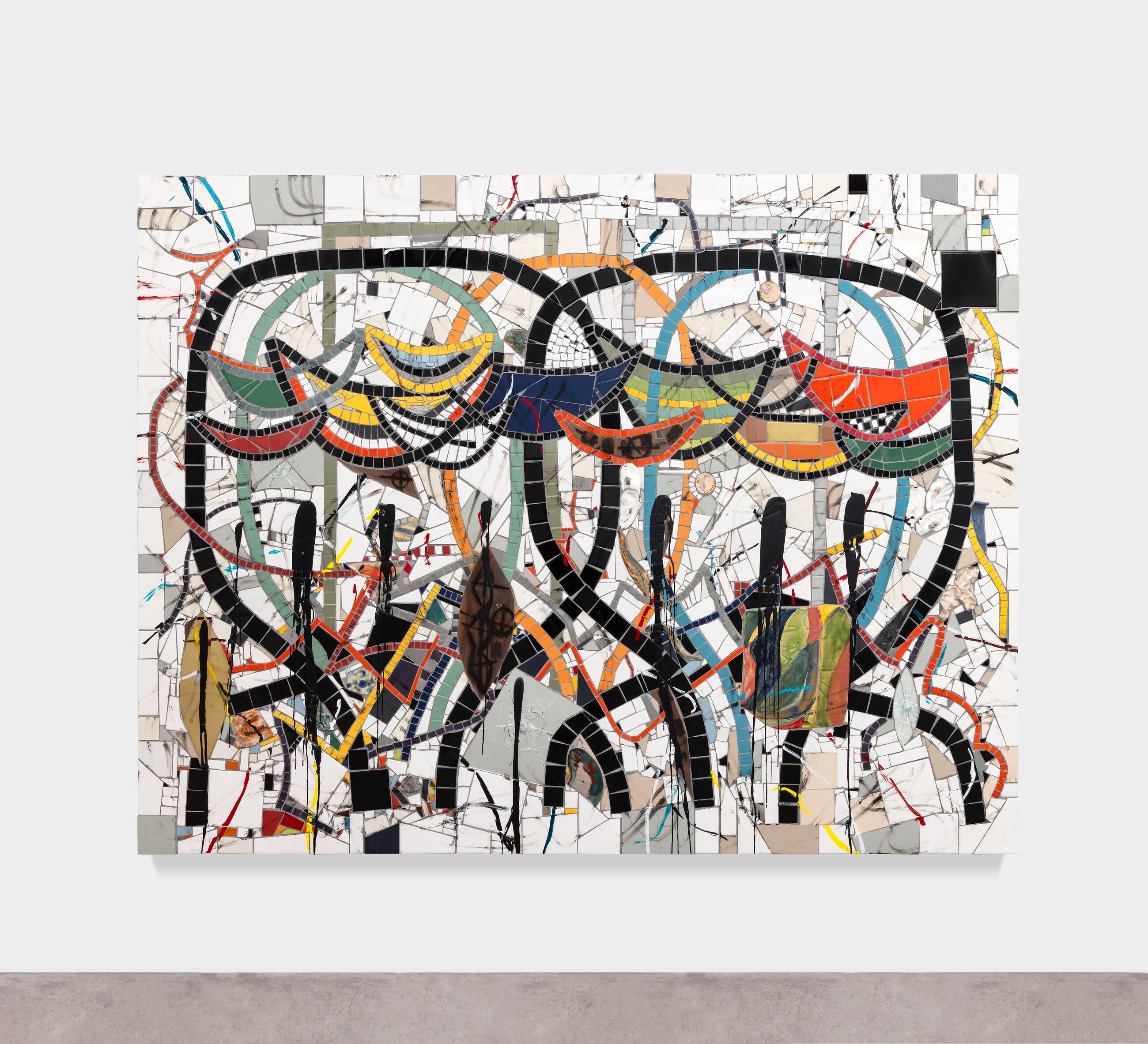
Broken Soul "Tristes Tropiques" 2026. Ceramic tile, mirror, spray enamel, branded black walnut, oyster shell, oil stick, black soap, wax, bronze 182.9 x 243.8 x 10.2 cm / 72 x 96 x 4 in. Photo: Stephanie Powell. Rashid Johnson © Rashid Johnson. Courtesy the artist and Hauser & Wirth
Moving into the gallery foyer, the exhibition shifts focus towards Johnson’s five mosaic works, ‘Broken Soul’, whose canvases line the walls with bright shards of saturated tile and reflective glass. Each canvas depicts two figure-like representations, their lines overlapping and separating again, the two entities caught between unity and division. A material tension is present, enrapturing the viewer in this tug-of-war. Although composed of these fragmented pieces, their edges sharp and unforgiving, a harmonious image emerges in total while each piece remains distinct.
Hanging from either end of the exhibition’s main space are the ‘Exhausted Figures’. Almost drooping on their lines, these sculptures invoke an insurmountable feeling of tiredness, brought on by emotional baggage. A weight carried into every new experience. Inside bent wire cages on both sculptures are works of literature, symbolizing the impact of learned behavior and how what is taught within a cultural and historical context influences life lived now. Present at the bottom of each figure is new growth in the form of live plants situated in soil satchels attached to the rest of the sculpture's mass. These plants continue to grow alongside the weight, persisting.
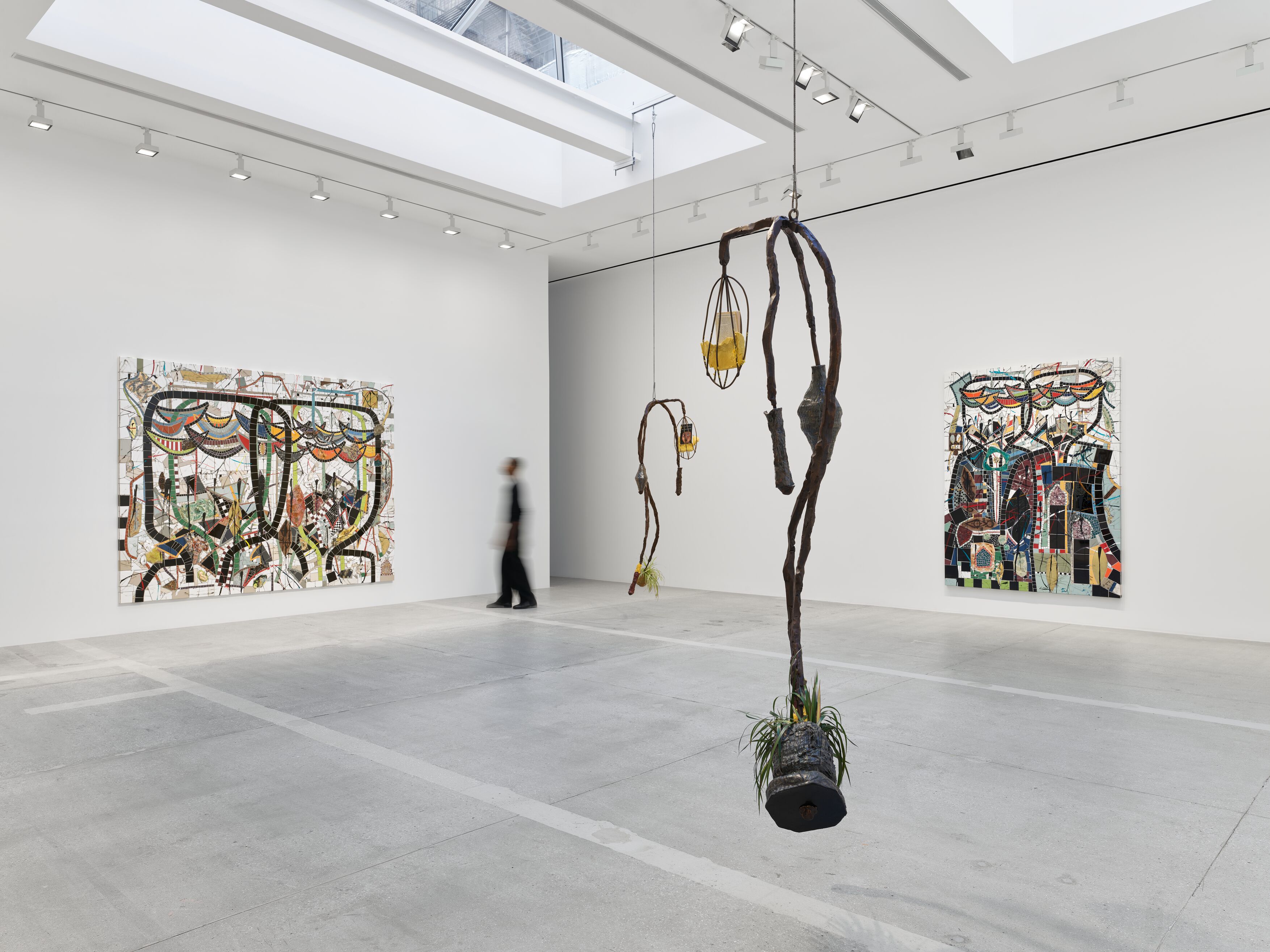
Installation view, ‘Rashid Johnson. Birthday Boys’ at Hauser & Wirth New York, Wooster Street 3 November 2026 – 16 January 2027. © Rashid Johnson. Courtesy the artist and Hauser & Wirth. Photo: Sarah Muehlbauer
In the farthest room, the exhibition's namesake film ‘Birthday Boys’ is shown on a loop starring Johnson himself alongside his son, whom he shares a birthday with in real life. Set on the day of their joint birthday, Johnson and his son go about the rituals of getting up, getting ready, and celebrating. Johnson’s son starts the film by mirroring Johnson’s movements and disposition, while brushing their teeth side by side, playing a game of chess, or swimming in the pool. At sudden instances, a mask covers one or both of their faces to symbolize connection shrouded in expectation born of cultural history and modern norms.

Still from 'Birthday Boys,' 2026. Color video with sound, transferred from 35 mm film. Duration: 4:43 min. Rashid Johnson © Rashid Johnson. Courtesy the artist and Hauser & Wirth
Over the course of the film, Johnson's son’s actions and presentation start to differ from his father's. The idiosyncratic aspects of each person’s unique disposition start to bleed through, illustrating the son’s blossoming individuality. As the film comes to a close, ‘Father and Son’ by Cat Stevens ripples through the speakers. One of the song's lines is, “From the time I could talk, I was ordered to listen.” This echoes the same themes of expectation and projection from fathers onto their sons. Like Cat Stevens’ song, Johnson questions this protocol and wonders if a father’s identity projection upon his son may stifle their self-growth and dictate who they should be before they decide for themselves. As the film draws to a close, both Johnson and his son stand in the middle of the pool embracing, symbolizing the preservation of their connection amidst these changes.
‘Birthday Boys’, presented by Rashid Johnson, will be on view at Hauser & Wirth’s New York Wooster St. location until January 16, 2027.
Madeleine Cronn
Madeleine Cronn is a New York City-based journalist and creative who writes on culture and the arts. Her fashion design work has been featured in Vogue Australia, Harper’s BAZAAR, Grazia. She has bylines in Schon! Magazine, TEETH Magazine, and Whitehot Magazine.
view all articles from this author