Whitehot Magazine
August 2026
"The Best Art In The World"
"The Best Art In The World"
August 2026
Words, images, spaces, and places A conversation between Ewa Monika Zebrowski + Dean Rader
 I NEVER KNEW CY TWOMBLY, Bassano in Teverina, Ewa Monika Zebrowski, 2023 Nearest Truth Editions
By DEAN RADER and EWA MONIKA ZEBROWSKI August 2, 2025
In 2024, the Canadian photographer and poet Ewa Monika Zebrowski visited an art gallery in New York in which a poem was written in chalk on the floor. This reminded her of a conversation she had once had with her friend and collaborator, poet, Dean Rader about wanting to exhibit photographs together with poetry in a gallery context.
Dean has collaborated with artists, calligraphers, and composers. His work has appeared on walls, on trees, on sidewalks, and in artworks themselves. The artist Jordan Kantor once said to Dean, “You are a poet who wants to be on the wall. I am a painter who wants to be on the shelf.”
That notion of a poem being on a wall or on a floor or on a sidewalk—anywhere but in a book—served as the jumping off point for Ewa and Dean as they discuss the location, the setting, the placeness, of poetry. What is the relationship between image and text? How can we explore the conversation and exchange between them?
Where one encounters art raises larger questions about what it means for visual texts to be in books, which we think of as being read and written texts on walls, where we imagine being seen.
What follows here is their exchange exploring these ideas.
 EWA MONIKA ZEBROWSKI a selection of limited edition artist’s books, words & images
Dean Rader: Ewa, when you saw that poem on the floor, what were you thinking? Were you intrigued by seeing a poem on the floor? Was that cool? Disrespectful?
Ewa Monika Zebrowski: I loved seeing the text written in chalk on the floor. It was not easy to read. Challenging for the viewer. What I loved was that the text was ephemeral, elusive, delicate. The more people visited the exhibition the less the words were visible. Erasure.
In time, as the exhibition progressed, there would remain only traces of text. The memory of the words remaining. I liked the relationship that was created between work on the wall and work on the floor. An unusual way of presenting poetry. I no longer remember whether the text on the floor was poetry or prose. What do you think the relationship should be between text and art in a gallery space? Often we see only art on the walls. No titles. No captions. The gallery becomes the white cube welcoming the viewer. A neutral space with no references to time or place. A meditation space.
DR: You know, your description of encountering the poem on the floor reminded me of this very interesting project from 2020 in Mill Valley, California called “Poetry Illuminated.” The director of the project, Anji Brenner, placed tiny projectors around the city, and poems were projected onto sidewalks, trees, walls, and buildings. My poem was projected from the branch of a tree down to the sidewalk. It was amazing at night to walk through my poem the way you might walk through snowfall.
The city as a gallery. The city as book. The city as page.
As for galleries, I’m always interested in how gallerists place text in relation to the art. Just last week I was at the Fog Art Fair in San Francisco with an artist friend and an art historian. Instead of the standard wall cards, one of the galleries had the artists’ names scrawled, often at a slant, on the wall in pencil. We all loved it.
I would love to see more exhibits that pair art with poetry. Typically, art gets to be cool and creative, while text is relegated to the instructional. What if wall text is evocative rather than declarative? Exploratory rather than explanatory?
As someone who both writes poems and exhibits photography, how do you distinguish between someone looking at your photographs and reading your poems? What if it was the other way around?
EMZ: I would like to see my poems written on walls or projected onto walls. Last summer, for the first time, my photographs were exhibited along with my poems.
 Bequest, 200 statues an exhibition at ONEROOM Books, Rome, 2019
The exhibition, Light and Fog, took place during the summer months at the Reford Gardens Museum in Metis, Quebec. It was thrilling to see the poems come to life in this context. The decision to show the poems was made by the curator, Helene Samson.
I believe Text can be viewed as Art.
Art is Mark Making.
Text is Mark Making too.
One can appreciate the form of words without knowing their meaning.
One can read art and look at poems
I love to look at Greek writing.
I am captivated by the beauty of the form.
I love not having a clue as to the meaning.
A sense of mystery and history.
Ancient script, ancient ties.
I once had the idea of organizing an exhibition called Two Rooms.
The exhibition would be based on one of my artist’s books which contains both poetry and photographs.
Sea of Lanterns (2011) is a limited edition artist’s book, a collaboration with poet, Anne Michaels.
The book is made up of 27 separate folios. Some folios contain only words, while others contain only images. At times the folios marry images with words. The reader reads one folio at a time. An unbound book of words and images, each folio having a page number. The idea for Two Rooms was that one room would show only photographs while the other room would show only poems.
The viewer would wander back and forth from room to room in order to understand
the relationship between the image and the text.
The book itself would be accessible on a table in the gallery, a reference,
thus establishing a dialogue between the book and the wall.
There could be an option of projecting the images and text thus making the experience
more ephemeral and referencing the idea of memory.
A lot to consider regarding the presentation and the budget.
Are the images and words framed or pinned to the walls?
Are the prints small or large or do they vary?
Text and image could appear on large panels hanging from the ceiling, the viewer walking
in between them. A bit like a forest or a maze.
I greatly admire the work of artist, Jenny Holzer.
Her Art is text-based.
The idea of inscriptions.
Ideas and words, to be witnessed outside of books in public spaces.
Holzer employs different ways of sharing her text: inscribed on stone,
projected on walls or on buildings, illuminated electronic displays in museums.
She also employs large-scale installations, advertising billboards to carry a/her message.
She only uses capital letters and sometimes italics.
I saw two examples of her work during my residency at Hauser & Wirth Somerset. I was intrigued and moved. I found a stone bench with an inscription hidden in a courtyard. A feeling of anonymity, of discovery. The other work consisted of a series of large stones/boulders placed adjacent to a path in the woods behind the gallery.
The path meandered in this wild landscape; each boulder inscribed with a phrase from Sappho, the Greek poet, translated into English by Anne Carson. One could wander and discover the stones.
Do you know her work? Do you admire other artists who create text-based work?
Have you ever considered showing your work on a wall? If so, what poems would you like to see outside the book?
DR: I love Holzer’s work. In fact, her 2019 show Vigil, featured texts from a book I co-edited, Bullets into Bells: Poets & Citizens Response to Gun Violence (Beacon, 2017). I have long admired how she uses the spaces of “art” to foreground text. I also appreciate the ways she works her politics into her art. I feel communicated to, not talked down to. I feel like I’m encountering information, not propaganda.

Jenny Holzer, from Vigil, 2019
I’ve been especially intrigued by—and have written about—a group of Indigenous artists who do really amazing work that limns the visual and the verbal. I’m thinking about Erica Lord, George Longfish, and Hock E Aye VI Edgar Heap of Birds, all of whom use text to ask probing questions about identity, sovereignty, and Indigeneity. All three artists should be better known.
My poems have been on walls on a few occasions. Once as part of an exhibit in which an artist, Robert Kingston, made a painting in response to a poem of mine. Another time, I was invited to write a poem that engaged a painting by a fabulous Bay Area artist Alicia McCarthy. I love it when my poems find a life outside of a book. Don’t get me wrong, I love books, as we discussed in our last conversation, but I also think poems—as individual things—can benefit from being cut loose from the book.
 Robert Kingston’s painting Echo and Trace (left) in response to Dean Rader’s “Nocturne (Lasciere Sonare) (right) at the “Lightning Strikes” Exhibit, Dolby Chadwick Gallery, San Francisco, December 7, 2019
 I NEVER KNEW CY TWOMBLY, Bassano in Teverina, Ewa Monika Zebrowski, 2023 Nearest Truth Editions
Walls are public in a way books are not. You carry books. They slide into backpacks and duffle bags and purses and satchels. You pull them out in public spaces like trains or planes but often they are locked away, closed, out of sight. Walls feel public. Open. Inviting. When poems are on walls, viewers are invited to look at them, not just read them. They become visual texts, not just written one. In so doing they are more easily engaged with.
Do you think there is a difference between looking and reading?
EMZ: Poems in Public Spaces. I too love that idea.
I remember once there was a project in New York City in 1996 when poems were displayed on buses and subways. Poetry in Motion: 100 Poems from the Subways and Buses included poems by Walt Whitman, Emily Dickinson, Octavio Paz, Joseph Brodsky, Marianne Moore, Adrienne Rich, Robert Frost, Langston Hughes and others.
The poems replaced the Ads that are usually shown in frames above the windows.
Not sure how long that project lasted or who initiated it.
It would be great if there was designated wall space for Poems in Airports.
Imagine Walls dedicated to Poetry in every airport in Canada and the USA.
Today people spend so much time in Airports waiting to board their planes.
People have a lot of time in limbo while travelling.
A poetry program could be initiated as a pilot project, maybe even sponsored by
an airline. Say Delta in their hub city of Atlanta.
But I have not answered your question.
Looking and Reading.
Perhaps there could be special poetry programs in Elementary Schools?
A program that would expose children to Poetry at a young age.
Children could look at and read poetry.
Learn about what poetry is.
Learn a little about the History of Poetry.
Poetry Listening moments.
Poetry Writing classes.
Poetry Reading contests.
I think Everyone looks but not Everyone reads.
Not Everyone knows how to read.
We need to define the word read, to read.
An active verb.
I have often thought that acting lessons could help poets more effectively deliver their poems. Inflections. Pauses. Silence.
DR: Was “pilot project” an intentional pun? If so, well played!
Rilke would say everyone looks but not everyone sees.
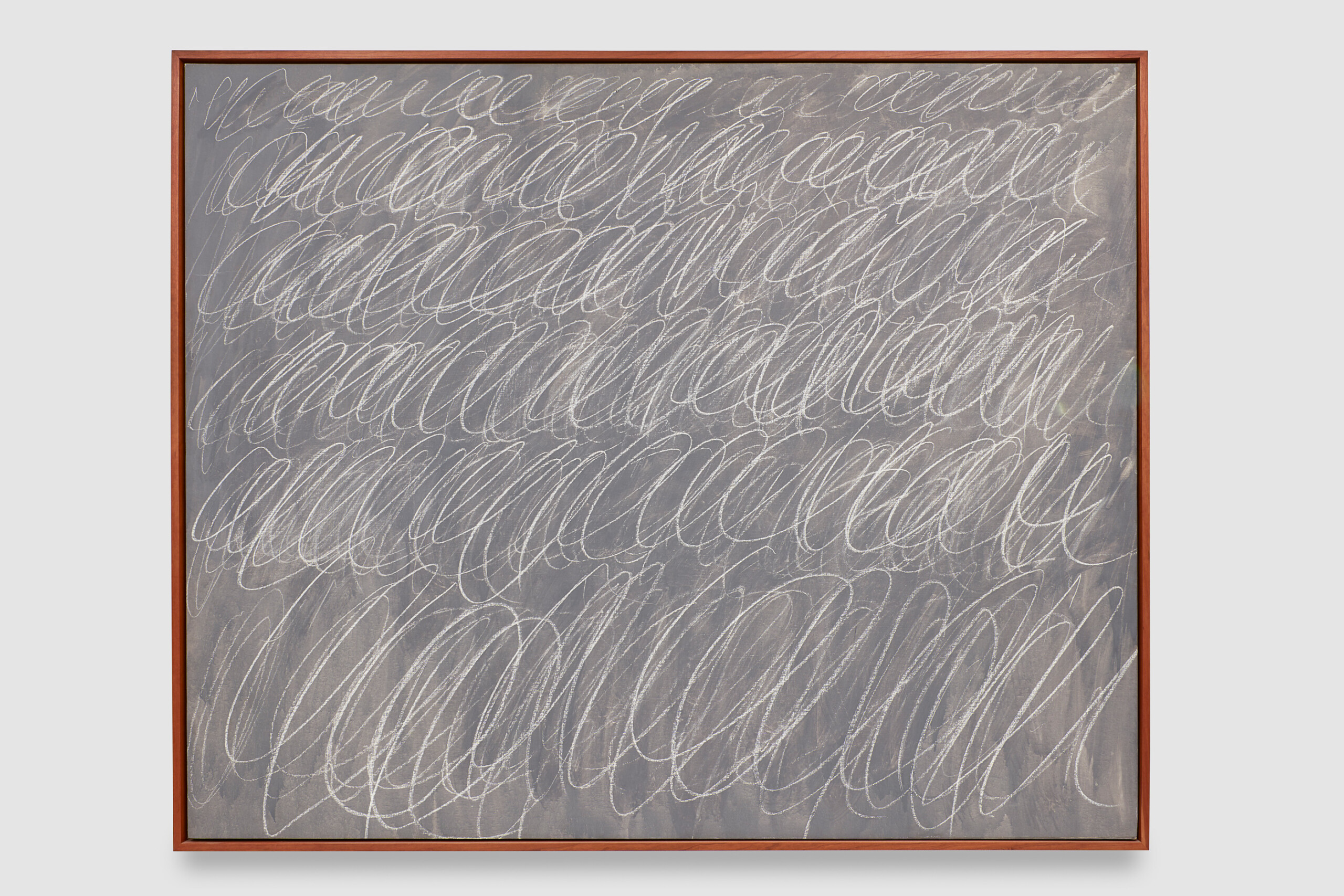
I was recently in New York to see three different art exhibits that foreground Cy Twombly, our shared muse. One of them, at the Hill Art Foundation, was called The Writing’s on the Wall and was curated by the famed author and curator Hilton Als. It featured a gorgeous Twombly canvas at the literal and metaphorical center of the show. The Twombly piece, which is one of his blackboard paintings from 1970, is both writing and not writing. Can text be writing if there are no legible letters?
This particular show raised some really interesting questions between writing and silence. In fact, the subtitle of the show was “Language and Silence in the Visual Arts.” It is so compelling to think of a painting as silent. To me, a poem could never be silent. It is always about voice. But, does that mean the poem is primarily about hearing and not seeing?
I ask because when I look at that Twombly painting, I truly don’t know if I am reading or seeing. Looking or decoding. Als is interested in the relationship between writing and silence. I am as well. I was thinking about that in relationship to photographs, which deploy a different kind of language.
When you are writing your poems, how is that process similar to (or different from) making photographs? How is editing a poem akin to cropping or shaping or altering a photo?
 Canadian photographer and poet Ewa Monika Zebrowski
EMZ: As Artists and Writers, we are always looking for inspiration and new ideas.
What impressions did you bring away from the Twombly exhibit at the Gagosian?
Further reflections on visual text? Visual text is a hybrid form between art and writing.
Many of Cy Twombly’s paintings contain text: lines from poems, names of Greek and Roman gods and goddesses, names of battles etc. Text is often embedded in his paintings and sculptures.
During the War Cy worked decoding texts for the American Army. He was a cryptologist. I find this so interesting in relation to his own enigmatic work.
Apparently, the current Twombly exhibit at the Gagosian will be the last exhibit to take place in this historic gallery space on Madison Avenue. Since years Gagosian has always opened his new galleries with an exhibition of Cy’s work.
It has become a kind of unspoken tradition. Did you know that?
You said that you were not sure if you were reading or seeing when looking at the work.
I feel that Cy’s work transmits a certain emotion and that his work is more about feeling.
We read into his scribbles, his writing. A secret language that transports us into another dimension of experience. A vibration. My artist book twombly, italia seeks to capture this feeling.
For me, writing and taking photographs are two very different processes.
Photographing is more immediate.
I shoot instinctively and not in studio.
I may have an idea in mind, but I like to allow the moment to inspire me.
There are often surprises.
For example, I wanted to see the Olson house in Cushing, Maine, where Andrew Wyeth had maintained a studio during his entire career. I had no idea what I would find.
The house, which belongs to the Farnsworth Museum, was filled with so much emotion for me that I created two limited edition artist’s books, visiting the house multiple times over 7 years.
With each visit I learned a little more about Wyeth and the landscape that so captivated his spirit.
I produced Finding Wyeth in 2011 and at the window in 2018.
 at the window, 2018 © Datz Books
The house told me a story that I captured in images and in words.
I think of my photographic work as narrative as opposed to documentary. Photography for me is about emotion and discovery and telling a story through images. Writing is more reflective, not as immediate. First draft, second draft, third draft. Embellishments over time. Many words strung together to create meaning. Adding and subtracting.
The process happens in the mind’s eye, in the imagination.
For me, my words often complement my images. They add another dimension. Amplify. One complements the other. I try to keep the form simple.
You ask: How is editing a poem akin to cropping or shaping or altering a photo?
Editing a poem is not at all like cropping or shaping or altering a photo for me.
Writing is a longer process than editing a photograph for me.
Firstly, I rarely “edit” my images.
I try to crop in the camera, when I look through the lens and shoot.
I clean up my images during editing.
Get rid of dust.
Adjust contrast or colour balance.
Minor changes.
I usually edit my poems over time.
A longer process.
Remove lines. Change or add words.
I let the words and the message dictate the shape, form, of the poem.
I like short poems, inspired by memories and/or events.
I write about my grandmother, about Cy Twombly, a beach I have visited.
The sound of reading a poem, out loud,
hearing the words is important to me.
And yet, we often read poetry alone in silence. Why?
Seeing the poem printed on a page is a different experience
from hearing the sound, the music of the words.
Hearing the language is more of a visceral, emotional experience for me.
It is moving to hear a poem being read in a room full of people.
My question to you is about sound and poetry.
Do you feel your poems need to be read aloud?
Why or why not?
I understand that the form, the visual presentation is important to you.
Is hearing the sound of the words important to your expression? to your art?
Seeing a poem printed on a page is so different from hearing it read.
The voice of the reader adds another dimension.
A dimension of music.
DR: I absolutely adored the Twombly show at the Gagosian. It was breathtaking. The blackboard paintings there were stunning. There were a couple of pieces that are so close to “writing” that it breaks your heart. Or, maybe it is writing—just not in a language we recognize.
 Cy Twombly, from left to right: Untitled, 1970; Untitled, 1971; Untitled, 1970. Artwork © Cy Twombly Foundation. Photo: Maris Hutchinson. Courtesy Gagosian
As for poems being read aloud, again, I think of Als, writing and silence. My friend David Baker asked me once if, when I write, I tend to think about sound or image.
I responded “image,” but then I wanted to change my answer. Because I feel like I am always thinking about sound. Sometimes, when I read a certain poem at an event, I will say something like, “People often ask me what this poem is about. It’s about sound.” Recently, I was at a dinner, and someone asked me what my poems are about, and I said “language.” Is sound language? Is language sound? When is language ever silent? When it’s visual language?
When you read a poem aloud, you can accentuate the poem’s sonic qualities. I think that is something that can be lost when a reader encounters a poem on the page. We tend to read in our heads, silently, and so hearing a poem aloud is like seeing a photograph in color.
So, I don’t think they need to be read aloud, but people generally respond to them when I read them out loud, in part because I try to make them sing. Or at least call attention to their singing.
Here I am talking about photos and color—to a photographer! The nerve!
When you write, how do you “color” a poem? Does that interest you? In photographs,
we can use filters or adjust things in the darkroom or now in some app.
Do you “alter” your poems? Are your photographs or your poems more “realistic?”
EMZ: I colour a poem with descriptive words.
I like the idea of “colour” in poems.
The presence of colour.
The idea of colour conveyed in words.
Especially if I write about a landscape.
In photography, we have gone from black & white photography to colour photography
and everything in between.
The manipulation of colour is an interesting idea, however,
I do not “alter” my photographs.
The digital platform offers endless possibilities.
More saturated? Less saturated?
Adjust shades? Alter the colour altogether?
Or eliminate the colour and tint the image?
I do not think about realistic representation
whether in my images or in my writing.
I am trying to convey, to illustrate my world.
I want to show how I see my world, what I experience.
An impression. A moment. An emotion.
An emotion brought into words or recorded as an image.
I remember during a photo workshop in Maine taught by Sam Abell one of the participants
said to me,
“I wish I could see like you!”
I was so moved by his comment.
To think that I saw differently from others!
That my perceptions were mine and mine only.
He referred to me as Miss Monet.
During this workshop I used a digital camera for the very first time.
A new discovery.
I guess I try not to think too much during the creative moment.
I respond.
I Photograph. I Write.
And reflect later.
For you, what is the connection between Emotion and Writing?
DR: The poet Robert Bly once said that we have three ears—an ear in our head, an ear in our chest, and an ear in our genitals. He says music bypasses the ear in our head and goes straight to the chest and genitals. He laments that in America, poetry stays in the head, based on how we are taught in schools to “analyze” or “decode” or “decipher” poetry. I agree with him to some degree.
I want readers to feel my poems. To hear their music. To respond to their rhythms and shapes and movements and modulations.
In his great book on documentary photography, Documentary Expression and Thirties America, William Stott argues that the documentary photographs of people like Dorothea Lange “educate our feelings. I love that. I think poems do similar work. They teach us how to feel. And, even better, they teach us how to think about our feelings.
I’m often jealous of the immediacy visual artists have on our emotions. You look at a Rothko, and you feel it instantly. I have that with Twombly. The emotional impact is sudden and big and overwhelming. Even a short poem takes a while to read, so I worry sometimes about emotions and temporality. But, my friend Laleh Khadivi, the novelist, claims that people remember the emotional contours of literature longer. So, I like to believe her.
Words that glisten / images that sparkle. WM
Bio: Ewa Monika Zebrowski is a Montreal-based photographer and a poet.
Her photographs and artist’s books touch on themes of displacement and memory, place and time, traces. She creates visual narratives often inspired by art and literature, sometimes collaborating with writers and poets, sometimes including her own poems or text.
She worked in the film industry for seventeen years before obtaining a BFA in Fine Arts and an MA in Visual Arts, having previously completed a degree in English Literature. She speaks Polish, English, French and Italian.
Zebrowski has had forty solo exhibitions and produced twenty-five artist’s books. Her work can be found in many museum and institutional collections in Canada, the United States, the United Kingdom, Italy, Denmark and Australia including MoMA, the Getty Research Institute, the Menil Collection, the Art Institute of Chicago, the Farnsworth Museum, the Tate Britain, National Gallery of Art Washington D.C., Columbia University, Yale University, Stanford University, the National Poetry Library London, McGill University among others.
Since 2012, the celebrated artist Cy Twombly has been a main inspiration for her work. In 2023 she published I NEVER KNEW CY TWOMBLY, Bassano in Teverina with Nearest Truth Editions.

Dean Rader
Dean Rader has authored or co-authored thirteen books, including Works & Days, winner of the 2010 T. S. Eliot Prize, Landscape Portrait Figure Form, a Barnes & Noble Review Best Book, and Self-Portrait as Wikipedia Entry, a finalist for the Oklahoma Book Award and the Northern California Book Award. Before the Borderless: Dialogues with the Art of Cy Twombly, was published in April of 2023 and was named by Book Riot as one of ten “mesmerizing” books of modern poetry. His essays and reviews have appeared recently in Artforum, Brooklyn Rail, Los Angeles Review of Books, Alta, Zyzzyva, Ploughshares, Hyperallergic and many others. His work has been supported by fellowships from Princeton University, Harvard University, Headlands Center for the Arts, Art Omi, and the MacDowell Foundation. Rader is a professor at the University of San Francisco and a 2019 Guggenheim Fellow in Poetry.
view all articles from this author