Whitehot Magazine
October 2026
"The Best Art In The World"
"The Best Art In The World"
October 2026
Everything Is Still Running Normally
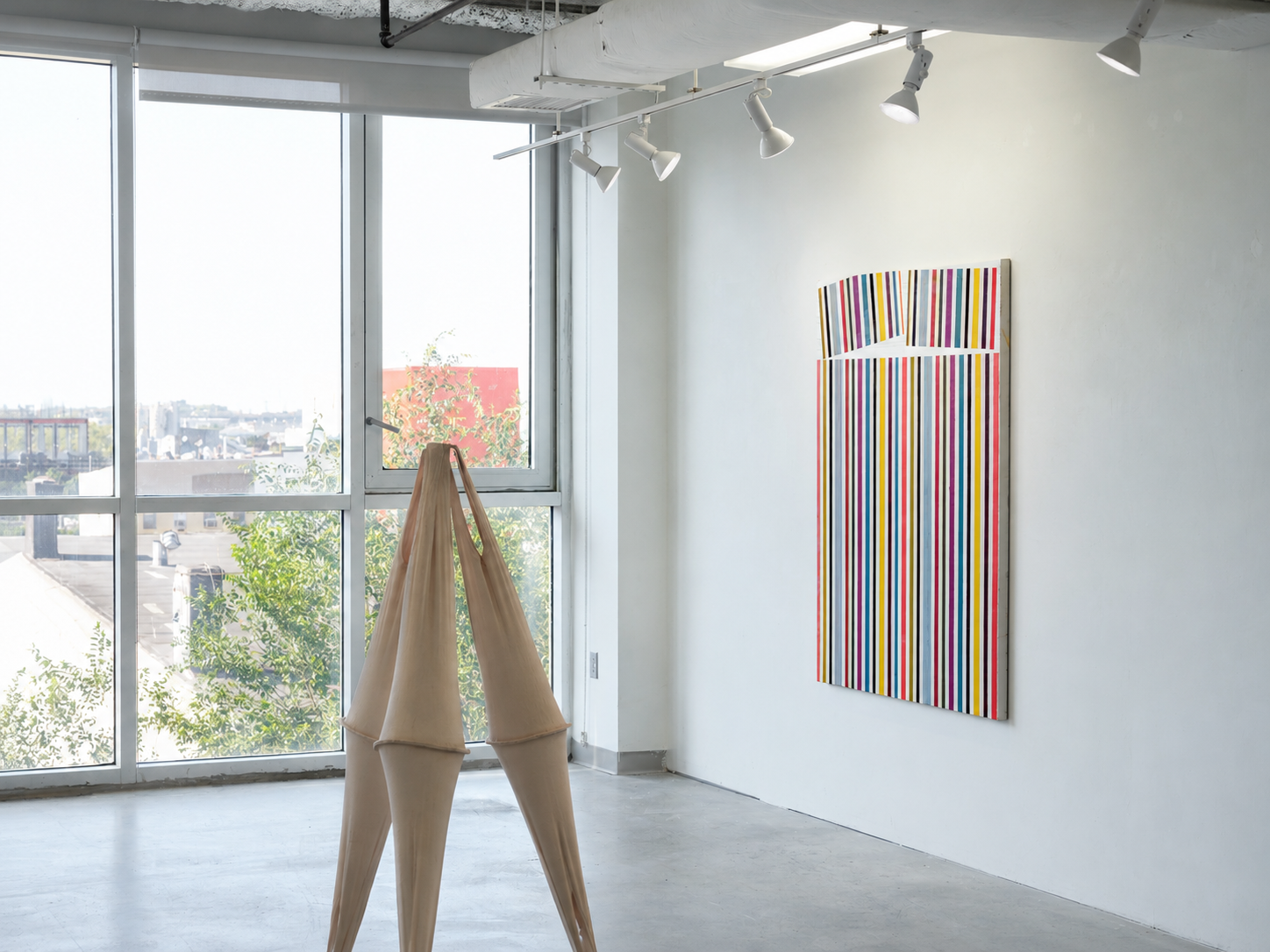 Installation view of Perfect System. Courtesy of the artist and A Space Gallery.
By SHUHAN ZHANG July 22nd, 2026
In New York, disorder rarely lasts for long. When the subway temporarily stops running, crowds quickly pour onto another line; when a meeting is compressed because of a delay, the next appointment still appears on the phone screen on time; when rain soaks a paper bag, people wrap another layer of plastic around it and continue toward the original destination. The city constantly experiences delays, congestion, and unexpected disruptions, yet it rarely truly comes to a halt. People check their phones, adjust their routes, and quicken their pace, finding a way to continue moving within brief moments of disorder.
Living within this rhythm, I have gradually realized that perhaps the city’s most distinctive ability is its capacity to rapidly repair disorder. Problems can be redirected, compressed, or rearranged. Fatigue is temporarily postponed by coffee, anxiety is placed after the next task, and lateness is absorbed by a brief explanation. Surface order is maintained through countless small adjustments, while the parts that remain unresolved are placed where the system is unlikely to notice them.
Curated by Maggie Wei, the group exhibition Perfect System makes this process of maintaining order visible. Featuring works by Jayden Liu, Matthew King, Shuyao Huang, and Sam Christian, the exhibition examines how individuals respond to pressure within a contemporary environment that demands composure, wholeness, and control. Here, “perfection” is closer to a state of continuous operation: the system absorbs tension, redirects loss, and contains conflict beneath a stable surface.
The exhibition brings together markedly different materials, including tank tops, wire, aqua resin, marble, oil paint, concrete, rubber, a toy gun, and electric wire. Their contrasting textures converge through actions of support, fixation, carving, connection, and preservation. Tension remains embedded within each work, holding it between collapse and release.
Jayden Liu’s WP 193T (2024) is composed of tank tops, wire, and aqua resin. A tank top usually acquires its shape from the body, then droops once the body leaves. Here, wire supports the contour from within, while resin fixes the fabric’s folds and curves, giving the garment a sculptural stability. This preservation also limits movement: the fabric can no longer fold, fall, or conform to another body. Retaining the scale of the human figure, the work becomes an independent shell in which wire replaces bones and resin replaces bodily support. Fluid and contradictory elements remain compressed beneath a legible surface.
Shuyao Huang's It Doesn't Quite Stay (2026) explores the instability of time and perception. The title suggests permanence only to withdraw it, echoing the fleeting clarity of looking through a subway window, where images appear and disappear before they can be fully grasped. While photography preserves a moment, Huang's painting captures something less tangible: the shifting rhythms of attention, memory, and perception. The work resists fixed interpretation, relying on subtle changes in color, space, and rhythm that reveal themselves differently over time. Each return to the painting invites a renewed encounter, shaped as much by the viewer's changing perception as by the image itself. Rather than pursuing visual certainty, Huang embraces instability without abandoning formal structure. This sustained investigation into perception has become a defining feature of her recent practice, giving her paintings a distinctive presence within contemporary painting through consistency of inquiry rather than repetition, and encouraging viewers to experience looking as an active, continually unfolding process rather than a fixed act of recognition.
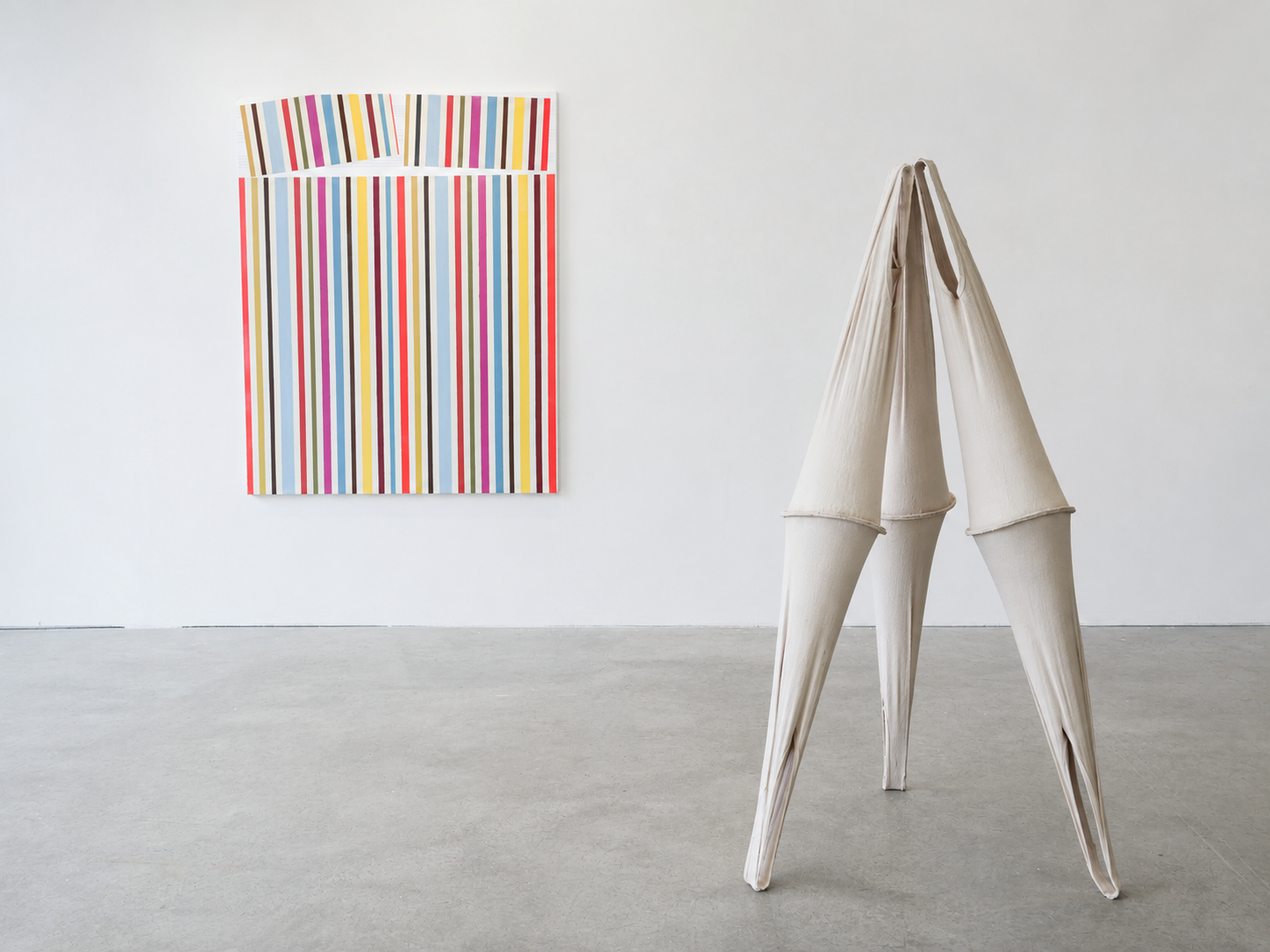
Installation view of Perfect System. Courtesy of the artist and A Space Gallery.
Matthew King’s Ostentatious (2025) turns hardness into a performance. Marble carries associations with monuments, authority, classical order, and permanence, while the title introduces exaggeration and deliberate display. Solidity becomes a posture that must continually demonstrate its weight and value. The work recalls the glass façades, stone lobbies, oversized conference tables, and formal language through which institutions project stability. King exposes how authority depends on being seen, named, and repeatedly reaffirmed.
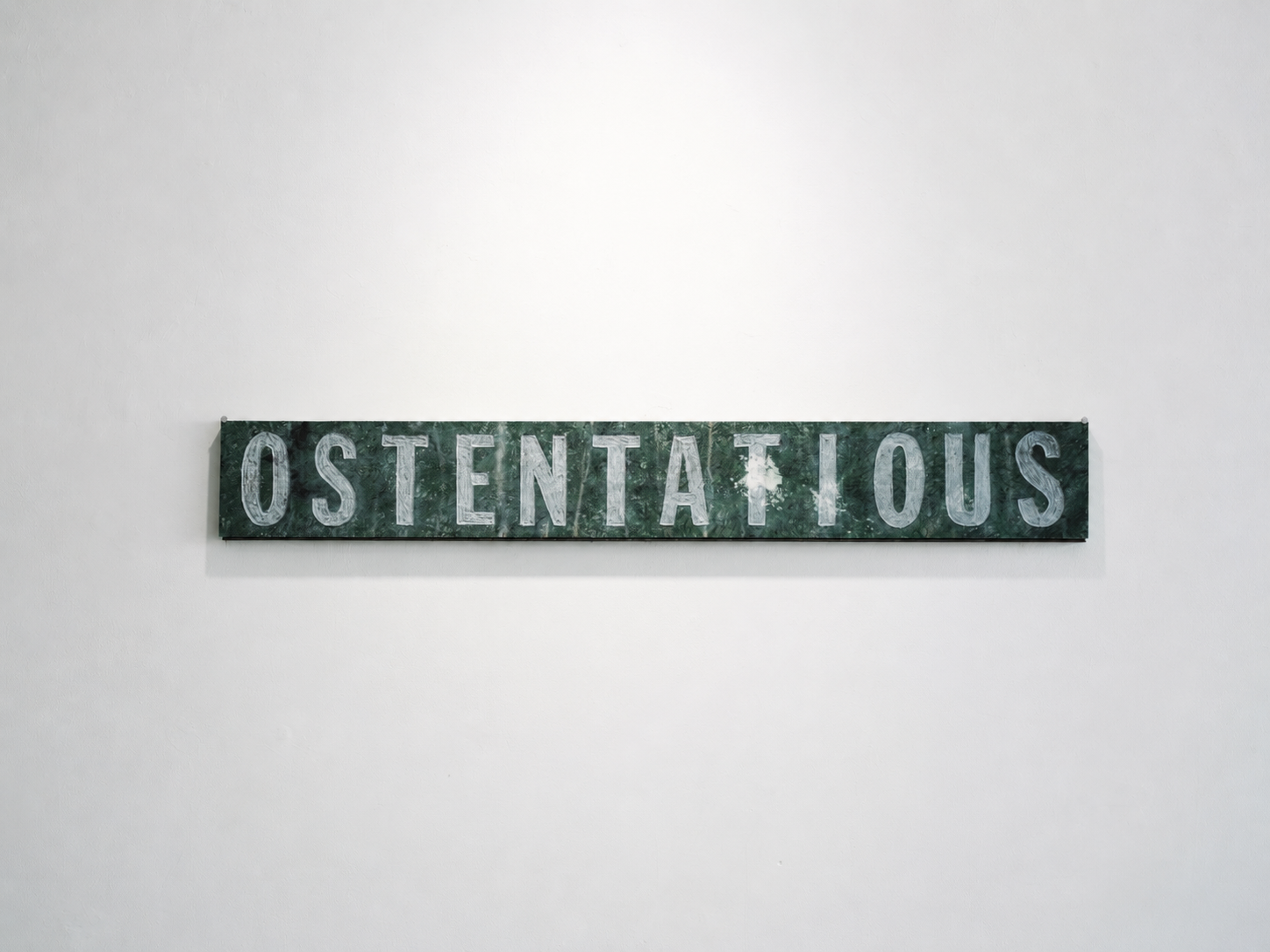 Installation view of Perfect System. Courtesy of the artist and A Space Gallery.
In Sam Christian’s Instrument #3 (2025), the system appears as a collection of functionally uncertain parts. Concrete suggests architecture and infrastructure; electric wire carries energy and connection; rubber stretches and absorbs impact; the found cap gun turns violence into a repeatable toy mechanism. Each material retains traces of its original use, yet the assemblage offers no clear operation or purpose. Its internal conflicts, the rigidity of concrete, the elasticity of rubber, the playfulness of the toy, and the violence of the gun, remain unresolved. The work resembles a component detached from a larger system, carrying the residue of production, labor, entertainment, and control.
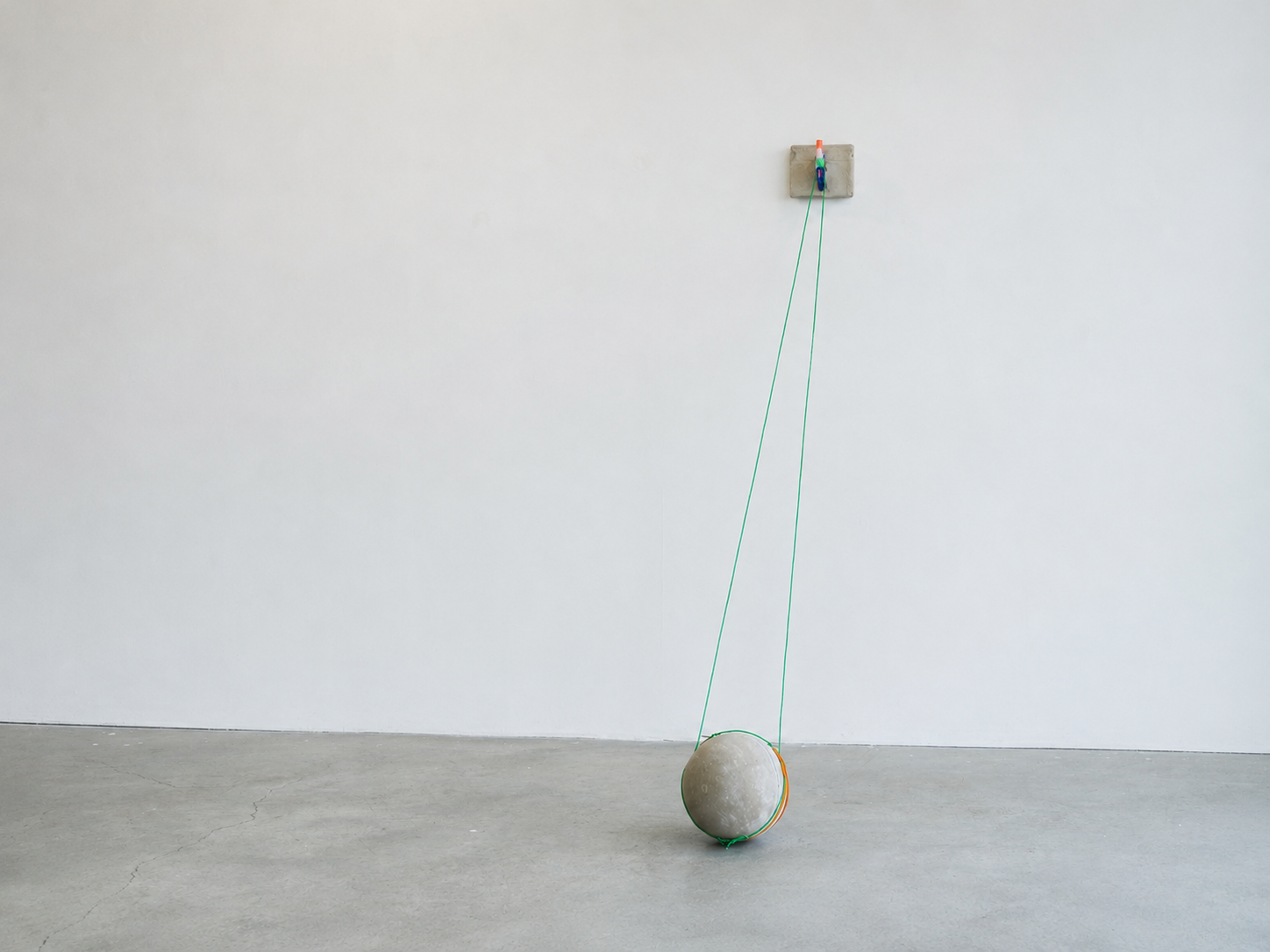 Installation view of Perfect System. Courtesy of the artist and A Space Gallery.
After leaving the exhibition, I returned once again to the streets of New York. People were still avoiding one another, waiting, and changing direction; maps kept updating routes, and traffic resumed after the red light. The city appeared not to have stopped. Yet Perfect System made this normal operation seem less self-evident. Behind every rapidly restored order, there may be softness held in place, solidity that must continuously prove itself, parts that have lost a clear function, and experiences that can never truly remain.

Shuhan Zhang
Shuhan Zhang is a curator and writer based in New York. Her work focuses on contemporary art, digital culture, and the politics of exhibition-making.
view all articles from this author