Whitehot Magazine
October 2026
"The Best Art In The World"
"The Best Art In The World"
October 2026
The Blur Between: Gerhard Richter's Enduring Duality at David Zwirner
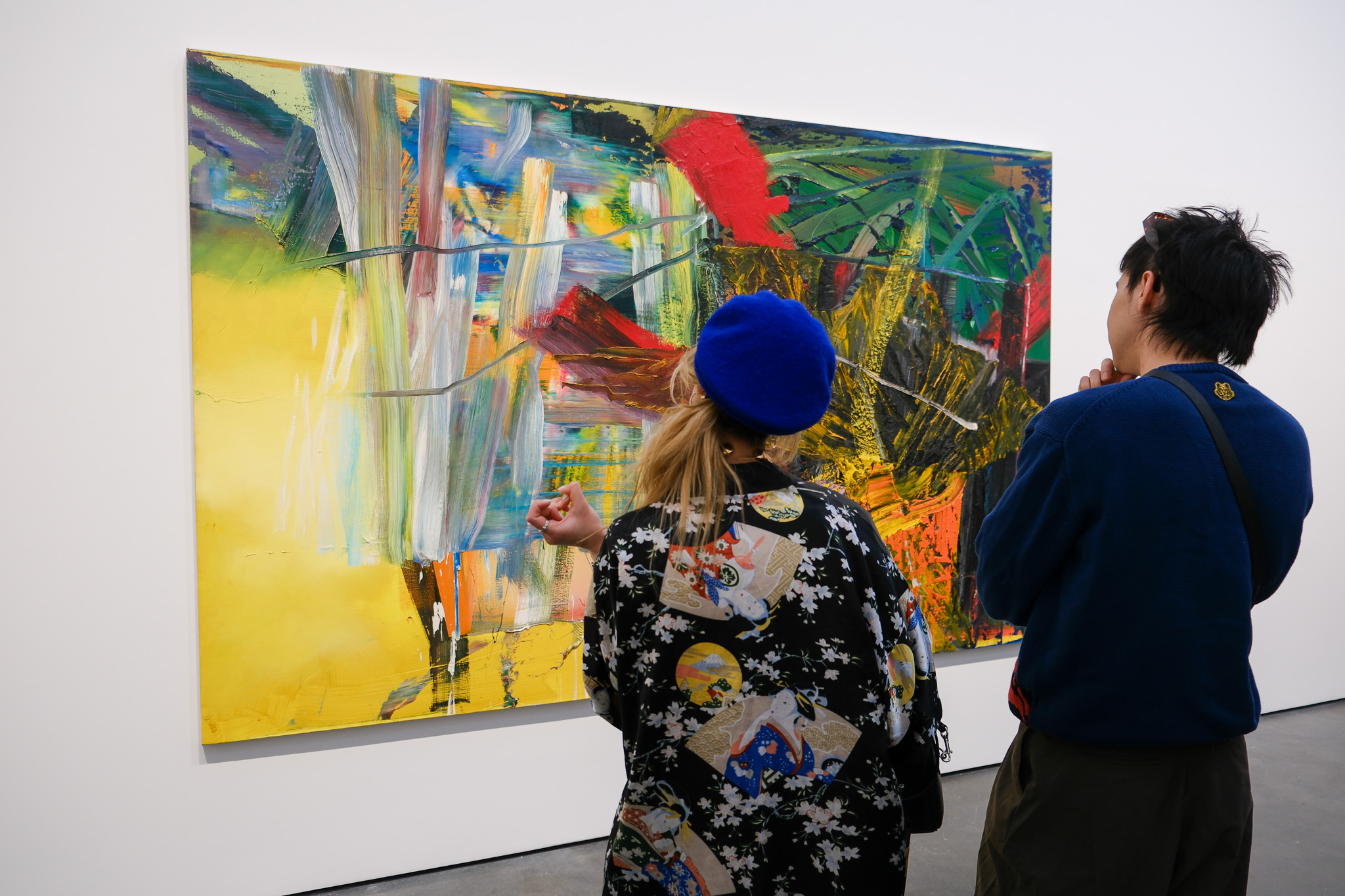 A pair consider Richter's 1985 work Fenster (Window). Photo by Jamie Lubetkin
BY J. SCOTT ORR April 9th, 2026
Gerhard Richter, the legendary German visual artist, once tried to explain his oeuvre’s parallel devotion to realism and abstraction this way: “I believe that every detail from nature has a logic that I would also like to see in abstraction,” he said. If there’s a contradiction between Richter’s simultaneous commitment to abstraction and photorealism, the nonagenarian artist does not cop to it.
Last night in Chelsea, David Zwirner opened Landschaften—a survey pairing Richter's photorealist landscape paintings from the 1960s through the 2000s with selected abstract works created over roughly that same period. Zwirner, who lists countryman Richter among his favorite artists, curated the exhibition with gallery partner David Leiber in close collaboration with the artist. Zwirner was all smiles last night, and why not? The exhibition was the gravitational center of a very busy night in Chelsea, with a line to get in stretching down W. 20th Street.
Inside, the seeming contradiction played out in works like Domecke II (Cathedral Corner II), 1988, which, by the way, is one of Zwirner’s favorites. In it, massive stone buttresses rise on either side of a narrow passageway as a single tree pushes up from a patch of mossy ground at the center, all rendered in Richter's fuzzy, mediated conception of photorealism.
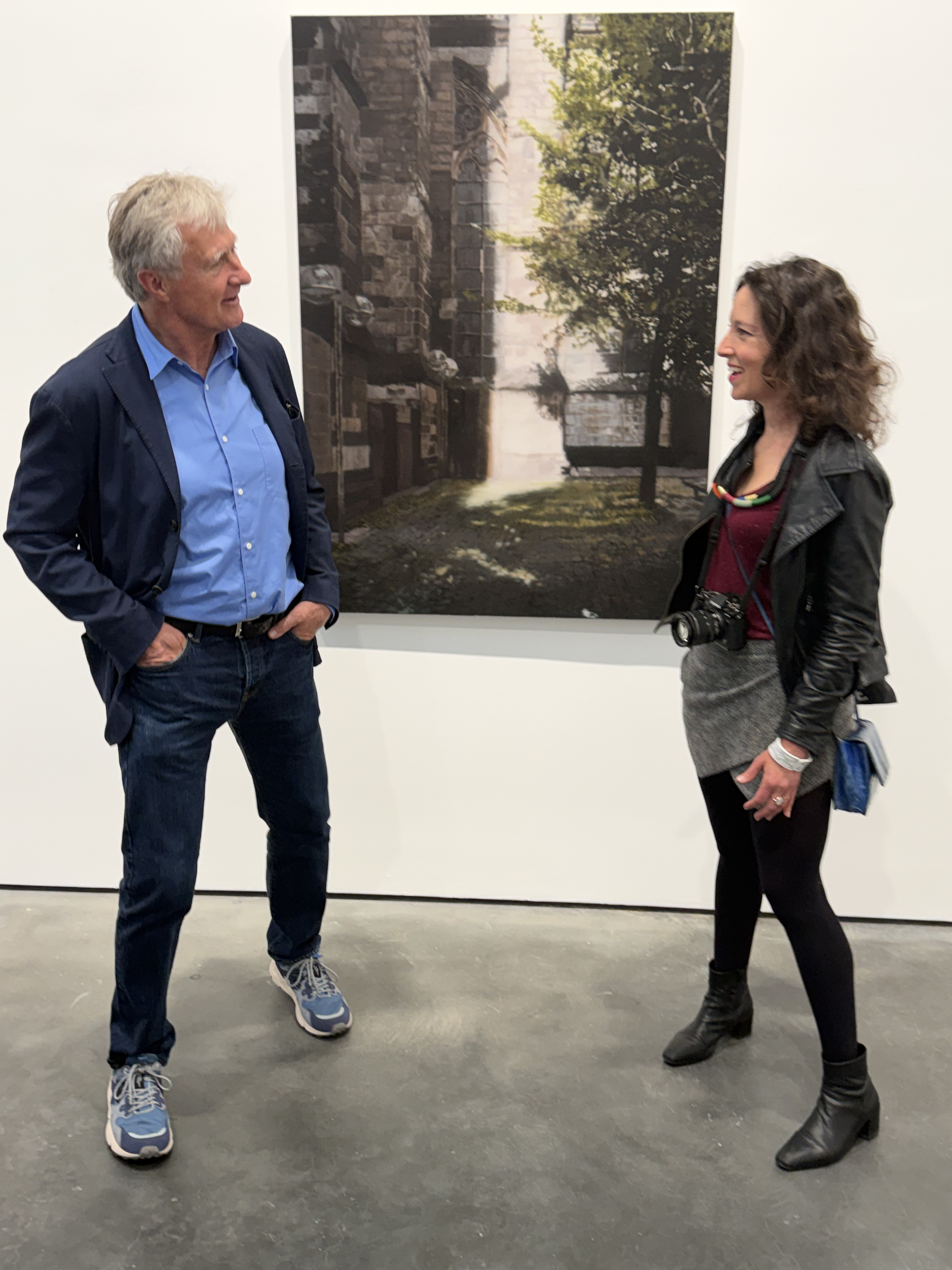 David Zwirner discusses Richter's 1988 piece Domecke II (Cathedral Corner II),one of his favorites, with Whitehot photographer Jamie Lubetkin. Photo by J. Scott Orr
Now look at Fenster (Window), 1985, in which a blast of cadmium yellow dominates the left third of the canvas before colliding into a dense squeegee-dragged white, blue-grey, deep green, red, and black. The title promises a window, but what Richter delivers is a surface so thoroughly worked and re-worked that any landscape lurking beneath the paint has been buried under successive layers of destruction and rebuilding.
That these are the work of the same hand is startling, confusing and only barely conceivable.
“If the abstract pictures show my reality,” Richter said in 1981, “then the landscapes … show my yearning.... Though these pictures are motivated by the dream of classical order and a pristine world—by nostalgia, in other words—the anachronism in them takes on a subversive and contemporary quality.”
The standard answer in the quest to define Richter is that he works in both modes—figurative and abstract—and that his art actually reveals itself in the tension between them. But that framing risks missing how deliberately he has refused to let the modes separate. The landscapes aren't straightforward representations. Richter built them from travel snapshots and then blurred them until the sources became something stranger than the originals. And the abstractions aren't merely raw expression. The squeegeed abstracts rely on the medium’s unpredictability to create an image, even as the chance manifestations in the fluid paint are made through a machine-like process—the hand of the artist removed by an instantaneous and industrial technique. Both bodies of work suggest an intention to retrieve what gets lost between a thing and its image.
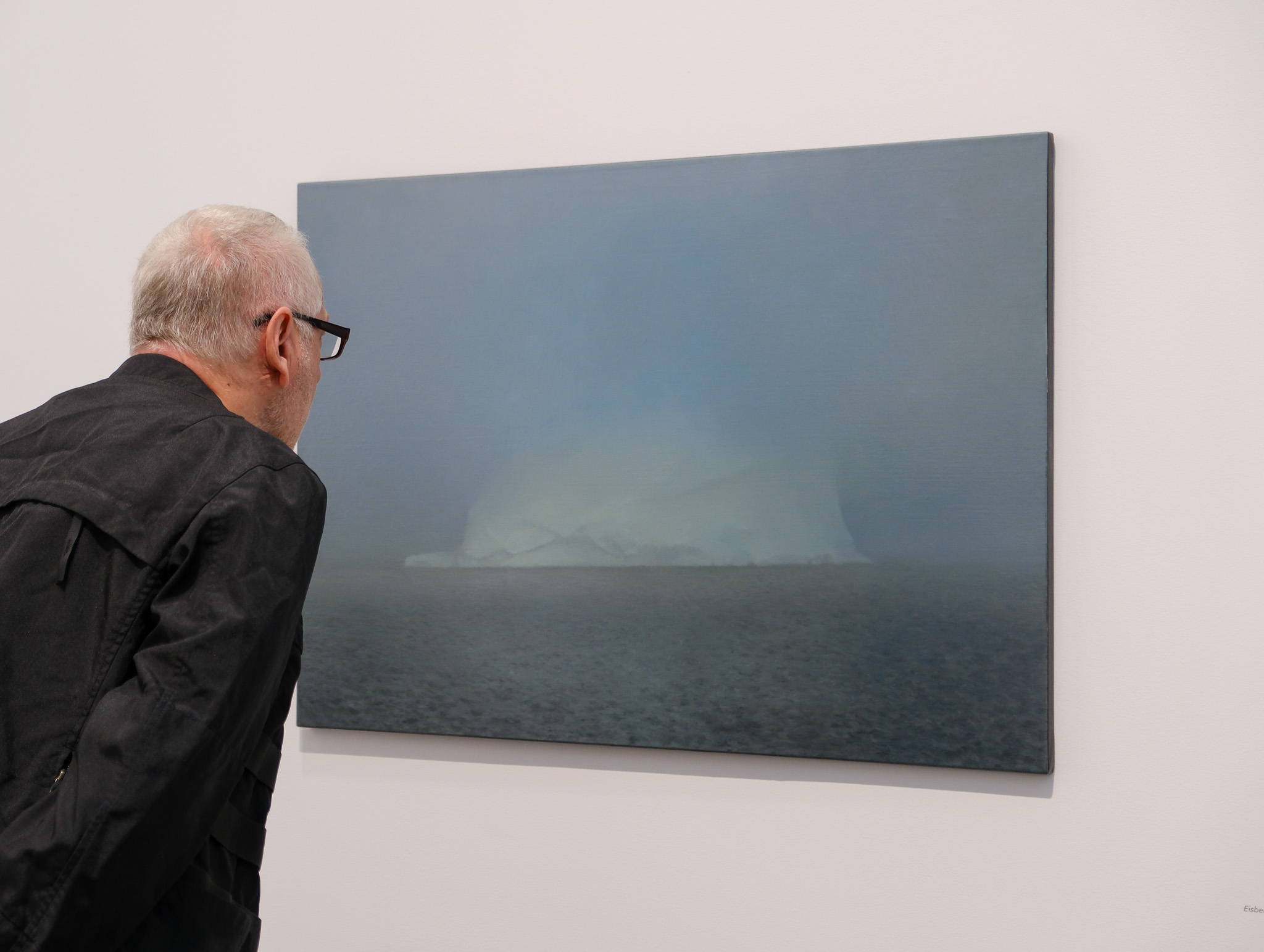 A man gets a close look at the Richter landscape Eisberg im Nebel (Iceberg in Mist),1982. Photo by Jamie Lubetkin
The yearning in the landscapes is evident precisely because the abstractions exist—because you know this artist also works in dense, layered fields of color where representation is deliberately exiled. And the abstractions carry a kind of landscape memory: for all their apparent chaos, they contain something geological, something atmospheric.
The Landschaften show moves chronologically, pairing the two bodies of work across rooms. Among the key pieces: Wolken (Clouds), 1982, from MoMA's permanent collection; Seestück (Gegenlicht), 1969, built from a collage of two photographs before Richter ever picked up a brush; and Lichtung (Clearing), 1987, where landscape and abstraction are literally layered onto the same canvas—nature scenes overlaid with squeegee marks. If the exhibition makes one thing clear, it’s that Richter’s durability as an artist is inseparable from this conceptual restlessness.
Meanwhile, spring 2026 is shaping up as something of a referendum on the 94-year-old Richter’s legacy. Next week, Christie's launches its spring sales with nine works by Richter from the estate of Marian Goodman, who died in January at 97; the complete collection is expected to gavel for $65 million, led by Kerze (Candle), 1982, which carries a presale estimate of $35 million to $50 million.
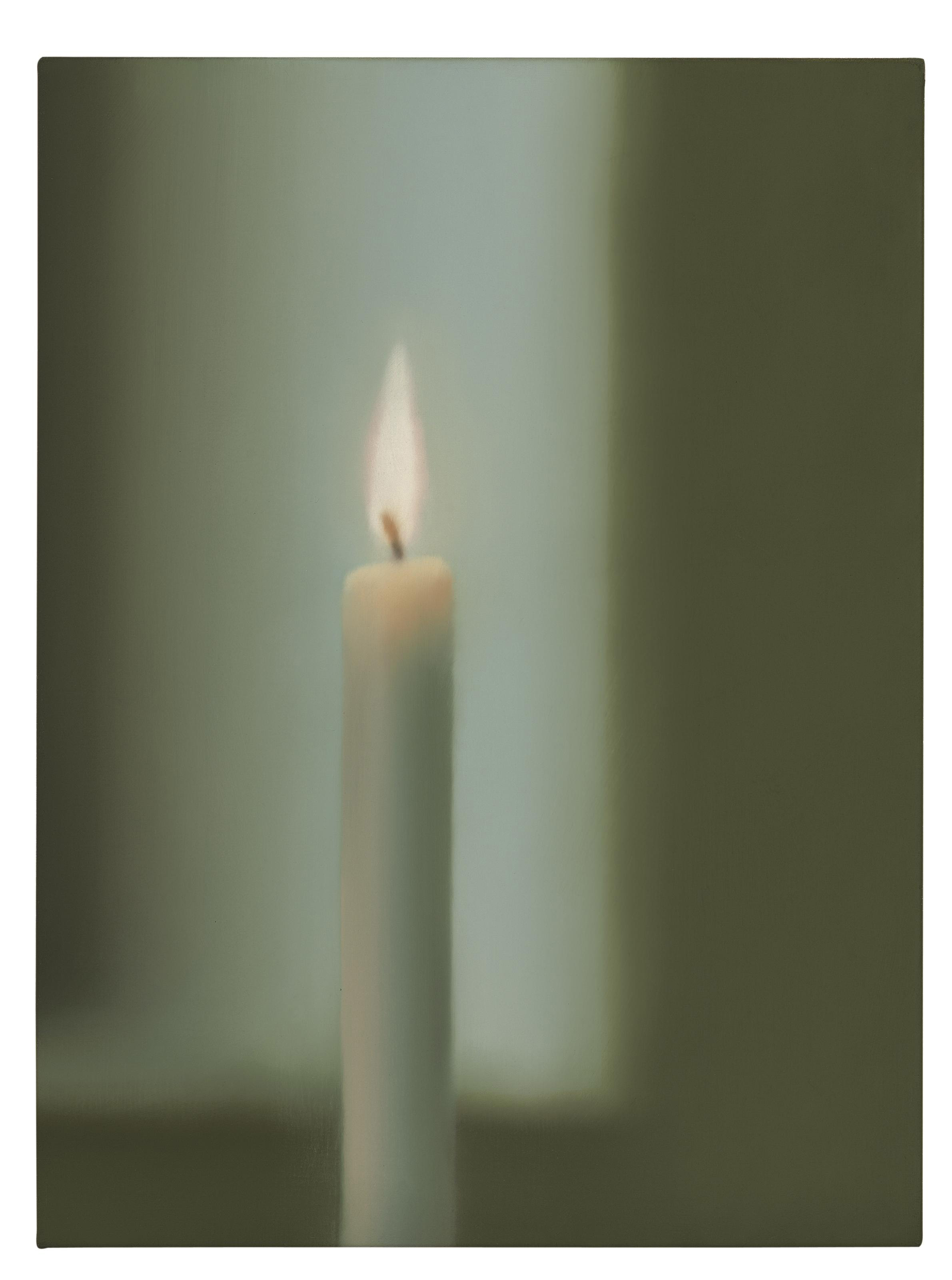 Gerhard Richter, Kerze (Candle). Photo courtesy Christie's
Kerze captures in near-photorealism a white taper in a ceramic holder, set on a shelf against a warm beige wall with a hard shadow at the right edge, mellowed by Richter’s signature sfumato. The painting carries its own history. Another canvas from the same candle series served as the cover image for Sonic Youth's Daydream Nation record in 1988, which did more to expand Richter's cultural reach in certain circles than any mainstream critical appeal. One of Richter’s 1986 Abstraktes Bild works sold for $46.3 million in 2015 at Sotheby's London, setting a record for a living European artist at the time, and the estimate for Kerze puts it within range of that record.
But Kerze isn't flirting with record territory at auction because it looks like a photograph. It's doing so because it doesn't. With that blurred flame, that softened wax, that almost-reflection, Richter took a vintage still life and ran it through the same process of mediation he applied to the seascapes and alpine slopes and anonymous German hillsides on view at Zwirner. The candle and the squeegee abstractions come from the same place. This raises another question about Richter’s practice: can reality survive the act of being painted softly?
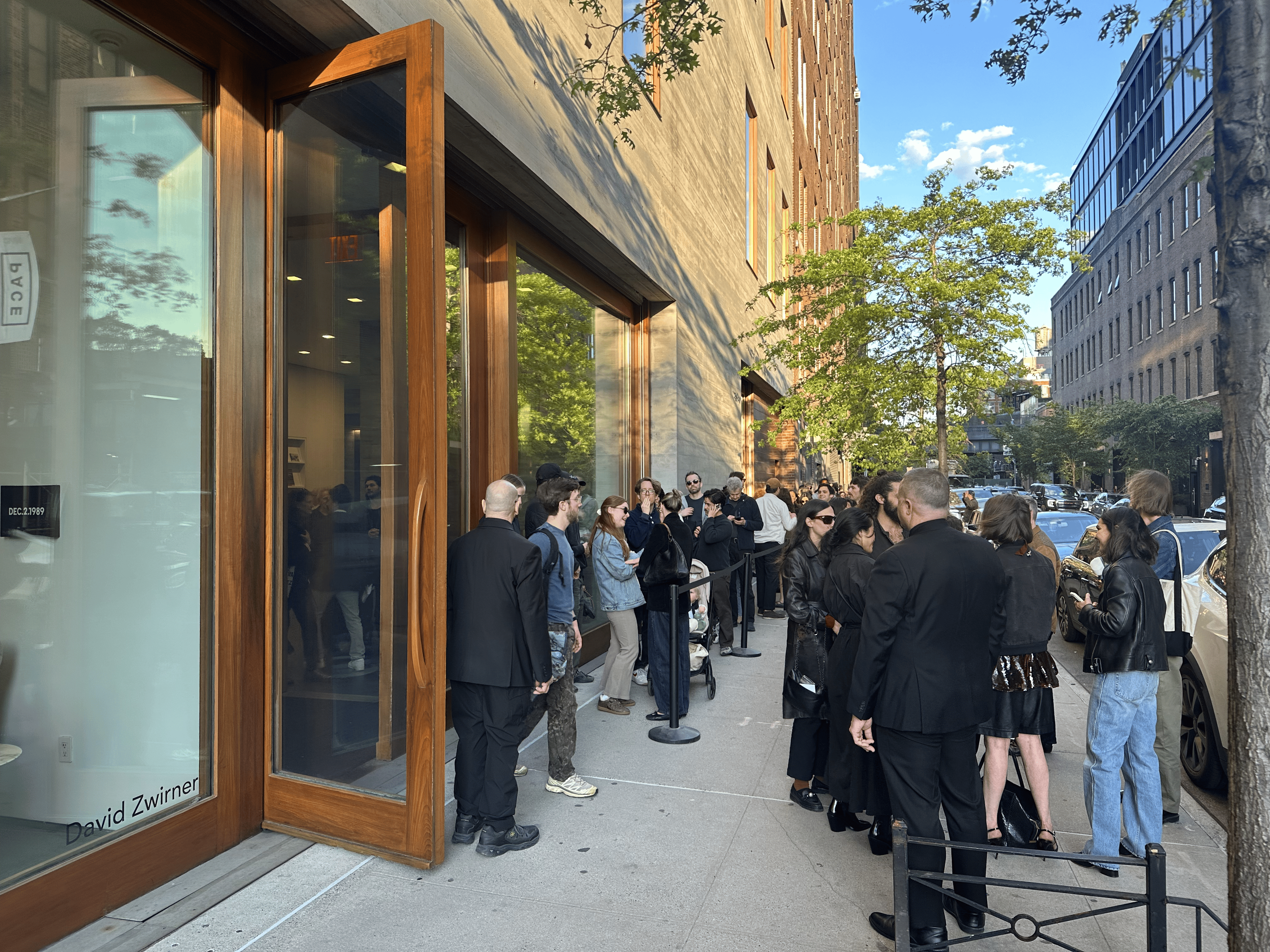 The line to get into Zwirner’s Gerhard Richter show stretches down 20th Street in Chelsea. Photo by Jamie Lubetkin
There probably aren’t many auction specialists who want to put Richter's status to the test against a background of geopolitical uncertainty—and yet here we are, with a $50 million candle and a Chelsea survey occurring within days of one another. The market and the gallery world rarely converge this cleanly around a single argument. Richter has spent 60 years refusing to be pinned down. May will be the latest test.
Gerhard Richter: Landschaften runs through July 10 at David Zwirner, 537 West 20th Street, New York. Christie's spring sale featuring works from the Marian Goodman estate is scheduled for May 20 at its 20 Rockefeller Plaza headquarters.

Scott Orr
Scott Orr is a career writer, editor and a recovering political journalist. He is publisher of the East Village art magazine B Scene Zine. He can be reached via @bscenezine, bscenezine.com, or bscenezine@gmail.com.
view all articles from this author