Whitehot Magazine
August 2026
"The Best Art In The World"
"The Best Art In The World"
August 2026
The Eloquence of the Tangible: Metamorphoses of Matter
By MANUELA ANNAMARIA ACCINNO April 16th, 2026
The relationship between the artist and matter has never been a mere exercise in subjecting substance to form, but rather an ontological dialogue which, today, in the heart of the 21st century, takes on tones of urgency and unease. Whereas in the Renaissance matter was the transparent vehicle towards the ideal and in Modernism the terrain of pure formal experimentation, the person of the present finds themselves interacting with a physicality that has become political, traumatic and deeply layered. In contemporary art, matter is no longer merely the medium of the work, but the work itself: it does not represent, but ‘presents’ reality in all its raw immediacy, acting as a sensory archive of our accelerated existence. Today, the artist should not be content merely to work with matter superficially; instead, they delve into the rubble of industrial production, manipulate digital pixels that simulate density, or recover organic substances subject to decomposition, making the artistic process an act of resistance against the immateriality of the virtual. This ‘material shift’ reflects the condition of contemporary humanity, a being suspended between the abstraction of data flows and the overwhelming burden of the waste it produces. The artwork thus becomes the place where the artist’s body and the body of the world meet without filters, where the creative act does not seek eternal perfection, but accepts entropy, rust and fragility as faithful mirrors of human precariousness.
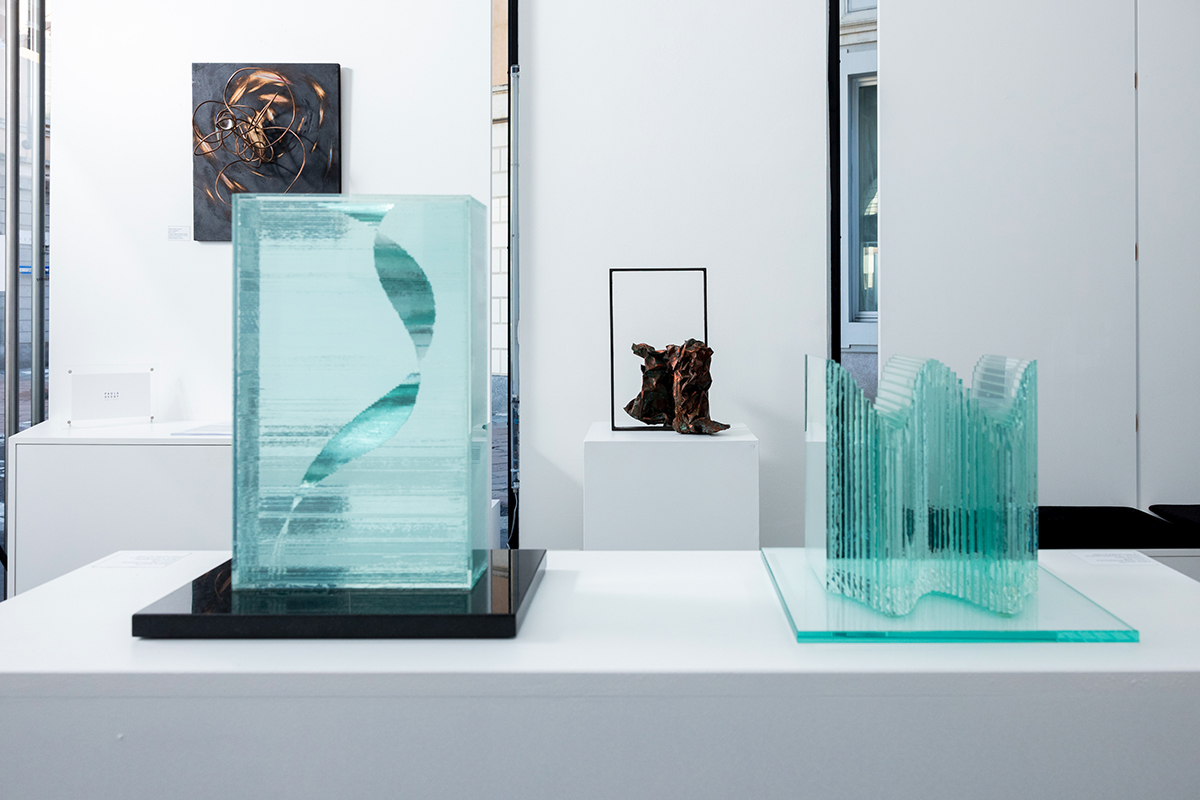
Details of works by Pietro Coletta and Ōki Izumi, Paula Seegy Gallery, photo by Fabio Enrico Viganò
In this cultural theatre, the creative act takes the form of a veritable archaeology of the present: the Milanese gallery Paula Seegy presents “Five Artists for Five Materials: Benedini, Coletta, Cuschera, De Marchi, Ōki”, curated by Luigi Sansone, an exhibition conceived as a multi-layered exploration of the expressive potential of materials. The exhibition sets out to explore not only the intrinsic qualities of the individual media—their resistance, transformations and residues—but also the capacity of contemporary artistic practice to orchestrate a holistic experience that assimilates history, technique and sensory perception. Through reciprocal relationships between surface and body, gesture and memory, the exhibition traces critical pathways in which the material becomes a vehicle of meaning: not merely formal content, but a primary actor in the production of an aesthetic knowledge that decodes the present and renders its cultural stratifications in a complex form. The investigation into materials conducted by Gabriella Benedini, Pietro Coletta, Salvatore Cuschera, Riccardo De Marchi and Ōki Izumi offers a sequence of paradigms through which to interpret how the transformation of surfaces and volumes reflects — and comments upon — the tensions of our era. Each material activates a specific grammar: wood speaks of life cycles and tactility, copper of patinas and time, iron of resistance and fracture, steel of geometry and reflection, glass of thresholds and visibility. By bringing these approaches into dialogue, a map emerges in which the material becomes an indicator of political, economic and existential conditions.
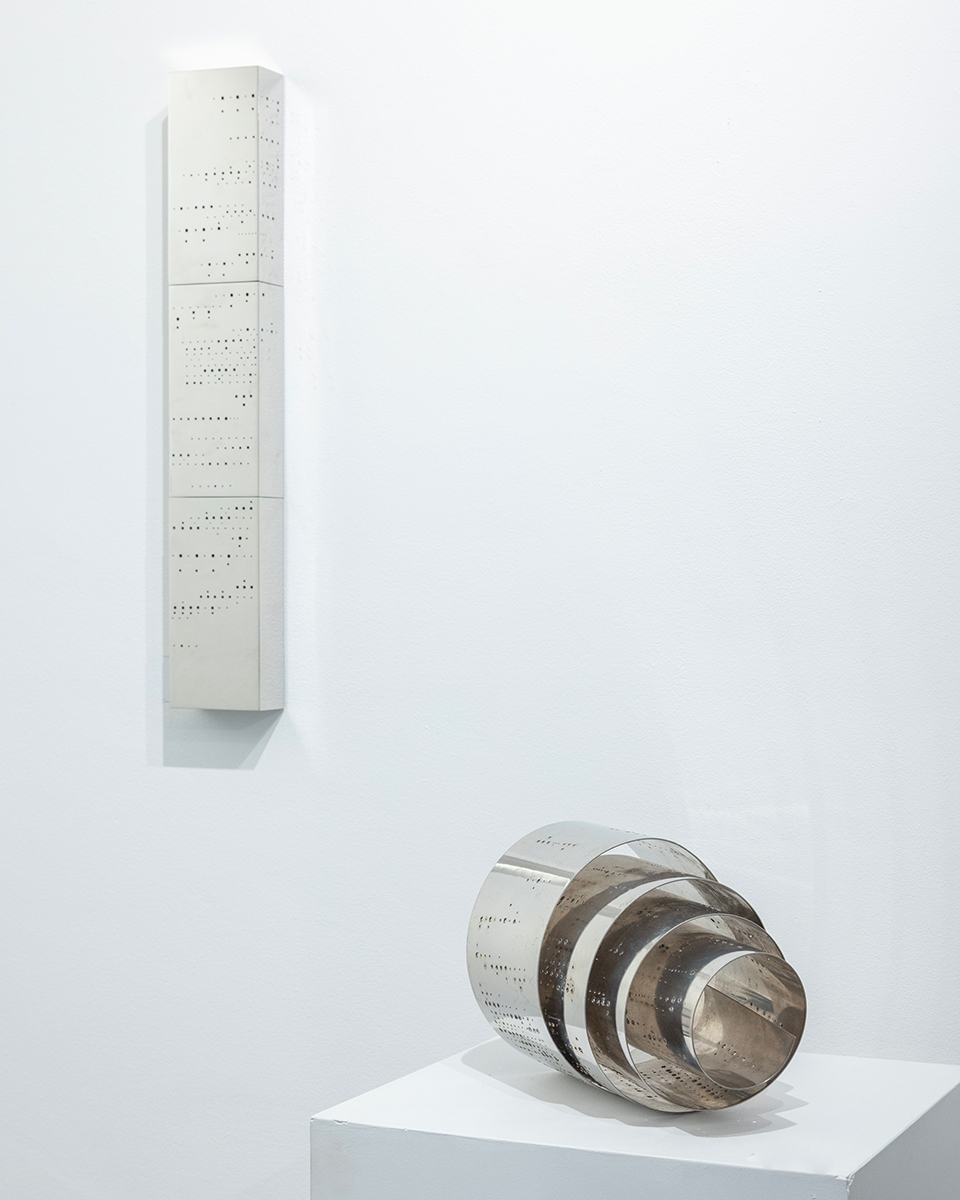
Riccardo De Marchi, Paula Seegy Gallery, photo by Fabio Enrico Viganò
Gabriella Benedini explores wood in its organic dimension and its tactile memory: the material retains traces of growth, knots and grain that speak of biological time and manual labor. Pietro Coletta chooses copper as a surface for transformation. Oxidation is not an imperfection, but a visible process of time that society tends to conceal. Salvatore Cuschera contrasts the hardness of iron with formal tensions of balance and rupture. Iron, the material of structure and machinery, carries with it a history of factories, labor and conflict. The sculptures, which play on unstable balances, allude to the precarious equilibrium of contemporary socio-economic relations: fragile political balances, employment contracts under pressure, and infrastructure barely holding up. Riccardo De Marchi uses steel as a testing ground for geometries, resistances and reflections. Steel, with its luster and formal rigor, evokes modernity, technological progress and the capacity for standardization. The reflective surfaces draw the public into the work: the viewer finds themselves implicated, mirrored, compelled to recognize their own position within the system of production and consumption that steel represents. Ōki Izumi uses glass to open thresholds between visibility and transparency, between fragility and monumentality. Glass grants and denies sight: it separates and connects, protects and enables visual control. In an age of surveillance and media exposure, glass becomes a symbol of contradictions: the promise of clarity that conceals layers of power, the aesthetic fragility that coexists with an imposing presence. The glass works stage the contemporary ambivalence between the desire for openness and the fear of exposure, between individual protection and public transparency.
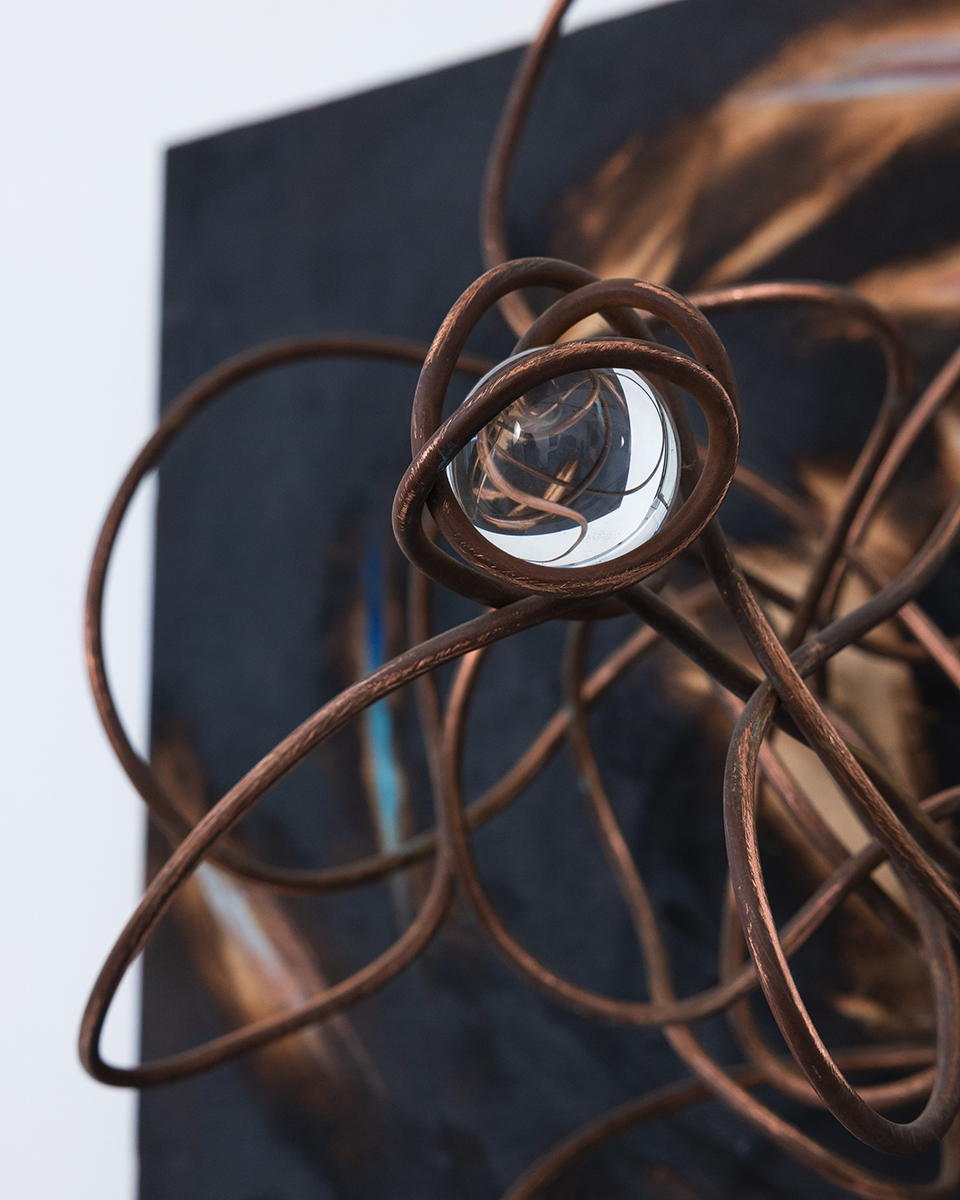
Pietro Coletta, Paula Seegy Gallery, photo by Fabio Enrico Viganò
Contemporary art teaches us that matter is not inert, but possesses its own capacity to act and to influence thought. When the artist relinquishes total control to allow gravity, oxidation or chance to act upon the material, he performs an act of intellectual humility, acknowledging that man is not the absolute master of creation but a part of its ceaseless becoming. In this interplay between substance and concept, art becomes modern alchemy: it does not seek to turn lead into gold, but to transform the anguish of our times into a form of tangible knowledge, capable of restoring substance to an existence that risks evaporating into pure simulation.

Manuela Annamaria Accinno
Manuela Annamaria Accinno, born and raised in Milan, is an art historian and critic with a degree from the University of Milan. She has been actively collaborating for several years with radio stations and magazines specializing in the field of art.
view all articles from this author