Whitehot Magazine
October 2026
"The Best Art In The World"
"The Best Art In The World"
October 2026
David Smalling: Elizabethan Collar at Galerie Templon
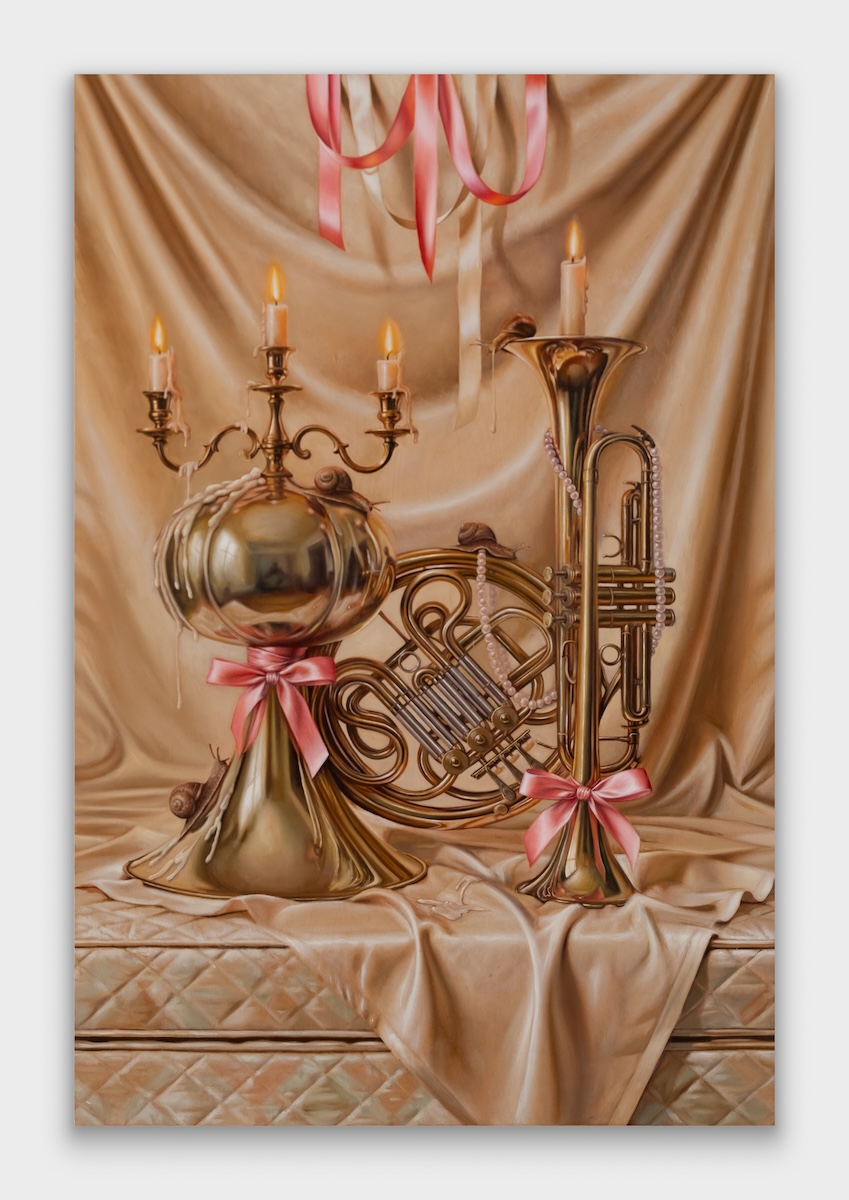 Standing Ovation, 2026, Oil on panel, 60 x 40 in. Courtesy of the artist and Templon, Paris – Brussels – New York . Photo © Charles Roussel
By EMANN ODUFU, April 23rd, 2026
One afternoon, a few days after Easter, I went to visit Galerie Templon. The coming of spring brought new light that felt like a present after a long, punishing East Coast winter. New York City had only just begun to soften, the air carrying that first real hint of warmer days, tentative but undeniable. You could feel people re-emerging, recalibrating, stepping back into themselves. There was a quiet sense of renewal in the air, not as a grand gesture, but as something more internal, a subtle shedding and re-emergence that would come to echo throughout Smalling’s exhibition.
It was in that atmosphere that I met David Smalling to walk through his exhibition Elizabethan Collar together. The show unfolds less as a fixed statement and more as a series of interlinked vignettes, each working in conversation with the next, forming what can be interpreted as an internal journal of symbols, connected memories and reflections rendered through paint. This idea is reiterated through David’s set of essays entitled the Elizabethan Collar Essays, writing created in cohort with the creation of the show that grounds the paintings firmly in the space of the artist's daily meditations and process of creation. Drawing from the visual language and techniques of classical European painting, Smalling stages a precise interplay between the canon and contemporary symbols. The result isn’t parody or pastiche, but something more layered: a testing of who has the right to claim the canon, and how that canon can be retooled to speak to the complexities of now.
Across the works, the bodies are largely absent, yet its presence is felt. Masculinity, particularly Black masculinity, is stretched, softened, and made fluid. In this sense, the work can be understood through what W. E. B. Du Bois termed double consciousness, where the Elizabethan collar reads as both adornment and constraint, a metaphor for moving within Western frameworks while remaining critically aware of them, even as the work insists on formal mastery over expectation. Read through the lens of the exhibition’s subtle memento mori motifs, the work ultimately leans less toward physical death and, from my perspective, toward a kind of ego death, where the slow passage of time becomes a mechanism for shedding fixed identities of race, gender, and expectation, opening instead onto a quieter, ongoing process of rebirth and self-becoming. Elizabethan Collar is on view at Galerie Templon through April 25.
Emann Odufu:
I know throughout these works there are a lot of recurring themes and motifs. All of the pieces feel like they’re in conversation with one another, rather than being standalone. What was your thinking process behind that? And also, what was your process of creating them, even conceptualizing the show?
David Smalling:
The way that I work, I do a lot of works on paper, a lot of sketches. When I’m in the studio, I’m doing a lot of writing, reading, but mostly writing about what I’m feeling and ideas for compositions. Over the past two years I probably drew, like, hundreds of slugs and snails and so forth. So I develop the iconography based on what I’m feeling, and the story I want to tell, kind of weaving together these vignettes. Each painting is a vignette from my own life. So for example, just starting here, this one is Last of Kin. And then this one over here is Follicular. Both of these I conceived when my partner was freezing her eggs. So that egg is quite literal. That experience forced me to think, do I want to have kids? Do I want to have kids with her? I mean, I always wanted to, but then you start asking yourself, what’s stopping me, why now, why not? So I was kind of diving into that internally. And in these works, the pearls, the ribbon, the lipstick, they all allude to a feminine presence in the images.
And what about the brass instruments I see in a lot of the work? Like in this case, the one protruding from the egg?
The brass instruments, and even the wooden ones, are sort of masculine figures for me, or parts of my own life. When they’re inflated, that’s me trying to figure out how to show up in this moment, after Obama, after Trump, after "Me Too", George Floyd, all these points of cultural shift. There’s not really a script. It’s just trying to figure out how to show up for people. But stepping back, each of these works is still a vignette. Follicular and Last of Kin are really about thinking through having a child, going from where I am now, fairly free, to being responsible for someone else. And the snail is a recurring motif, it represents a memento mori.
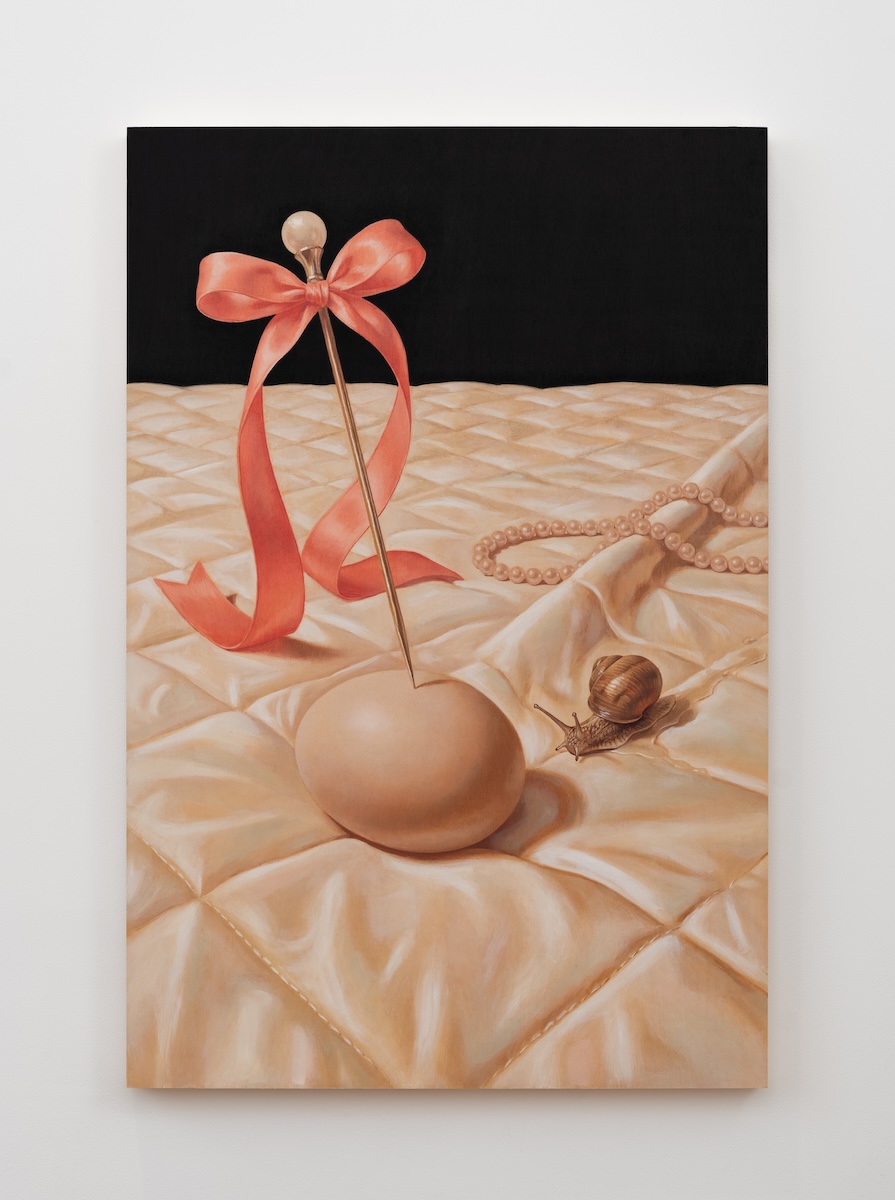 Follicular, 2025, Oil on Panel, 36 x 24 in. Courtesy of the artist and Templon, Paris – Brussels – New York . Photo © Charles Roussel
Yeah, I’m familiar with "memento mori" more through skull and bones iconography. It represents the transience of life. I didn’t realize a snail also symbolizes that. But with that in mind, I’m curious about the positioning of it on the egg, which represents fertility. The two together feel like they’re holding life and its transience at the same time.
That’s exactly right. A lot of what got me into this body of work was reflecting on my 20s. My mom actually came into the studio and said, “This body of work is about your 20s.”So the show is really an internal journal, a retrospective of sorts. And in terms of how I work, I’m not trying to teach something grand about blackness or masculinity or Afro Caribbean identity. Those are important, but that’s not really how my practice exists in my mind. It’s more these personal vignettes.
Yeah, I get that, it’s not about a grand message. But I do think it’s interesting, because whether you’re trying to or not, those ideas are still present. Even just thinking about Black masculinity, like the fact that you’re a Black artist making work with this palette. The colors, pink, cream, gold, those aren’t typically associated with masculinity, especially Black masculinity.
And masculinity is shaped by the environment, right? From birth, blue for boys, pink for girls. And depending on where you’re from, Jersey, Jamaica, there are different expectations, different codes. Even in hip hop, you think about someone like Kanye with the pink polos, or Cam’ron with the pink tee, there are these moments where people stretch what Black masculinity can look like.So I look at your work as doing that, even if unintentionally. You’re making a show about something like egg freezing, using this palette, and that alone feels like a kind of rebellion. It redefines what can be expected from someone that fits certain descriptors.
Yeah, I agree. People come in with fixed assumptions. I was here one day and someone walked in and said, “I wonder what she’s like,” referring to me. So that happens. There are a lot of expectations, and I think my visual language sits outside of those in many ways.I mean, part of that is just how I grew up. Artists like John Currin, Lucian Freud, Cecily Brown, those opened the door for me into contemporary painting. And then I kind of found my way back to the old masters through Courbet. What’s funny is this work actually feels closer to what I was doing in high school and college. It’s kind of come full circle and everything in the show is on wood panel.
Is there a reason for that material choice?
Yeah, you just can’t get these effects on canvas. Like these really thin glazes, areas where the wood is still showing through. You can kind of enjoy the spontaneity of the wood grain in a way that you can’t with canvas, which has a more regular pattern.
And how long does a piece take, from conception to execution?
Anywhere from two weeks to a couple months for the larger ones. But it varies. I do a lot of works on paper, then I scan them, edit them in Photoshop, print them out, and paint from that.
So you’re not actually staging objects, you’re drawing, then translating that digitally, then painting from that?
Yeah. I wouldn’t call it assembling exactly, it’s more like I have a rough idea, I make a sketch that’s almost there, then refine it. People think it’s AI sometimes, but it’s all real. Like this painting here includes part of my partner. A lot of the reflections are just my apartment, mirror selfies, things like that.
What’s your studio practice like? Is it just you, or do you have assistants?
It’s mostly just me. I have assistants who help with things like mixing paints or prepping panels. I built a system using a physics model, Kubelka-Munk, that predicts pigment mixing. So assistants help run those experiments. But composition and drawing, that’s all me. It’s a pretty solitary process.
In some of the works you can really see a clash between masculine and feminine archetypes, like the bullets against the pink background.
Yeah, I’m creating those tensions in texture. The bullets feel rough, antagonistic, coded as masculine. The lipstick reads as feminine. But I’m not trying to strictly gender strength or anything like that.The snail again is about time passing, me maturing, figuring out how to be better, to others and to myself.
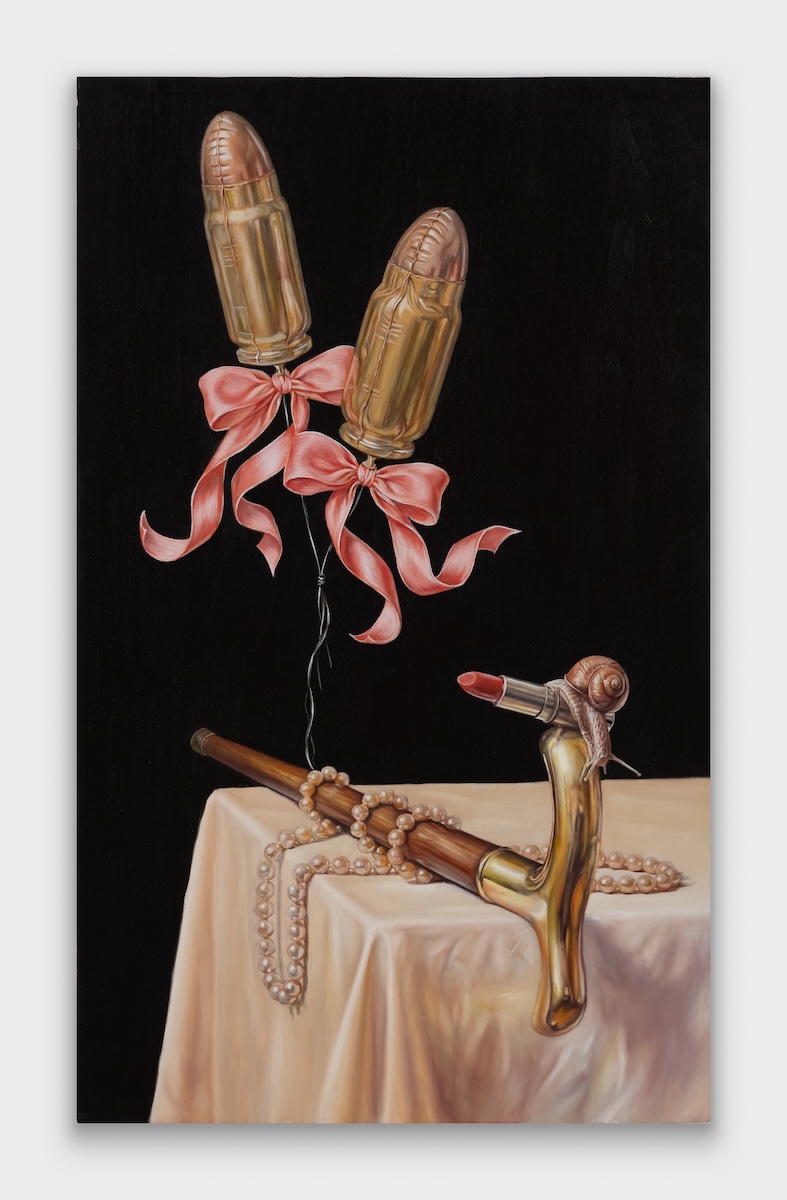 Buck Nasty, 2025, Oil on Panel, 36 x 22 in. Courtesy of the artist and Templon, Paris – Brussels – New York . Photo © Charles Roussel
And the mattresses, they feel loaded. Like sexuality, interior life, perhaps a nod to the freedom, experimentation, and chaos of young adulthood.
Yeah, exactly. They represent interior scenes, domestic space that can be a physical space or an emotional one. It’s a reimagining of interiority as a genre.
I also feel like the show is very spring or Easter coded. The pink, the eggs, the snails it feels aligned with that seasonal moment.
That was totally unintentional.
I’m from Newark, and in Branch Brook Park we have one of the biggest collections of cherry blossoms in the U.S. I was there recently, but I was thinking about the natural environment of the park in relation to what I was seeing in your show. It all felt connected to spring and to Easter iconography, and now that I think about it even the "memento mori" aspect.
Yeah, that’s completely serendipitous.
It's wild how things like this can happen. It almost echoes the chicken and egg debate. Does art reflect life or is it the other way around. This piece here, entitled Tourniquet, I really like it. I love the reflections that you can see in the brass instrument.
Yeah, I like this one too. The journey on it was good. Wherever you see the wood grain coming through, that means I’m happy. If you don’t see it, it means I was fighting the painting. A lot of what you’re seeing here is just my apartment reflected back. These works are really about interior scenes, kind of like a contemporary nod to something like the Arnolfini Portrait.
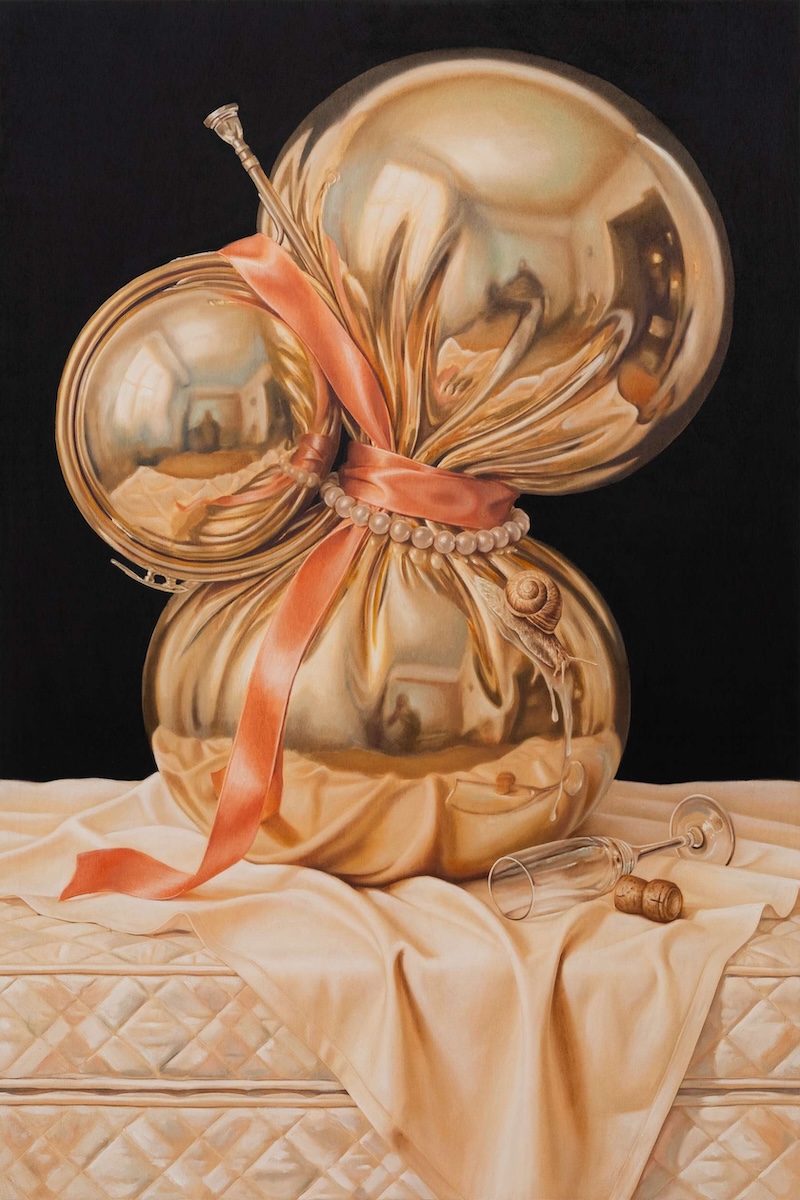 Tourniquet, 2025, Oil on Panel, 36 x 24in. Courtesy of the artist and Templon, Paris – Brussels – New York . Photo © Charles Roussel

Emann Odufu
Emann Odufu is an independent art and culture critic, filmmaker, and curator from Newark, New Jersey, whose work explores contemporary art and Black visual culture through Afro-Futurism, narrative, and cultural memory. His writing and creative work has appeared and been featured in The New York Times, HuffPost, Paper Magazine, Office Magazine, and The Brooklyn Rail, and his curatorial practice includes exhibitions at the Liu Shiming Foundation, National Arts Club, MoCA Westport, Friedrichs Pontone Gallery, and Leila Heller Gallery. He has spoken at Harvard University, Yale University, the British Film Institute, and the National Academy of Design.
view all articles from this author