Whitehot Magazine
October 2026
"The Best Art In The World"
"The Best Art In The World"
October 2026
Eleanor Conover/Abattoir Gallery
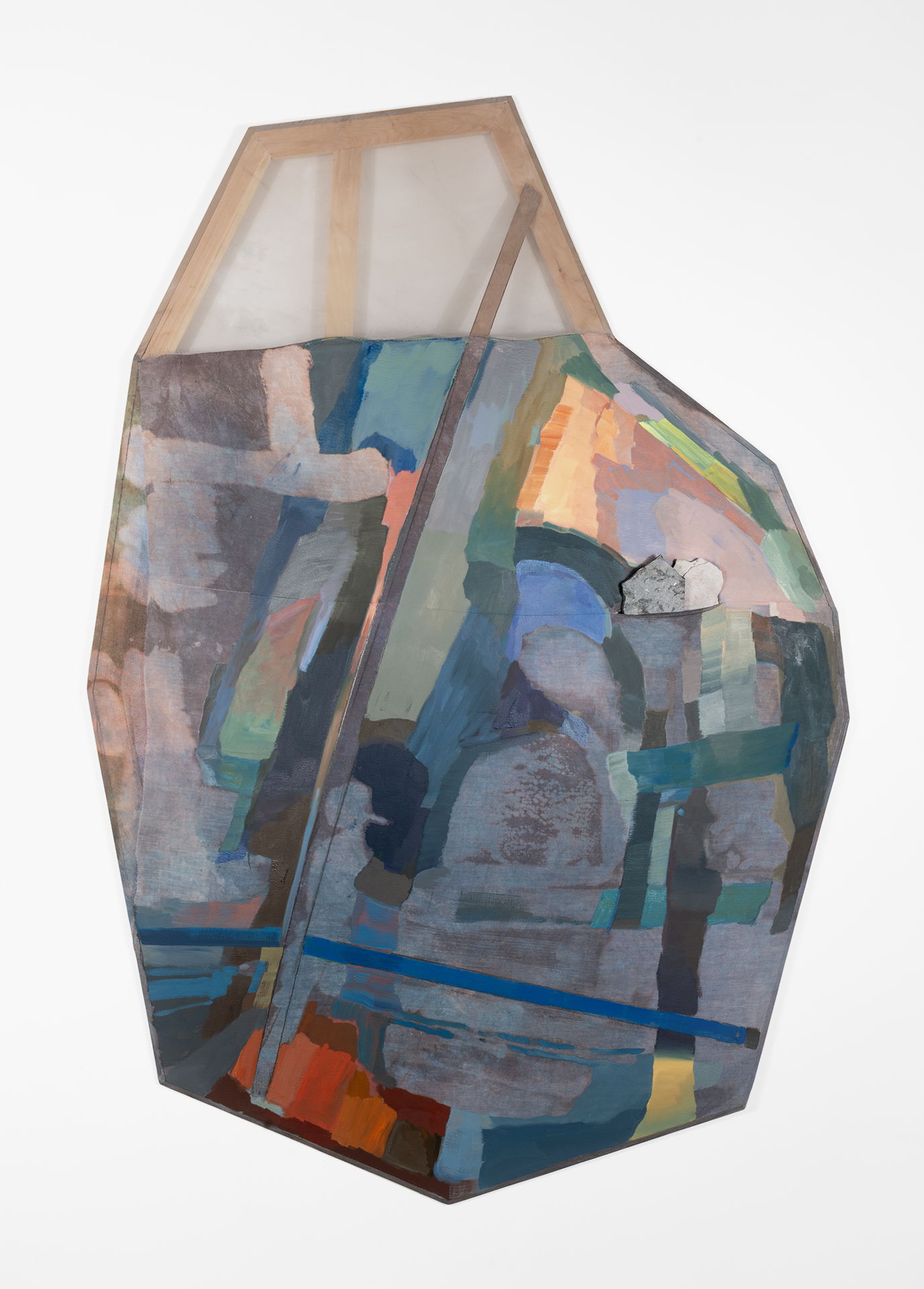 Eleanor Conover Here, Here, 2026 Oil, dye, and graphite on sewn canvas and polyester with marble, bowed oak, and beveled pine 86 x 60 x 5 inches
By WM May 12th, 2026
Eleanor Conover doesn’t just paint pictures—she builds them. The Maine-based artist has been gaining attention for her sculptural, shaped canvases that foreground process. With layered paint, translucent materials, and hand-made elements, her works feel less like images and more like experiences—traces of time, touch, and instinct.
After a recent run of shows and fair presentations, Conover will make her New York solo debut this May at Independent with Abattoir Gallery, as part of the fair’s Independent Debuts initiative—one of the fair’s highlights. The presentation comes just ahead of her first solo museum exhibition at the Center for Maine Contemporary Art, featuring a text by veteran artist and curator Michelle Grabner.
We caught up with Conover ahead of New York Art Week to talk about her process, her creative life in Maine, and what to expect from an exciting year ahead that’s just getting started.
Abattoir Gallery’s solo presentation of work by Eleanor Conover will be on view at Independent (Booth 415) from May 14–17, 2026.
A Conversation with Eleanor Conover and Michelle Grabner will take place on Saturday, May 16 at 4pm at Independent as part of the fair’s programming.
WM: What were your early works like, and how has your practice evolved over time?
ELEANOR CONOVER: Eight years ago, I was making large, unstretched paintings outside on the ground, in spaces where there was an intersection between the built and natural environment. This was in graduate school, and my thinking was informed by a young adult life of equating painting with landscape. I was pushed, and now push myself, to broaden my understanding of the medium. I have gradually opened to painting’s history and possibilities in a more full-bodied way, and I have shifted to a greater focus on painting’s material and metaphorical weight: in other words, the structure and canvas has become the site.
What does your process look like from start to finish?
I make drawings that serve as blueprints for the supports. The building process also invokes drawing, in the way that I often intuitively adjust angles and lengths as I construct. I then make decisions about the surface of the painting: for example, if there will be some transparent fabric involved, which is often a compositional question. Some of the paintings are dyed, and/or treated with an acrylic stain, before I size them and build out an image with oil paint. That’s the brief on the physical process, but in practice it is wilder and involves more fits and starts!
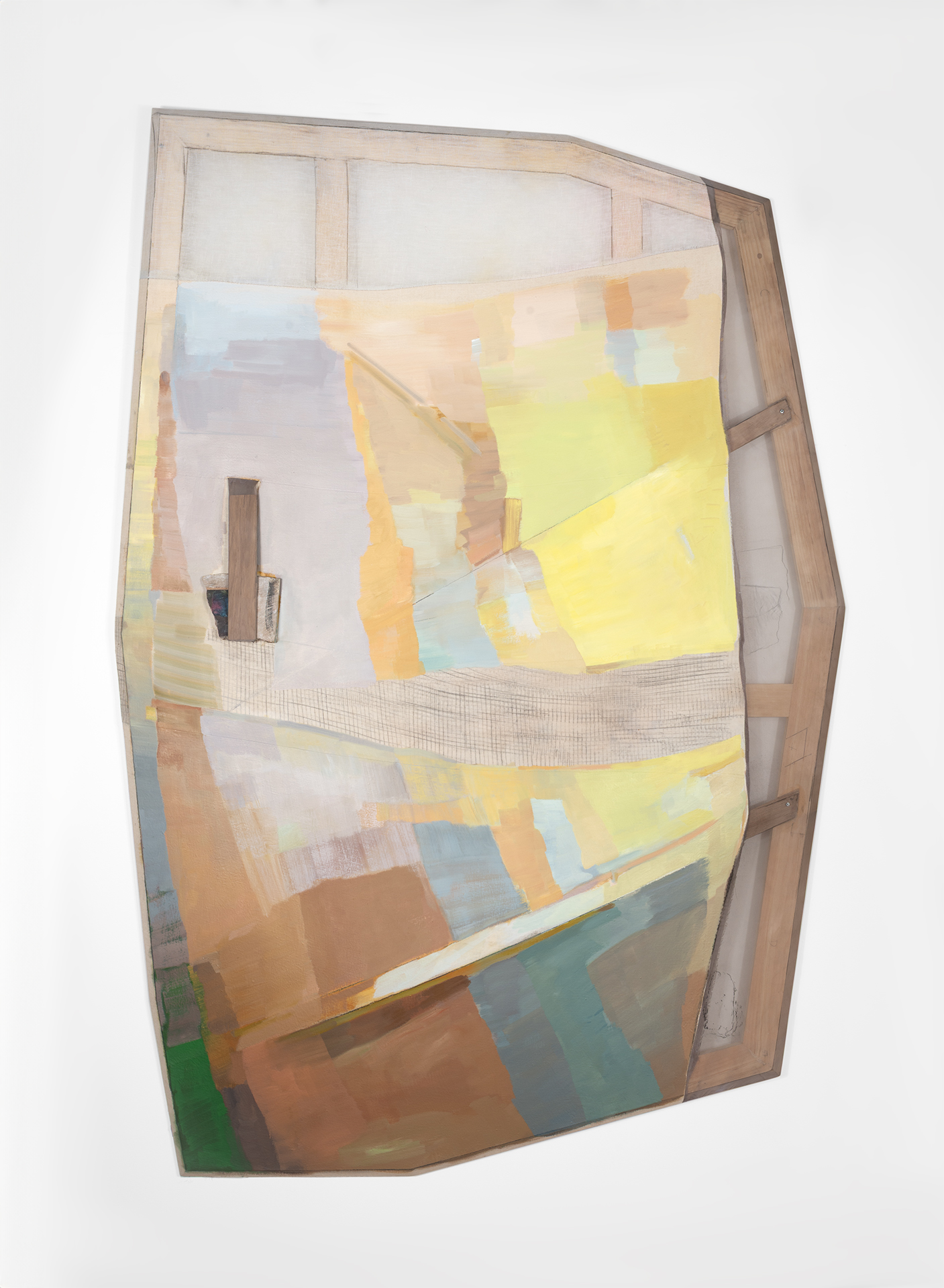 Eleanor Conover Warm Illusion, 2026 Oil, graphite, and dye on sewn polyester and linen with marble, bowed oak, and beveled pine 70.5 x 49 x 3.5 inches
How has your interest in poetry shaped your work—particularly your shaped canvases?
In the preface to the publication of Emily Dickinson’s late envelope poems, Susan Howe asks, “does form envelop everything? Can a thought hear itself see?” I find these poems, written on fragments of envelopes, incredibly moving as objects: Dickinson was composing in response to the shape of the envelope fragment. What happens to language when it is not inscribed in a rectangle, and how can color and form re-orient to new objects of geometry? In my head, there is a non-straight (slanted?) line (shape?) that connects Dickinson to Lygia Clark to Dorothea Rockburne to Susan Howe.
Many artists seem drawn to Maine in recent years. What led you to move there, and have you been able to build a creative community?
I’ve had a lifelong relationship to Maine, and for years I relied on the generosity of family and friends to spend time here. In 2024, I was hired for a teaching job that allowed me to move and sustain a life in Maine full time. An incredible community of ambitious, brilliant, and thoughtful artists welcomed me. I am continuously touched by the generosity and mutual respect that we share—which takes conscious, empathetic work. The harsh seasonal changes and shifts in light structure a creative rhythm that generates organic movement between community engagement and focused studio time: dark winter, ecstatic summer.
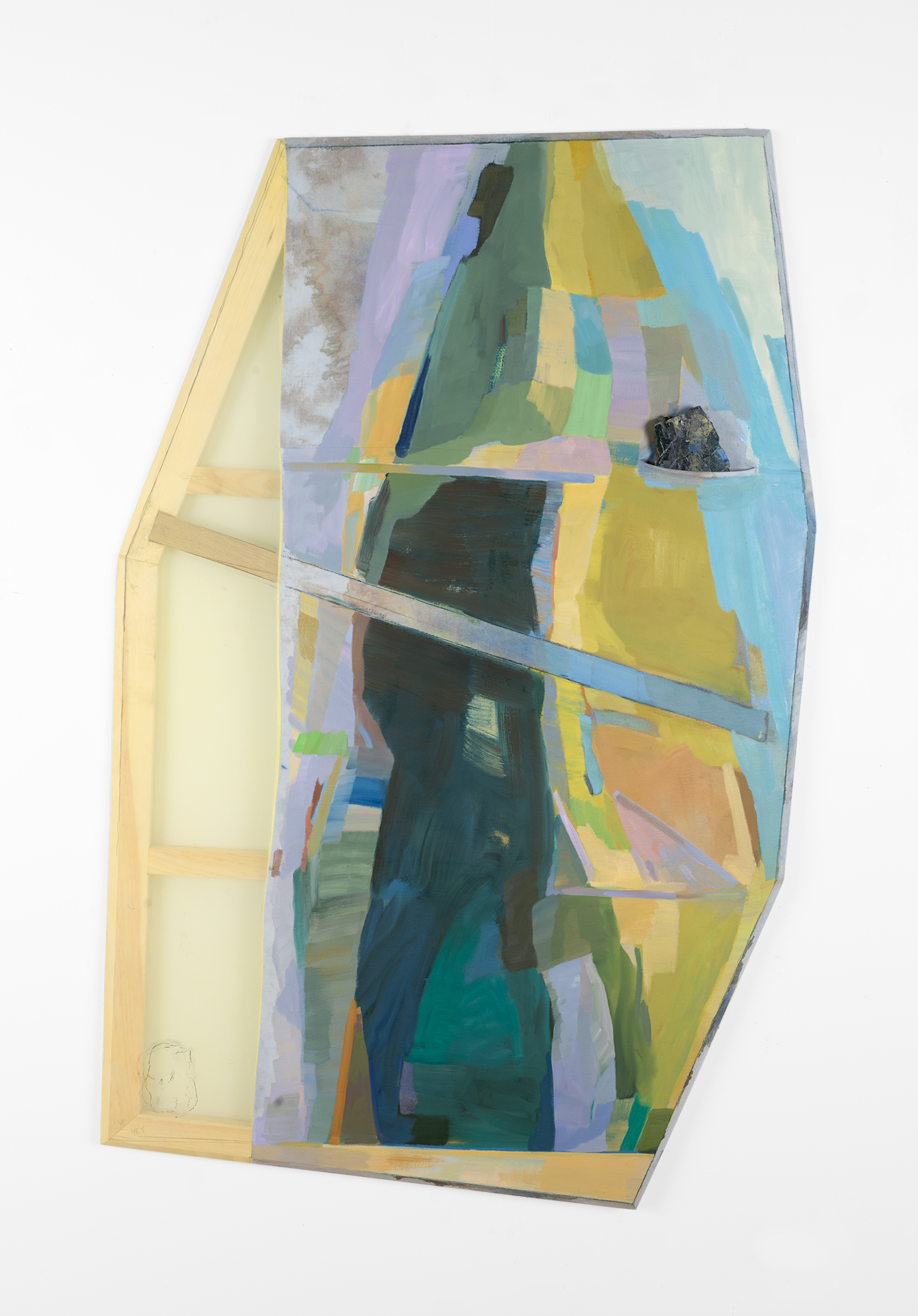 Eleanor Conover After, Against, Among, 2025 Oil, acrylic, dye, and graphite on sewn linen and polyester with marble, beveled pine, and bowed oak. 62 x 39 x 3 inches (157.5 x 99.1 x 7.6 cm)
Your recent presentations with Abattoir Gallery have been well received, and your New York debut at Independent feels like a major moment. What’s next—any upcoming projects or exhibitions you can share?
This opportunity to have the work in the world, and to participate in a dialogue about the material and sculptural engagement of a cross section of contemporary painting, is so meaningful to me. I’m thrilled to be having my first institutional show at the Center for Maine Contemporary Art in Rockland, Maine, which will open in early 2027.
Which artists or poets have influenced your work, and how do those references show up in your practice?
This is the tip of the proverbial iceberg, but two drawing shows at MoMA: Seurat in 2007 and Cezanne in 2021—in terms of the role of the texture and openness of the paper in the resulting drawings. Every time I see Sam Gilliam’s work in person, I am drawn to the aliveness of the painting and object, which is informed by my time at Tyler studying with Dona Nelson and being exposed to her fearless work and practice. And Marsden Hartley, in his rough-hewn images and people that feel so linked to the physical directness of the Maine environment.
WM
Whitehot writes about the best art in the world - founded by artist Noah Becker in 2005.
view all articles from this author