Whitehot Magazine
October 2026
"The Best Art In The World"
"The Best Art In The World"
October 2026
Monet, Painting Time: Musée de l’Orangerie, Paris
By MICHEL KLEIN, October 20th, 2026
To mark the 100th anniversary of Monet’s death, this exhibition is a tribute to one of the key proponents of the “new painting” in the mid-19th century. The exhibition features a selection of almost forty of Monet’s paintings, mostly from the collections of the Musée d’Orsay and the Musée Marmottan Monet, along with loans from French and international public and private collections.
Today, these paintings are as familiar to the world, yet at the time they were criticized as “Impressionist,” that is, unacademic and entirely painted “en plein air,” outdoors, as if there was no skill presented here, just dabs of colored paint helter-skelter amassed on the canvas. “Unfinished wallpaper,” as critic Louis Leroy wrote in 1874.
In art critic Sebastian Smee’s Pulitzer Prize-winning book, Paris in Ruins, Love War and the Birth of Impressionism, he notes, “the crucial thing was that the new painter’s (speaking of Monet, Renoir, and Degas) work was rooted in the here and now rather than in exhausted mythologies, religious parables or legends of the ancients. The society they portrayed and the way they painted it—in loose, unfinished-looking brushstrokes that captured colored light.”
Why painting time? Because Monet is known for his observation of scenes at different times of day under different atmospheric conditions, the myriad variations of “colored light.” He did not simply repeat favorite sites but instead came back to look, see, experience and address the location anew. He visits again and again the Cathedral at Rouen, the steam trains at the Gare Saint-Lazare or mornings on the Seine.
Many aspects of contemporary life are represented in these memorable places in Paris and Normandy by this astute and passionate observer. Not studio-bound, he travelled, the painted canvas serving as a visual diary, if you will, of his numerous visits. On one excursion, he arrives at the train station in the 8th arrondissement; it was the first railway station built in Paris, opening in 1837, where he witnessed the coming and going of this remarkable invention, the locomotive.
Powered by steam, it is a man-made machine. As it moves, it fills the station with clouds of smoke that Monet depicts in whites, grays, and pale blue. Monet comments, “Color is my daylong obsession, joy, and torment.”
Through the rising smoke and beyond the waiting passengers, we see Parisian apartments in the distance. In this dynamic picture of 1877, he captures a very bustling moment in time. In Rouen, where he went in 1892 and again in 1893, his focus is on the imposing façade of the Gothic church built in the 12th century, Cathédrale Notre-Dame de Rouen. There, Monet monitors the changing light from day to day—again, the theme of time is at work—and therefore its effect on the surface of the building’s stone structure. In one painting entitled Morning Fog, the façade seemingly disappears behind a veil of blues and grays. In another, Sunlight Effect, End of the Day, we experience a subtle and beautiful balance between the sunlit towers and the darker base of the church now in shade. Again, Monet paints a portrait of time.
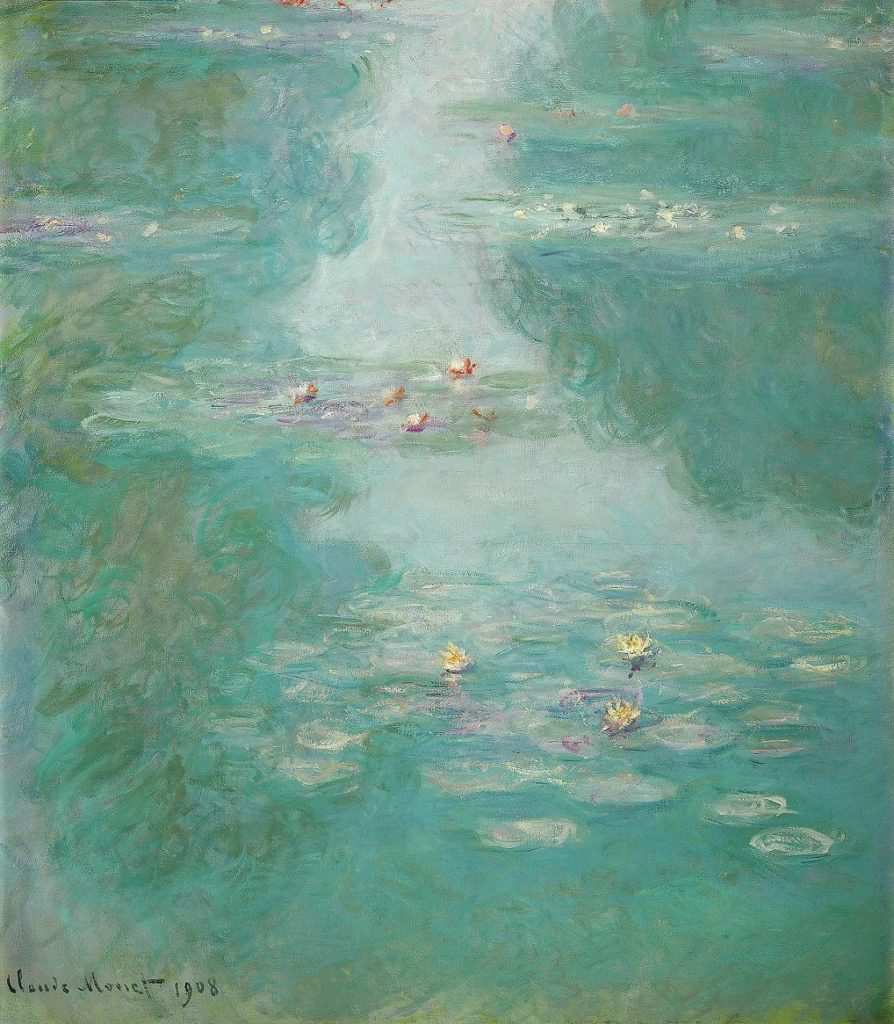
Monet, Nympheas, 1908. Courtesy of Musée de l’Orangerie, Paris
He has said, “For me, a landscape does not exist in its own right, since its appearance changes at every moment.” Such works are both dramatic and monumental; the resulting series is a highly modern idea, as noted by Jennifer Dyer in her book Serial Images: The Modern Art of Iteration. She wrote, “seriality is essential to understanding modern art's meaning and structure, as demonstrated in diverse artists' works.”
A third series worth noting is Mornings on the Seine, a series of 21 paintings that explore this river view. It is said that Monet got up before dawn to make his way to the site near his garden at Giverny and watch as the sun rose and the colors of river, sky, and trees were enlivened by the early morning light. Another series whose very existence is based on time. As one writer affirmed, “none of the previous series had been concerned with the changing light within such a tight time-frame.”
Last came the Water Lilies, a tour de force of some 250 works in which the painter explored color, light, and composition from many, many points of view. Begun in 1893 and ongoing until his death. As explained in the museum’s brochure: “The titles of some of the compositions evoke scenes of sunrise or dusk, giving material form to the idea of a continuum of time within space.” The paintings focus on the lilies in water but also the remarkable reflective quality of the sky and surrounding garden in the water. In these pictures, time stands still.
We consider them timeless masterpieces representing the best of imaginative painting. Writing on Monet in an essay from 1955, art historian Leo Steinberg wrote, “For this painter who is ‘only an eye,’ the hierarchy of things more or less real is not determined by degrees of tangibility for him; those things are real which fully form the content of experience. For Monet, experience is time.”
This last series of paintings has become a hallmark not only of his robust career but of Impressionism as a significant art movement that redefined art. The movement led artists away from the Academy and encouraged free expression, self-determination, an equivalent of what’s happening in the political life of the French Republic again, as noted by Smee’s book: “what they yearned for (the Impressionists): a secular, open, and democratic society…”
This new generation of artists also launched the careers of many new art dealers who supported this evolving movement, such as Paul Durand-Ruel and Georges Petit in France, and Paul Cassirer in Germany. At the same time, new collectors and collections in America came into being. And now in the 21st century, Monet and his fellow Impressionists, so well recognized, are highly sought after by art buyers around the world, while at the same time continuing to attract huge audiences when exhibited. WM
Monet, painting time
Musée de l’Orangerie, Paris
September 30, 2026 - January 25, 2027

Michael Klein
Michael Klein is a private dealer and freelance and independent curator for individuals, institutions and arts organizations.
view all articles from this author