Whitehot Magazine
August 2026
"The Best Art In The World"
"The Best Art In The World"
August 2026
Sonia E. Barrett: When History Speaks
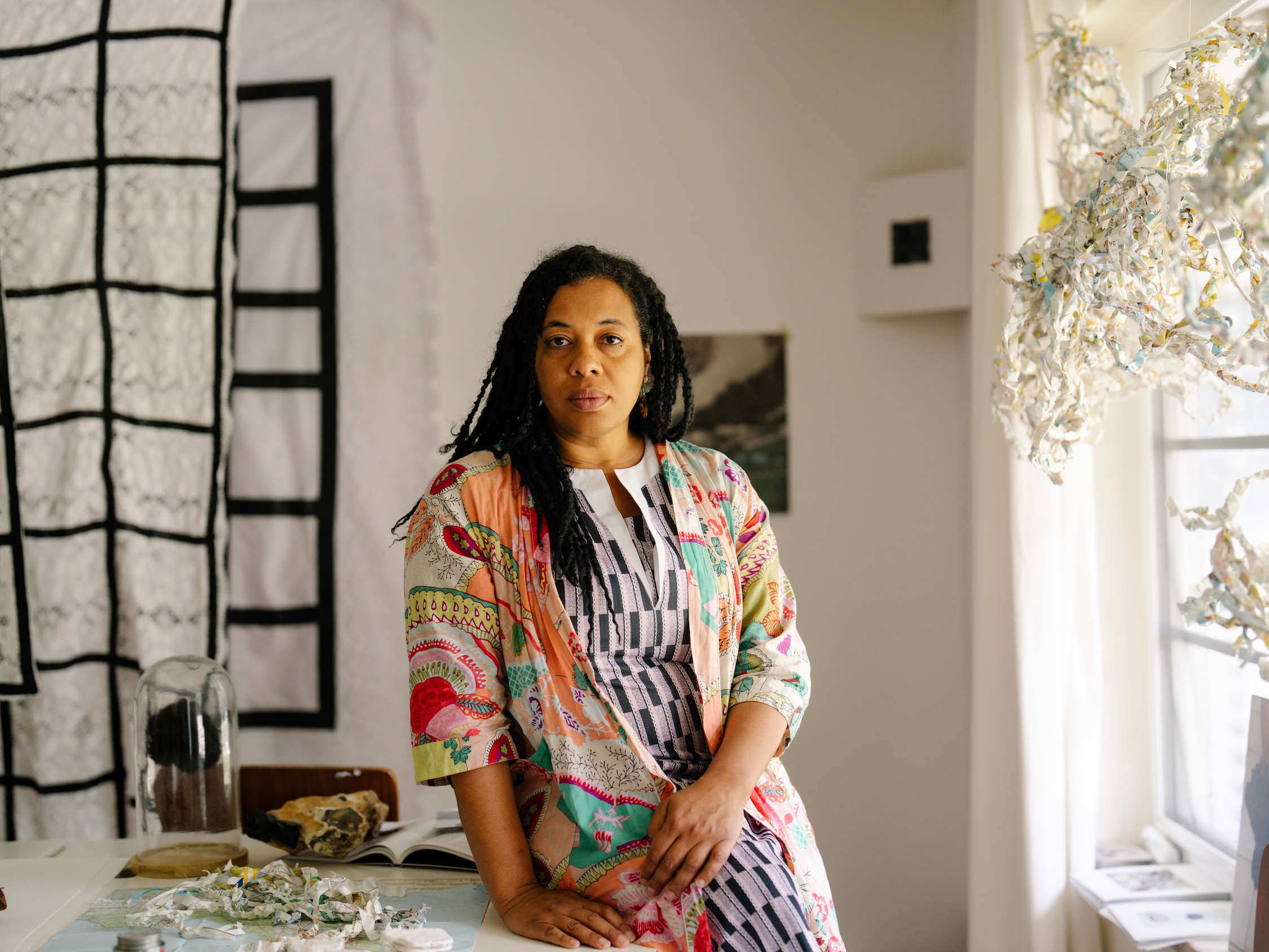
Sonia E. Barrett. Photo: Martina Tuaty
By CARLOTA GAMBOA September 25, 2025
For Sonia E. Barrett, sculptural work isn’t just about a physical container, but about an embodied conversation. Barrett’s site-specific installations—primarily using furniture, maps and most recently paper, hair and fibers—meditate with the materials. The London-based artist behaves as a catalyst for the objects she engages with, and creates a space for them to become witnesses and participants of the work, beings with their own voices, histories and desires.
Though Barrett began her creative life as a painter, selling her canvases to fund a trip to Berlin for an experimental summer program, furniture became her first major material almost by accident. With no studio to work in during her early MFA days, Barrett first turned to her own furniture as found object, leading the way to an intense trajectory around the de-objectification of overlooked post-colonial sites.
“I started with furniture because it was what I had,” Barrett says. “But when I looked closer, I realized these chairs and tables were already telling stories.” Barrett’s foundational sculptures began after noticing and doing research on 18th Century Queen Anne–style furniture, ornate pieces often seen with clawed feet or animal motifs.
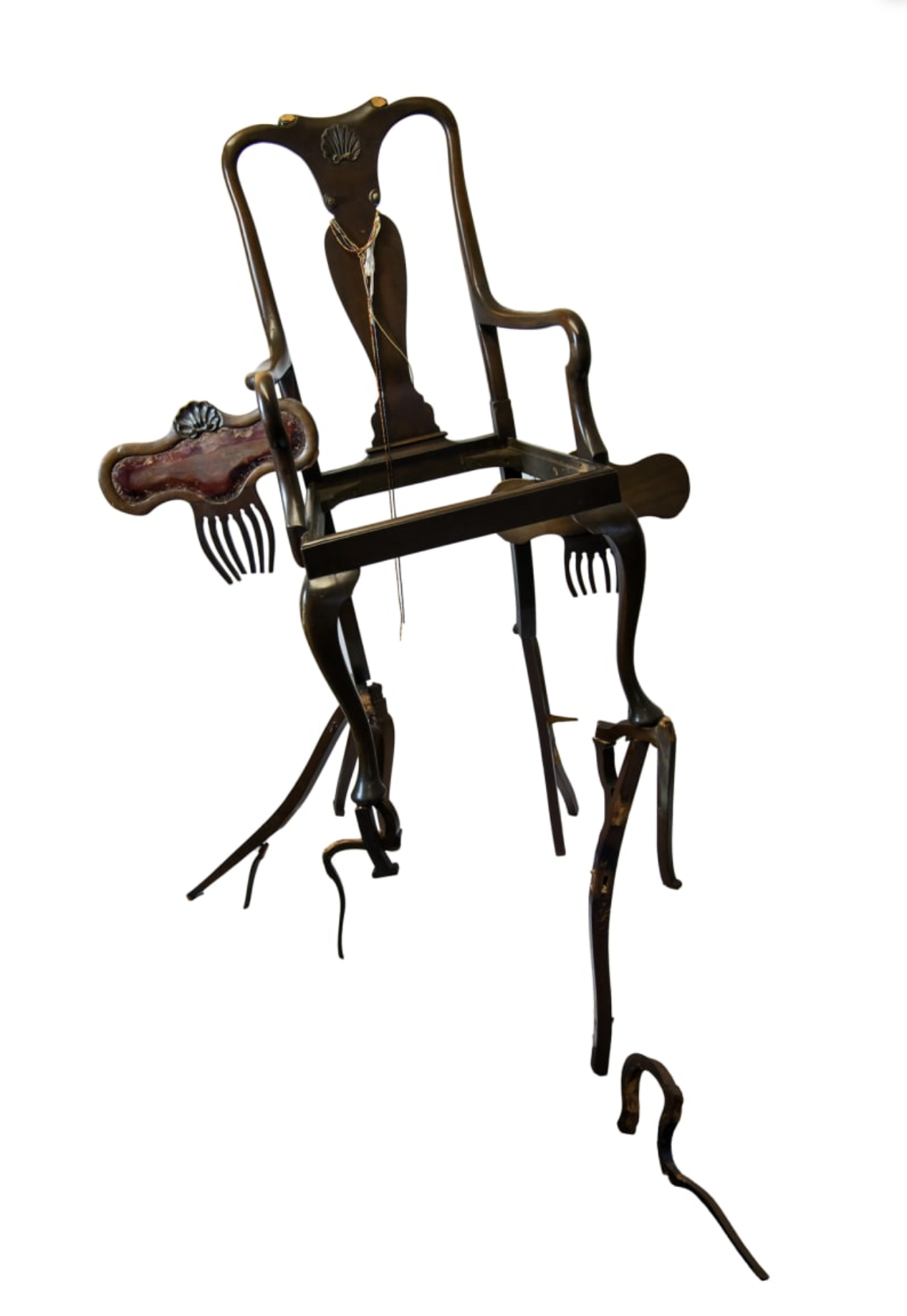 Chairs nr 40, 41 and 42, 2022, Mahogany chairs, African waist beads, 200 x 100 x 100 cm
“I found this one piece with tropical hardwood and lion’s feet carved into it. And I thought, hang on, there’s something here. I realized it was everything at once. It was a tropical hardwood tree, felled in the Caribbean to extinction. And then the wood was being shipped to Europe in the same boats that carried enslaved people.”
The realization of this relationship exposed terrain for Barrett to unpack. The significance of the shared experience between these two different iterations of brown bodies, as Barrett says, “both uprooted, both forced into new forms,” opened a space for the metaphoric landscape to be physicalized. This discovery of “a multi-species, multifaceted death,” created a marker of acknowledgement. The pieces have a sensation of persona, communicating messages through the fundamental shifts in their outward expression. Perhaps due to their resemblance to the body, or through their shared history with bodies, the work becomes a recovery site.
“I listen to every part of the furniture,” says Barrett. “I find out what it wants to do. Often, they just want to rest, to stop carrying all these bodies. They want to stop serving. They want to collectivize. And so in a sense, I’m creating that body for the impossible job of mourning all the people who were enslaved, who perished either in the Middle Passage or during capture or later at labor.”
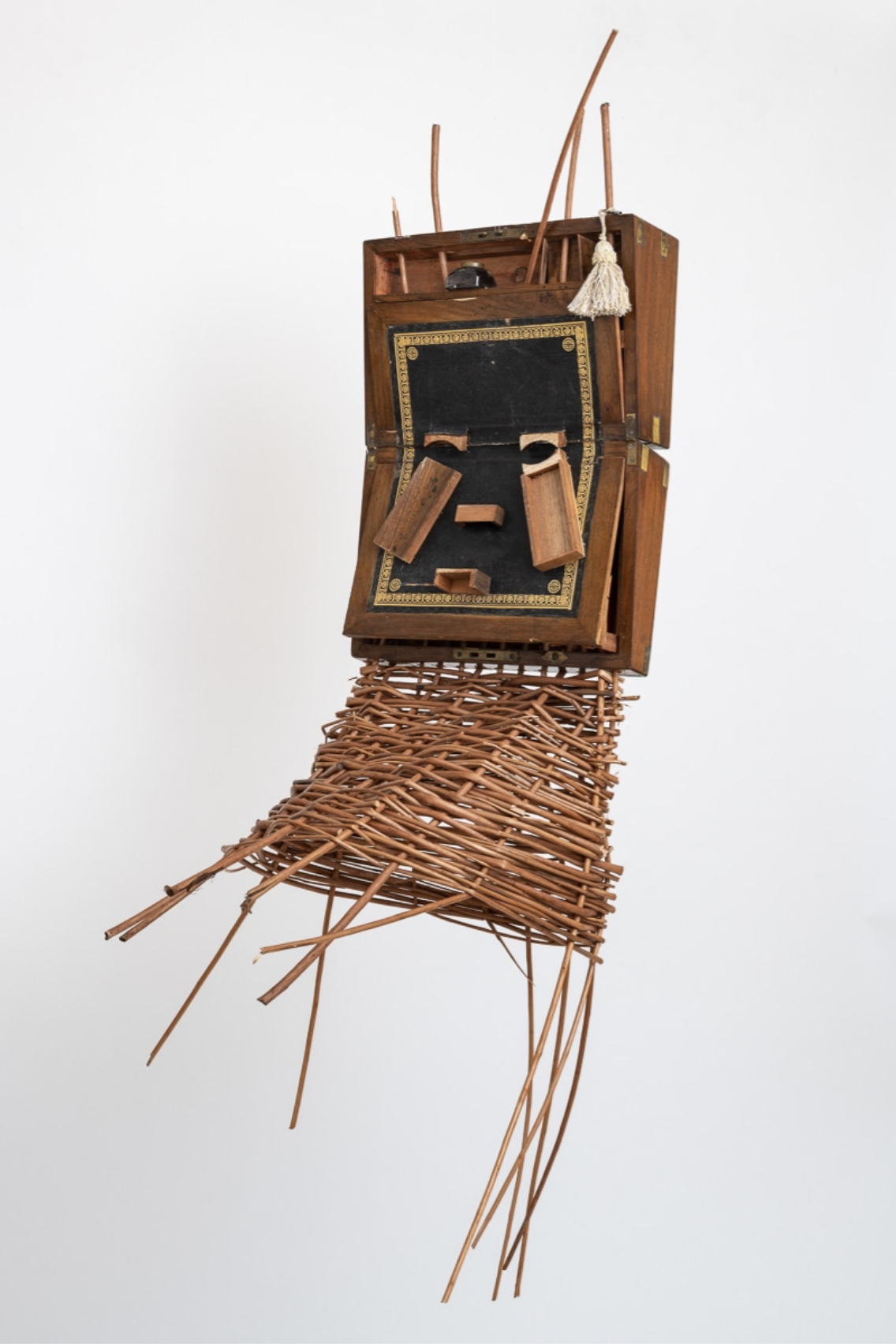 Desk number 6, 2021, Lockable Antique Portable Travel Desk, Mahogany, with embossed leather inlay, wicker, ink and key, 100 x 60 x 60 cm
Eventually, Barrett expanded upon the ideas found in her furniture series through lighter and more collective means. In 2020, Barrett staged a powerful intervention by shredding and braiding maps into a monumental hanging sculpture at the Royal Geographical Society. These were not just historical charts but also contemporary maps, transformed into flowing strands of paper and printed topography that looped through space. She worked on the project with a group of women during lockdown, finding a rhythm in the collaborative act of cutting and braiding.
“It became an actual critique of mapmaking.” Barrett explains, “because when you braid them, what you get is more holes than knowledge. And that’s our real relationship with the world, we hardly know what’s under the sea or in the soil. The sculpture makes that visible. But it also creates community.”
This collectivity was a much appreciated reprise for Barrett, after having worked with retiring furniture for so long. “We worked together, six women, for three days. We shredded, we braided, we ate together, we had music. And this was happening in the Royal Geographical Society, a huge, stuffy manor house in Central London. It felt radical. Offensive even. Shredding these maps in that space.” The sculpture became a way of holding that collective experience. It moved beyond knowledge-making and into care.
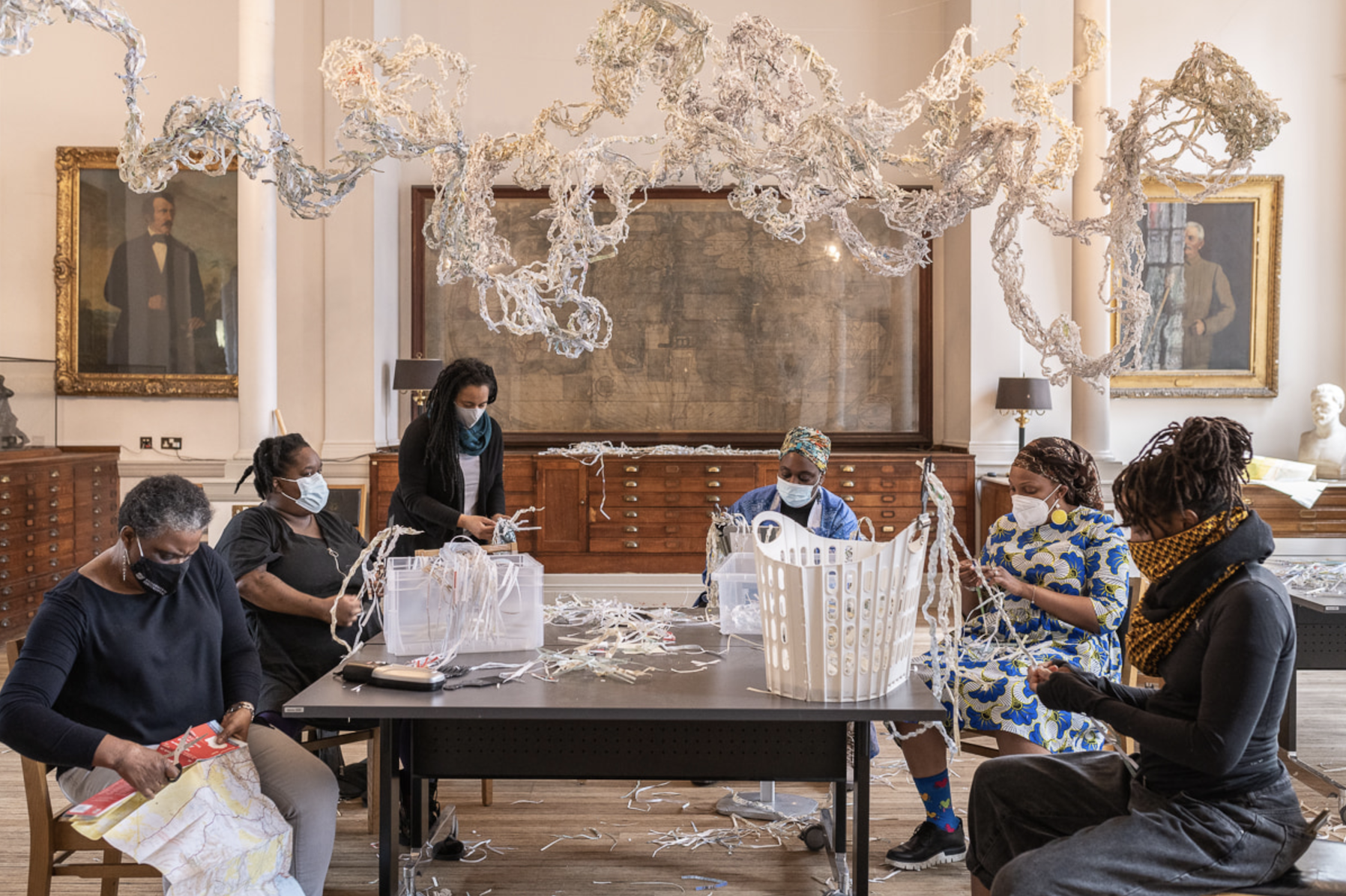 Dreading the Map, created as a map-lective, The Royal Geographical Society London, 2021, Antique dated and contemprary maps paper, string metal, 400 x 500 x 500 cm
The installation confronted that arrogance of completeness. Instead of flat surfaces and borders, the braided sculpture embodied movement and interconnectivity. It also reframed the institution itself and the histories being prioritized and centered within it. This ability to shift perception—to make people notice what was hidden in plain sight—is central to Barrett’s work.
It’s why she often calls her installations “interventions” rather than objects. They alter how a space feels, how an institution presents itself, how memory sits in a room. Even after they are dismantled, something lingers.
“Maps pretend to know everything,” Barrett continues. “They grid the world, fill in every blank square. But what about what moves through soil, or air, or water? What about the things that don’t count on the map?, Braided maps make those flows visible”
Though Barrett's recent work has been moving toward lighter materials, they still carry weight, both historical and emotional, while resisting the heaviness of her earlier furniture-based works. The shift feels both ecological and personal, a way of attending to materials without reproducing the same extractive cycles she critiques.
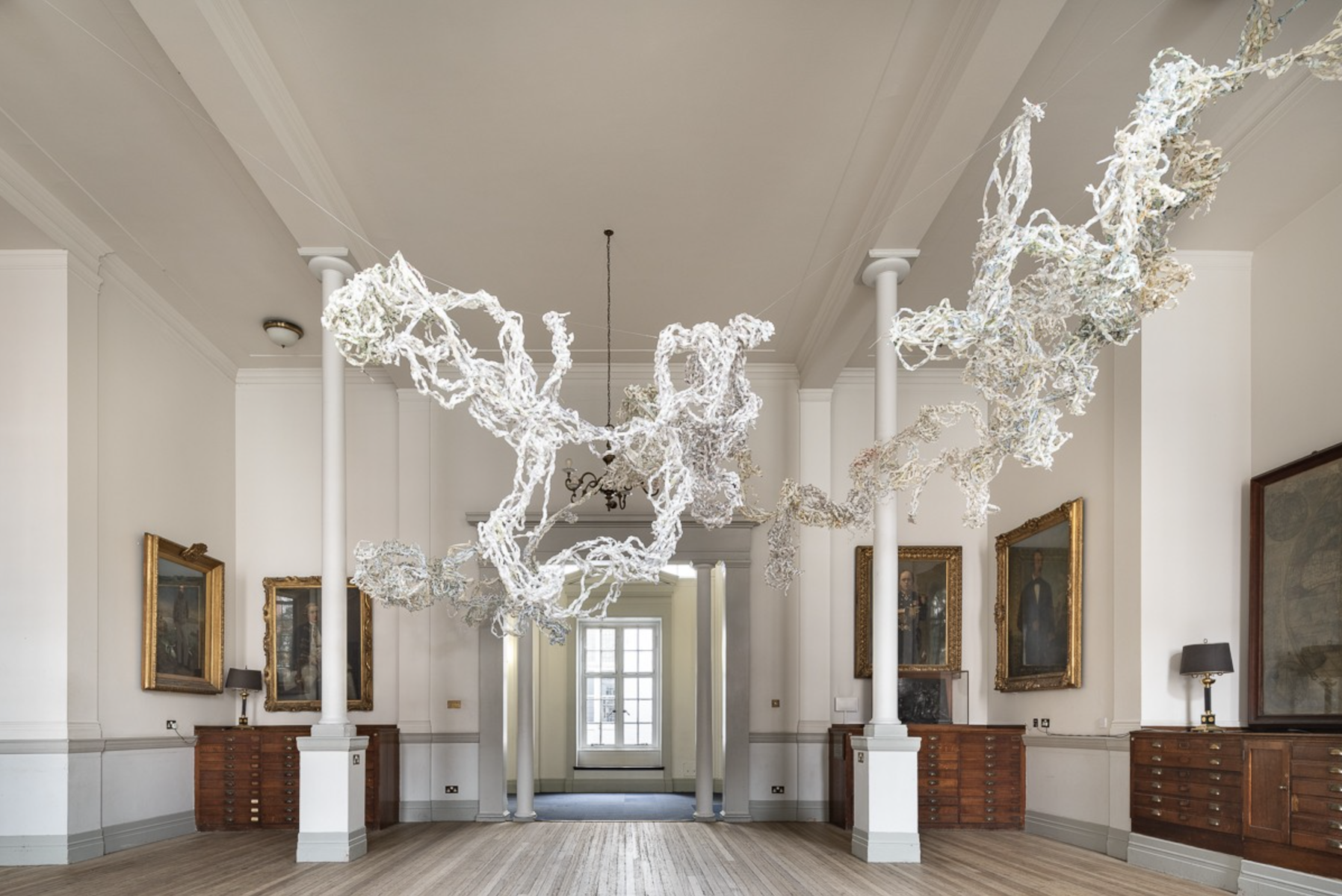 Dreading the Map, created as a map-lective, The Royal Geographical Society London, 2021, Antique dated and contemprary maps paper, string metal, 400 x 500 x 500 cm
Her career has been steadily expanding across borders. She recently completed 9 Nights, a commission for the City of London, and has exhibited in Dakar, Berlin and New York. This fall, she will begin a residency at Fountainhead in Miami before presenting new work in the 24th Bienal de Arte Paiz in Guatemala, working on a project that continues her commitment to the map series’ focus on collaboration and community.
Still, her ambitions remain consistent. Whether giving agency to an antique chair or an outdated map, Barrett is less interested in creating objects for their own sake than in reorienting how we see that object’s place in our world. She wants her work to disturb the narratives that institutions smooth over, to spark recognition where silence has prevailed.
In the end, Barrett’s sculptures are not about closure but about opening. They are invitations—to grieve, to remember, to notice, and to imagine otherwise. Objects that may seem fixed, she reminds us, can speak back.
To learn more about Sonia E. Barrett, please visit her website and follow her on Instagram @soniaelizabethbarrett

Carlota Gamboa
Carlota Gamboa is an art writer and poet from Los Angeles. You can find some of her writing in Art & Object, Clot Magazine, Salt Hill Journal, Bodega Magazine, Oversound and Overstandard.
view all articles from this author