Whitehot Magazine
August 2026
"The Best Art In The World"
"The Best Art In The World"
August 2026
Paz Sher’s Dumb Luck and the Familiarity of Damage
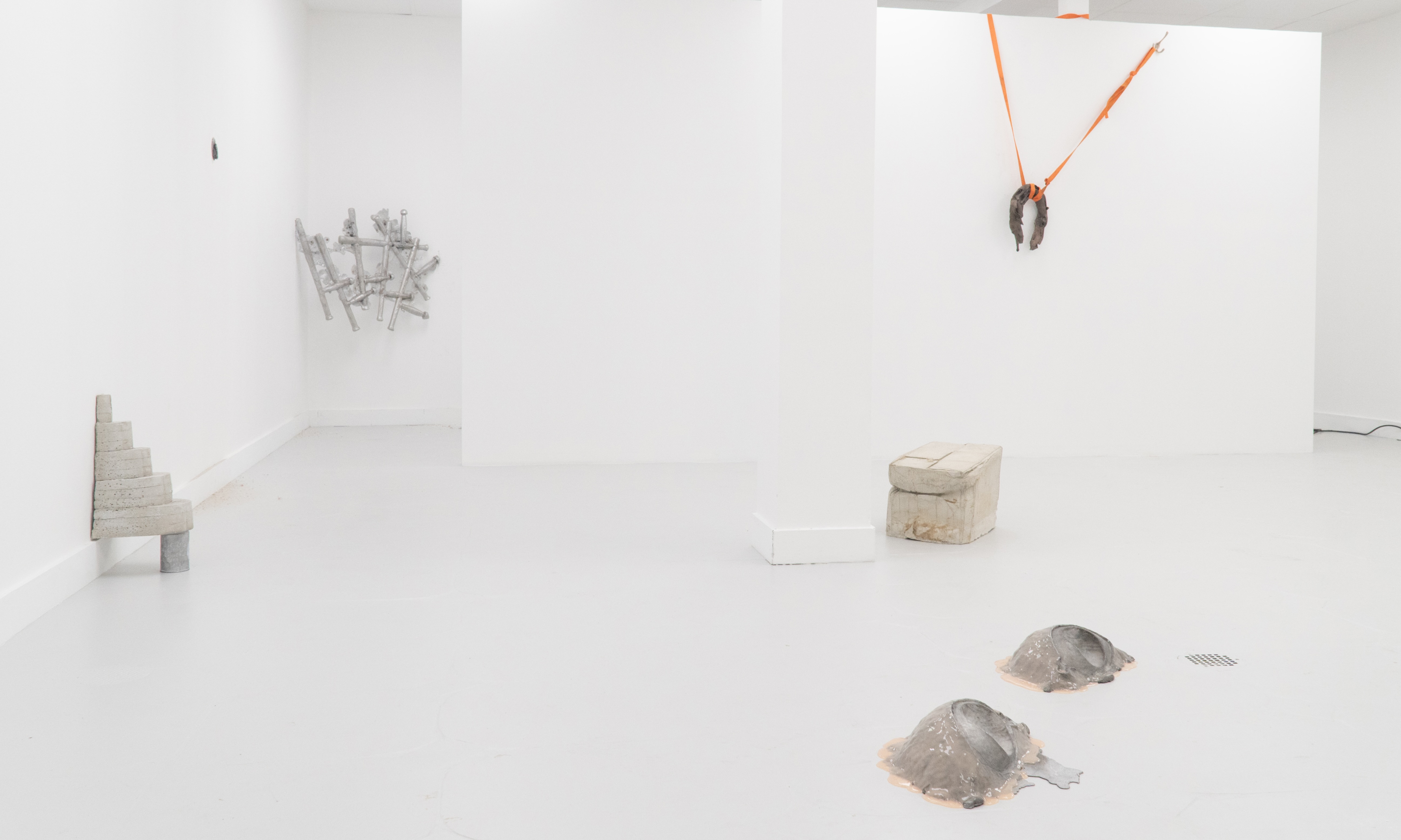 Installation view of Dumb Luck, New York. Artist: Paz Sher. Curated by Fanfan Yuxuan Fan. Courtesy of the artist and FanFlus.
By MER MORA August 27th, 2026
Anyone born in the 90s and after is familiar with the phrase “it’s the damn phone.” The first generations to grow up at the same time as the internet was setting its foot has heard their parents use that phrase to excuse their problematic behavior. And as social media keeps evolving its addictive nature through curated algorithms and consumerist trends, it has also transformed the way in which we receive information. We receive all types of information constantly, and as a result, we have become extremely desensitized to all of it. One second it's a video of a cute cat, the next a news report of the latest tragedy, then an influencer asking you to run, not walk, to purchase the next thing you need for fall. So maybe it is that damn phone. Or perhaps, more precisely, it is what the phone has taught us to accept: a world where destruction can exist alongside us without demanding our attention for very long, and as a result, becoming background noise to our everyday life.
Presented by the cross-cultural curatorial collective Fanflus, Dumb Luck is a solo exhibition by artist Paz Sher, curated by Fanfan Yuxuan Fan. Filling the basement of 29 Henry Street in Chinatown with sculpture, video, AI-generated imagery, and the destruction of the space itself, the exhibition stages a world built around the chaos that destruction leaves behind. The curator Fan frames this through Roger Caillois's concept of alea or pure chance, where the outcome is completely outside of the player’s control. In Dumb Luck, we do not witness this moment, though; we do not grieve the collapse of shared order. Instead, the exhibition traces what happens afterwards, how we have acclimated to its absence.
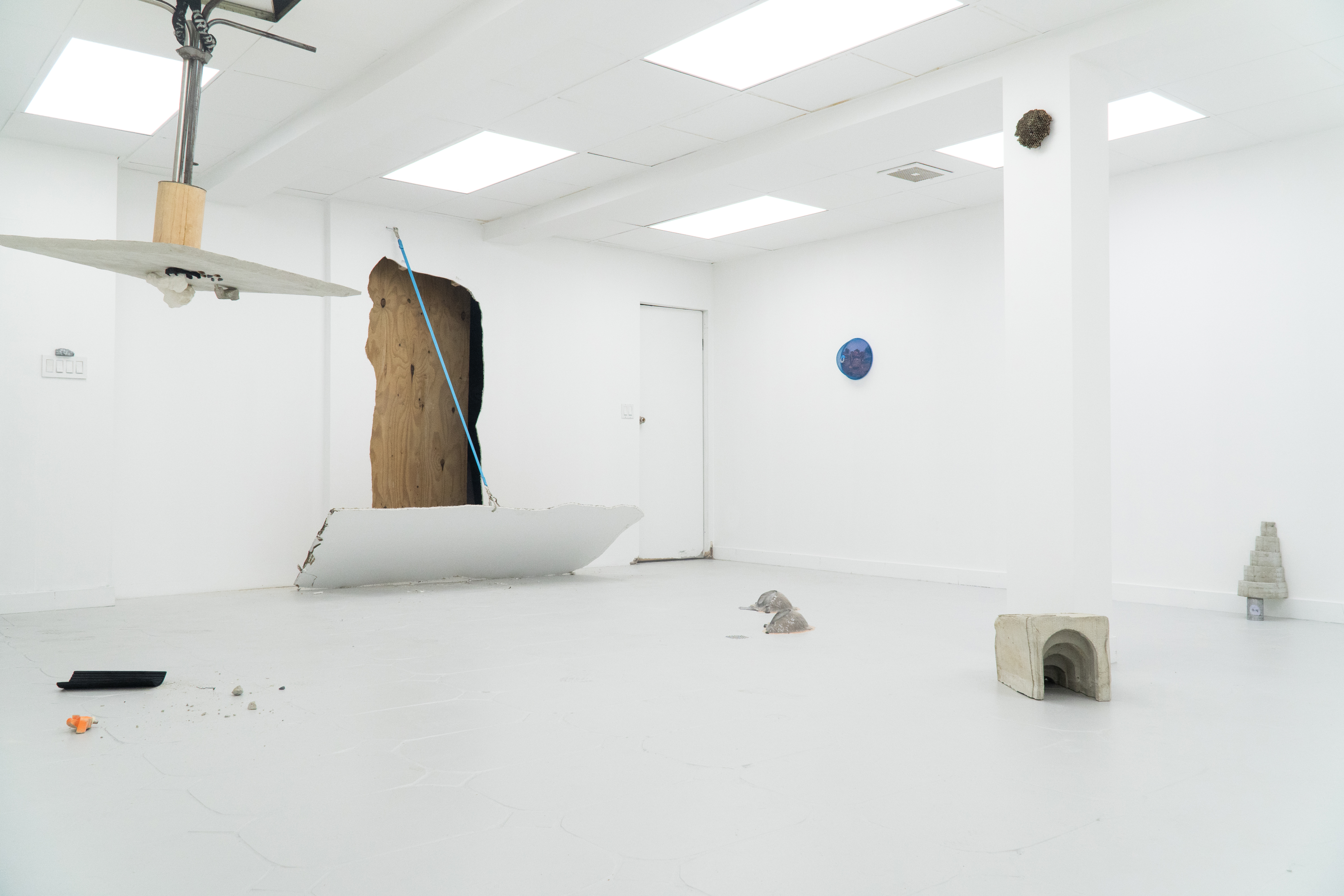
Installation view of Dumb Luck, New York. Artist: Paz Sher. Curated by Fanfan Yuxuan Fan. Courtesy of the artist and FanFlus.
A viewer’s first interaction with Dumb Luck prepares you to accept this new reality. Right at the entrance, Gambler’s Run (2025), a suspended table, hangs from the ceiling. Below lies the debris of the ceiling panel, which has been torn in order to hang the piece. This sculpture has already gone through some transformation, not only because it’s defying its original function by being unusable and upside down, but also because this is the second time it’s exhibited and in a completely different way. Previously, the work had been exhibited upright as a normal table would've, but here Sher completely strips it of its purpose and adapts it to a new reality in which destruction has become part of it. Presenting it in a space with a bright white floor and walls—which neutralize the disruption around it—Gambler's Run camouflages itself into the space.
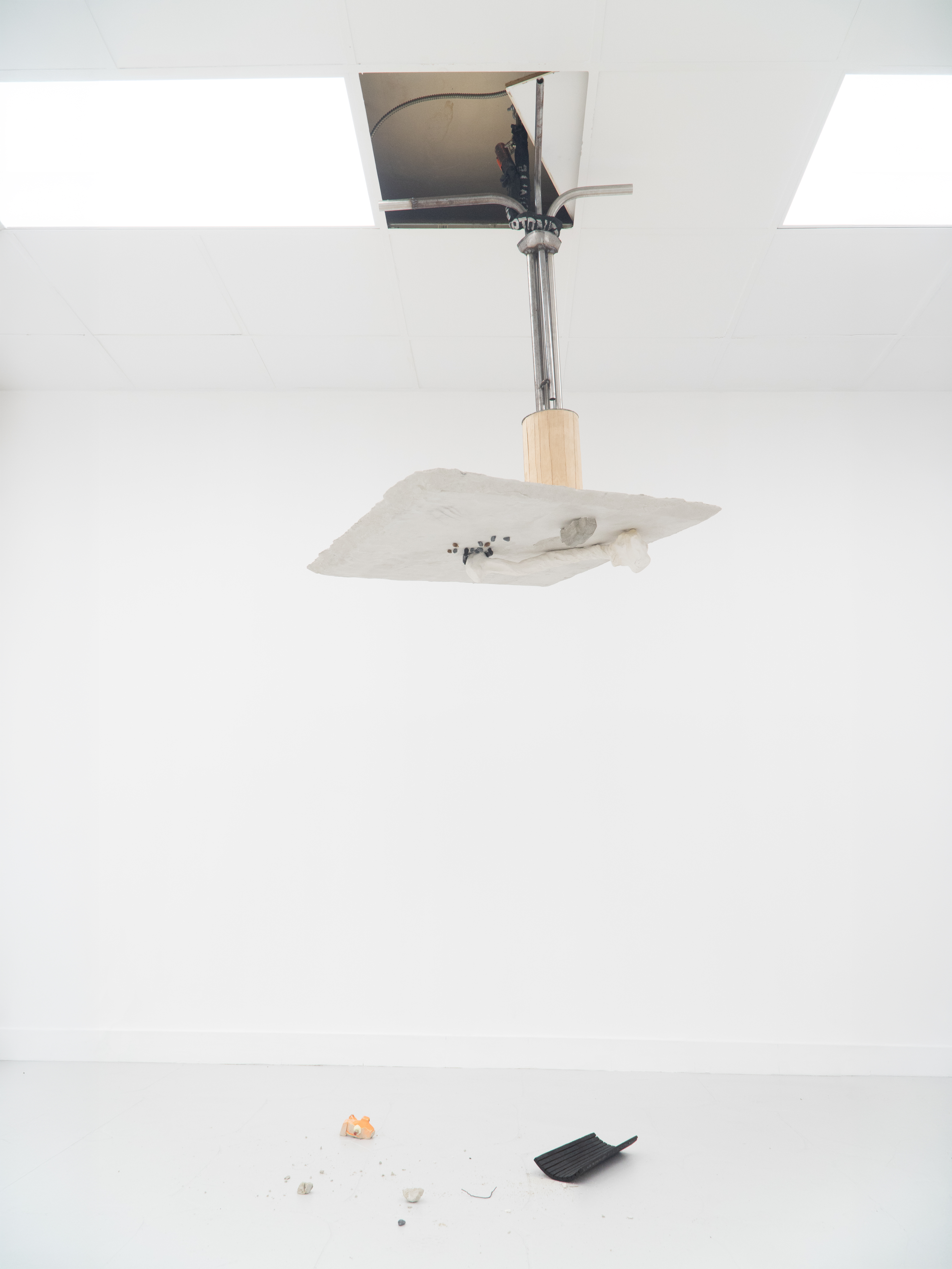 Gambler’s Run, 2025. Installation view of Dumb Luck, New York. Artist: Paz Sher. Curated by Fanfan Yuxuan Fan. Courtesy of the artist and FanFlus.
In Cross Tied (Sculpture) (2026), the darkened cast in the shape of a horseshoe hangs by orange ropes against a white wall. The wall stops a few inches below the ceiling, allowing a tense orange rope to go to the other side, where something is holding it down. On the opposite side, a TV screen plays Cross Tied (2026), the video of a horse standing in the middle of a stable tied by ropes, looking directly at the camera and making repeated and slow movements. That tension is what keeps the works existing in perfect symbiosis; it looks stable, which is what keeps you from noticing that the works would easily collapse the moment this pull disappears. Exposing what Gambler’s Run was hiding, Cross Tied reveals how acclimation is not really passive; something always has to keep being in tension somewhere for the appearance of order to continue.
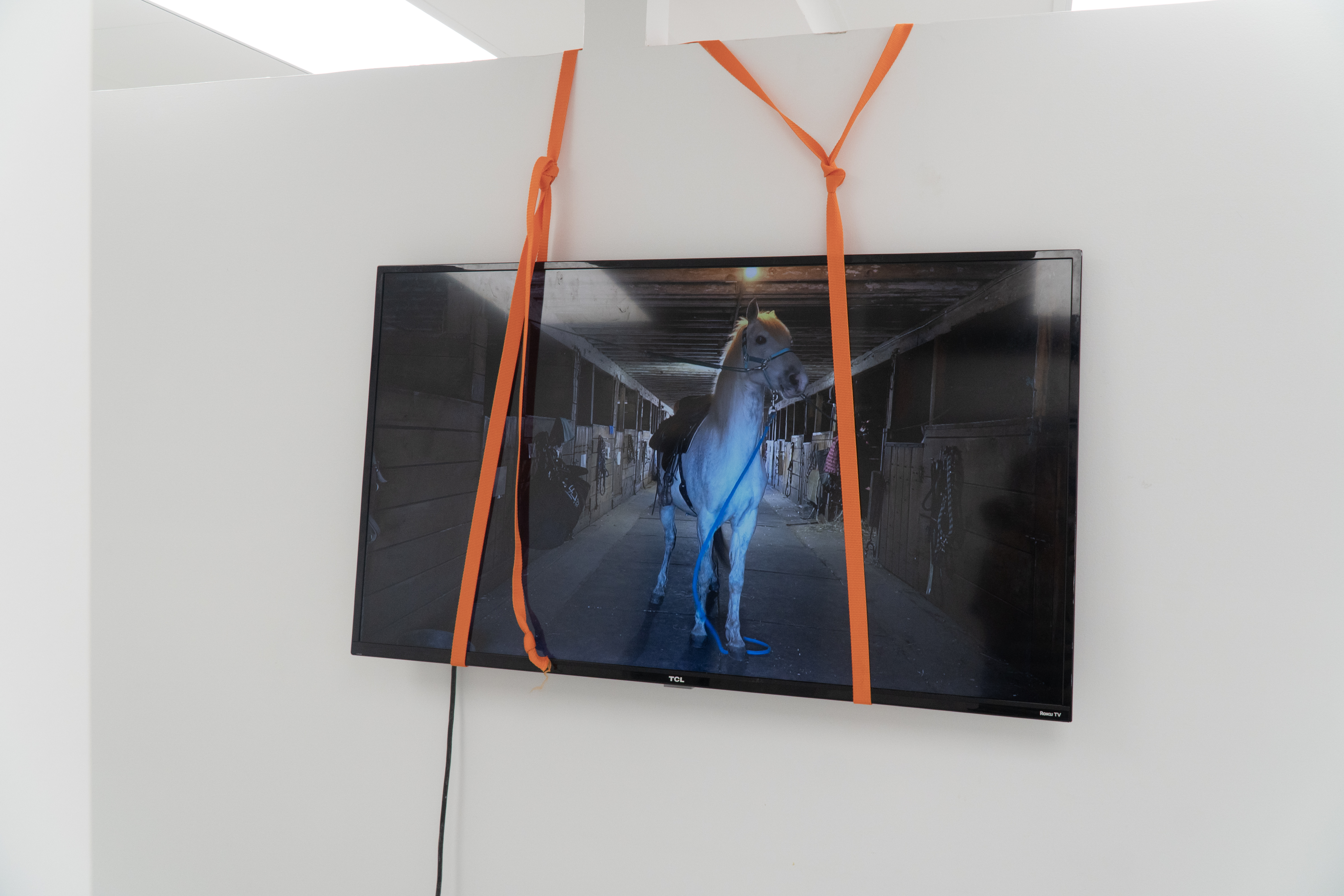 Cross Tied (video), 2023. Installation view of Dumb Luck, New York. Artist: Paz Sher. Curated by Fanfan Yuxuan Fan. Courtesy of the artist and FanFlus.
It is Untitled (Wall) (2026) where we first see a tear that forces us to confront an uncomfortable truth. Part of the wall is completely torn apart, and the remaining wall is held by a strap, not fully letting its undoing take place. The drywall opens slightly to reveal the inside of the wall and the structural part of the building. Within that space surrounded by dust and the obscurity of the interior, there are five AI-generated images hanging from a thread, and on the floor lies Head Birth (2026), a head split at its center with a metal rod piercing one of its eyes.
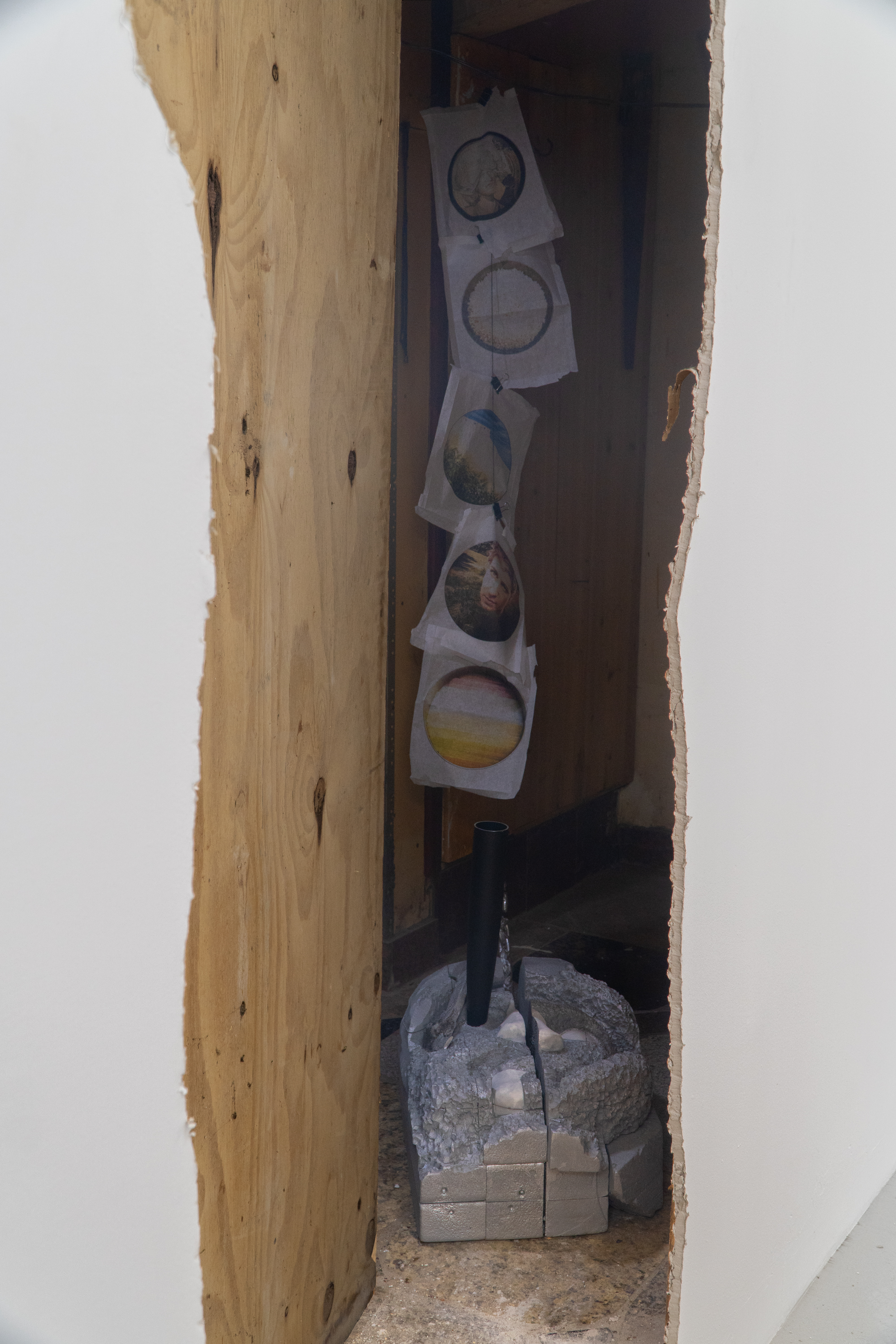 Head Birth, 2026. Installation view of Dumb Luck, New York. Artist Paz Sher. Curated by Fanfan Yuxuan Fan. Courtesy of the artist and FanFlus.
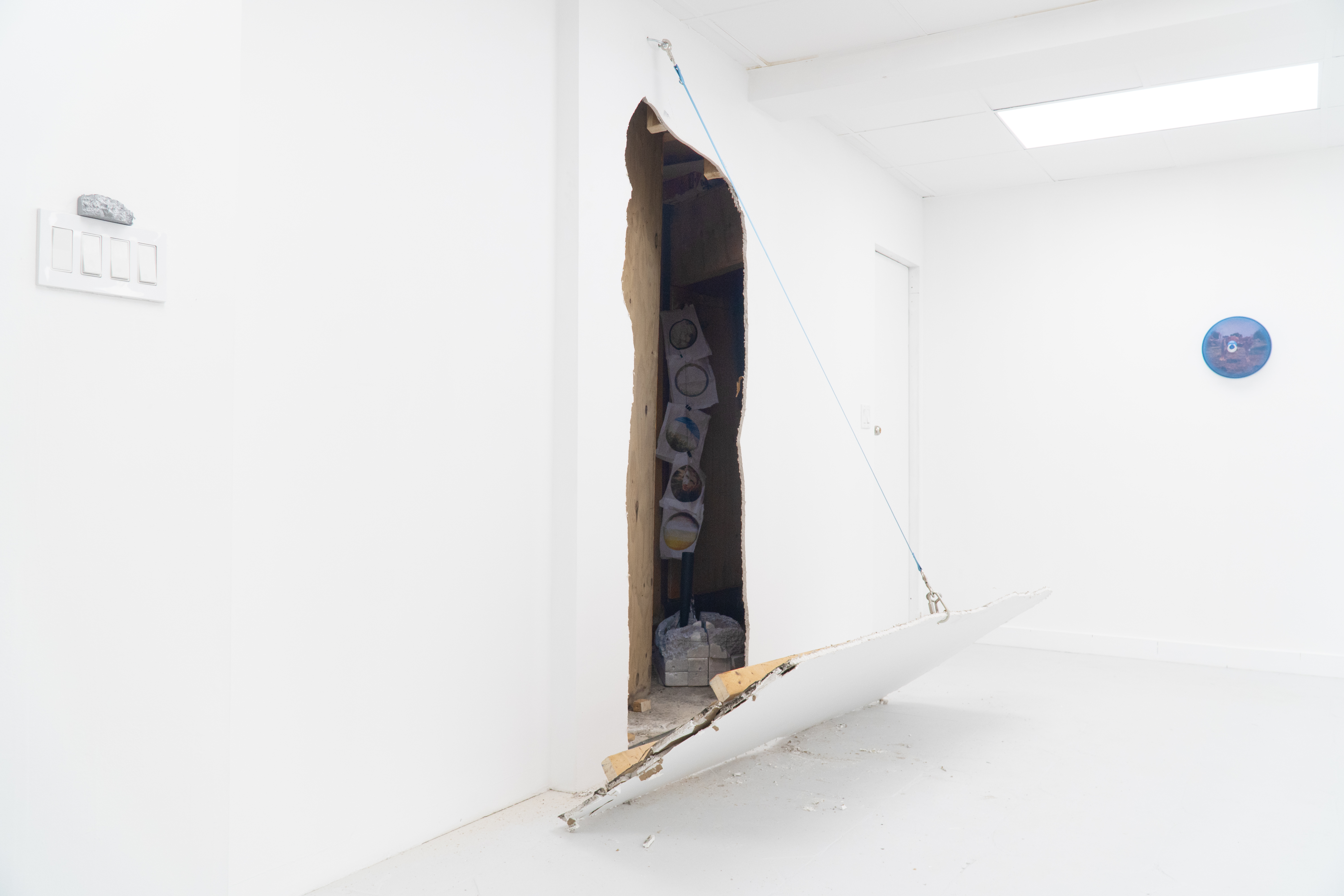 Untitled (wall), 2026. Installation view of Dumb Luck, New York. Artist: Paz Sher. Curated by Fanfan Yuxuan Fan. Courtesy of the artist and FanFlus.
There are moments like these where the viewer gets the chance to see through the carefully constructed surface to take a look at what's holding it together. Untitled (Wall) does this literally by ripping apart the space and exposing the dust and cement behind it. It’s abrupt, violent, and exposed, making it hard to look away against the neutrality of the rest of the space. But Sher also creates violence in objects that might be more familiar. In Untitled (Corner I) (2023), a stack of batons, modeled directly after police batons, are stripped of their original purpose to create what looks almost like a sculptural mass. The violence that is innate in their purpose hasn’t really disappeared; it has just been rearranged. What surfaces here is a rare moment of clarity in what has become assimilated, how violence has become familiar enough to disappear.
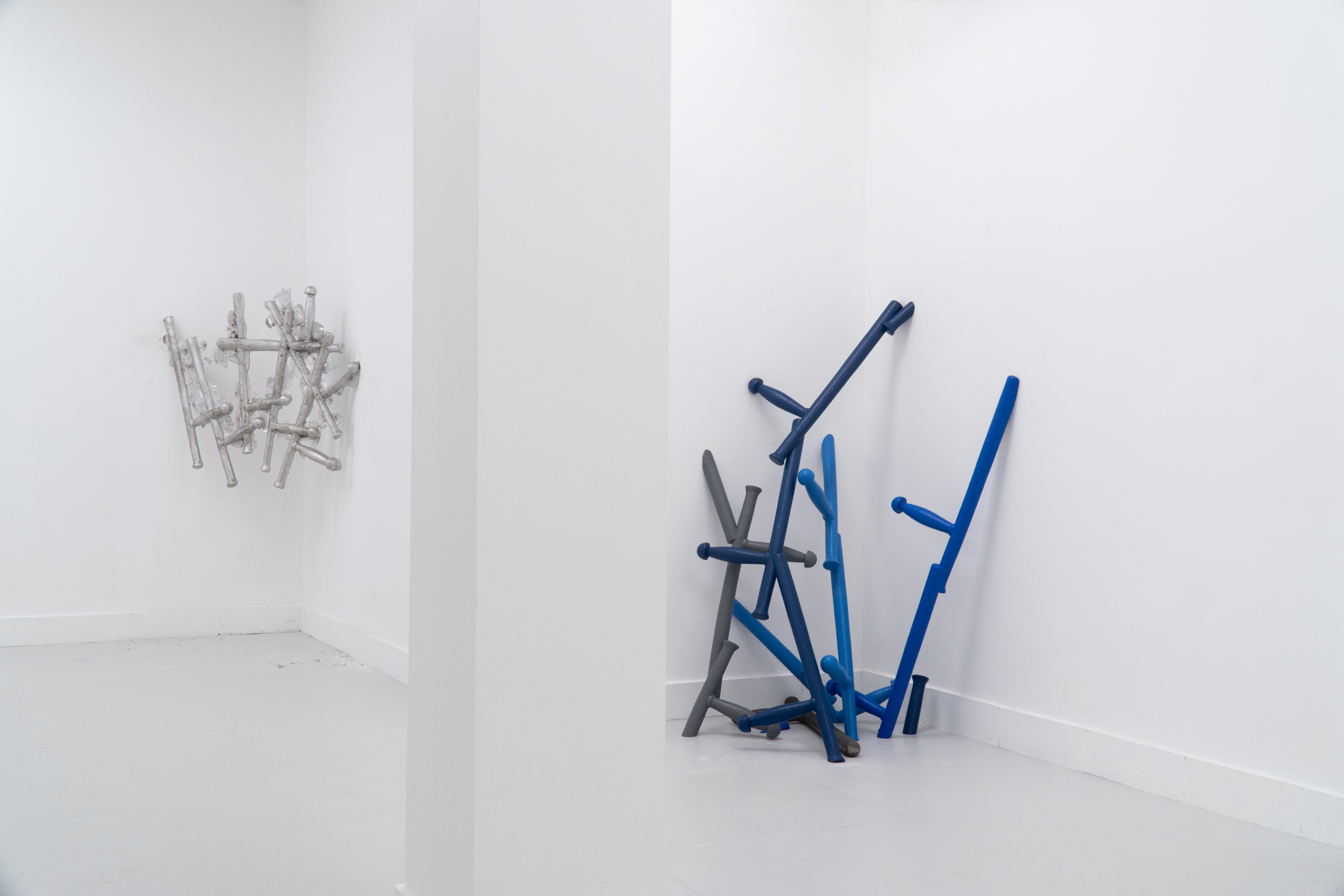 Untitled (Corner I & II), 2023. Installation view of Dumb Luck, New York. Artist: Paz Sher. Curated by Fanfan Yuxuan Fan. Courtesy of the artist and FanFlus.
In Temporariness (2026), a metal can with the Chinese characters 临时––meaning “temporary”––written on it, holds the weight of a cast made directly from Descending Order of Permanence (2026). The work brings together two opposing ideas: permanence and impermanence, but in this show they aren’t really presented as opposites. We see a wall torn apart, a table upside down, familiar objects reshaped by conditions that this space treats as ordinary. Even the meaning of a word can shift when it moves between languages. The curator Fan and Sher, who are both not native English speakers, settled in writing 临时 through a process of moving between Chinese, Hebrew, and English, in search of the right way to describe something that does not last. Like the exhibition itself, nothing in the space is fully stable, but nothing has fallen apart either. We simply learn to live with things in their altered state. In Dumb Luck we might have a glimpse of what acclimation looks like: learning to exist with the uncertainty and destruction that are out of our control.
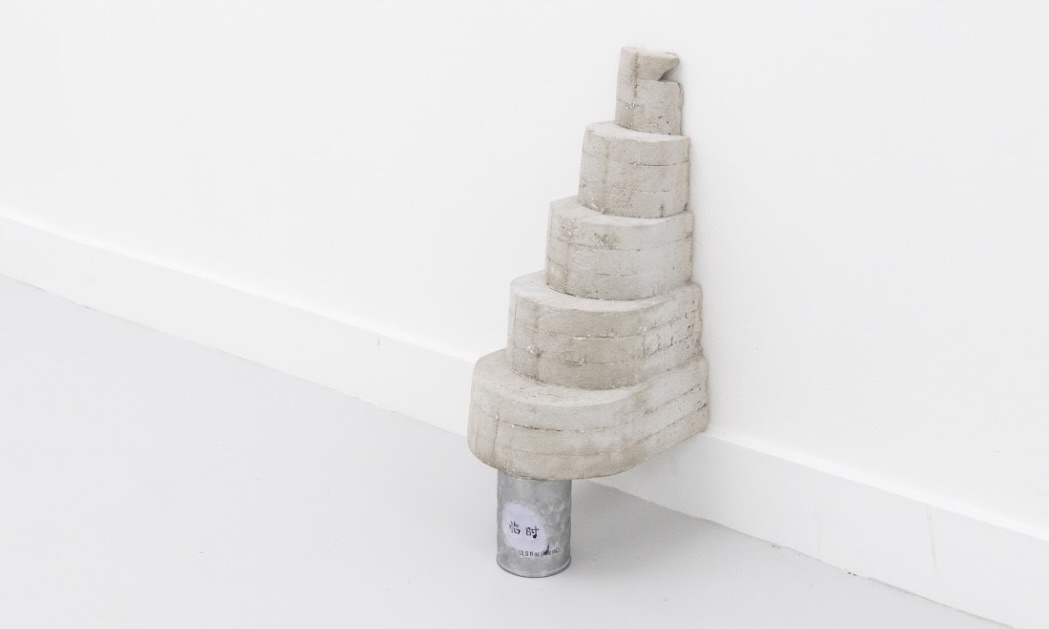 Temporariness, 2026. Installation view of Dumb Luck, New York. Artist: Paz Sher. Curated by Fanfan Yuxuan Fan. Courtesy of the artist and FanFlus.
Dumb Luck is on view at 29 Henry Street through September 1st, 2026.
Mer Mora
Mer Mora is a New York City–based writer and communications professional. Her writing has appeared in art and gaming publications, including IMPULSE, Critic's Chronicle, TUSSLE, Art Spiel, Unwinnable, and GameObserver. She holds a BA in Art History from the Autonomous University of Barcelona and an MA in Visual Arts Administration from New York University.
view all articles from this author