Whitehot Magazine
September 2026
"The Best Art In The World"
"The Best Art In The World"
September 2026
Brittany Markert Doesn't Photograph Dreams - She Builds Rooms for Them
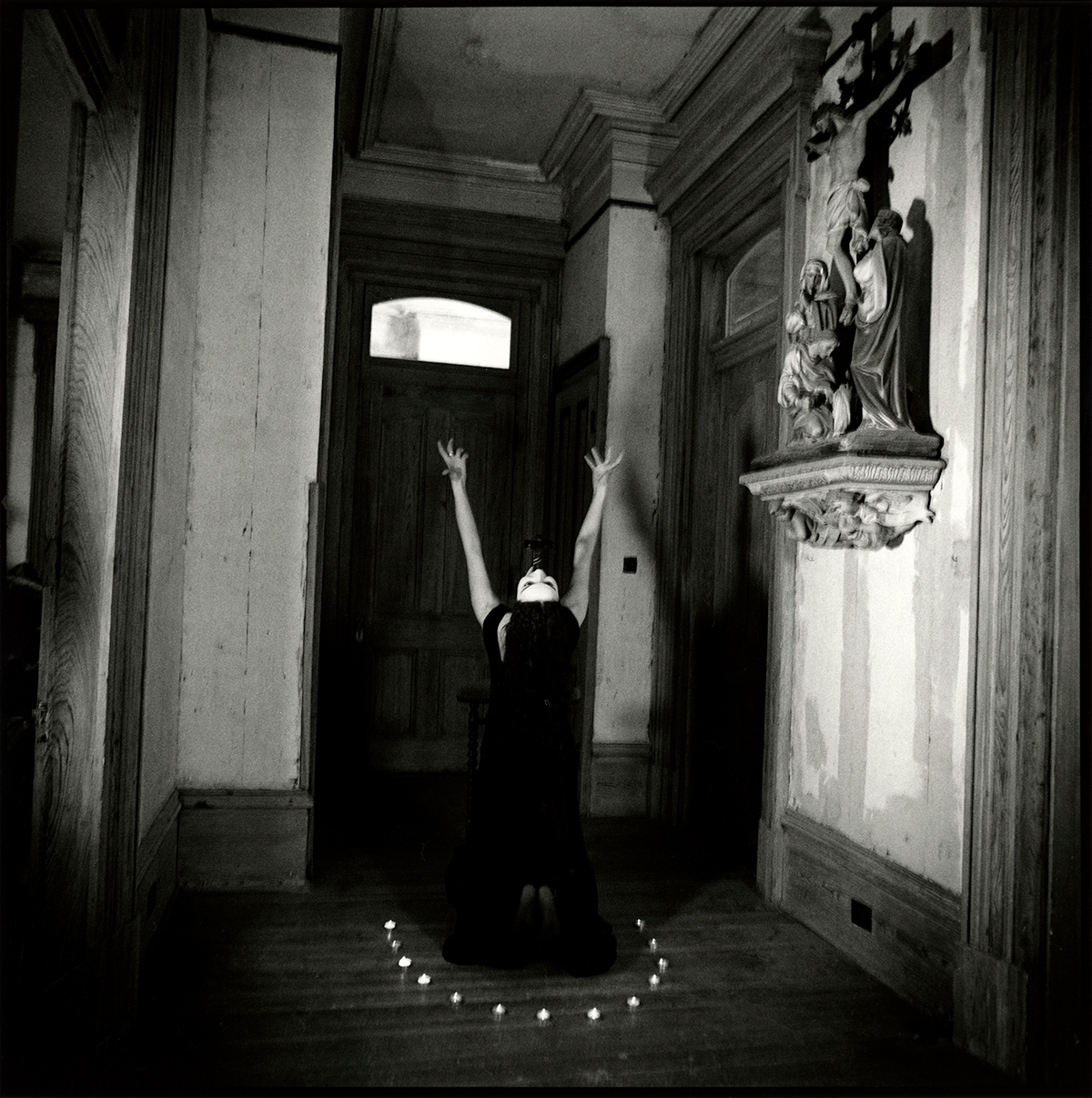
The Uprising, featuring Abby Holgerson, 2024, Silver gelatin print
By Carlota Gamboa, July 17, 2026
Long before In Rooms became a twelve-year photographic series, visual artist Brittany Markert already knew its name. The title arrived years before the work itself—before New York, before the darkroom, before she could have imagined the project would become a consistent satellite of her craft. She knew only that she wanted it to exist as "its own unique world," a space as self-contained and idiosyncratic as the influential Twin Peaks and The Twilight Zone.
More than a decade later, In Rooms has grown into an expansive body of black-and-white photographs, artist books, experimental films, and an evolving archive of symbols through which Markert continues to investigate what she calls "the hidden realms of life."
“I've always been curious about what's underneath the surface,” she says. Her images move into uncomfortable positions in order to explore such a subterranean place. Diving into Jungian archetypes, social and political metaphors, Markert’s questioning curiosity builds itself a teetering landscape.
Raised in Orange County, California, Markert describes becoming an artist as something of an anomaly. Contemporary art wasn't part of her upbringing. In lieu of a formal exposure to museums or art history, she gravitated toward ghost stories, haunted houses, and the strange emotional charge of places that seemed to hold invisible histories. Holding just as much tangible emotionality as a classical painting, photography entered her life through family albums—objects handled, revisited, and passed between generations. “I grew up with the idea that the image was an object,” she says. “It was something to share, and it evoked memories.”
 Secrets, featuring Brittany Ball, 2024, Silver gelatin print
The photographs found In Rooms refuse straightforward narrative. Draped figures emerge beneath translucent plastic. Bodies dissolve into domestic interiors. Familiar rooms become stages where memory, ritual, and fear quietly overlap. Rather than illustrating Jungian theory, the images operate through suggestion, asking viewers to inhabit uncertainty rather than resolve it.
In the 2024 piece Secrets (featuring actress Brittany Ball), the image stages the body as something both compartmentalized and unknowable. Seated in the narrow throat of a hallway, the figure appears almost childlike, dwarfed by the domestic architecture that encloses her. The perspective compresses the space until the walls seem less like shelter than a psychological pressure, pushing the eye toward the scattered doll pieces, gesturing toward either (or dually) reproductive expectation and subversion. As though the inherited associations we have toward womanhood are being continually taken apart and reassembled.
Markert’s pieces are quietly gruesome and theatrical, possessing the strange stillness of relics. Inspired by photographers like Diane Arbus, whose camera she admired as a tool for entering unfamiliar worlds, Markert began building an increasingly intuitive practice. She created questionnaires for subjects, filled notebooks with observations from books and films, and slowly developed a symbolic vocabulary that expanded alongside her own life. Even now, after more than a decade, she resists arriving at fixed conclusions.
 Wrapped in Plastic, featuring Angel Monsoon, 2025, Silver gelatin print
Looking back at the work’s trajectory, Markert resists describing the series as something she consciously planned. "Initially, I really didn't know what I was getting myself into," she says. "It came out of me like a calling." She speaks about the work less as a project and more like a discovery. For Markert, photography gradually became less about making pictures than about asking questions she couldn't otherwise answer. "I still stay open," she says. "I try to be intuitive and not exactly know where I'm going." That openness has allowed In Rooms to evolve organically and find a devoted audience.
What began as individual photographs gradually became a continuous visual dialogue, each image informing the objects found in the previous or following iterations. "Without really understanding it," she says, "it became a source of stability for my psyche, for my nervous system. I would always return to thinking about this series. If the series kept going, that meant I always had something to do. It kept me moving. It kept me alive. It kept me believing in something when nothing else really made sense."
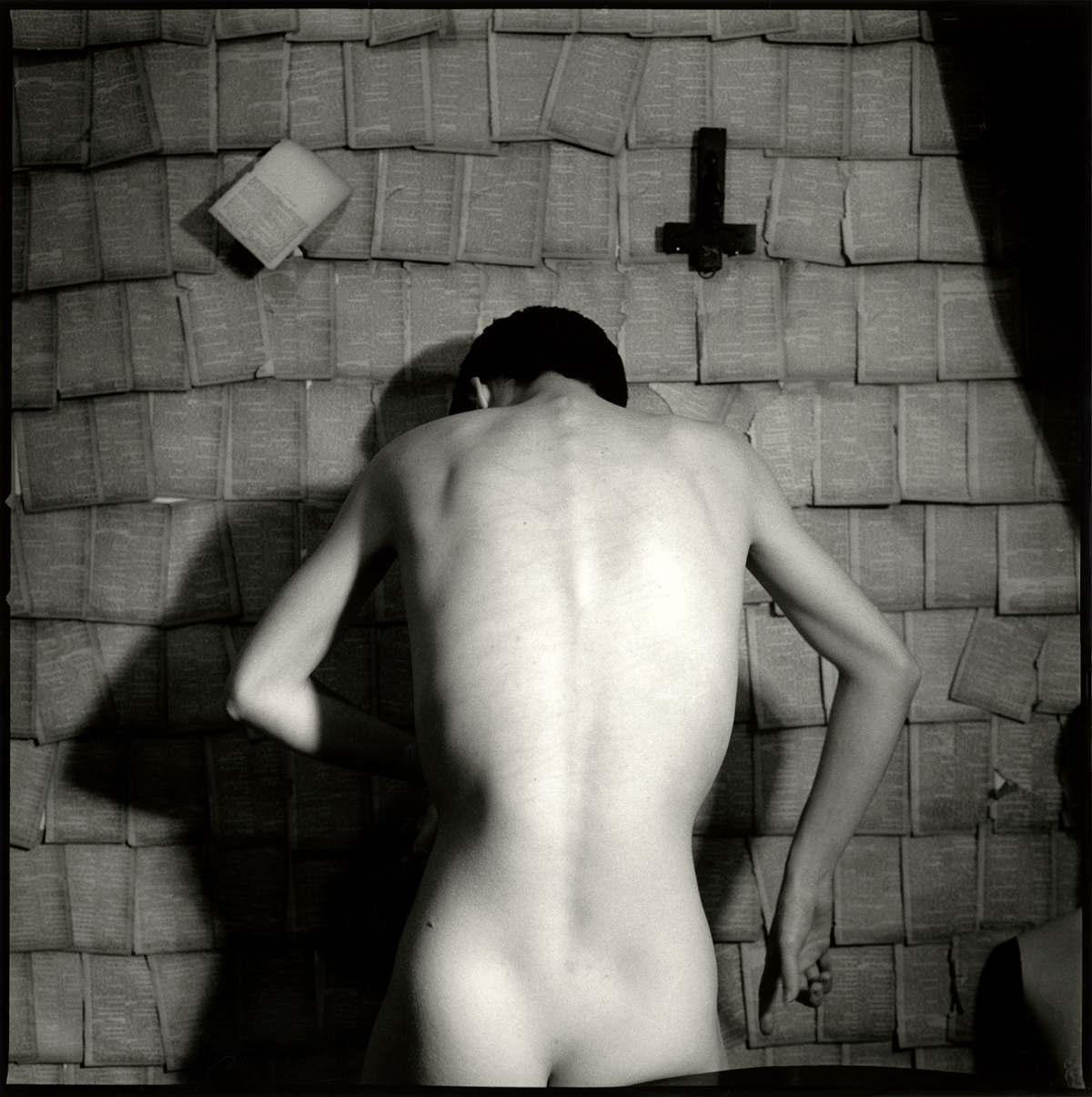 As Below, 2017, Silver gelatin print
Viewers often experience In Rooms as dreamlike or surreal, but Markert describes its function in remarkably practical terms. The work gives shape to uncertainty. As long as the project continues, there is always another photograph to make, another book to assemble, another room to enter.
Now, twelve years after she first imagined its title, Markert finds herself entering a different chapter. Having completed the third volume of In Rooms, alongside an experimental film, her attention has begun shifting toward teaching, writing, and mentorship. She is currently developing an arts foundation that will create space for artists seeking guidance outside the hierarchies and market pressures that often define creative careers.
"There aren't really a lot of artist-led spaces where artists can go to receive support or guidance," she says. "I'd love to help other artists feel more aligned to their own voice and deepen their own practice. It feels like I'm entering a new chapter."
 Put on Your Face, 2024, Silver gelatin print
After all, In Rooms was never simply a photographic project. From the very beginning, it was a place—a world Markert entered before she fully understood why. Over the years, that world has expanded through books, film, writing, and now education and community-building, without ever abandoning the intuitive impulse that first brought it into being. In Rooms stands as a microcosm for the internal spaces we return to, over and over again, discovering something each time we enter.
To learn more about Brittany Markert and her work, please visit her website and follow on Instagram @_inrooms

Carlota Gamboa
Carlota Gamboa is an art writer and poet from Los Angeles. You can find some of her writing in Art & Object, Clot Magazine, Salt Hill Journal, Bodega Magazine, Oversound and Overstandard.
view all articles from this author