Whitehot Magazine
October 2026
"The Best Art In The World"
"The Best Art In The World"
October 2026
Life/line: Willem de Kooning Drawing at The Art Institute of Chicago
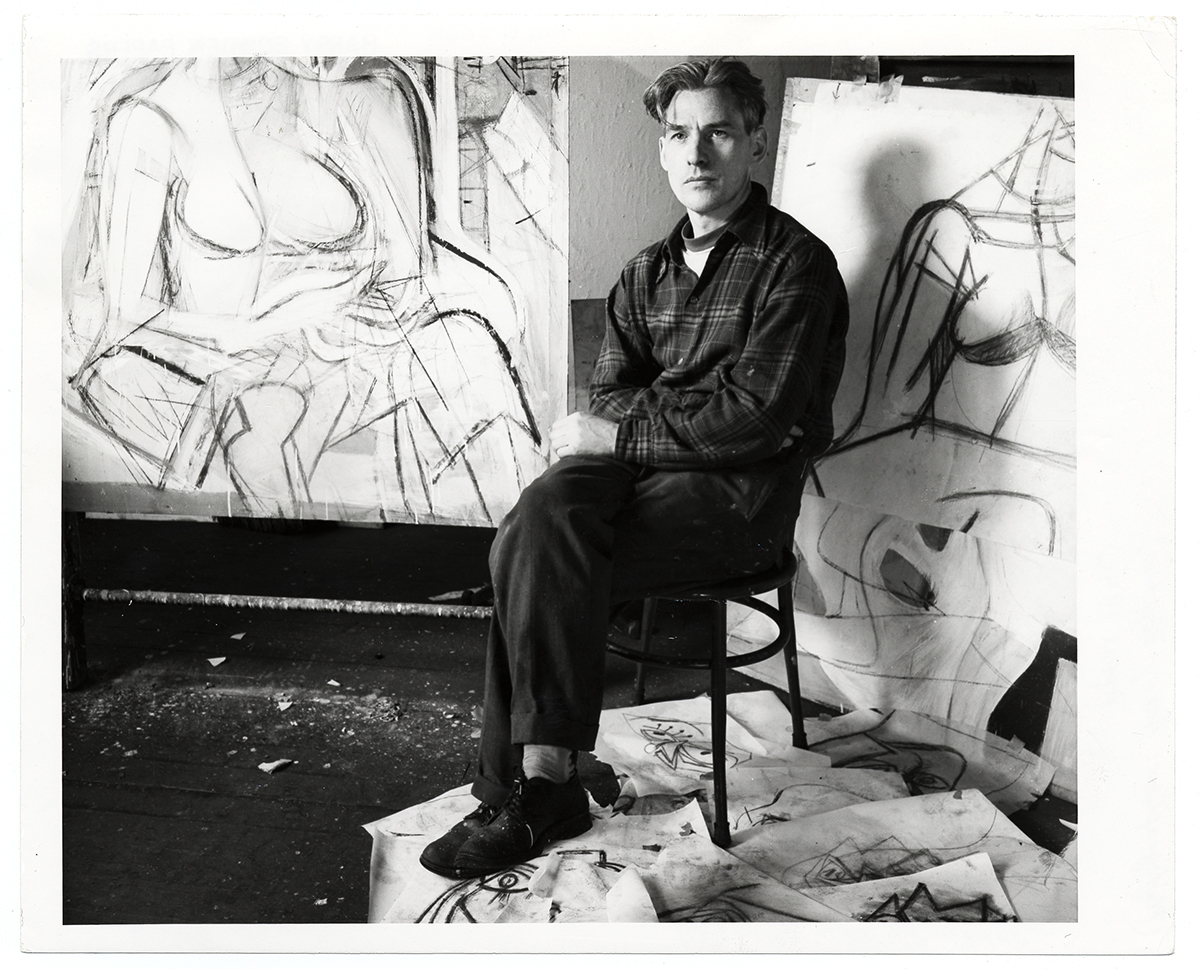 Willem de Kooning sitting with charcoal drawings scattered on the floor in his studio at 85 Fourth Avenue, New York, 1946. Photograph by Harry Bowden.
By KURT COLE EIDSVIG August 29th, 2026
Willem de Kooning Drawing is the story of a line. A line that pushes forward the whole of art history while expanding into an emblematic painterly shape. Not line as a system of measure (think Walter de Maria’s Broken Kilometer), or line as an archaeological rendering of trajectory (like Keith Haring’s elbow- and knee-shaking dancing figures), but rather a line with a twisting, oozing, and spreading natural fury that sheds, swells, and grows. A singularly unique, transformative, and magnificent line. A line with a life of its own.
Under the umbrella of de Kooning's practice of drawing, the exhibition lets us watch this line move from the basic act of mark-making and art creation into an energized organism; a mobilized entity. Willem de Kooning Drawing extends far beyond conventional definitions of drawing as we experience this line morph from a masterful tool of photorealistic depiction into an iconic emblem of the seismic cultural shift that Abstract Expressionism became. Featured in over 200 works, punctuated in sculptures, and celebrated in painted canvases like Excavation, Pink Angels, and Woman I, the line featured in the Art Institute’s landmark exhibition might as well be the tracks beckoning below The Little Engine That Could. This line is the edge of a butterfly wing forming deep inside a scribbled mass of cocoon. This line is the inherent promise of an ugly duckling before, during, and after her transformation into a swan. This line is an action, a dimension, a premonition, as much as it is a line.
Simply: as an art world, we are continually drawn back to de Kooning because this line insisted on becoming something else entirely.
If Frankenstein is the doctor and Frankenstein's Monster is the creation, with Willem de Kooning Drawing, we wonder who built who. Tracing de Kooning’s early life in Rotterdam through his late works in East Hampton, we’re presented with the urgent question: Did the man make the line, or was the monster-line in charge all along?
Did the line make the man?
To quote some version of Victor Frankenstein: It's alive.
To misquote Victor Frankenstein: It’s a line.
The exhibition shows that even before he left Rotterdam as a boy, de Kooning could render immaculate visual representation with the line, as seen in Dish with Jugs, from about 1919–21. The same is true with his early cartoons and sketches. These images do more than establish de Kooning as incredibly skilled; they connect him to art history. His caricatures recall the early drawings of Claude Monet, another drafting wunderkind. And if Monet’s inclusion in the Impressionist movement helped propel the collective into a deeper, more radical revolution in art, de Kooning did the same for the AbExers. The early rooms of Willem de Kooning Drawing reveal the embryonic roots of the man's study of the line that would grow into its own sort of lilypad, while becoming the foundation for American Post-War art’s global credibility.
The Impressionists needed Monet’s skill as a foundation for plausibility. The guy could draw. He just chose to depict flower blossoms with globs of paint. Maybe even more so, the champions of the AbExers could call back to de Kooning’s abilities and state with authority, “But he can draw anything he wants to.”
His prominence in the movement isn't just as a towering figure or a powerful persona. De Kooning, more than anyone, was the paragon of skill, as these early works show. Plus, anyone who still falls for the old fable that de Kooning couldn’t draw hands is provided with Study of a Man's Arm, c. 1927-39 in the exhibition.
Over and over again, in these paintings, sketches, tools, and sculptures displayed, de Kooning’s drawing suggests being born. Not just the birth of a single entity but of a new evolutionary species: The birth of the line, as well as the birth of Post-War American Art. We find this as de Kooning emerges from the sea and begins to walk on land once he arrives in New York. Of course, none of this happens exactly like a fish sprouting legs. De Kooning’s trip was a circuitous line, as his stowaway ship was actually bound for Argentina. The artist had to hop off in Virginia to make his way to New York.
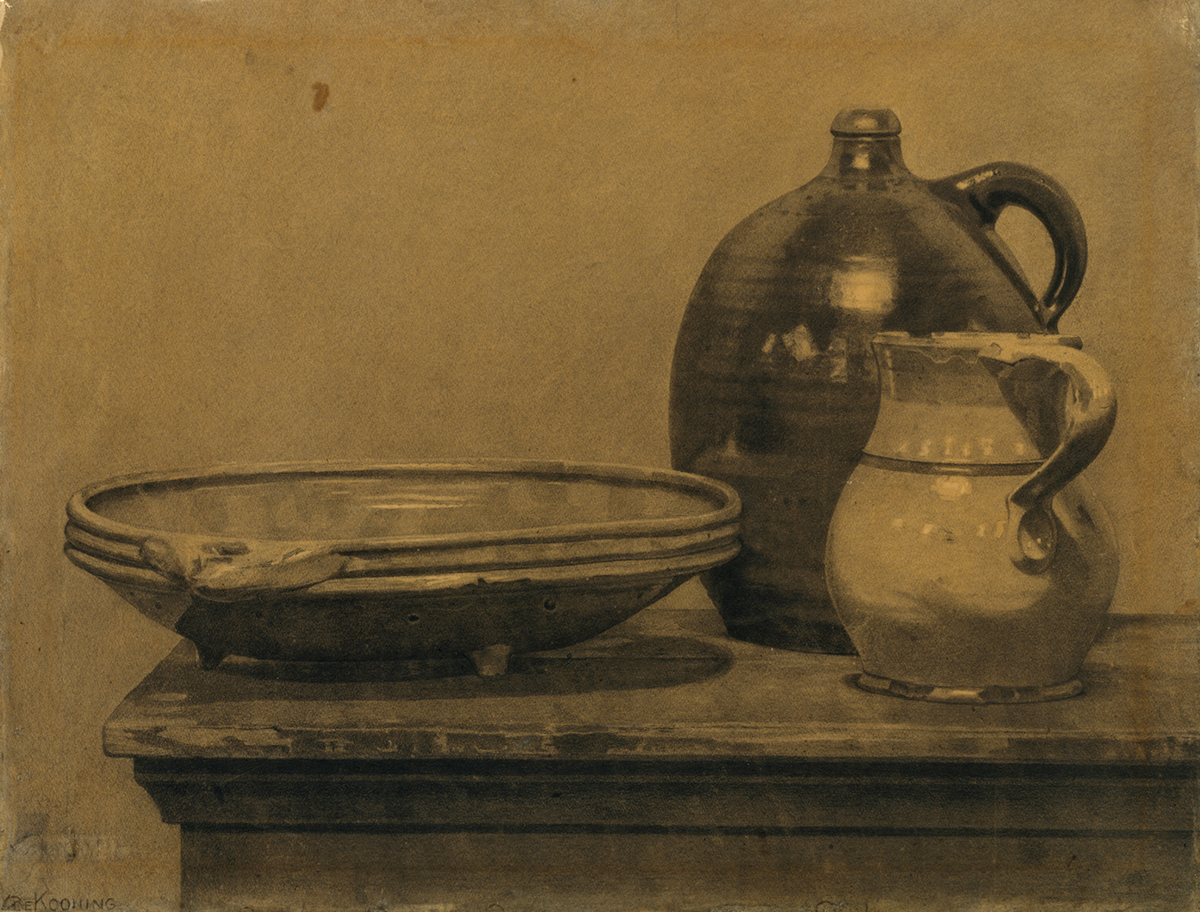 Willem de Kooning. Dish with Jugs, about 1919–21. The Metropolitan Museum of Art, New York, Van Day Truex Fund, 1983, 1983.436. © 2026 The Willem de Kooning Foundation/ Artists Rights Society (ARS), New York. Image © The Metropolitan Museum of Art.
Or is it the line that pulled de Kooning along, having him stowaway on a ship from Rotterdam to eventually emerge in New York City as some sort of art world infant? Anyone who endured high school English class can tell you that a ship’s hold becomes a symbol for the womb. In the inherent sexuality of de Kooning pushing against surfaces with a phallic tool (whether pencils, chalks, paintbrushes, or palette knives) and pressing into pigment or charcoal or graphite, we continually see the contention, confusion, and embrace of gender and intimacy in his work. De Kooning's early images before leaving Rotterdam, where he apprenticed for designers and studied at the Rotterdam Academy of Fine Arts and Techniques, show a fully formed set of skills. But they're a bit like the unavoidable anti-abortion billboards shouting from roadsides all along the highways in the rural United States. Except here, it wasn't just de Kooning's fingers and toes that were fully formed early on in his pre-New York womb. Before his birth from the hold of that ship, de Kooning possessed the essentials of artistic mastery.
Of course, that wasn't enough for the line.
Whether we see the line as a tugboat cable dragging de Kooning onto American shores or the line as a winding canal of asphalt highway coursing from Virginia to New York, the water imagery forces us to consider his arrival as an emergence from the sea. After his landfall, the works render this continual afterbirth. His lines become streams. We see someone crawling from the sea, but incessantly backtracking toward it again. Sheets of paper become basins for rivers and harbors. But the pulling, urging insistence continues throughout his life as place's impact on the line is undeniable. Later, in Venice, without his supplies, de Kooning paints great swaths of shape with enamel with fine particulate filler on torn wove paper. Outside a school in California waiting for his daughter, de Kooning dashes off a sketch. We see his brushes. We see the sculptures. When he moves to East Hampton, the line becomes as much about capturing shimmering, airy reflections on surfaces as it is about depicting waves.
This American journey–of travel, of wandering, of home–is an evolution of the line just as there is an evolution of the artist that is continuous throughout the exhibition rooms. If de Kooning arrived on American soil with suitcases full of conventional skill, the line renderings after show an insistent demand that he open those bags, dump everything out, and start all over. Again and again and again. His searching and experimentation comes in the form of materials, approaches, and action. Describing his adventures in eyes-closed drawings, de Kooning, swallowed by another water-based metaphor, said, “I feel my hand skate over the paper. I have some image in mind, but the results surprise me.”
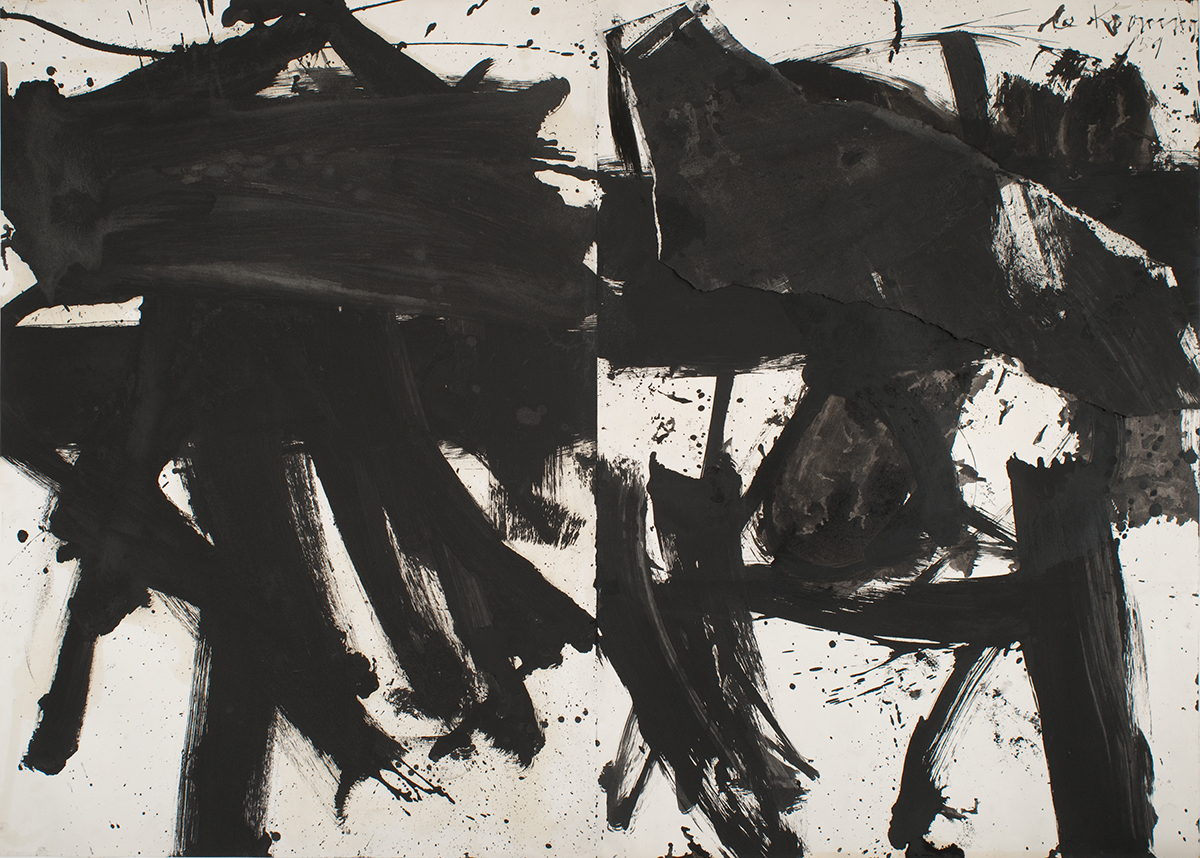 Willem de Kooning. Black and White Rome S, 1959. The Menil Collection, Houston, 2007-3 © 2026 The Willem de Kooning Foundation/ Artists Rights Society (ARS), New York.
Victor Frankenstein experimented too. His work achieved the impossible. He was able to animate the previously lifeless.
The record of de Kooning’s experiments, continuous and far beyond the closed-eyes-searching, is ever present in Willem de Kooning Drawing. We encounter the sketchy graphite or charcoal lines mixed in with fixative, becoming alluvial silt spilling over the page or canvas. We see the remnants of those lines as broad, liquid streams across the images. Line drawings turn to collages, tracings become transfers. The layout of the spaces, with large de Kooning masterworks anchoring the surrounding support materials, creates a series of swells, troughs, and eddies. We’re propelled along this surge of churning power as this line demands to transmute to other forms.
Striking here is the influence of people in de Kooning’s work as well. We confront the building blocks of love in his sketches and paintings of people. Brilliant remnants of self-portrait studies emerge from finished paintings, Elaine’s beauty appears in tonal drawings, and quick sketches appear from his captures of flickering TV screens. There are images dedicated or directed to art world giants like Harold Rosenberg, as well as notes to personal friends dashed off in the margins of a sketch. We see community; Jasper Johns owning this painting as marked on a wall plate, and Robert Rauschenberg credited for an included photo.
At first, I bristled at the Willem de Kooning Drawing show's decision to limit the vast range of influences and alterations to what is shown on the page. Therefore, we aren't acquainted here with Robert Rauschenberg creating an Erased de Kooning. We aren't reminded of the questions on provenance with Elaine de Kooning projecting drawings on the wall as an Alzheimer's-riddled Willem traced their casting with paint strokes. We aren't reminded of the questionable funding for Excavation, the centerpiece of the exhibition, with the requisite funds coming from a precursor to the American CIA in a contest rigged for Bill dK.
But in the end it is all for the better. Because without these gossipy distractions we are forced to let go of the mythos of those types of collisions and interactions and focus more on this ever-evolving line. Line as sculpture, line as rendering. And we get to experience the line pulling de Kooning along through a life and a career, transforming and meandering all along the way. Remember, Frankenstein’s Monster is the star of the story. Not the other way around.
The Art Institute placed small pamphlets of the Willem de Kooning Drawing Guide around the exhibition galleries. Complete with tiny, pink, golf-scoring-sized pencils, the white folded pages encourage visitors to mimic de Kooning’s practice. Inside, they provide sketching space and prompts: Draw with your eyes closed. Switch to your nondominant hand and see where it takes you. With these undulating, insistent versions of the line surrounding visitors on every wall, participants didn’t just see de Kooning’s work; they get their turn at being possessed by the monster. They feel themselves giving over to something much bigger than the self. The beautiful monster, contending and creating, required de Kooning to cast aside his aptitudes for physical depiction in favor of a more elemental capture of reality. While none of us arrive with de Kooning's dexterity for sketching, the provided guides let us consider the integrity required to surrender to the unknown.
With the perspective of time and distance, cultural observers find a waxing and waning perpetual time clock of art history. Preferences slide between Rubenist and Poussinist, between painterly rendering and line-based representation. The cycle is as inevitable as moon cycles spinning, tides lifting, or 90s baggy jeans making a comeback. As such, contemporary audiences might struggle to comprehend de Kooning's insistent searching and grasping for truth with his line. Our society’s prevailing wish seems to be to dominate and control image through filters, surgeries, lighting, and position. Can we comprehend the importance of magic that comes from letting loose this rigid manipulation? The Willem de Kooning Drawing exhibition makes its case in many ways, and lets a new generation know that even if you can render something meticulously, there is greater truth in trying to find the essence of the thing way back there behind the facade. Just the attempt itself is a hero’s journey.
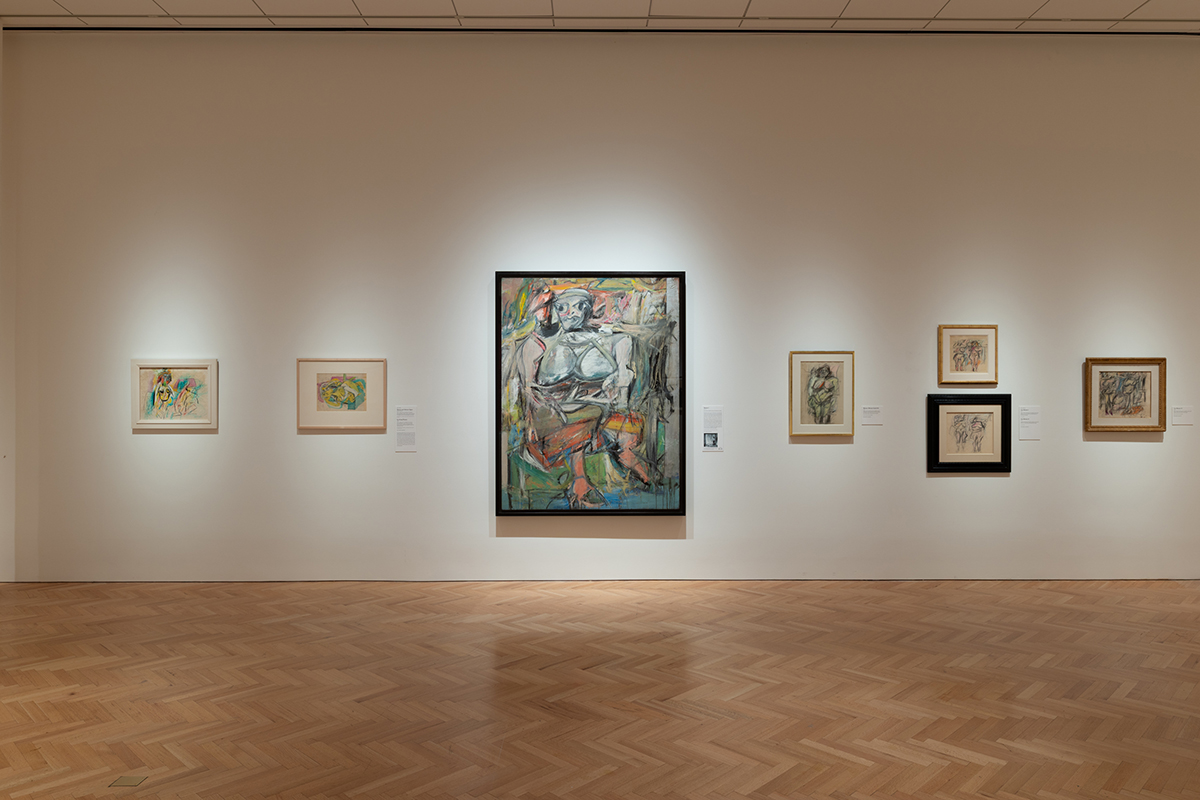
Willem de Kooning Drawing at the Art Institute of Chicago, 2026. Photo by Jonathan Mathias, The Art Institute of Chicago.
And to circle back to the start: If the hold of a ship is a womb then at some point we have to contend with the mother. If de Kooning's work is marked by the accomplishment of his line becoming something else, the same is true for his portraits in his depictions of the feminine, the ferocious, and the maternal. One of the greater museum pleasures I've had in recent years was watching people contend with the woman paintings in this exhibition. The build-up and placement to get to Woman I, meant that visitors of every gender and age stood transfixed at this artwork. I watched them stare, freeze, stop, and return to this masterpiece, as if they were wrestling with the figure themselves. As if they were confused, seduced, shocked, or saddened. Just as de Kooning was. Do we need the bio to see this solid ship of a woman is the looming shape of de Kooning's mother? Of his lovers? Of his beliefs and practices? Do we need a mirror to see our lives in there somewhere? Not a chance.
A simple line could not possibly be a painting in itself before the work of de Kooning. And before his quest, the basic act of holding a canvas vertically meant it must be a portrait. With Woman I, de Kooning subverts this powerfully. This is full-on internal narrative, far beyond a portrait. As much as Monet's landscapes were religious paintings rather than pictures of a lily pond, de Kooning's women push into territory far beyond portraiture or traditional history painting. That’s why the visitors freeze. We’re embedded in emotion, swallowed in the scene. If anyone wants to create their own conceptual art piece this summer, just head over to the Willem de Kooning Drawing exhibition and watch those people look. Experience those people turn into young, contemplative versions of Willem de Kooning. Watch them get stared at and scolded from an allegedly static figure on the wall. Watch them getting watched by Woman I. Take 100 different photos. You're bound to hit it big.
Speaking of size: There’s an idea that scale is a prerequisite now in art. A requirement. A function of preferring experience to things. Installations, Richard Serra's monuments, and all-encompassing Turrell habitats. But de Kooning’s largest work, Excavation, is an immersion in itself. At 81 × 100 1/4 inches, it's tiny compared to a Rosenquist F-111 or Kara Walker’s A Subtlety. This de Kooning is a reminder, as are all his drawings. A reminder that the seduction of succumbing to an artwork isn't a function of scale. Anyone who spends time at the Art Institute’s love letter to de Kooning’s line this summer can see that being present before these artworks goes far beyond the practice of looking. The line all but throws a lasso around our waists, ensnaring us by the insides, and dragging us to the walls. De Kooning demonstrates that the prerequisite of a masterpiece is the scale of the emotion. Not the size of the art.
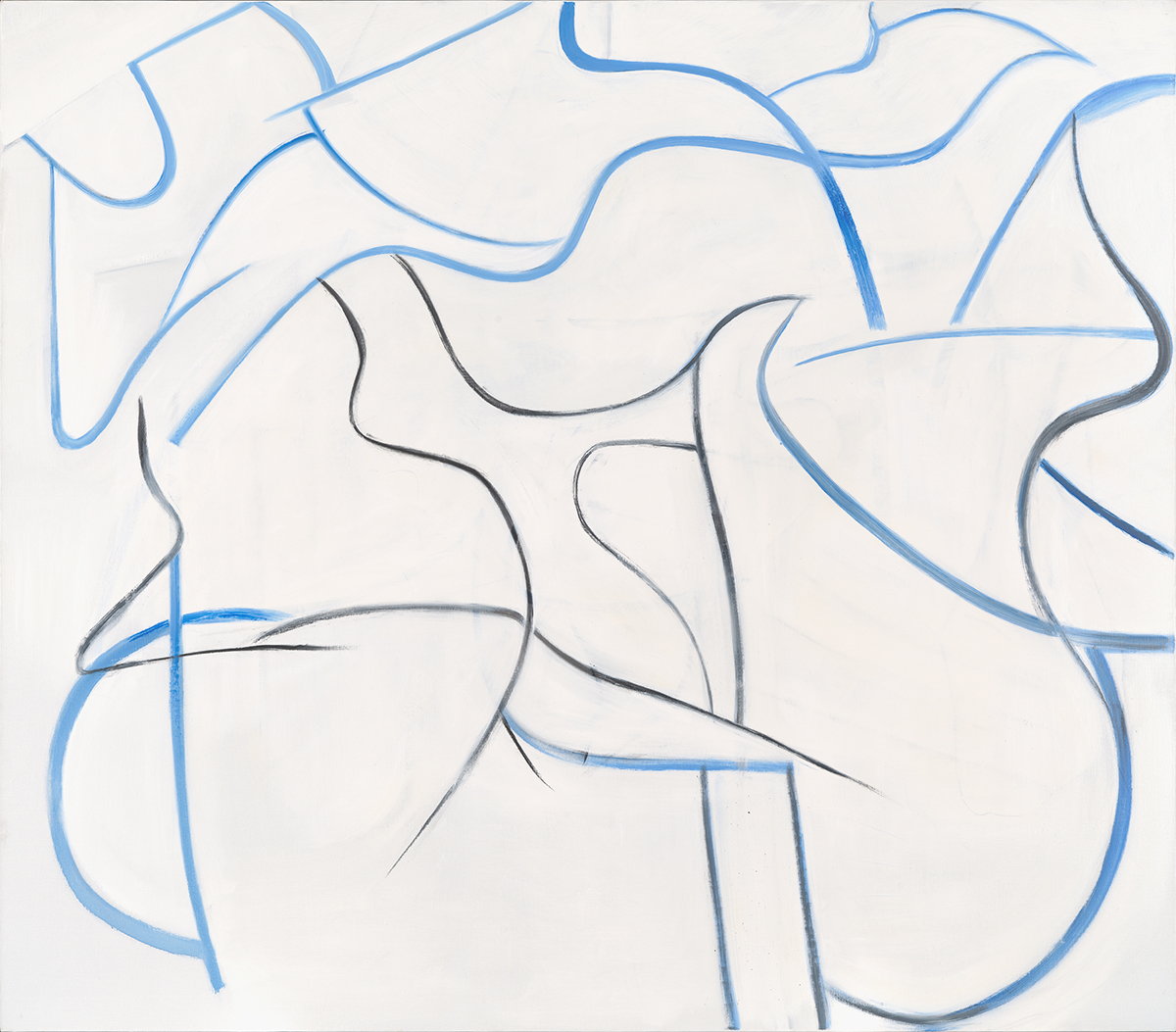 Willem de Kooning, American, born the Netherlands, 1904–1997, [no title], 1985, Oil on canvas, 195.6 × 223.5 cm (77 × 88 in.), Private collection, © 2026 The Willem de Kooning Foundation/ Artists Rights Society (ARS), New York
Those 3-dimensional computer models of the brain’s synapses show intersecting networks of lines bundled into responses. These lines throb and glow, reacting to external stimulus as well as internal cognitive functions. Fixated on the practice, rather than the biography, Willem de Kooning Drawing operates like those webs, with the line featured as the star of the affair. The intersecting stimuli–love, separation, lust, alcoholism, aggression, kindness, humor, death–are inferred from the arcs and collisions of the strands and their paths. We can feel the impact of these events without investigating their specifics. This is true again, as we enter into the last phases of de Kooning’s painting amidst his cognitive decline, as another superb curatorial decision is the placement of the untitled painting from 1985 with charcoal gray and blue ribbon-like lines at the far end of the space. This large 77 × 88 inch canvas shows a set of marks more pure and essential than some of their earlier versions. Here we aren’t confronted by the end, despite the late career work. Instead, we are forced to backtrack through the earlier phases of his career to exit the exhibition. These gestures in this untitled work are the far curve of a continuum, much like the urges in de Kooning’s yearning. We exit back through memory and history, creator and creation, in a tangle of trajectory, encountering the confusion between where the man stops and the line begins.
You may remember at the end of Mary Shelley’s Frankenstein, the explorer Robert Walton watches the creature before it disappears. Here, with the creature shouting, the book reads,“‘Soon these burning miseries will be extinct. I shall ascend my funeral pile triumphantly, and exult in the agony of the torturing flames. The light of that conflagration will fade away; my ashes will be swept into the sea by the winds. My spirit will sleep in peace; or if it thinks, it will not surely think thus. Farewell.’”
Then, the creature moves with, “He sprung from the cabin-window, as he said this, upon the ice-raft which lay close to the vessel. He was soon borne away by the waves, and lost in darkness and distance.”
Shelley left what happened to the creature ambiguous. But those of us who experience Willem de Kooning Drawing know that the line won’t ever end.
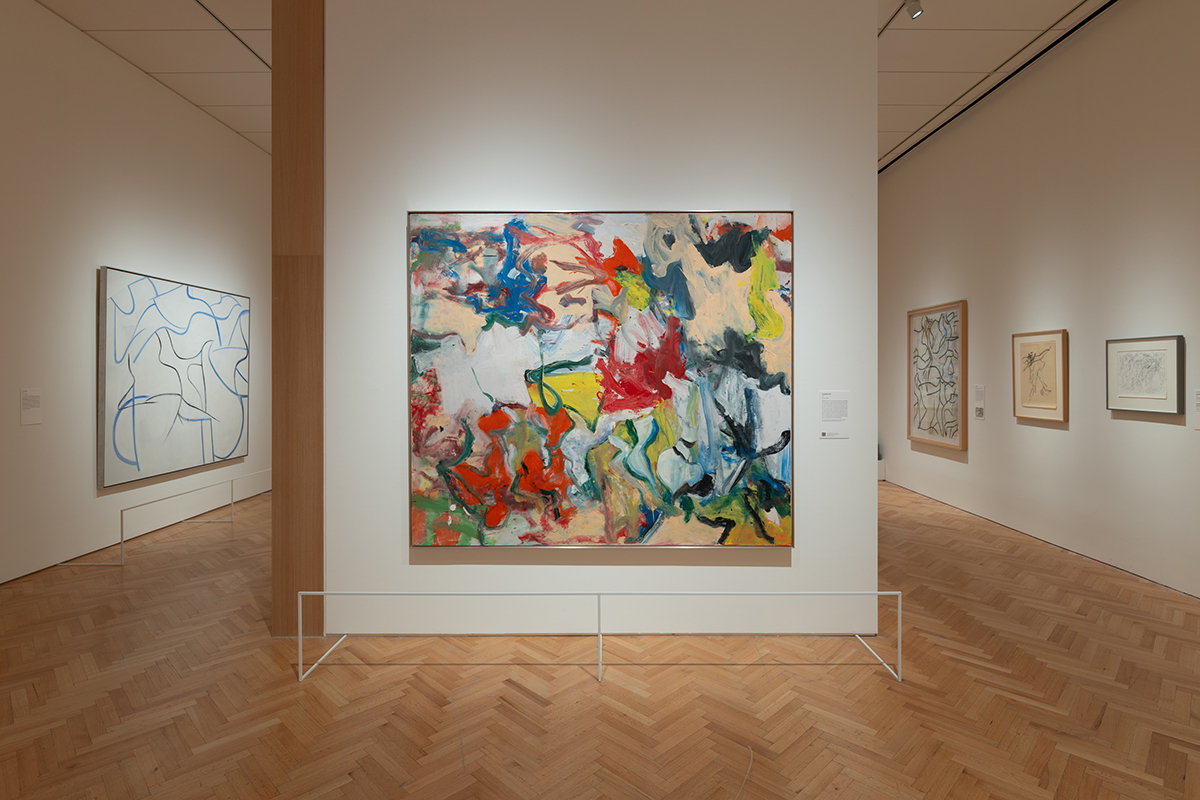 Willem de Kooning Drawing at the Art Institute of Chicago, 2026. Photo by Jonathan Mathias, The Art Institute of Chicago.
I'd encourage anyone to head upstairs to the Pepper Family Galleries after leaving the de Kooning exhibition at the Art Institute. Walk through them slowly. See Ferdinando Tacca's Bireno and Olimpia in the same gallery as El Greco's Saint Martin and the Beggar, The Feast in the House of Simon, Saint Francis Kneeling in Meditation, and Christ Taking Leave of His Mother, along with the Bassano and Tintoretto women, and Luca Cambiaso's Venus and Cupid.
Take in the undulations and twists, the flatness and line, the reverence. Ask: Where is your God? Is it here in these images? Or is it back downstairs in the fleeting sparkles of water in de Kooning's Springs?
Of course we keep returning to de Kooning and his line.
Willem de Kooning Drawing is on view at The Art Institute of Chicago through September 20, 2026.
Kurt Cole Eidsvig
Kurt Cole Eidsvig is an artist, poet, and author. His most recent book, Drowning Girl, is a book-length novel-poem inspired by the Lichtenstein painting of the same name. He maintains a website at EidsvigArt.com.
view all articles from this author