Whitehot Magazine
September 2026
"The Best Art In The World"
"The Best Art In The World"
September 2026
When Time Slows Down: Teodora Axente in Siena
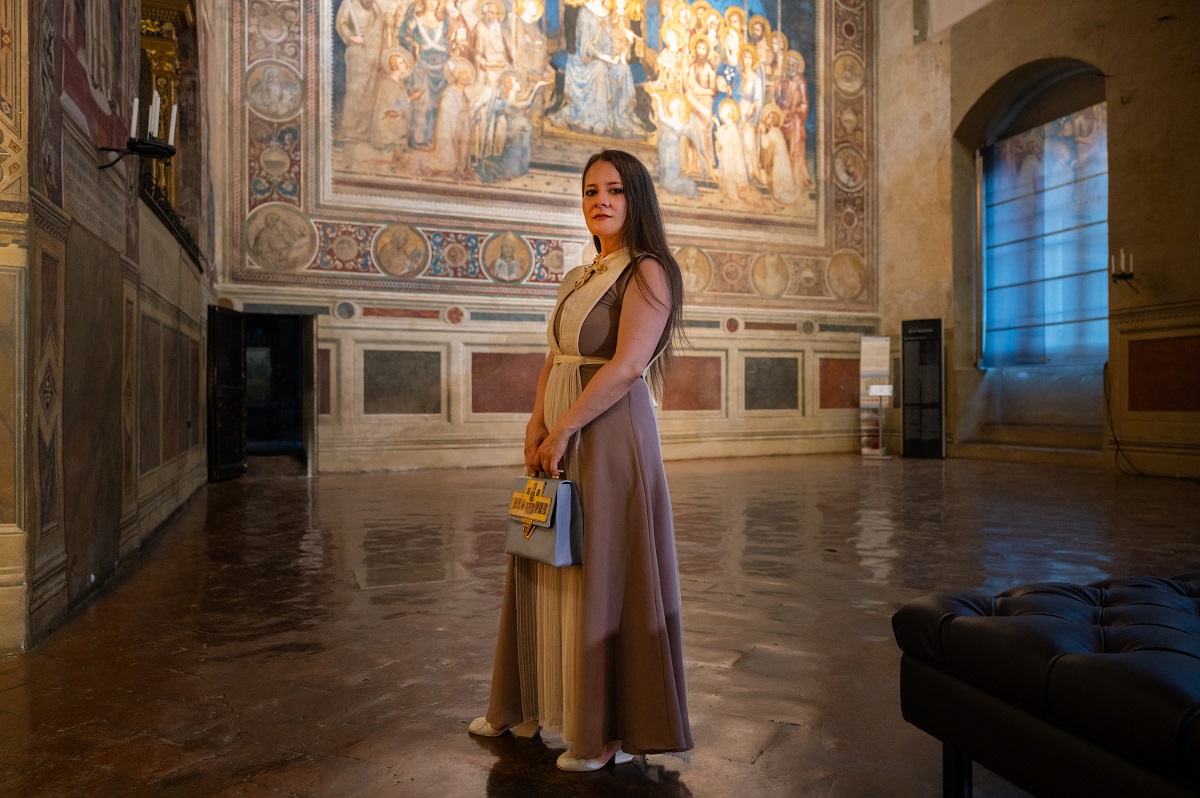 Teodora Axente, Foto di Toni Thorimbert
By LARA PAN September 14th, 2026
Behind the pinkish walls of Siena, there is always more than meets the eye.
Famous for its independence and centuries-long rivalry with Florence, Siena was once a powerful autonomous republic. It was also an important stop along the Via Francigena, the medieval pilgrimage route to Rome, and over the centuries the city accumulated extraordinary relics, artworks, and sacred traditions.
Perhaps nowhere is this living history more visible than in the Palio. The famous horse race is only one part of a much larger ritual involving Siena’s seventeen Contrade and their deeply rooted identities. At the center is the Drappellone, the painted banner awarded to the winning Contrada, a unique meeting point today between civic tradition, religious symbolism, and contemporary art.
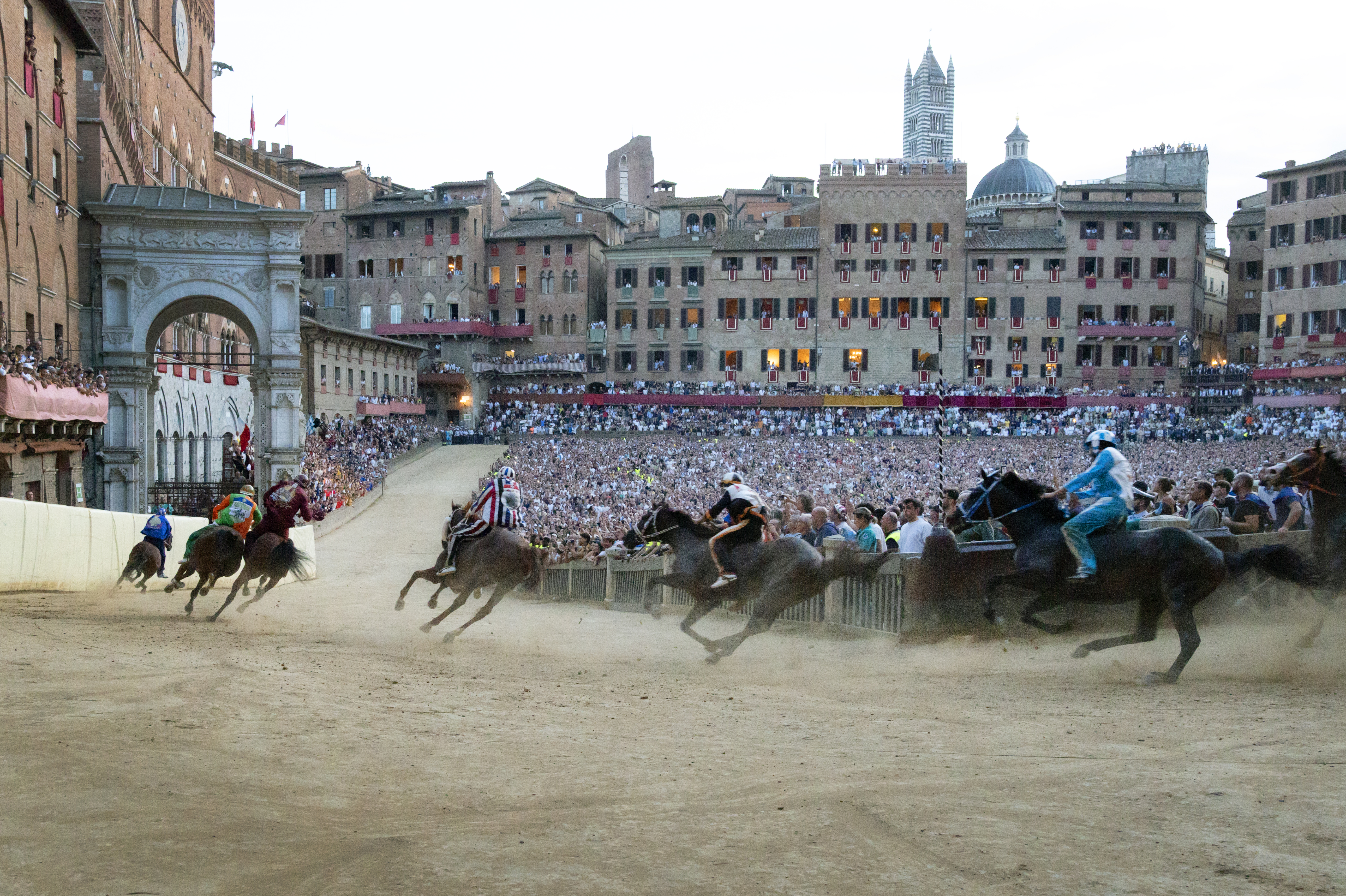 Palio Siena Agosto 2026, fotografie di Greta Gandini e Toni Thorimbert
I was honored to be invited to experience this extraordinary world by Riccardo Freddo, curator of the 2026 Drappellone and one of the youngest curators to take on this role.
The former stable of the Santa Maria della Scala museum complex also hosted the reinstallation of Metamorphoses of the Sacred, an exhibition devoted to Teodora Axente, bringing together fourteen works. Curated by Riccardo Freddo and Michelina Eremita, the exhibition was conceived in connection with the artist’s appointment by the Municipality of Siena as painter of the August 16, 2026 Palio.
It was in this remarkable environment that I encountered Axente, one of the most interesting painters working today. Born in Romania and based in Cluj, she brings together the language of European painting with an intensely contemporary, dreamlike, and sometimes unsettling vision.
At first sight, you might not even recognize that her characters are inspired by sacred art. Her canvases are so rich in detail and subtlety that one can easily become absorbed in the perfection of her technique. But that would be appreciating only a fraction of what is actually taking place. These are theatrical, psychologically complex paintings, populated by figures that seem suspended between different states of being.
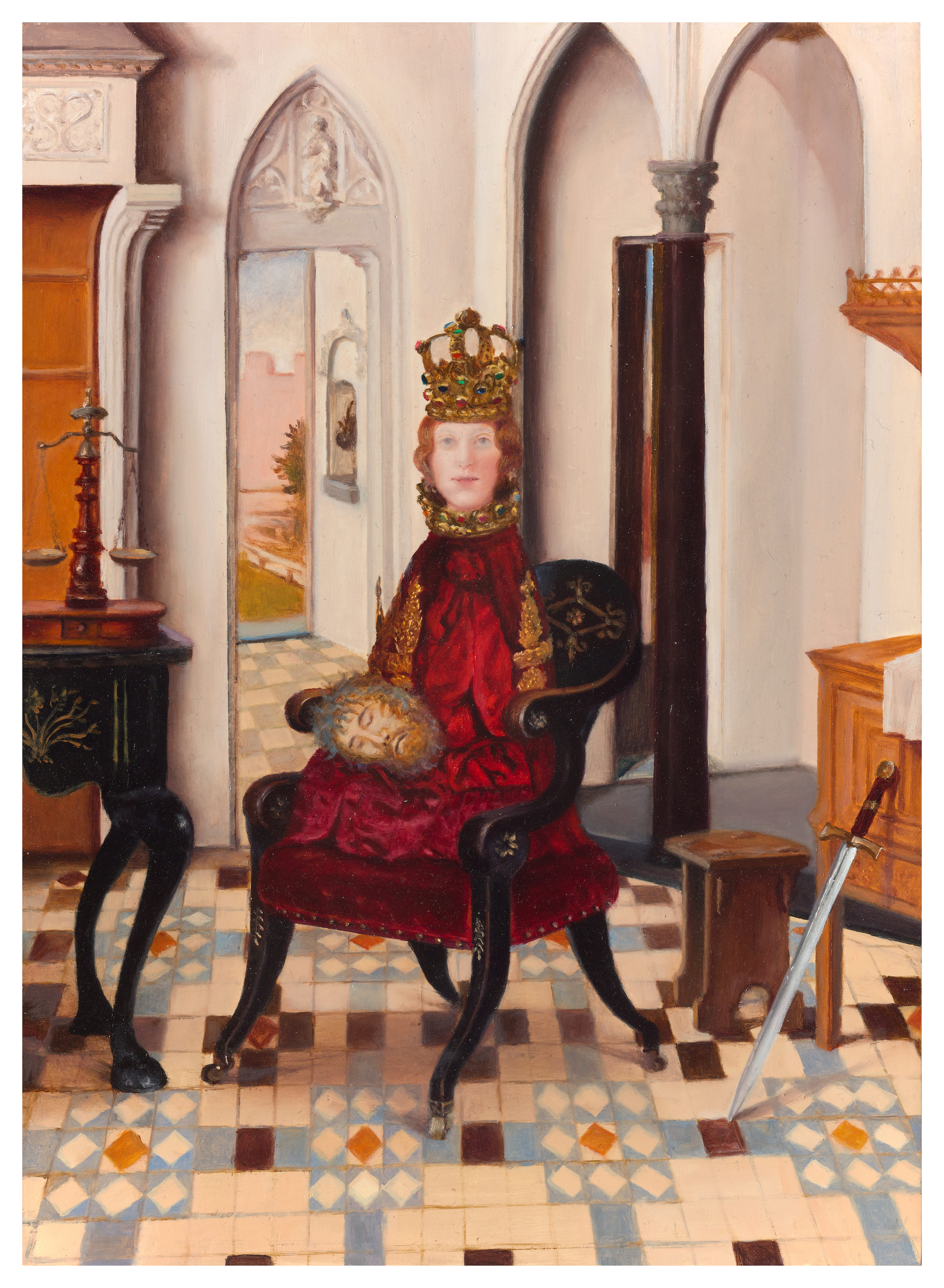 Teodora Axente, Allegoria Dedica ad Ambrogio Lorenzetti, Siena, Foto via Galleria Rosenfeld
Her encounter with Siena is therefore particularly fascinating. Here, her paintings enter into a dialogue with centuries of sacred imagery and with the legacy of artists such as Ambrogio Lorenzetti, while becoming part of a ritual that is still very much alive.
What interests me is precisely this tension between the ancient and the contemporary. Axente does not simply illustrate Siena’s history; she enters it through her own imagination, creating another layer of meaning.
I had the chance to conduct an interview with both Riccardo Freddo and Teodora Axente, and to glimpse more deeply into Axente’s surreal and sacred universe. Looking at her paintings, one has the strange sensation that time has slowed down, that the figures, objects, and fragments of reality have been caught somewhere between dream and memory.
Perhaps this is what makes Siena so alive: the past is never really past. It continues to be reinvented.
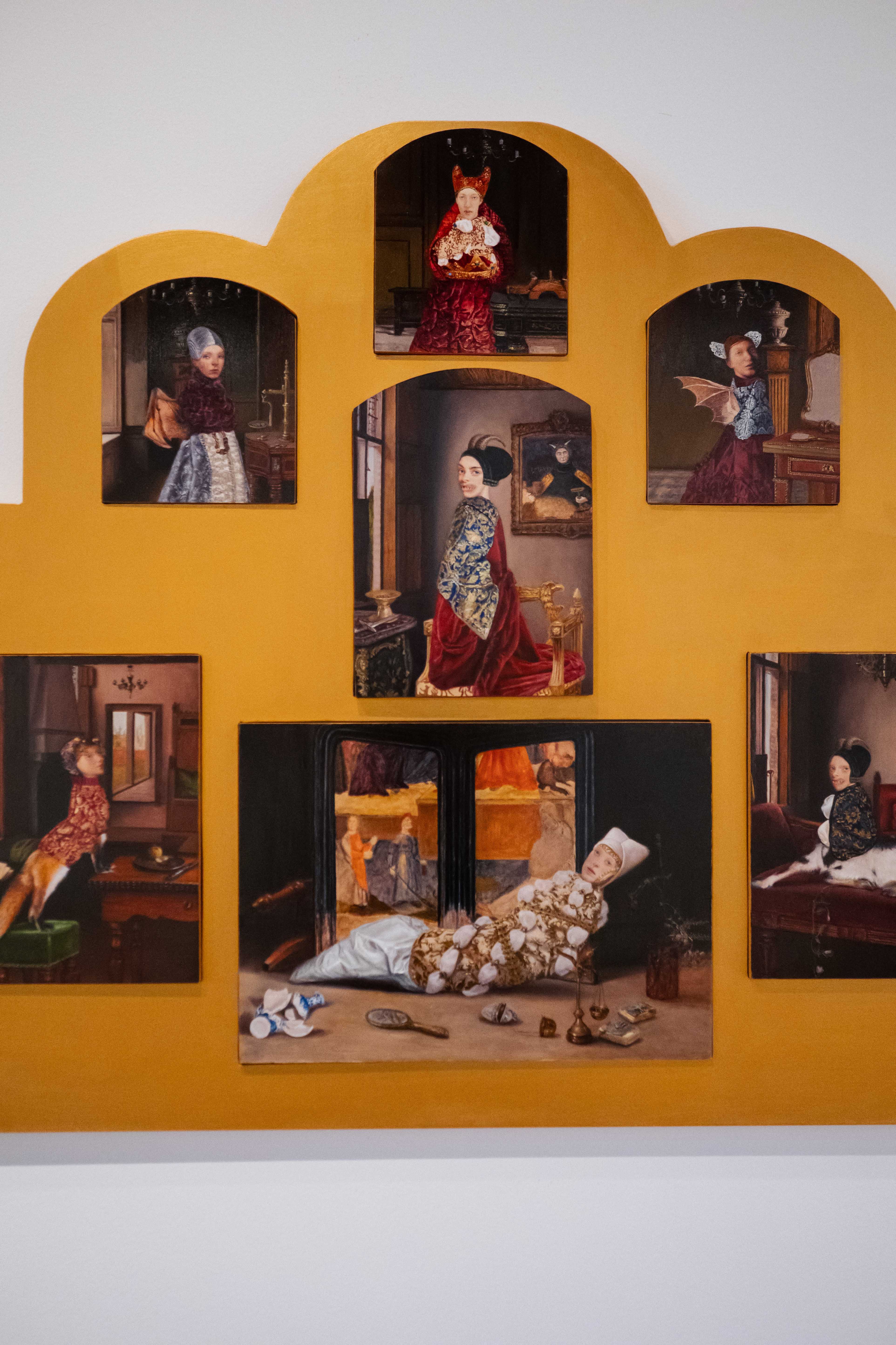 Teodora Axente, Allegoria, Foto Giulia Lenzi
RICCARDO FREDDO
LP: Riccardo, what did you see in Teodora Axente’s work that made you feel it belonged in Siena, with its deep tradition of sacred art?
Riccardo Freddo: What immediately struck me in Teodora’s work was that, beneath its surreal and contemporary language, there is something deeply connected to the history of European painting. Her figures, objects, and compositions have an almost timeless quality. They can feel mysterious, even sacred, without being religious in any conventional sense.
That is what made me think of Siena. Siena has an extraordinary tradition of using images to speak about morality, humanity, power, and the relationship between the individual and society. When you stand in front of Ambrogio Lorenzetti’s Allegory of Good and Bad Government, you realise that painting here has never been merely decorative; it has been a way of thinking.
That became the central curatorial idea for Allegoria: Dedica ad Ambrogio Lorenzetti. Rather than treating Siena’s history as something fixed and untouchable, I wanted to see what happens when a contemporary artist enters it and asks new questions. The result is not a reconstruction of the past, but a living dialogue with it.
LP: Having worked closely with Teodora, what surprised you most about her process or about the way her work developed through her encounter with Siena?
Riccardo Freddo: What surprised me most was how intensely Teodora responded to the place. I did not want her simply to bring an existing body of work to Siena and install it in a historic room. The encounter with Siena became part of the work itself.
She has a very instinctive way of working. There is an incredible precision in her paintings, but at the same time they retain something unresolved and dreamlike. As she spent more time thinking about Lorenzetti and the Palazzo Pubblico, I felt that the works began to acquire another layer—one connected to ideas of power, responsibility, morality, and the fragility of human structures.
For me, that evolution was important. The project became less about placing a contemporary artist next to a historical master and more about creating a conversation between two artists separated by almost seven hundred years.
 Teodora Axente, mostra Allegoria, foto Jane Pere
LP: How did you approach bringing Axente’s contemporary and surreal language into the centuries-old tradition of the Palio and the Drappellone?
Riccardo Freddo: I approached it through dialogue rather than contrast. I was never interested in making Teodora’s work look “Sienese” or artificially adapting her visual language to the tradition of the Palio. I wanted to preserve what is radical and contemporary about her work and allow it to confront Siena on its own terms.
The Drappellone itself is such a fascinating tradition because it demonstrates that Siena has always understood the importance of contemporary image-making within an ancient civic and ritual context. Every year, a contemporary artist is asked to create an image that enters into one of the city’s oldest traditions.
With Teodora, I wanted to extend that idea into a broader conversation. Her surreal imagery, with its dreamlike figures and ambiguous symbolism, can initially seem far removed from the visual language of the Palio. But underneath, there is a shared interest in allegory: using the image to speak about something larger than itself.
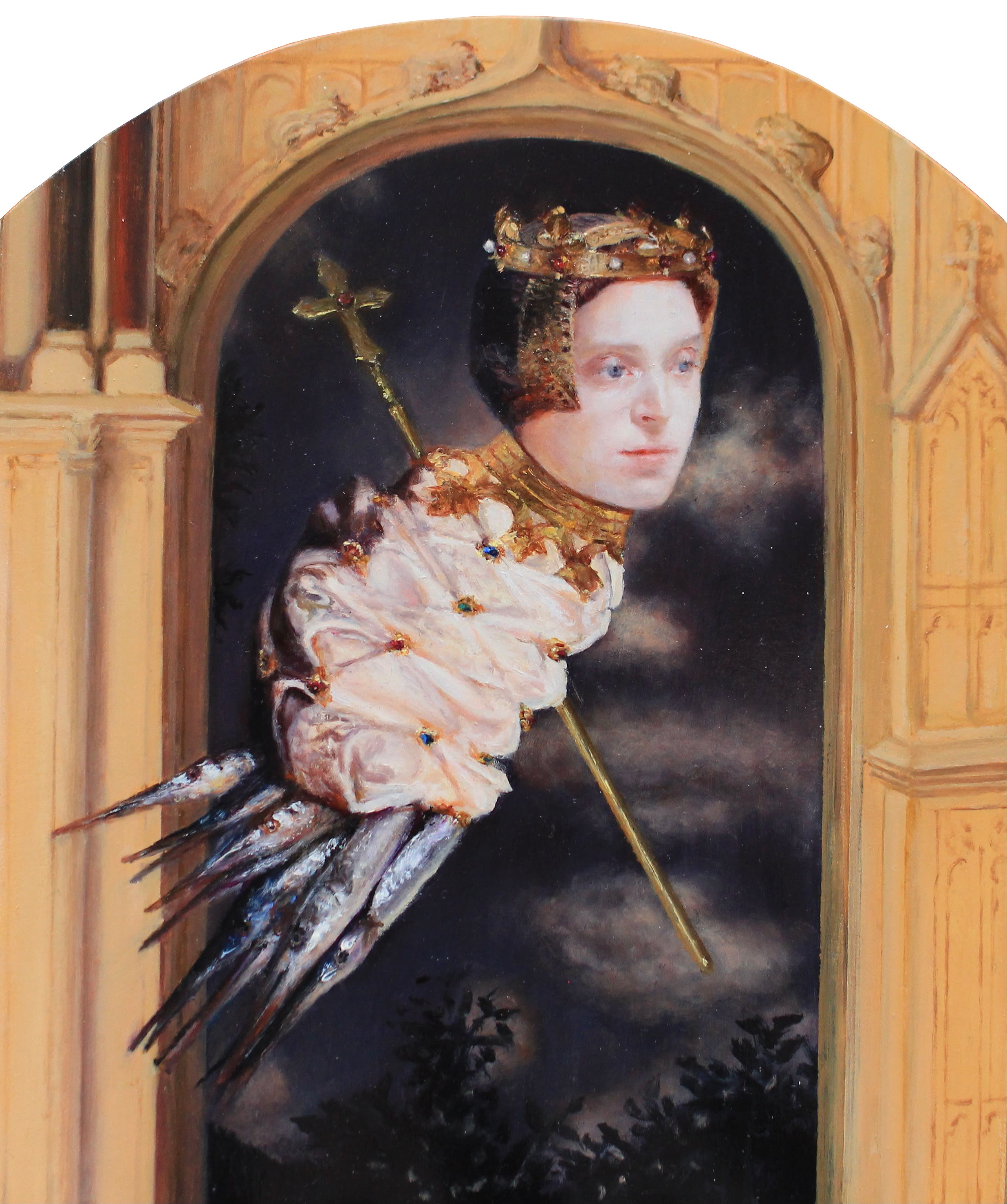 Teodora Axente, mostra Allegoria, foto Jane Pere
TEODORA AXENTE
LP: Teodora, in coming to Siena and working within the tradition of the Palio, did you feel that you were entering a new visual language, or did you discover connections with something already present in your own cultural memory?
Teodora Axente: My encounter with Siena has made a significant contribution to my professional life.
Siena boasts a vast and remarkably rich history. It was a city with economic potential, driven by pilgrims passing through on their way to Rome and by the acquisition of relics from Constantinople that drew crowds of the faithful. A community of Sienese artists and painters began to coalesce, eventually establishing a distinct artistic movement: the Sienese School.
Sacred themes are prominently featured in the Sienese School. Drawing inspiration from Byzantine painting—a source shared by the art found in Romanian Orthodox churches—I found a common ground and an additional reason to identify with this Sienese artistic culture.
The aesthetic forms of these paintings—such as polyptychs and diptychs—inspired the work I created for the exhibition at the Museo Civico.
I examined the artifacts from Constantinople housed at the Santa Maria della Scala museum and sought to translate the essence of Sienese culture into my own painting, blending it with my own identity—a process of synthesis and personal interpretation.
Regarding Ambrogio Lorenzetti’s frescoes, Good Government and Bad Government (Buon Governo e Cattivo Governo), I was struck by how contemporary they felt. They speak to the same human weaknesses and virtues that have existed throughout history.
I decided to explore this theme through a series of smaller works arranged within a polyptych, employing human-animal metamorphoses to depict both human vices and virtues.
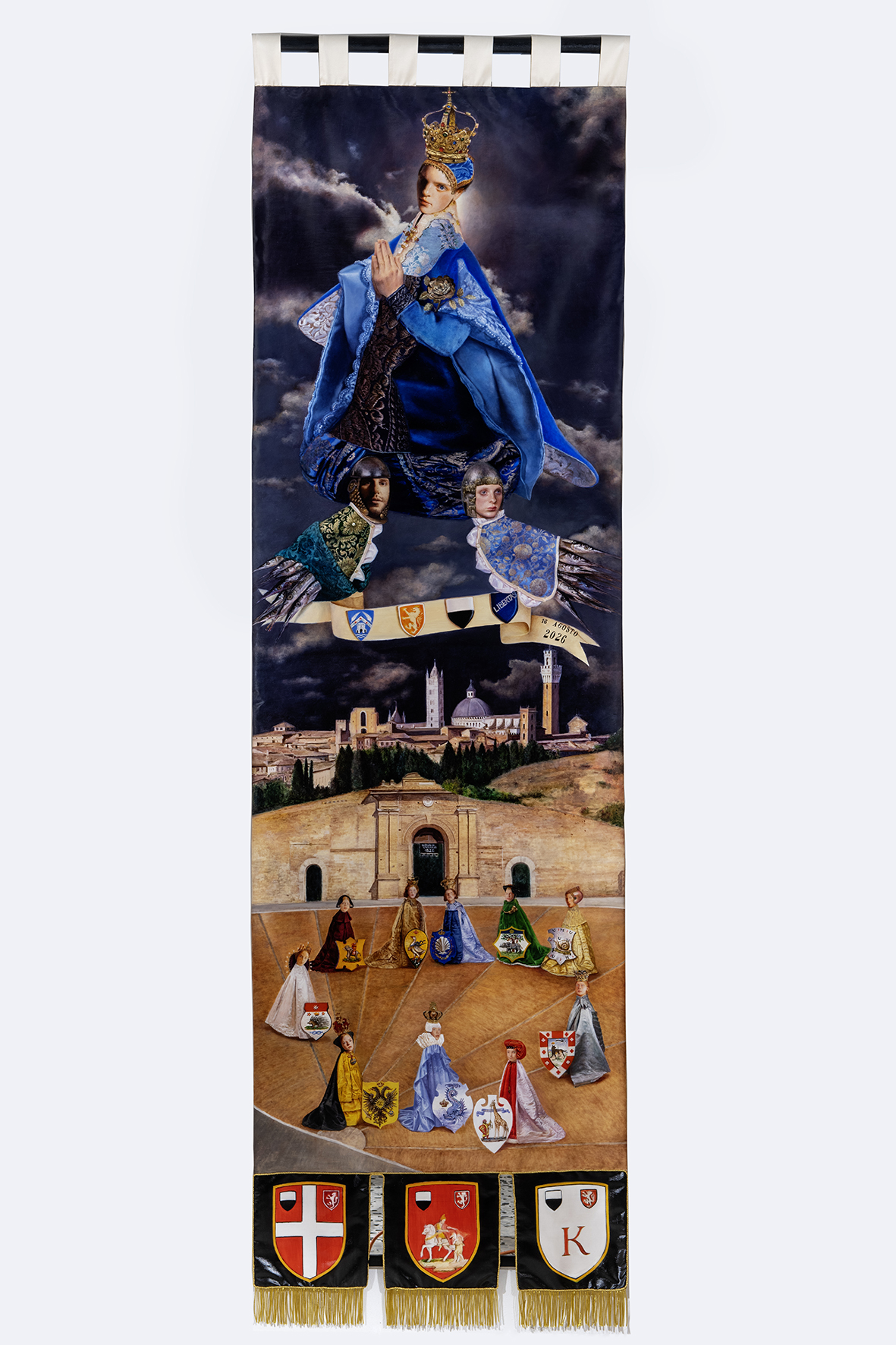 Drappellone 16 agosto 2026, Teodora Axente, Foto di Andrea Lensini
My overarching theme—the duality of soul and body—is thus transposed into the parallel between good and bad government.
Above all, one can sense the energy of the Sienese School, imbued with the artistic inspiration of the masters of that era: Ambrogio Lorenzetti, Simone Martini, Taddeo di Bartolo, Sassetta, and others.
With these overwhelming feelings, I, too, strive to make my humble contribution to the art scene and the Sienese community, never for a moment forgetting the privilege granted to me and the opportunity to draw inspiration from this rich heritage for my work—now and in the future.
LP: Your imagery seems to bring together Romanian and Eastern European traditions with Italian Renaissance and Catholic sacred imagery. How do these different visual and spiritual traditions meet in your work, and what happens when Orthodox and Catholic iconographies enter the same painting?
Teodora Axente: Both Catholic and Orthodox symbolism share common Christian roots. Through a process of metamorphosis, I capture precisely this evolution and harmonisation of symbols—elements that are at once distinct and alike.
My overarching theme—the duality of soul and body—is reflected in the following ways: the Byzantine tradition, as seen in Orthodoxy, focuses on the inner dimension, stylisation, and abstraction of the icon’s subject. Conversely, the Catholic tradition—with its emphasis on external appearance, realism, human anatomy, drama, and physical suffering—anchors the viewer’s gaze in immediate, tangible reality.
The rich detail found in certain objects and vestments associated with Catholic worship allows me to delight in rendering various materials and textures—such as velvet, satin, gold, porcelain, silver, and pearls—while the contemplative, spiritual state of my figures evokes the Orthodox ritual of inner prayer.
LP: Your paintings seem to exist outside ordinary time. How do you think about time in your work? Does painting allow you to slow it down, suspend it, or create another kind of time?
Teodora Axente: I wish to suspend time, to create a dimension distinct from immediate reality. My figures are often captured in meditation and in a continuous ritual. This mystical state transcends reality and convention; they descend into a realm of the imagination and the dreamlike, where neither time nor...

Lara Pan
Lara Pan is an independent curator,writer and researcher based in New York. Her research focuses on the intersection between art, science, technology and paranormal phenomena.
view all articles from this author