Whitehot Magazine
October 2026
"The Best Art In The World"
"The Best Art In The World"
October 2026
Douglas Melini: An Order of Things
By RAPHY SARKISSIAN | May 20, 2026
In Douglas Melini's paintings at Weber Fine Art in Connecticut, language collapses before the image can be named. A burgundy field, dense as a Jackson Pollock, resolves into Georges Seurat's Sunday lawn. Farmlands dissolve into plant tissues. And chromosomes register as the bark of redwood trees. A strangely luminous suite of works on paper extends this logic further, where a leaf may become a panoramic site of partly accumulated snow. Despite its inevitability, iconography proves insufficient here. These works exist at once as abstractions and magnifications: the visible and invisible simultaneously present, nature felt before it is mapped, the micro and macro occupying the same surface without resolution. They call forth what the art historian Michael Fried, writing about Larry Poons, might have recognized as presentness, that arrest of temporality whereby the painting refuses to assimilate into mere memory.
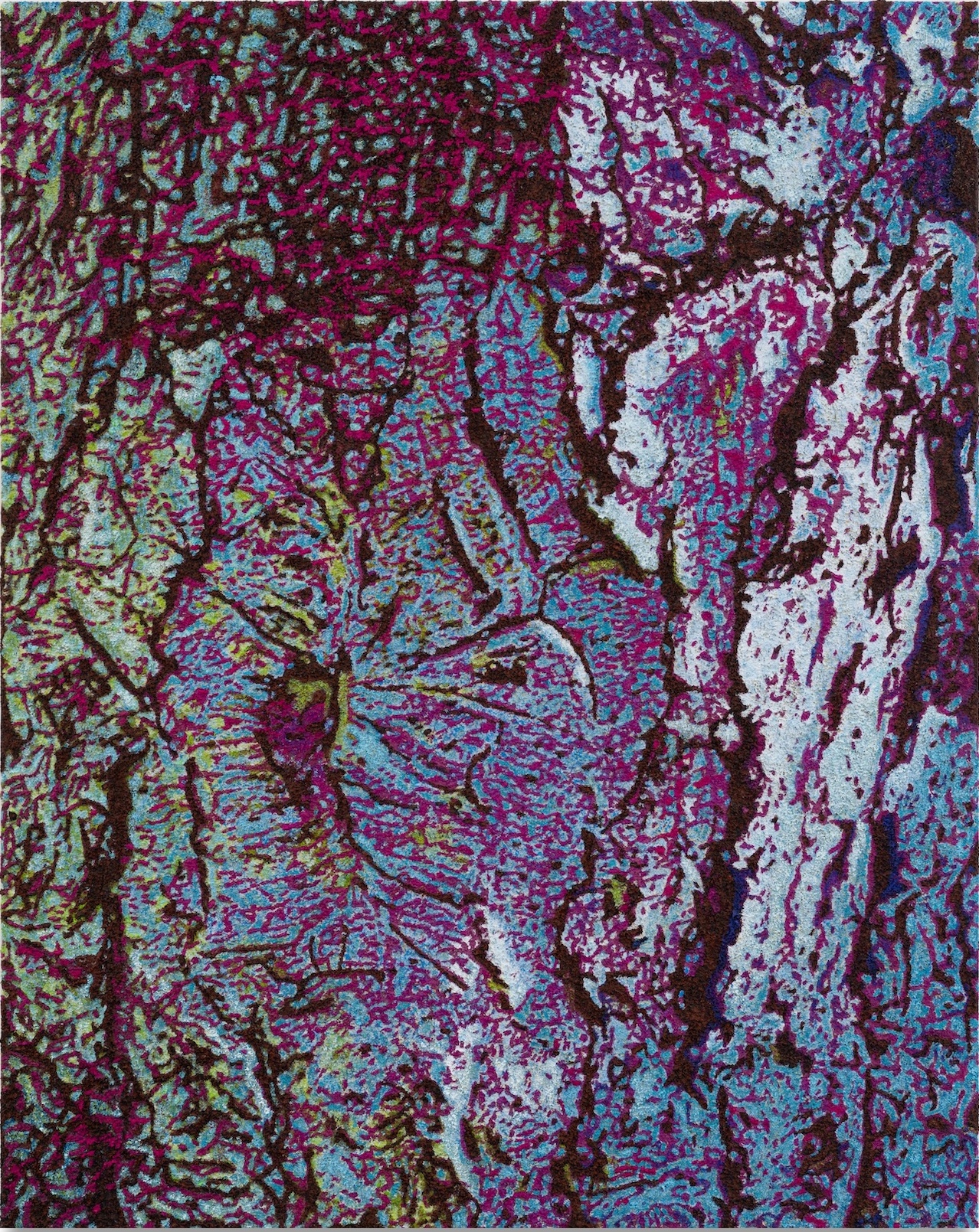 Douglas Melini, Tree (White oak in purple, green, and blue), 2026. Oil on linen, 60 × 48 inches. © Douglas Melini. Courtesy of the artist and Weber Fine Art.
The show arrives roughly a year after Melini's most recent solo exhibition at Miles McEnery Gallery in New York, Under Your Skin and Over the Moon, which announced a significant turn in his practice. For much of his career Melini had been associated with a rigorous geometric abstraction, pattern-based, often extended across the physical frame of reclaimed wood in works that were as much object as painting. That work had real intellectual authority, and its relationship to traditions of Minimalism as well as Pattern and Decoration gave it a clear critical address. But the new body of work sets all of that wooden armature and patterning aside. What remains, what Melini has chosen to trust, is oil on linen, a brush, and the problem of how paint can be made to carry the weight of a living body or matter as such into something of cool viscerality.
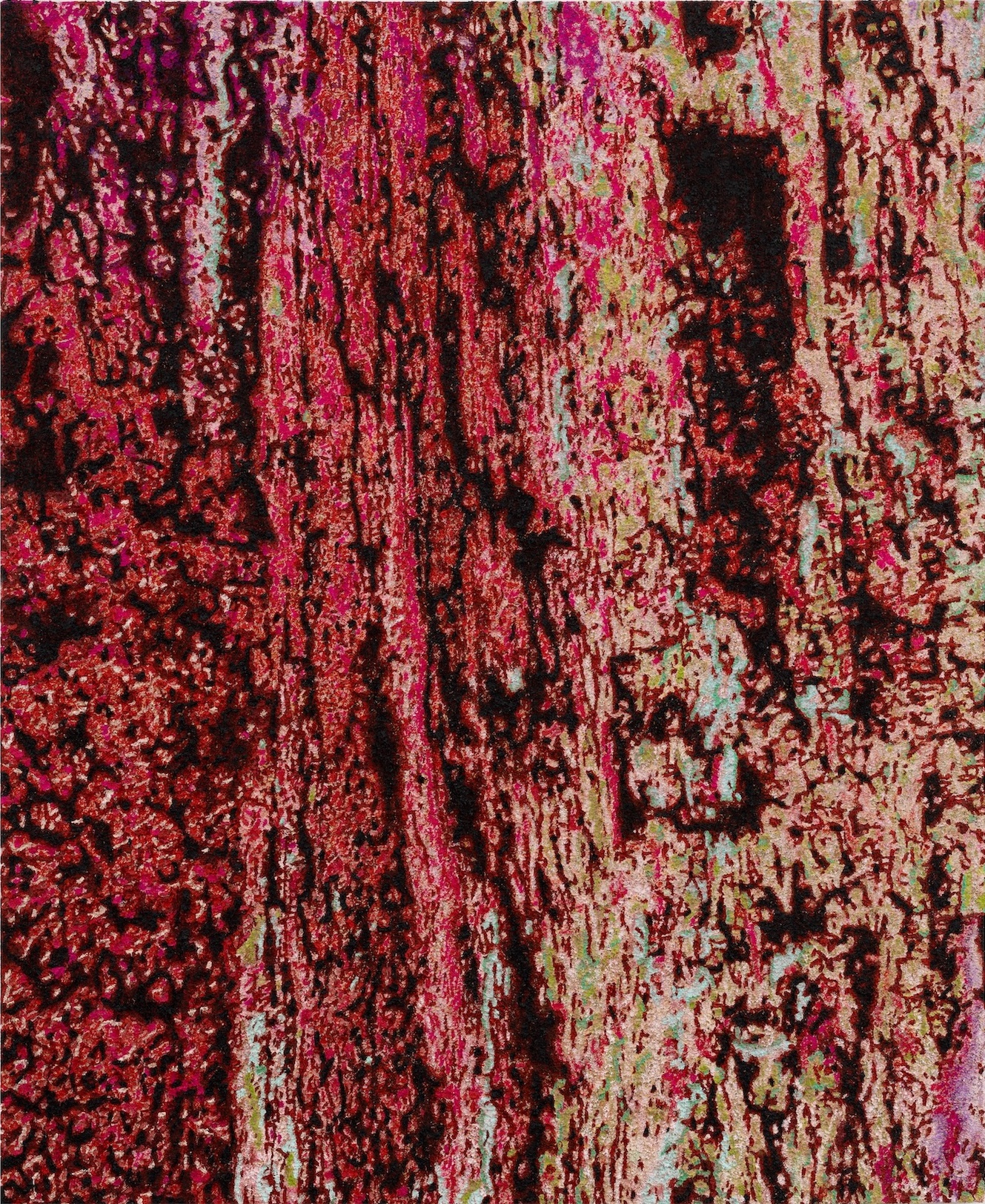 Douglas Melini, Tree (Redwood in magenta, red, brown, and purples), 2025. Oil on linen, 66 × 54 inches. © Douglas Melini. Courtesy of the artist and Weber Fine Art.
The tree is the declared subject of five of the seven works, their titles specifying not just genus but palette: Tree (Redwood in magenta, red, brown, and purples), Tree (Redwood in flesh tone, blue, brown, purple, and green), and two versions of Tree (White oak in purple, green, and blue), the latter pair identical in title but different in scale, a quiet provocation that resists the pressure to differentiate. It is as if Melini were insisting that the same indecipherable statement, held at different distances, remains the same indecipherable statement. This taxonomic precision in the titling is interesting, even a little wry, because the paintings themselves are not botanical illustrations. He is painting something more like the interior logic of a tree: the way growth accumulates, the way structure is at once random and deeply ordered, the way a living system generates both visible and invisible patterns to the human eye. Theoretical discourses surrounding the flat canvas aside, can we ever exhaust our wonder at the visceral logic that binds human growth to that of a tree, a moth wing, a galaxy?
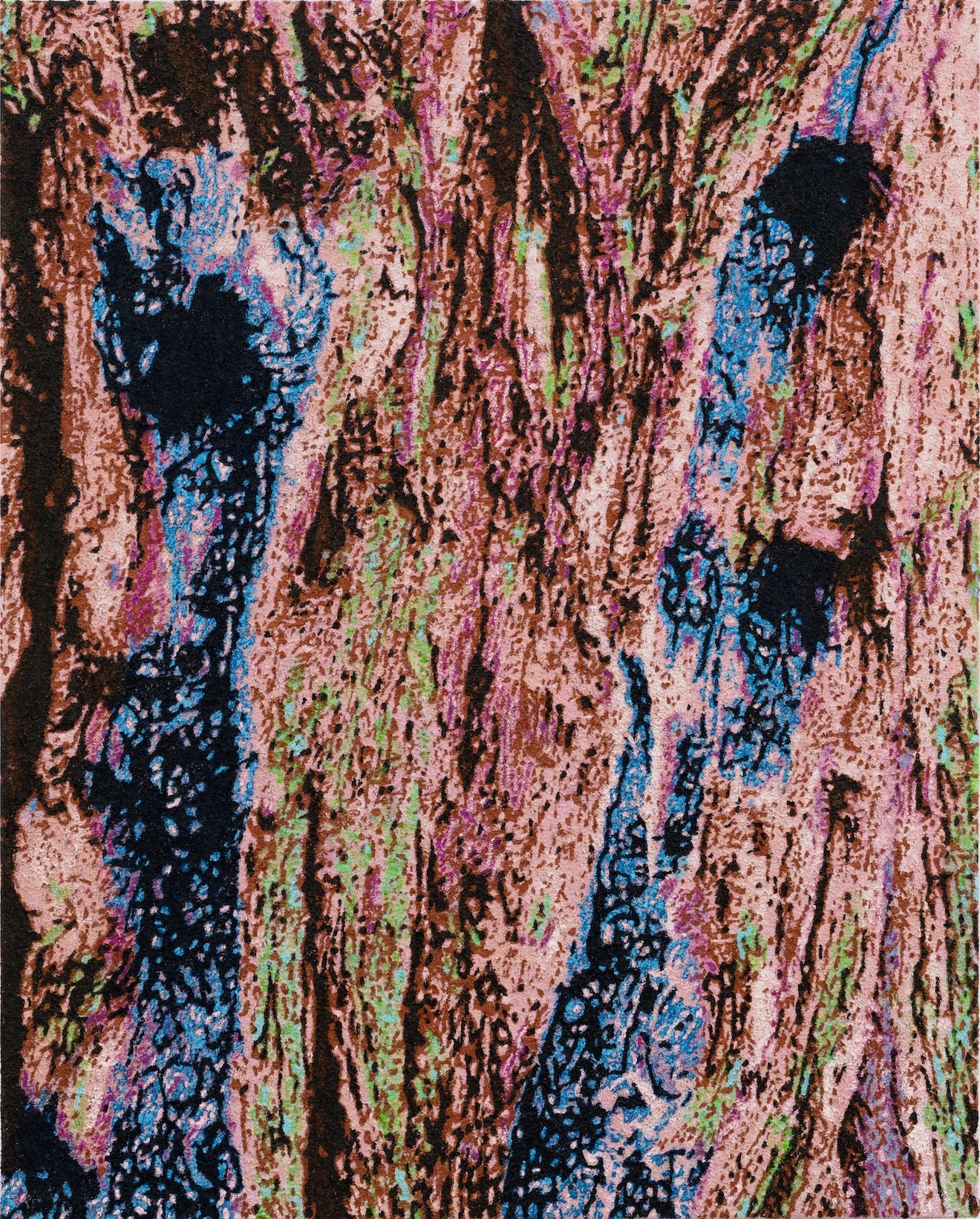
Douglas Melini, Tree (Redwood in flesh tone, blue, brown, purple, and green), 2026. Oil on linen, 60 × 48 inches. © Douglas Melini. Courtesy of the artist and Weber Fine Art.
A pair of thrumming paintings bring the patterned translucency of insect wings into dialogue with the sheer scale of redwood trees and oaks. These are Spring Light (Moth wing in green) and Deep Change (Moth wing in pink and black), each striking in its chromatic opposition to the other. This juxtaposition seems to be anything but arbitrary. Both the tree and the moth wing are systems of organized complexity: they are structures in which pattern arises from biological necessity rather than aesthetic intention. Melini seems drawn to natural forms that defeat the eye's inquisition of hierarchy, offering instead an allover density in which no part dominates another. The titles themselves enact this tension: Spring Light and Deep Change reach toward the lyrical, even as their parenthetical subtitles—hinting at moth wings, white oaks, or redwoods—insist on figuration. Like the paint surface itself, the titles offer the comfort of naming while withdrawing the comfort of knowing. The most intimate painting in the show, Deep Change feels like a micro-window opening onto a cellular landscape, where pink and white chromosomes seem to inhabit a coloristic terrain of burgundy and black—an interiority rather than a surface.
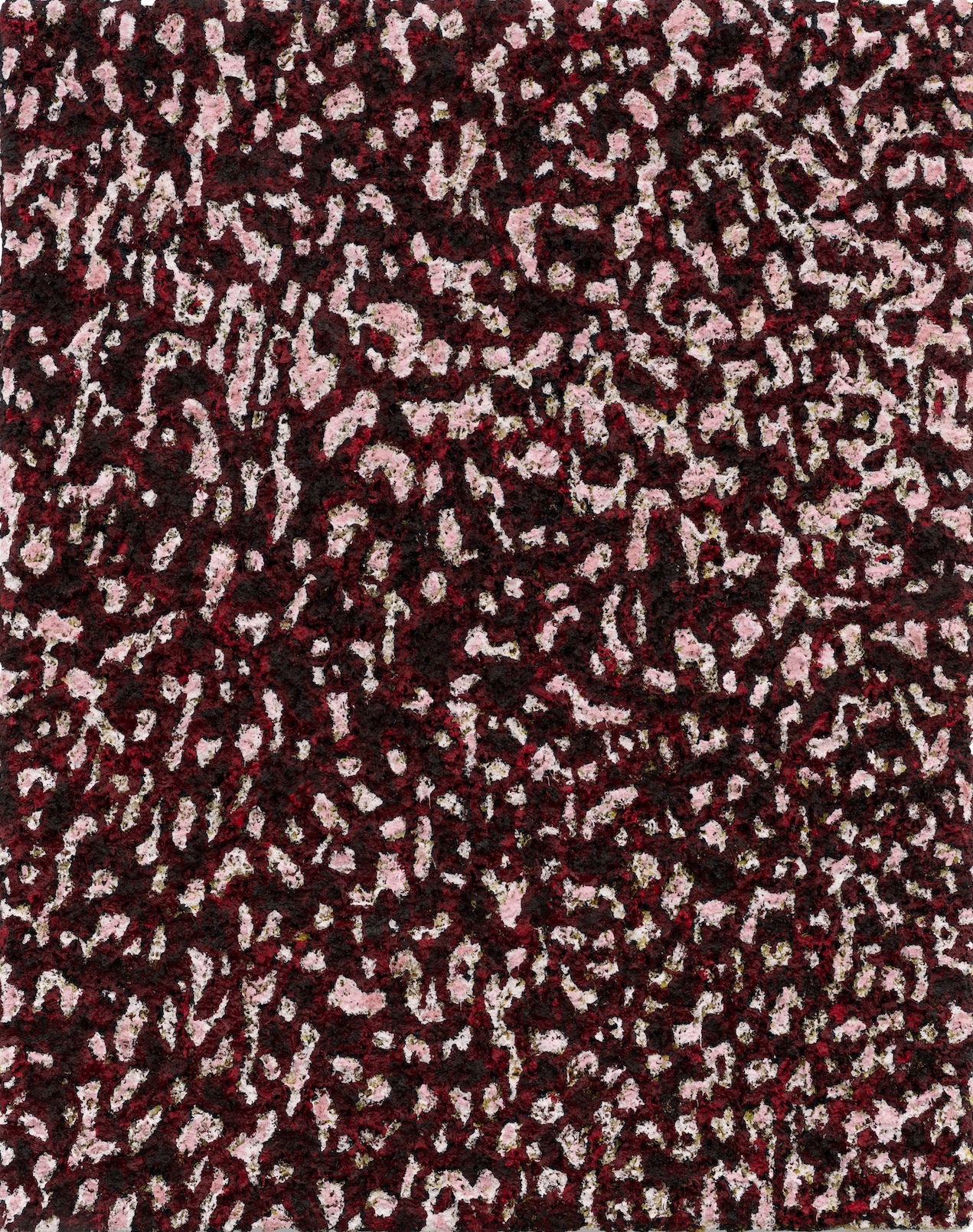 Douglas Melini, Deep Change (Moth wing in pink and black), 2025. Oil on linen, 20 × 16 inches. © Douglas Melini. Courtesy of the artist and Weber Fine Art.
The Nature of Life is the painting that most transparently demonstrates the exhibition's suspended empirical tenet: that paint can resist representation and abstraction in equal measure, and that vision itself encompasses both the recognizable and the unmappable. Here the painting's surface reveals a brushwork that is rigorously controlled yet constantly giving way to the formless, generating a luminosity as crafted as it is accidental. Melini's visual grammar calls to mind Vija Celmins's ocean surfaces, "a kind of rigorous building, letting the material just be the material. Letting the image be more and more like an armature," as Celmins has described her process in the Whitney Museum's collection notes for Ocean Surface Woodcut (1992). Yet where Celmins anchors the gaze to a literal threshold of material, Melini yields an interior luminosity and absorbing tenebrism reminiscent of Ross Bleckner. Melini’s surfaces balance the dense weight of built-up matter against an elusive, flickering depth.
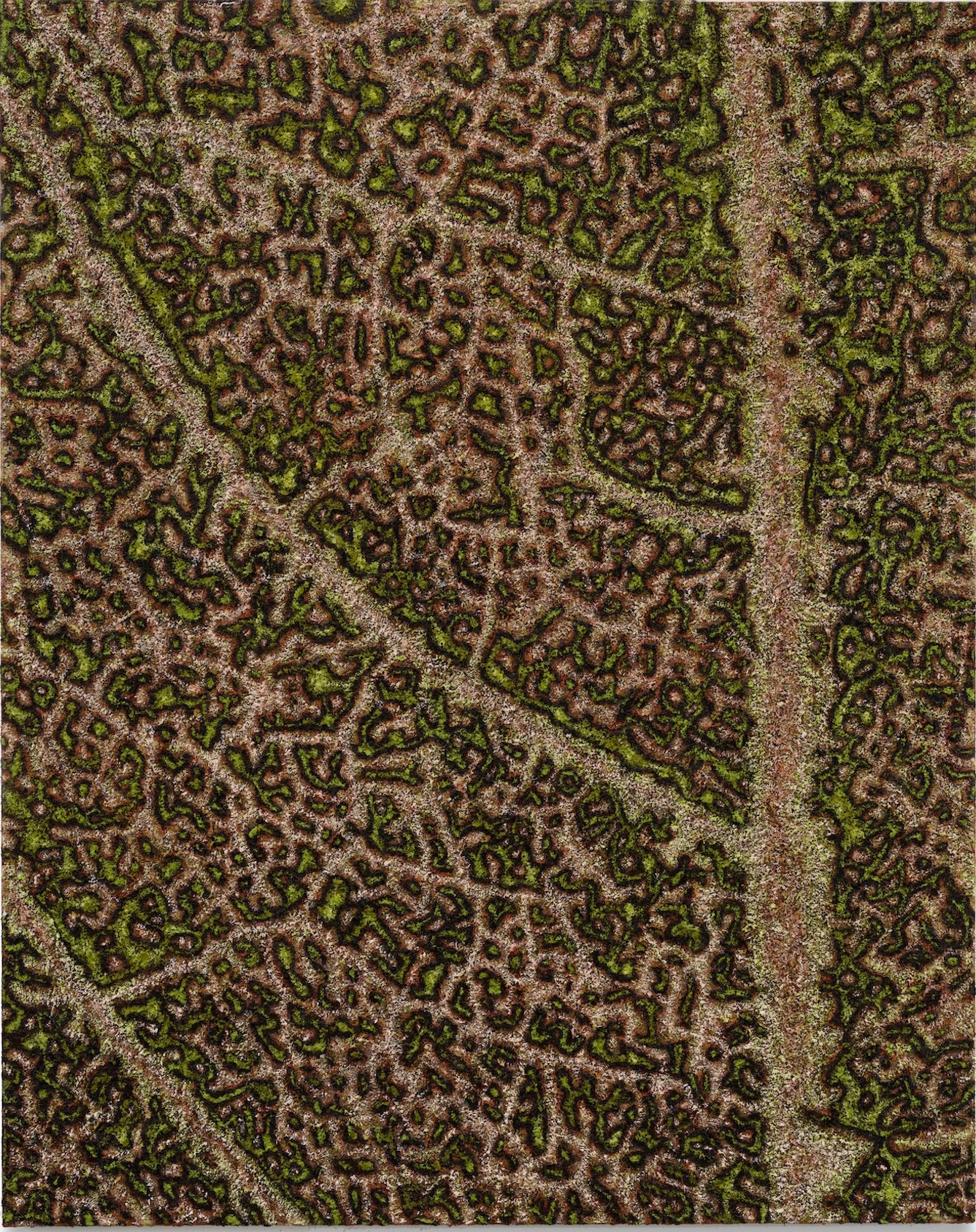
Douglas Melini, The Nature of Life, 2024. Oil on linen, 60 × 48 inches. © Douglas Melini. Courtesy of the artist and Weber Fine Art.
Dan Cameron, whose catalogue essay accompanied the McEnery show, writes with characteristic eloquence that Melini offers a way of perceiving natural form and beauty that keeps us attuned to our perceptual shortcuts while resisting the assumption that nature is fully contained within our sensorial understanding. It is a beautiful formulation, and one that the paintings themselves seem to exceed. What they demand is less a passive philosophical reflection than an immediate reckoning with something formally unprecedented: here the gestalt seems to implode from within, the dense, accumulative, and fully engrossed methodology of the surface paradoxically generating the entropy of vision as such. Here is an interplay of colors as particles, shades of green and tan negotiating their identities, while white flecks pulse through the surface like entities of raw matter. The whole simultaneously suggests the aerial cartography of farmlands and tissue examined under a microscope.
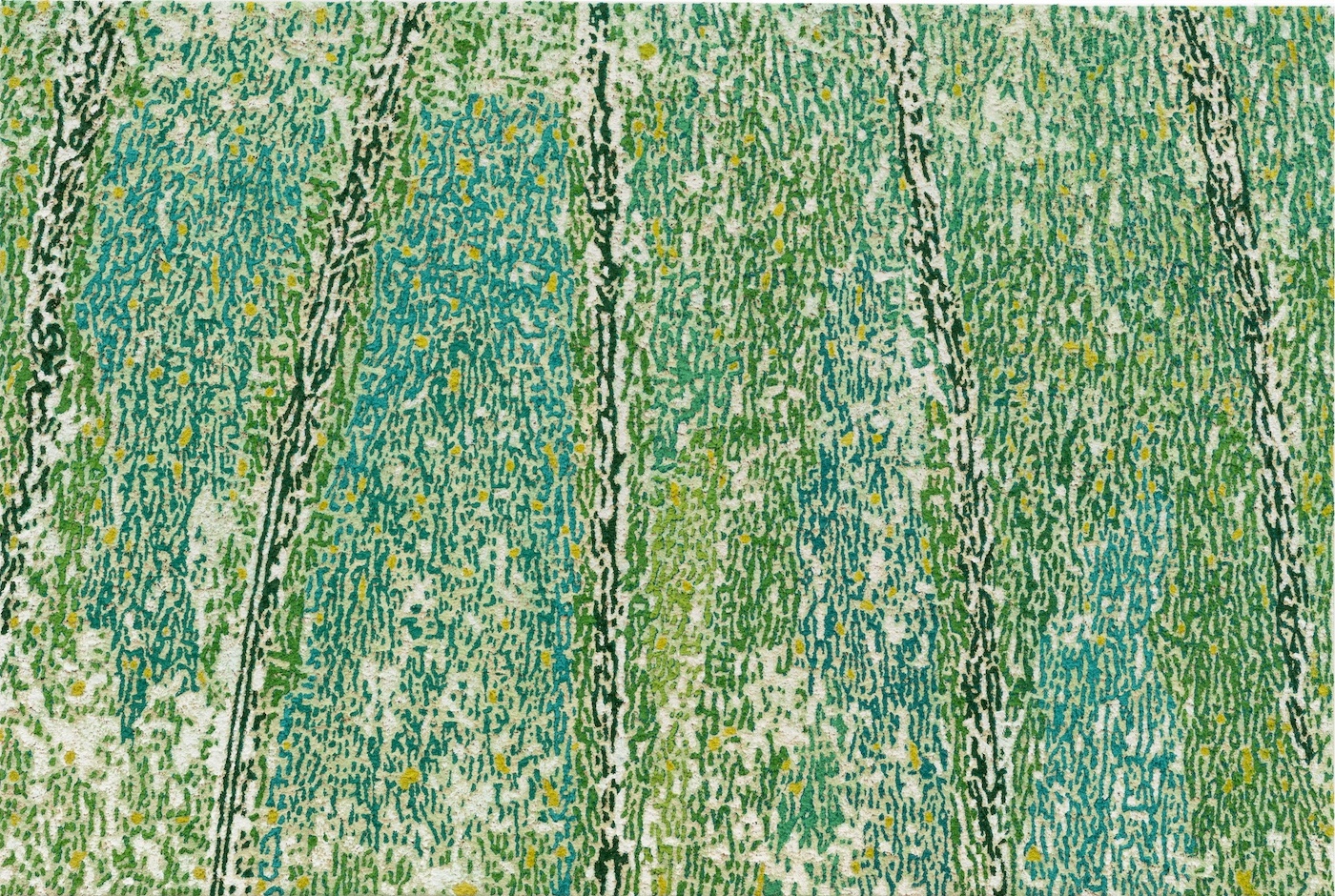
Douglas Melini, Spring Light (Moth wing in green), 2025. Oil on linen, 36 × 54 inches. © Douglas Melini. Courtesy of the artist and Weber Fine Art.
Spring Light (Moth wing in green) registers as the brightest painting in the show, its pixelated seafoam greens signaling at the lawn of Seurat's La Grande Jatte, as if not abstracted but magnified, as if operating as a pointer to the archaeology of painting rather than the world as such. By contrast, the large redwood painting, Tree (Redwood in magenta, red, brown, and purples), reads like Pollock mediated through the pointillism of Seurat, the burgundy surface uncannily evoking a detail lifted from the umbrella or blouse of a central figure in La Grande Jatte, now a fragment of a grand composition expanded to fill the entire field here. Melini's paintings announce the postmodern parks of our time, highly ordered spaces where the wildness of nature has been processed into an intellectual topography: inviting, immaculate, and slightly vertiginous underfoot.
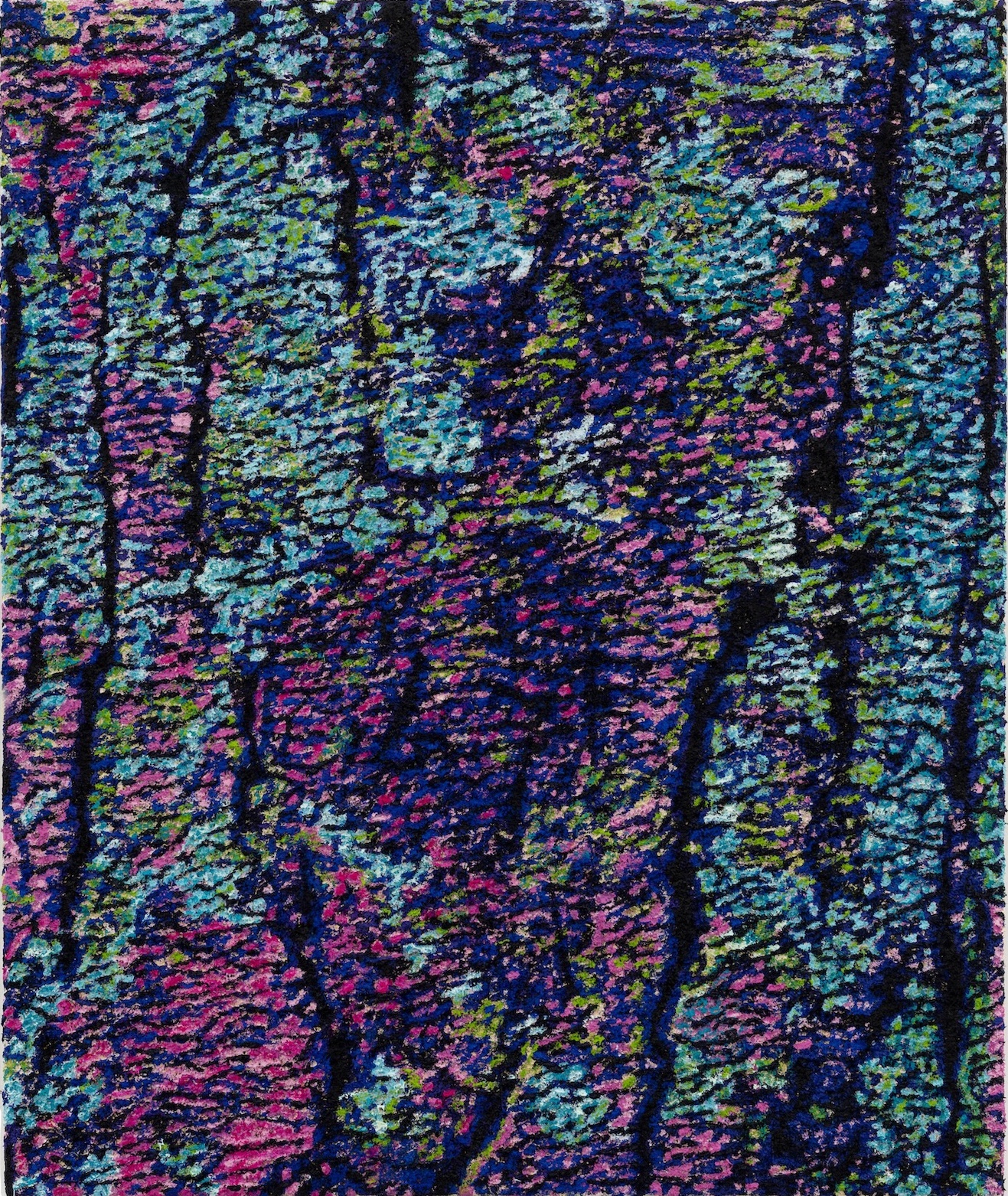
Douglas Melini, Tree (White oak in purple, green, and blue), 2026. Oil on linen, 36 × 30 inches. © Douglas Melini. Courtesy of the artist and Weber Fine Art.
Just as language continues negotiating its relation to the world and to knowledge, painting harbors its own desire: not to replicate that negotiation but to contend with it pictorially, on its own terms, through its own irreducible means. Michel Foucault's observations of human knowledge, however familiar by now, retain an uncanny precision when brought before certain works of art. In the preface to The Order of Things he wrote: "Order is, at one and the same time, that which is given in things as their inner law, the hidden network that determines the way they confront one another, and also that which has no existence except in the grid created by a glance, an examination, a language."(1) Douglas Melini's paintings enact precisely this tension between the order hidden in things and the order imposed upon them through looking, examining, naming. They do not close the epistemological quest. They make it visible. WM
Note
1. Michel Foucault, The Order of Things: An Archaeology of the Human Sciences (New York: Vintage Books, 1973), p. xx.
Douglas Melini
Weber Fine Art
April 16 – May 23, 2026

Raphy Sarkissian
Raphy Sarkissian received his masters in studio arts from New York University and is currently affiliated with the School of Visual Arts in New York. His recent writings on art include essays for exhibition catalogues, monographs and reviews. He has written on Rachel Lee Hovnanian, Anish Kapoor, KAWS, David Novros, Sean Scully, Liliane Tomasko, Dan Walsh and Jonas Wood. He can be reached through his website www.raphysarkissian.com.
view all articles from this author