Whitehot Magazine
October 2026
"The Best Art In The World"
"The Best Art In The World"
October 2026
Distortion/Memory/Resilience - Giles Duley
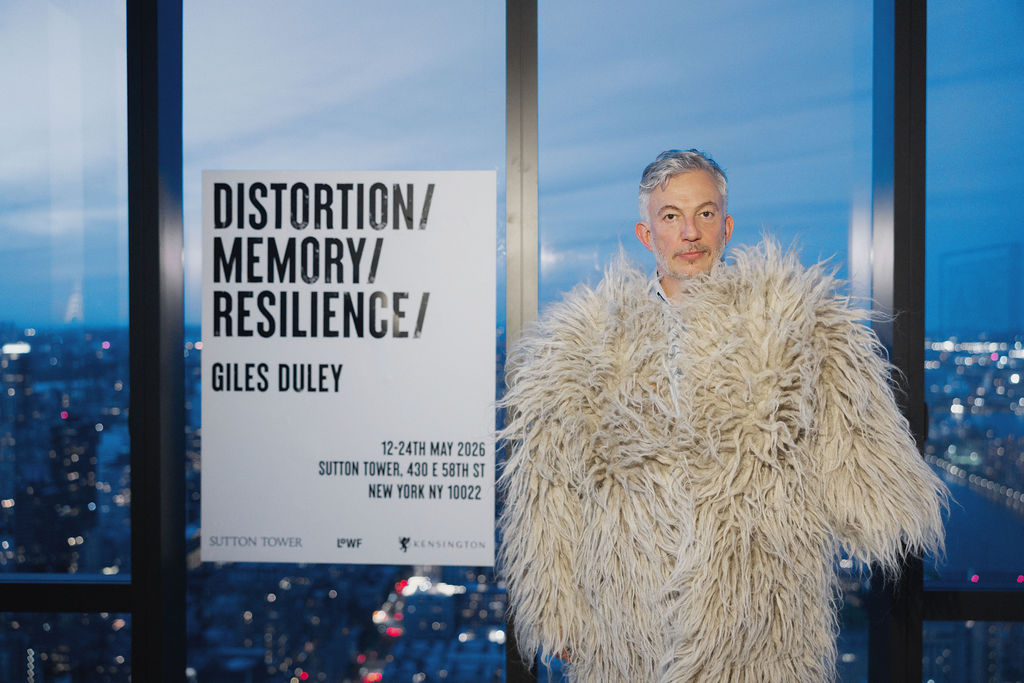
Photo by Tetiana Nikolaenko
By KEN KRANTZ May 14th, 2026
Distortion/Memory/Resilience, Giles Duley’s exhibition as the artist-in-residence of Sutton Tower, is the hidden gem of New York Art Week in Spring 2026. In a week often defined by spectacle, the show feels like a hidden room inside the city: intimate, disarming, and unusually concrete.
Presented as a reimagining of Duley’s two decades spent documenting the impact of conflict, the exhibition brings together photographs, personal history, installation, and humanitarian impact. Distortion/Memory/Resilience is less interested in presenting war as something elsewhere. Its force comes from proximity. It makes the familiar feel newly unstable.
My visit began inside a camera obscura projecting the Midtown Manhattan skyline. Just before sunset, we closed the door, cutting off the halfway light, and stood in a darkened room furnished with only a mattress. The skyline outside was inverted and projected, as if New York City itself had been turned over. We listened to a recording of Yuliia Tymoshenko, a prominent Ukrainian journalist, describing how she survived a Russian bombing from the floor of her bathroom in Kyiv during the first days of the invasion. Nearby, a phone played sirens from the real Ukrainian air alert app, tying the installation not to a past event, but to an ongoing threat.
The exhibition refuses distance without forcing a response. The rooms are spare enough to let the materials breathe. In the second installation, a traditional schoolroom is arranged with wooden desks. When opened, the desks reveal children’s drawings shared by the nonprofit Gen.Ukrainian. The images are bloody recollections of war and trauma rendered in the primitive visual language of childhood. An audio track recounts the children’s stories as visitors move through the room. The effect is not sentimental. It is clarifying. These are not abstractions about conflict. They are records of what children have had to absorb.
The third room resembles a grandmother’s living room. Visitors are invited to sift through a box of black-and-white photographs that, at first glance, appear historical. However, they are portraits of soldiers fighting in Ukraine today. Duley captured the images using cameras from the 1940s, collapsing the visual language of World War II into the contemporary war in Ukraine.
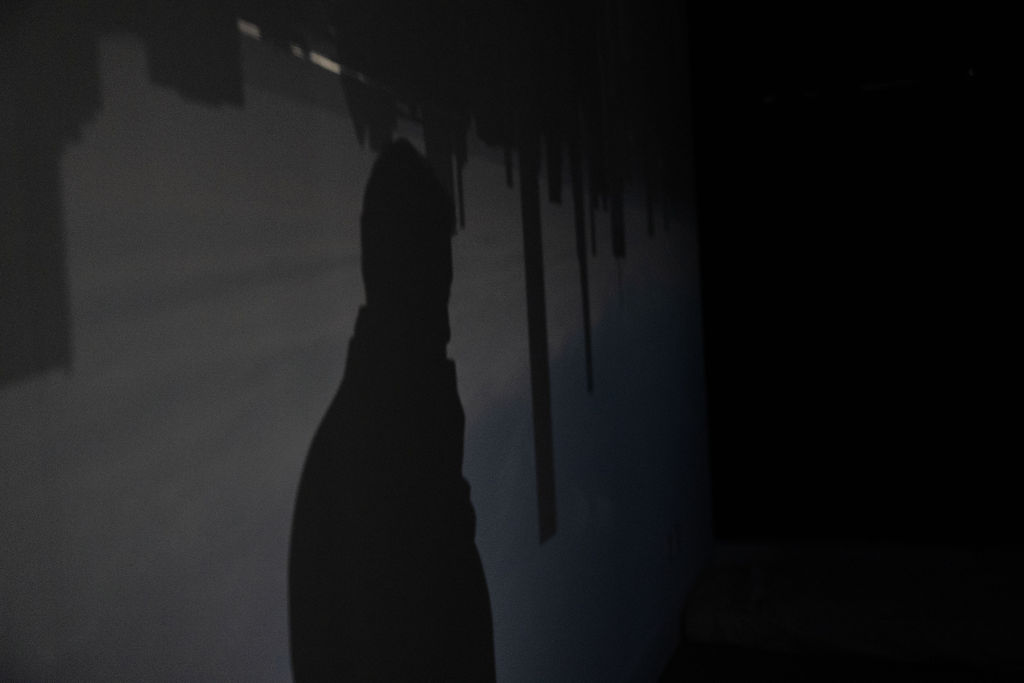
Photo by Tetiana Nikolaenko
Duley has described his life as shaped by war but driven by love, and that distinction matters. Duley’s mother, Flora, was a nurse at St. Mary’s Hospital during the V1 and V2 rocket attacks during WWII. The manifestation of her community care lives on through his dedication to his work as a war documentarian, focusing on the long-term humanitarian impact of conflict. In the last year alone, he has visited 14 countries to document and support the lives of those impacted by war.
Duley’s stated goal for his work is plain: for the world to “stop killing children.” It is the minimum condition for calling ourselves human. At the same time, he resists the false comfort of easy optimism. “I cannot promise that things will be better,” he says. “I can only promise that they will be different in a year.”
That line carries much of the exhibition’s emotional intelligence. Change does not automatically progress. But change is still where responsibility begins. One of Duley’s stories captures the exhibition’s broader invitation. After a talk in London, a woman approached him and said she did not have much money, but wanted to help. She felt she had little to offer. Duley encouraged her to find a local refugee center and reach out. Months later, she wrote to him. She had baked a cake to welcome her new neighbors, and they loved it. The story could easily become precious, but in Duley’s telling it becomes practical. Faced with global violence, the question is not always what grand intervention one person can make. Sometimes the question is where, nearby, one can begin. The luxury penthouse of 430 E 58th St. is a beautiful place to begin.
Food is central to Duley’s practice: he shares a meal with every subject before making their portrait. That belief in domestic acts of care extends into the exhibition’s salon dinners, curated by Duley under his moniker The One-Armed Chef, a play off of his own story of personal resilience against the scars of war. For this series of New York salons, he describes food as “the greatest storyteller,” with menus drawing from Ukraine, Persia, and Rwanda. Dr. Sofia Yatsyuk, a Ukrainian-British concert violinist, serves as musician in residence for the dinners. The show’s programming fixes Duley as a centerpiece to the work itself, his lived experience in conflict zones and as a premier photographer allowing him to translate between worlds.

Photo by Tetiana Nikolaenko
What makes Distortion/Memory/Resilience worth seeing is that it is an opportunity to slough off nihilistic helplessness. Duley believes that “99% of people are good” and would help someone in need if given the chance. The exhibition takes that belief seriously. It does not let viewers off with awareness alone, but it also does not shame them into paralysis. It opens a space for curiosity, vulnerability, and action at a human scale.
During a week crowded with art, parties, and polished surfaces, Distortion/Memory/Resilience offers something rare: a place to pause and allow attention to be a form of care. Go for the immersive installation. Go for the photographs. Go to support vital NGOs such as Gen.Ukraine and the Legacy of War Foundation. But mostly, go because you want to believe that you can help make the world a better place.
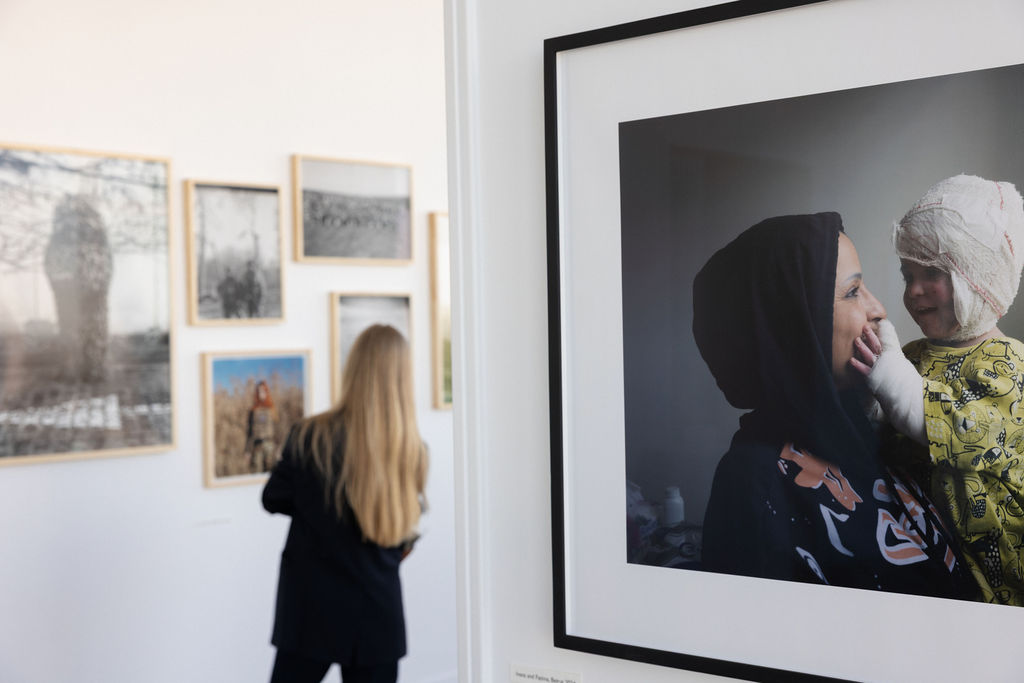
Photo by Tetiana Nikolaenko

Ken Krantz
Ken Krantz is interested in the intersection of business, culture, and bravery where great artwork emerges. He can be found on Instagram as @G00dkenergy or online at goodkenergy.com.
view all articles from this author