Whitehot Magazine
September 2026
"The Best Art In The World"
"The Best Art In The World"
September 2026
Kevin A. Williams : Super-Realism, Directism, and The canon of Black Figurative art
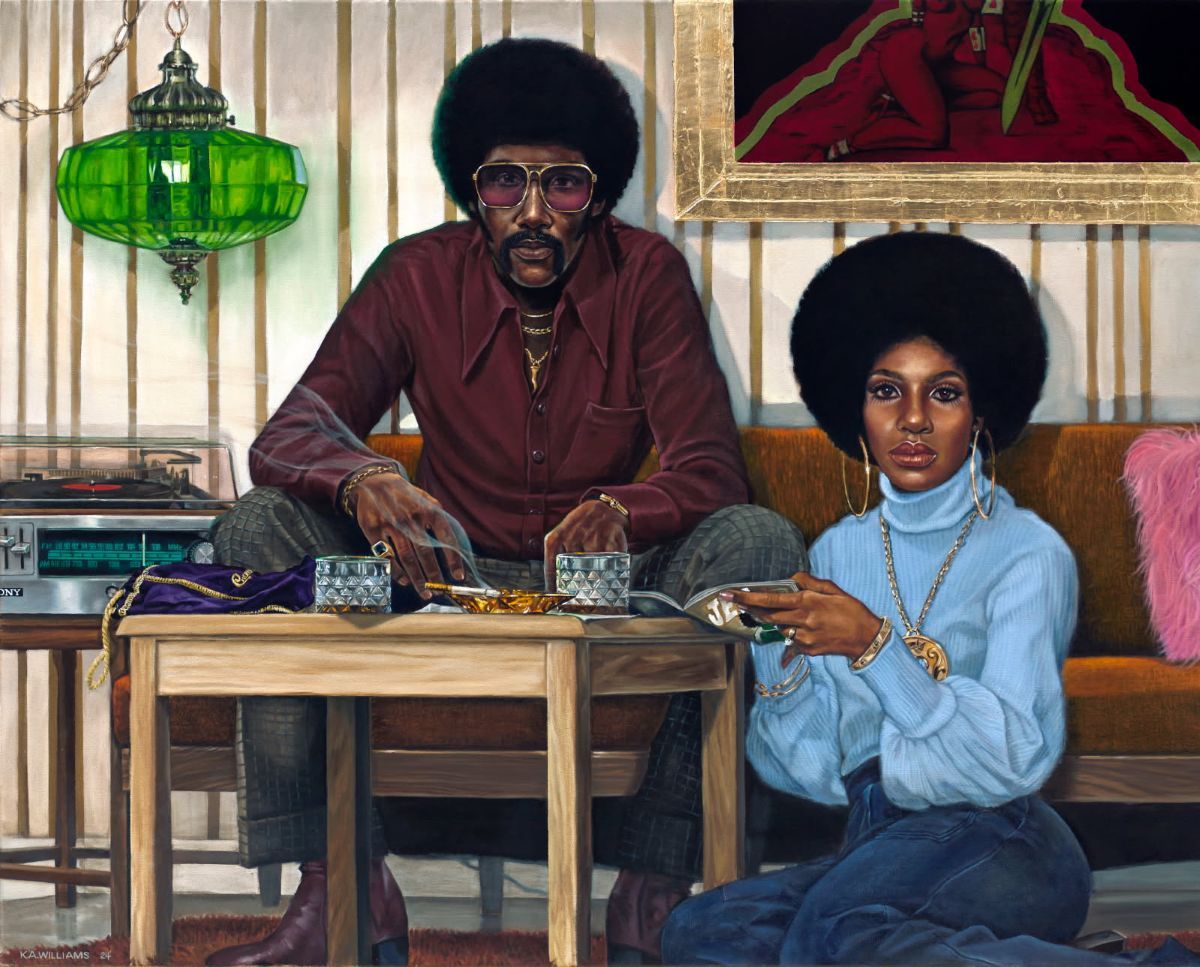
Kevin A. Williams, Boogie Wonderland (2024), 48 x 60, oil/gold leaf on canvas, courtesy of the artist
By Richard Allen May III July 25th, 2026
Turntable. Sunglasses. Turtle neck. Oversize collar. Soul Train Afro haloed like an album ready to bump. These are the visual coordinates of Kevin A. Williams's artistic practice—a super-realist painter who demands we recognize Black life in its unflinching, uninterrupted joy. To understand Williams's rightful place in the contemporary canon of Black figurative art is to understand Directism: the visual strategy of immediate recognition and refusal to be erased. His works do not ask permission to exist. They command attention.
Originally from Chicago’s Southside, Williams stands at the intersection of three critical traditions in African American visual culture: the super-realism of meticulous figurative rendering, the photo-realist documentation of everyday Black life, and the unapologetic Directism exemplified by AFRICOBRA's Nelson Stevens and later by Barkley L. Hendricks in the 1970s. Similar to Stevens’s facial anatomical precision, Williams's figures meet the viewer with unflinching gazes. They refuse to be secondary, decorative, or apologetic. They demand recognition. Like Hendricks—who painted life-size portraits of his students, neighbors, and friends with an almost confrontational intimacy—Williams renders Black Americans with an uncompromising commitment to gestural mastery.
The genealogy is clear: Charles White established the foundational language of dignified Black figuration in the mid-twentieth century. Nelson Stevens's Uhuru (1971) brought architectural rigor to Black portraiture—his subjects grounded in geometric color fields built through color rappin', his improvisational application of color theory that amplified presence. Then came Barkley Hendricks in the mid-1970s, whose life-size paintings of friends like Lynn Jenkins in Sweet Thang (1975–76) abandoned all pretense of distance. Hendricks's subjects wear their fashion, their attitude, their style like armor and announcement. They are not historical figures or allegorical types. They are present-tense, immediate, demanding. This visual strategy—the refusal of erasure through the power of direct address—is what we call Directism. Williams inherits this legacy with full consciousness.
Williams's super-realism operates in a radically different register than purely formal or decorative approaches to the medium. His subjects are not commodities. They are people. His meticulous rendering serves not aesthetic formalism but cultural affirmation. The precision of his technique—the way light catches gold jewelry, the way skin tones shift across a face, the way fabric drapes—becomes a form of testimony. This is documentation as love. This is super-realism as Directism.
Williams remixes the visual language of the 1970s through the vocabulary of contemporary painting. He takes you back—wayback—to an era before social media, before streaming, before the Internet mediated our relationship to beauty and community. His paintings are visual Chicago House Music scratch-mixes, layering Minnie Ripperton memories with Earth Wind and Fire's 1979 promise that "all the love in the world can't be gone." He resurrects the sonic and visual world of backyard barbecues, basement parties, folks playing dominos, Bid Whist & Spades, boys riding Big Wheels and girls jumping Double-Dutch. But this is not nostalgia. This is a reclamation of a moment when Black cultural autonomy was tangible, when Jet magazine was ubiquitous in neighborhood households, beauty salons and barbershops.
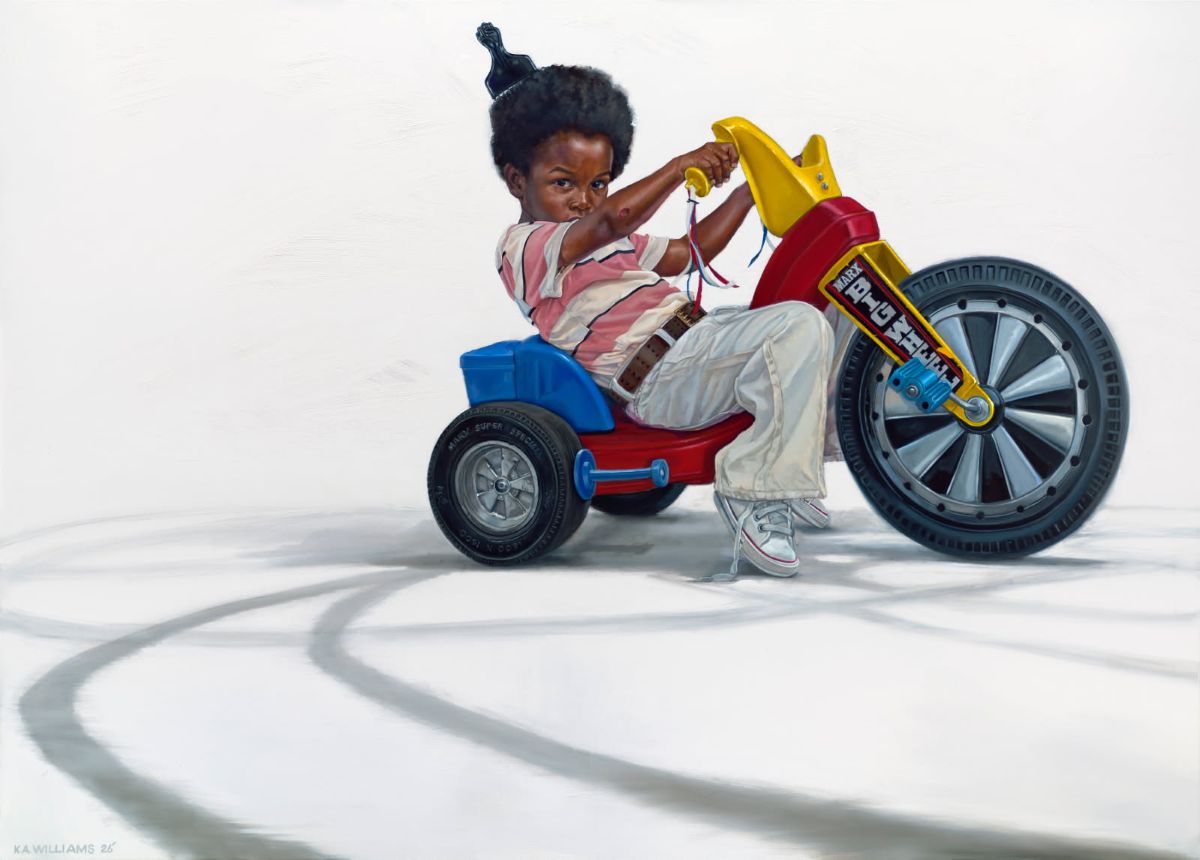 Kevin A. Williams, BIG BOY TOYS ( 2026) oil on Belgium linen, 55 x 77, courtesy of the artist
In Boogie Wonderland (2024), Williams depicts a couple in a living room reminiscent of a Kodak family photo. The color palette celebrates Black skin in its full spectrum: mocha, coffee, Hershey, caramel. This is not neutral description. Each shade is a brushstroke of affirmation. The gestural quality points to Los Angeles muralist, Richard Wyatt, whose African American figurative works understood that rendering Black life was an act of documentation and celebration simultaneously. But it is the Directism—the unflinching confidence of their gazes—that positions Williams's work as a contemporary intervention.
The male figure, "Soul Brotha," wears a cranberry velvet shirt and rose-tinted shades. Gold jewelry catches light around his neck, finger, wrist—each piece a marker of status, style, self-possession. Two glasses filled with Crown Royal sit on a tan table. Cigarette smoke snakes through the air toward a turntable underneath a Jolly Rancher candy apple green light. The setting is specific, historical, culturally coded. These objects are not incidental. They are signatures of a moment, markers of Black taste and Black pleasure. But the gaze is present-tense. He looks at you. He doesn't perform Blackness for your consumption. He exists in his own freedom.
The female figure, "Soul Sistah," reclines with equal majesty. Gold hula-hoop earrings, medallion necklace, matching bracelet, diamond ring—each element announces her status, her value, her refusal to be diminished. She wears a fall sky blue turtleneck and jeans that emphasize her rollercoaster curves and her power. Critically, she holds a copy of Jet magazine in her hand. This is not decoration. Jet was the publication that had Black interests at heart, that celebrated beauty on its own aesthetic terms, that featured the Jet Beauty of the Week—the shapely sistah in a bathing suit, admired and appreciated by the culture. Williams references this archive as an assertion of historical memory.
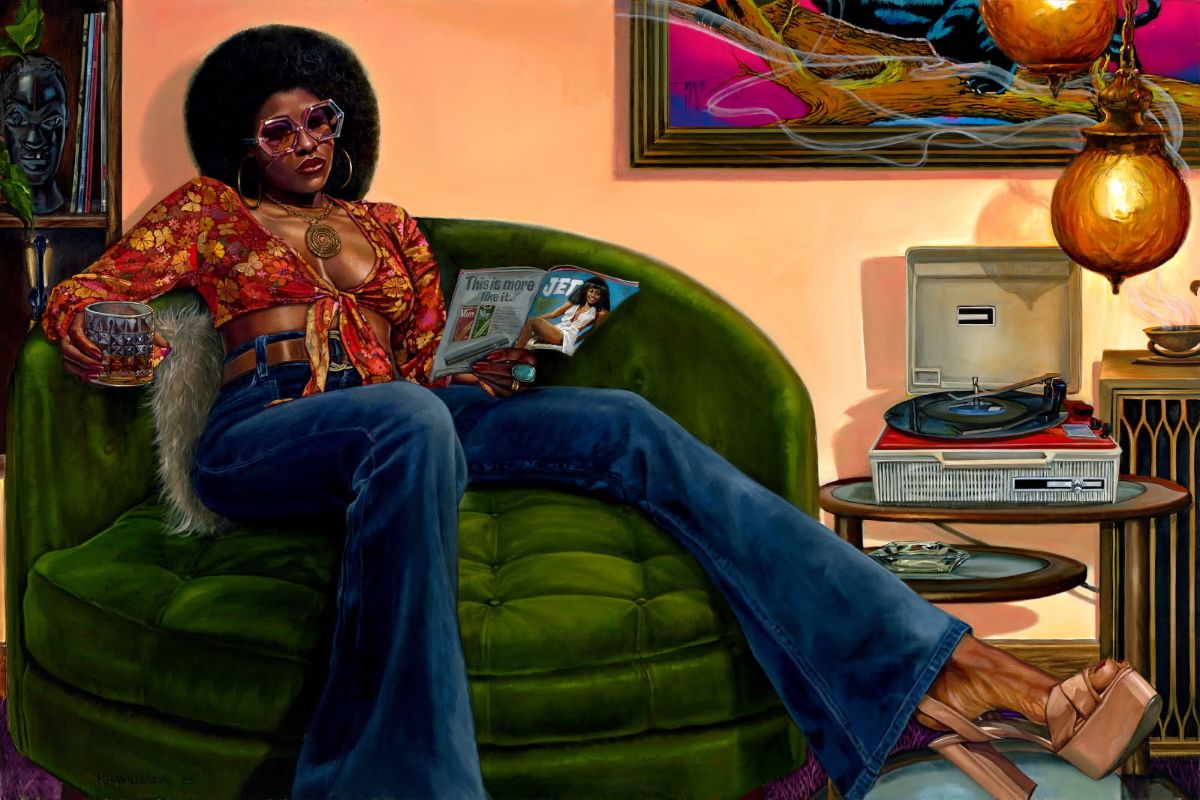
Kevin A. Williams, Jet Beauty of the Week (2025), 48 x 72 oil on canvas, courtesy of the artist
In Jet Beauty of the Week (2025), a solo female figure sits in her living room holding Jet magazine. One can almost hear Lady (1979) by the Whispers playing on vinyl, the needle crackling like Rice Krispies cereal—that specific sound of the 1970s, before CDs, before digital files. Her geometric shades complement her halo Afro. Her spirograph-shaped earrings catch light. Blue jeans hug her Brickhouse figure with confident presence. The setting is intimate, domestic, ordinary. But the painting's monumental scale and the meticulous super-realist rendering transform the ordinary into the extraordinary. This is Directism applied to the female body: an assertion that Black female beauty, joy, and self-determination matter enough to be rendered life-size with the kind of technical mastery that reflects Blacknificence.
This “A Free I Can” artist takes his place in a lineage that includes Jeff Donaldson, Laura Wheeler Waring, John Biggers, Amoako Boafo, Amy Sherald, Kehinde Wiley, and the broader tradition of Black figurative painters who understood that rendering Black people with dignity and technical excellence was a revolutionary act. His unapologetic super-realism—his commitment to depicting Black Americans in their own terms, on their own terms, with their own cultural references intact—constitutes an intervention into the very canon of contemporary art. His figures do not ask; they demand. They meet your gaze. They exist in joy, in style, in the uninterrupted pleasure of their own Blackness.
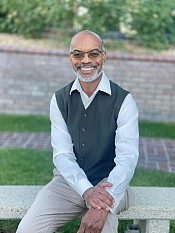
Richard Allen May III
Richard Allen May III is a 2025 Andy Warhol Foundation Arts Writers Grant recipient, independent curator, and educator at CSU Fullerton, CSU San Bernardino, ArtCenter College of Design, and Bowie State University, where he teaches art history. He has been a contributing writer for Artillery for over eight years and wrote the foreword to AFRICOBRA: Experimental Art Toward a School of Thought (Duke University Press, 2020).
A project supported by the Andy Warhol Foundation Arts Writers Grant.
view all articles from this author