Whitehot Magazine
October 2026
"The Best Art In The World"
"The Best Art In The World"
October 2026
Immersed in the Afterlife: Frida and Diego: The Last Dream at MoMA
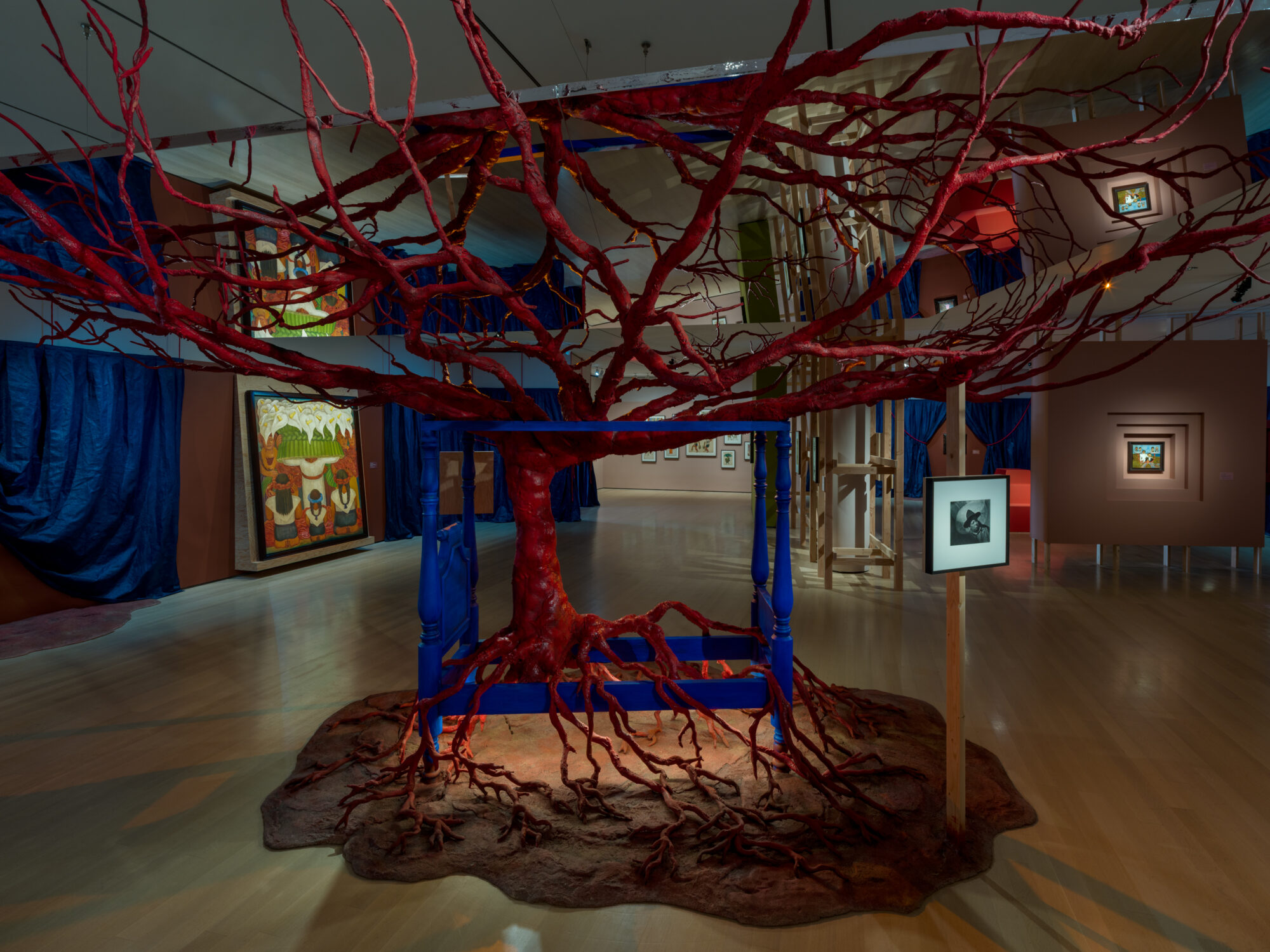 Installation view of Frida and Diego: The Last Dream on view at The Museum of Modern Art, New York, from March 21 through September 12, 2026. Photo by Jonathan Dorado © The Museum of Modern Art, New York
By KURT COLE EIDSVIG July 14th 2026
A leafless red tree stretches floor to ceiling, acting as a centerpiece for Frida and Diego: The Last Dream. Fashioned with a mirror above, the tree grows through a deep blue bed frame and branches into tributaries; harbingers of the dreamy wandering ahead. Red stick-ends point out to gallery spaces surrounded by exposed scaffolding, colored cabinets, a red pedestal, and billowing blue textiles, while positioned throughout are six paintings and a drawing on display by Frida Kahlo, and over a dozen works by Diego Rivera, interspersed with photographic portraits of the artists by Lola Álvarez Bravo, Leo Matiz, and others. This trip into the magical is thanks in part to Jon Bausor, the stage set and co-costume designer of the Metropolitan Opera’s presentation of El Último Sueño de Frida y Diego, who was invited by MoMA to create this setting for The Last Dream. The result is an occasion in which art, gallery design, and curation intertwine into an immersive experience, casting visitors as actors in the drama rather than casual observers.
The exhibition's start even anticipates a unique interaction between art and drama. Visitors enter through a hall flanked in deep blue textiles, cinched back by red ropes. The space opens, and the structure of the focal tree eventually confuses the eye. Are we actually looking at a tree above ground or below ground? Without leaves, there’s a tension between these being branches or roots. Are we witnessing growth or decay?
While the representation shifts between a direct depiction of a tree and a rendering of its root system in the ground below, the mirror also serves a dual role. The reflections cast viewers as crane-necked wonderers at the ceiling-sky, finding our dreams in the clouds above, or as deceased dreamers piecing together the memories of our former lives. This immersive tension between above/below and life/death is a testament to Bausor's gallery design, as well as the exhibition’s adept borrowing of themes from the opera. Bausor’s craft and invention accentuate the art, the opera’s narrative, and the overall experience of visiting the galleries in a way that begs the question: why don't audiences get the pleasure of this type of detailed attention to organization and display more often?
Presented in conjunction with the opera El Último Sueño de Frida y Diego, the exhibition Frida and Diego: The Last Dream showcases the power of interdisciplinary collaboration. Curators, designers, assistants, and the Metropolitan Opera worked together to create an art-viewing experience that brings multiple fields of expertise into dialogue. The opera, El Último Sueño de Frida y Diego, composed by Gabriela Lena Frank with a libretto by Nilo Cruz, is directed and choreographed by Deborah Colker. The opera tells the story of Diego Rivera at the end of his life as he mourns Frida Kahlo. Through memories, returns, and reunions, she reluctantly comes back from the dead and spends 24 hours among the living, reuniting with Rivera. By the end, the two of them join together in the underworld.
It's not just the tree that allows us to accompany the artists so actively in their journey of contemplating life, love, and death. A similar narrative envelops us as we contemplate their art, offering further indications that we're actually underground, fighting to grow, die, or transcend alongside them.
 Diego Rivera. Flower Festival: Feast of Santa Anita. 1931. Encaustic on canvas, 6′ 6 1/2″ x 64″ (199.3 x 162.5 cm). The Museum of Modern Art, New York. Gift of Abby Aldrich Rockefeller. © 2025 Banco de México Diego Rivera Frida Kahlo Museums Trust, Mexico, D.F. / Artists Rights Society (ARS), New York. Photo: Erik Landsberg
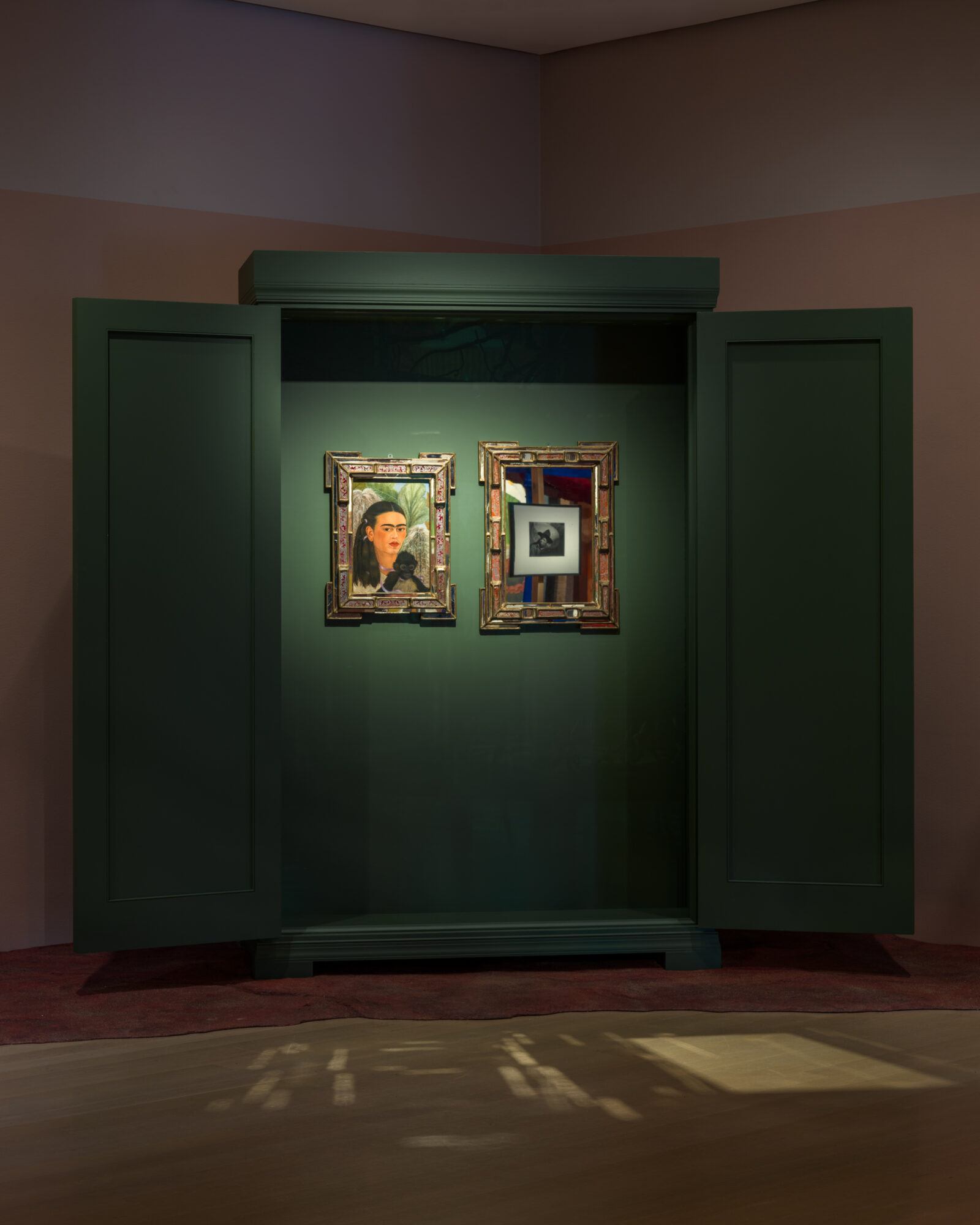
As anyone could guess, Kahlo and Rivera’s works have no trouble competing and excelling beyond the exhibition design. In addition to the mirror above the tree, there is Kahlo’s Fulang-Chang and I, to place us in the space. Shown in two parts, oil on board, and a mirror with a painted mirror frame, we are forced to see ourselves in the underworld next to the Kahlo self-portrait. A fitting placement, given the opera’s story of separation in life and reunion in death.
Further, magnificent works like Rivera’s Flower Festival: Feast of Santa Anita, 1931 are given fresh energy in the exhibition. With the pressed composition of flowers simultaneously sprouting upward and compressing the figures participating in the feast, the parallels of symbolism, tradition, and transcendence ricochet against the constructs of the exhibition space both visually and thematically.
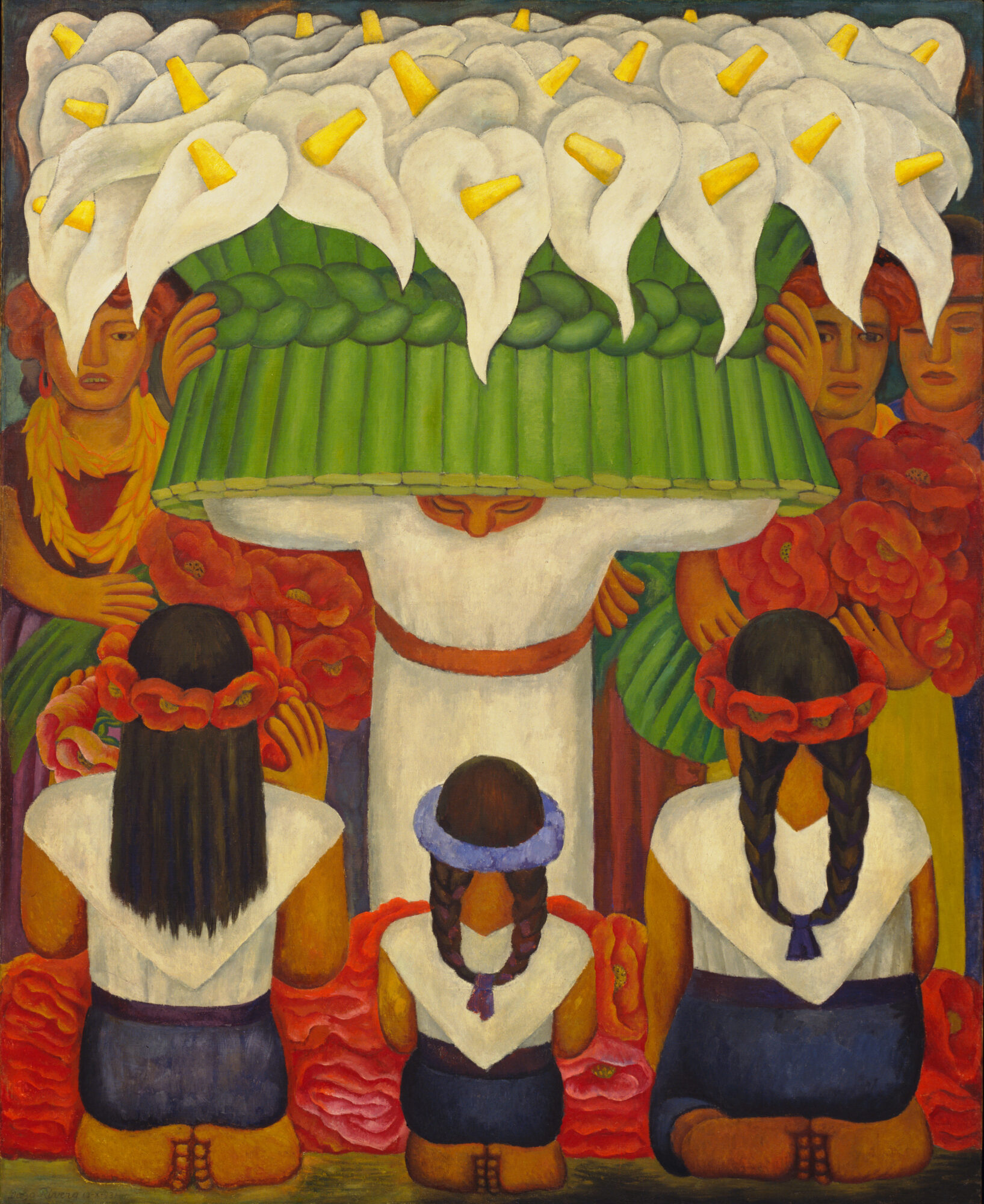 Diego Rivera. Flower Festival: Feast of Santa Anita. 1931. Encaustic on canvas, 6′ 6 1/2″ x 64″ (199.3 x 162.5 cm). The Museum of Modern Art, New York. Gift of Abby Aldrich Rockefeller. © 2025 Banco de México Diego Rivera Frida Kahlo Museums Trust, Mexico, D.F. / Artists Rights Society (ARS), New York. Photo: Erik Landsberg
Frida and Diego: The Last Dream is housed one floor below MoMA’s sweeping Marcel Duchamp retrospective that's being presented at the same time. As such, the red tree quite literally reaches up to the ceiling positioned below the Duchamp exhibition. We aren’t just forced to consider the underworld or the afterlife; this placement underscores the interplay and influence between the works of Kahlo and Rivera and those of Duchamp, roots infusing growth and vice versa. Here, the very essence of outgrowth and artistic trajectory quite literally sprouts, meanders, and informs, with asking which is more surreal or transcendent, the Dada Duchamp above or this show of Rivera and Kahlo. If Duchamp is the forefather of the intellectual brain-teasing revelations found later in Jasper Johns, The Last Dream hits with the emotional wallop of a Rothko. This journey into death we are invited to join feels like the early wincing of pulling on a cactus-skin suit inside out, like an Iron Maiden torture device, only to find the quills you feared are made of feathers or microfiber. There, beneath the Earth’s crust, we are provided a relief and an exhale, a rung-out sponge of reds and pain that seeps away the tension and allows for awe-filled contemplation.
Frida and Diego: The Last Dream, an exhibition of key works from MoMA’s collection by Frida Kahlo and Diego Rivera, is on view at The Museum of Modern Art from March 21 through September 12, 2026.
Kurt Cole Eidsvig
Kurt Cole Eidsvig is an artist, poet, and author. His most recent book, Drowning Girl, is a book-length novel-poem inspired by the Lichtenstein painting of the same name. He maintains a website at EidsvigArt.com.
view all articles from this author