Whitehot Magazine
August 2026
"The Best Art In The World"
"The Best Art In The World"
August 2026
The artist’s freedom in Pedro Casqueiro: on the exhibition "Detour" at MAAT Lisbon - Portugal
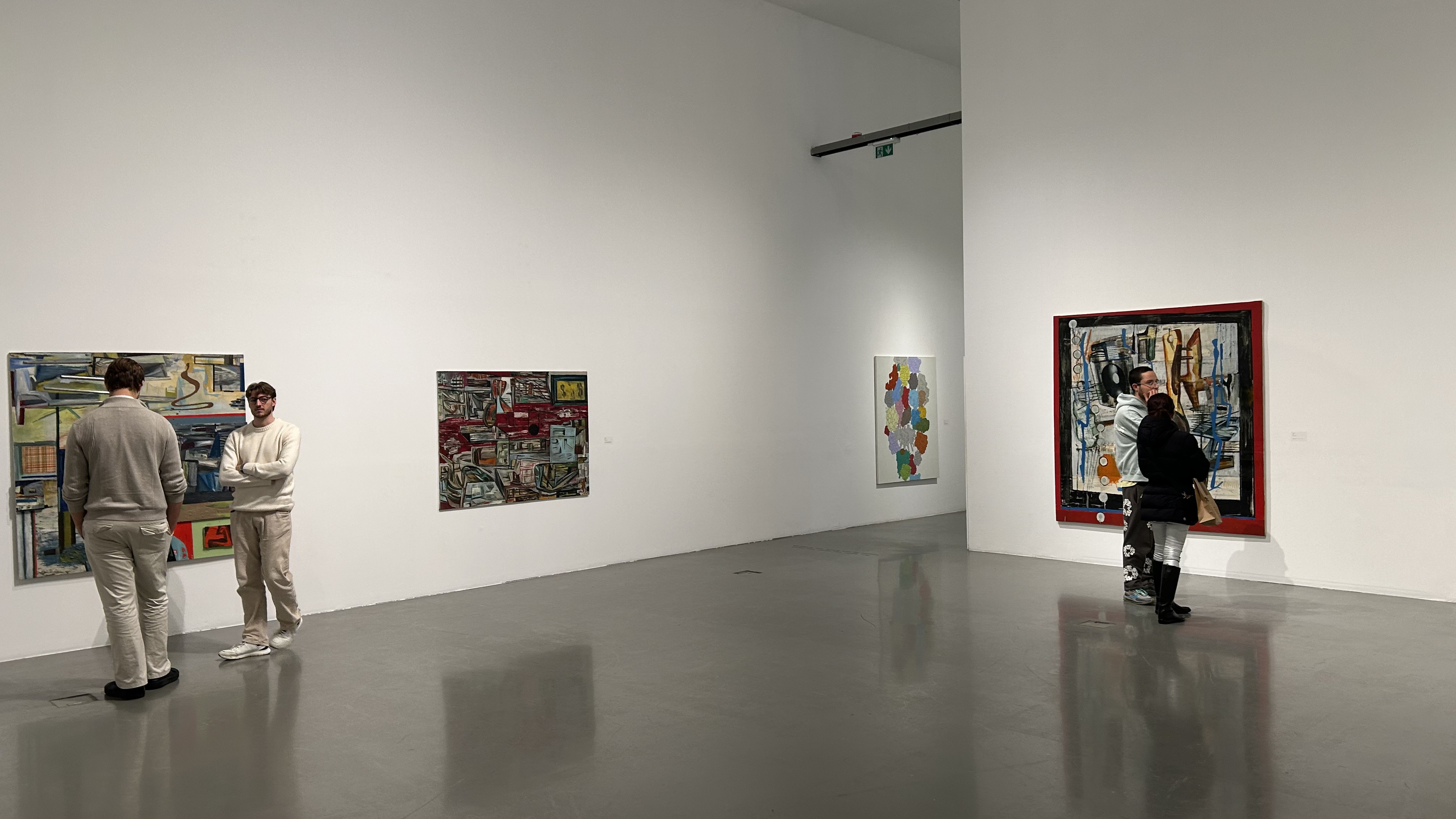
Detour, Museum of Art, Architecture and Technology (MAAT/Lisbon), 2025.
Photo: Flávio Rocha de Deus
By Flávio Rocha de Deus March 29th, 2026
In recent years, as I have dedicated myself more systematically to art criticism, I have noticed a trap that often flirts with artists at the moment when their language becomes recognizable. When we look at a work and immediately think “it is his,” when the artist’s signature no longer depends on the signature on the work, at the very moment when the peak of artistic authorship is reached, a subtle prison may also be taking shape.
A style consecrated within the field can turn into expectation, and expectation can turn into a demand for style as a toll for permanence, in which the artist is gently invited to systematically repeat the gesture that consecrated him, not to betray the signature that made him identifiable, to remain faithful to the image that the circuit has chosen to love. Thus, the mass of the public, the mass of criticism, and the ordinariness of the market learn to desire precisely what has already been done, and in this way, a curious fetishism of repetition is consolidated around the consecration of the artist’s work. The past experiment is loved, but the future experiment is feared. The experimentation that was celebrated becomes a formula, and the artist becomes the involuntary guardian of his own invention.
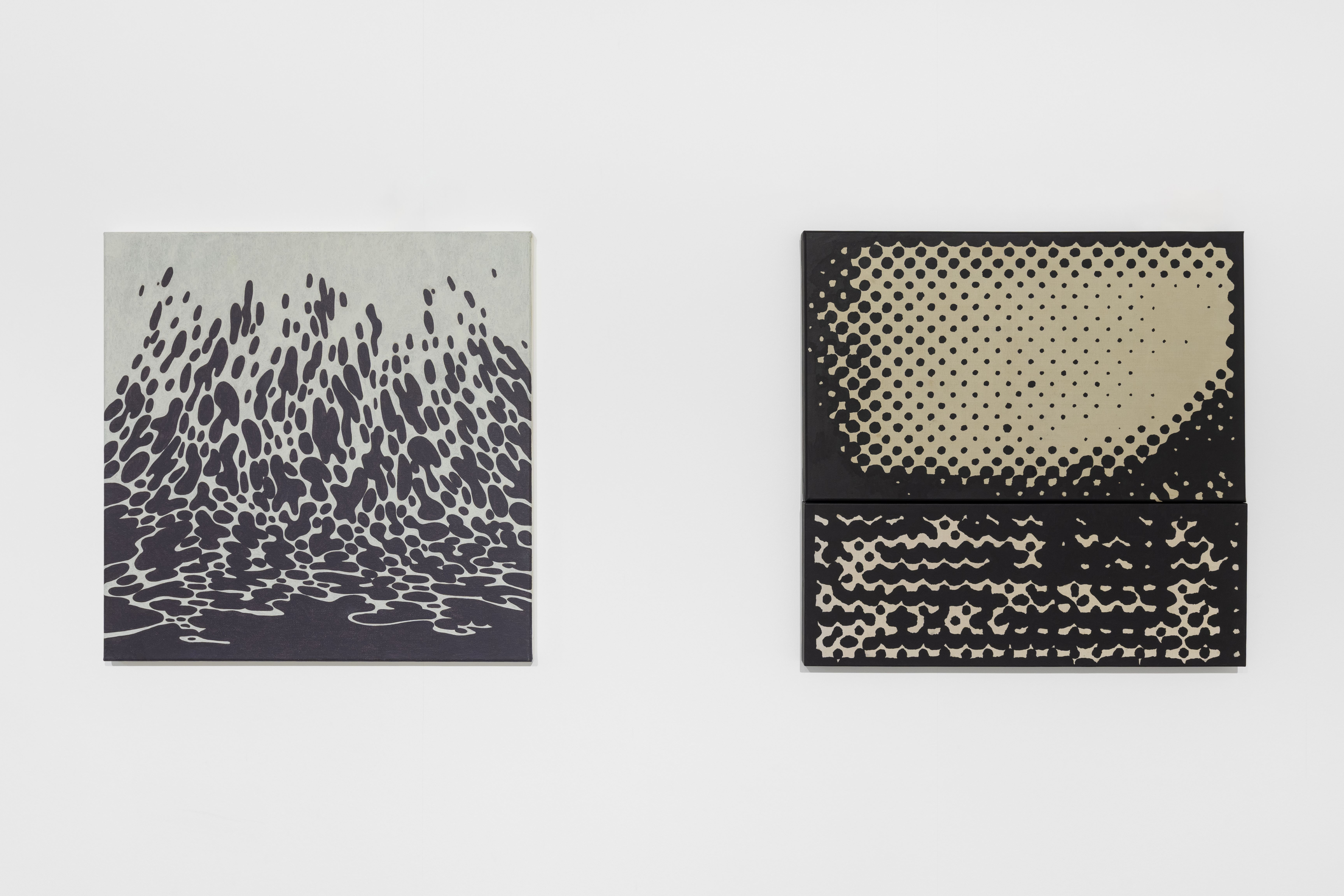
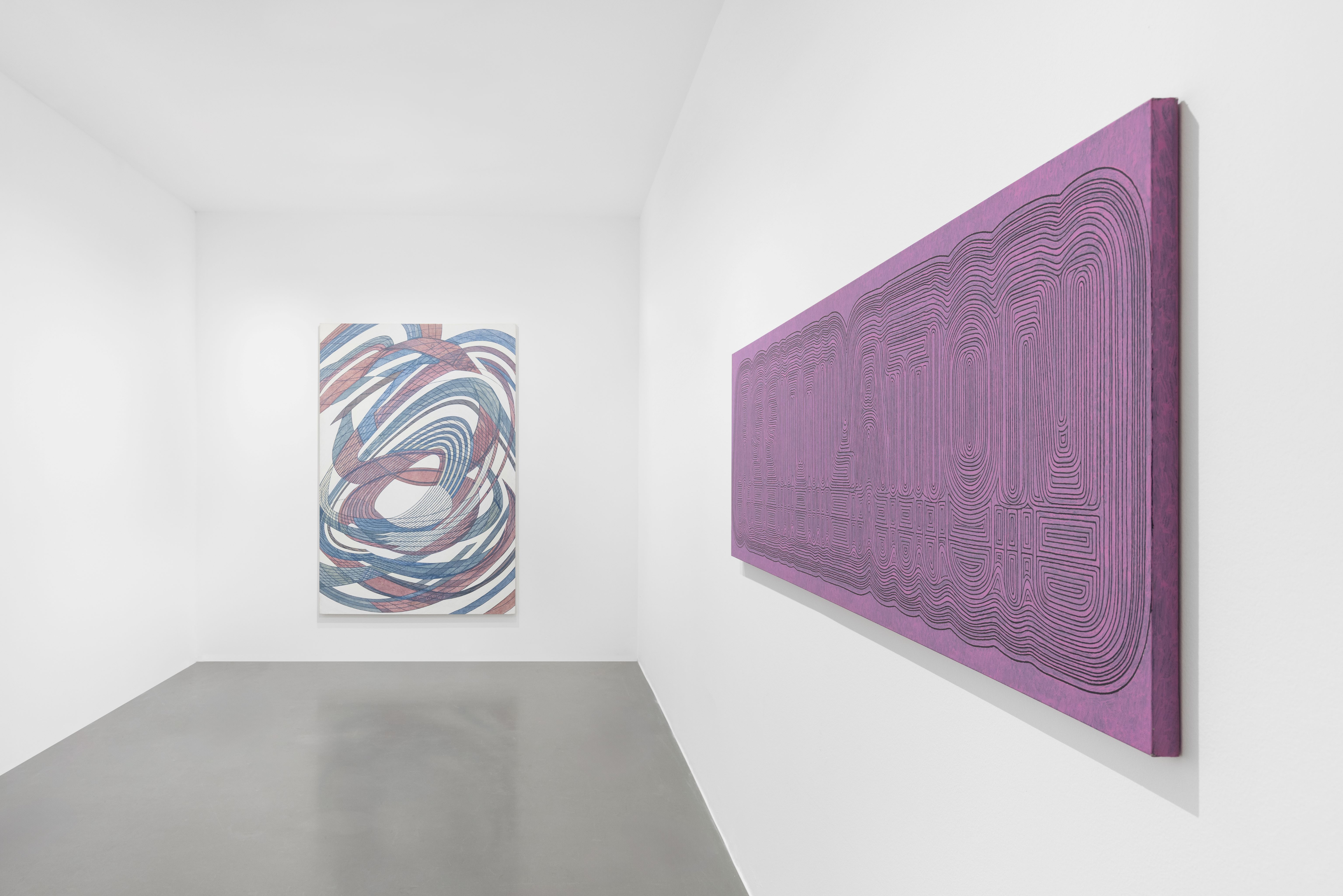
Pedro Casqueiro, Museum of Art, Architecture and Technology (MAAT/Lisbon), 2025.
Photo: Bruno Lopes.
This type of observation is unavoidable in our time. It applies both to criticism, which must be attentive to its comfort zone, and to the artist, who must pay bills and satisfy creative desires. In this interval, Detour (12 November 2025 to 6 April 2026), Pedro Casqueiro’s solo exhibition curated by João Pinharanda at the Museum of Art, Architecture and Technology (MAAT) in Lisbon, struck me as a place for reflecting on this issue.
It is not uncommon for the critic, the essayist, or the philosopher to instrumentalize the creations of others in order to speak about concerns that already provoke them. At least, not for me. But in fact, Detour presented itself to me as a visual essay whose unavoidable themes are experimentation and reinvention.
The exhibition presented at MAAT spans more than four decades of the Portuguese artist’s work, bringing together pieces produced between 1984 and 2025. As one moves through this temporal arc, it becomes clear that Casqueiro has never remained still within the same pictorial zone. From his earliest works, associated with the so called return to painting of the 1980s, his production has been characterized by a formal energy marked by intense textures and a radical subjectivity that prefers instability over narrative.
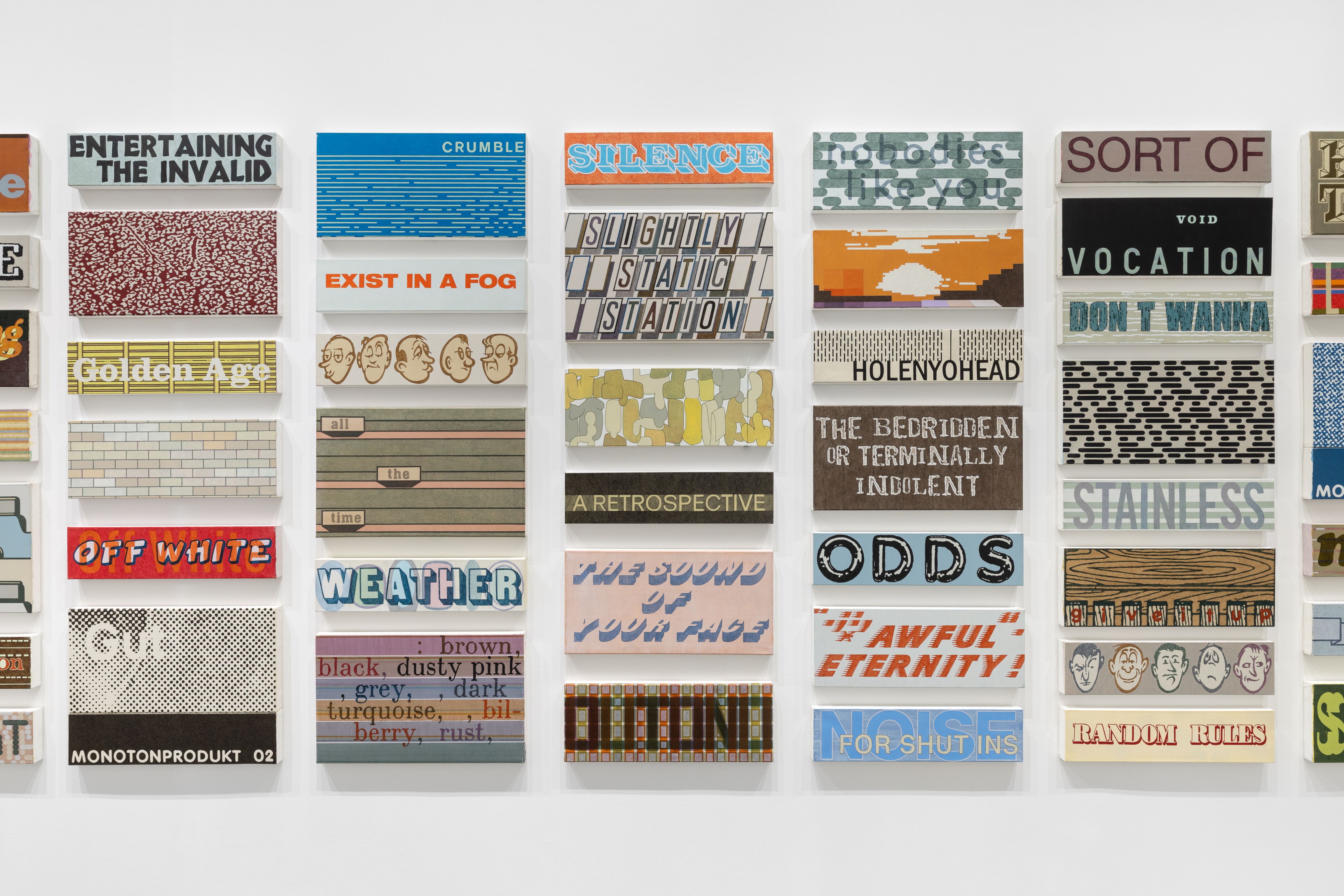
Pedro Casqueiro, Museum of Art, Architecture and Technology (MAAT/Lisbon), 2025.
Photo: Bruno Lopes.
Likewise, what initially manifested as his style, the thickness of paint, chromatic turbulence, dense surfaces, also shifts toward colder and more graphic regimes, where human figures, animals, textual fragments, cultural references, and signs of pop culture emerge. This shift is particularly interesting because it does not dissolve the artist’s identity. Perhaps because it is not an abrupt rupture, but a continuous drift, in which what we witness is not the evolution of a style, but multiple experiments in ways of organizing an image. The artist’s logic is not repetition, but deviation. Not by chance, the exhibition itself is titled Detour, a word that suggests an indirect path, a route that moves away from the expected trajectory.
This gesture appears in multiple ways throughout the exhibition. In some canvases, painting dialogues with the graphic culture of comics. In others, it incorporates letters and words that function simultaneously as language and visual form. There are also moments of more explicit citation, such as in the work Detour (2013), which references a print by Katsushika Hokusai, absorbed and transformed within the artist’s pictorial system, and in the series Tone Test (2022), in which Casqueiro appropriates a cartoon style, turning the exhibition wall into a comic page. In general, in these cases, what matters is not the citation itself, but the way it is deformed, displaced, and reinserted into a new visual context.
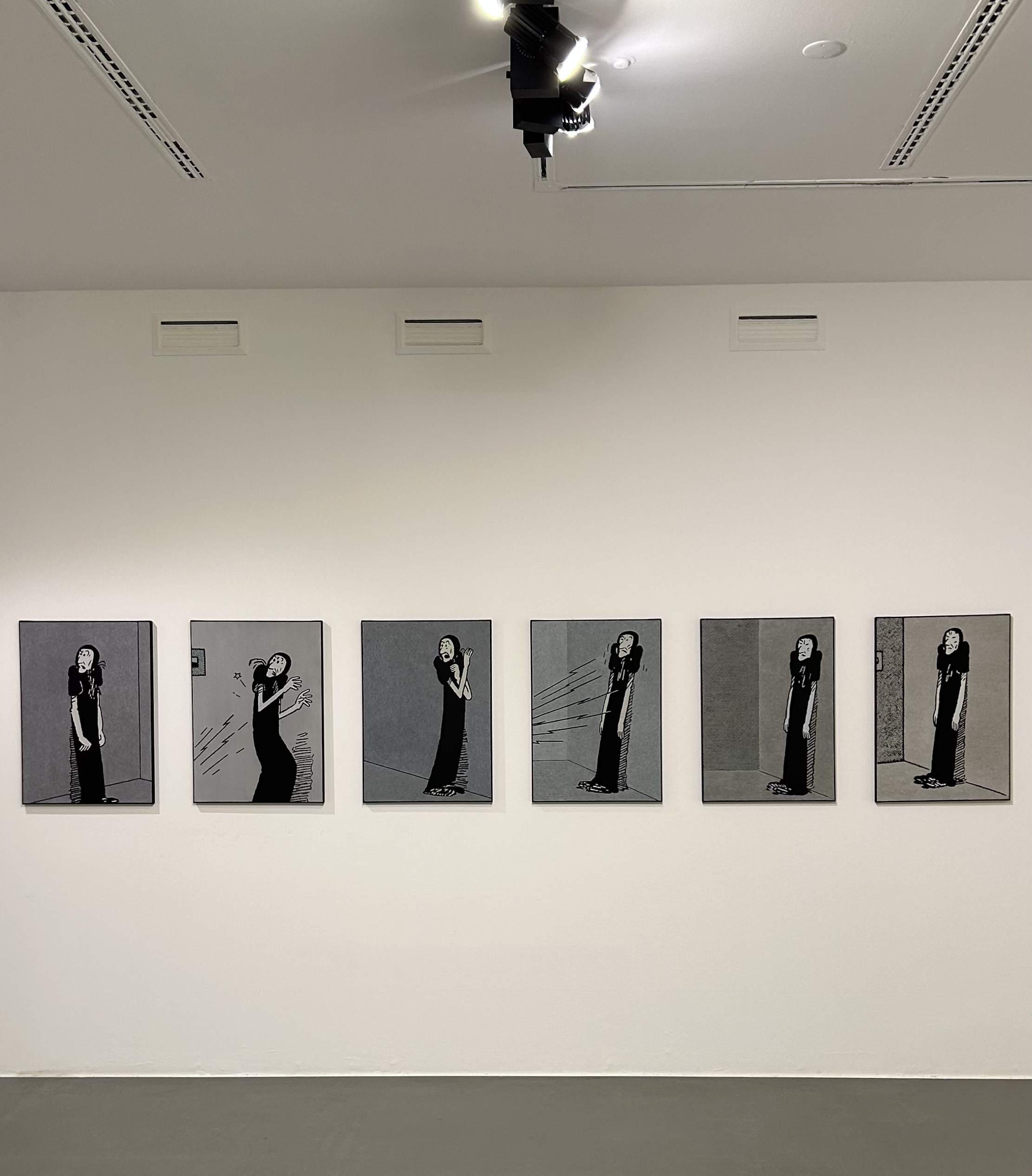
Pedro Casqueiro, Tone Test (I/VII), 2022. Acrylic on canvas, 70 × 50 cm.
Photo: Flávio Rocha de Deus.
Thus, Casqueiro’s painting functions as a machine for recombining worlds. Elements of high culture and mass culture appear without rigid hierarchy. Erudite references coexist with urban signs and popular graphic language. Everything is absorbed, transformed, and returned in the form of images that seem familiar and strange at the same time.
There is, however, one point that seems important to note. While moving through the exhibition, I did not find in Casqueiro’s painting what is often sought as a primary criterion of artistic greatness: a radical technical innovation, an innovative appropriation of represented content, or a formal invention that decisively reconfigures the limits of painting. Nor does it seem that the strength of his work lies in the affirmation of a singular pictorial solution that imposes itself as a paradigm. But perhaps this is not the most appropriate measure for understanding what is at stake in the body of his work.
Pedro Casqueiro, Tone Test (I/VII), 2022. Acrylic on canvas, 70 × 50 cm.
Photo: Flávio Rocha de Deus.
The trajectory presented by the exhibition curated by Pinharanda bears witness to a freedom conquered at each step. From the disappearance of dense texture to the emergence of a provocative graphic and figurative vocation, all of this could have been read, by a less attentive eye, as betrayal or unnecessary risk. This is where my gaze finds its place in Casqueiro’s trajectory. The artist did not merely survive his style. He reinvented it successively, keeping alive the restlessness that truly defines his work. As the curator notes, there is a deeper continuity in the body of his work: that of the attitude and the motor of his creativity, a control that deals without constraint with all the elements of contemporary pictorial discourse, allowing him to escape the prison of repeating himself.
Flávio Rocha de Deus
Flávio Rocha de Deus is a Brazilian philosopher, professor, and art critic. He holds a Master’s degree in Contemporary Philosophy and is currently a Ph.D. candidate in Aesthetics and Philosophy of Art at the Federal University of Ouro Preto (Brazil). Member of the Brazilian Association of Art Critics, he is also the author of the acronym fradde.art; writes essays and art criticism for national and international platforms and publications.
view all articles from this author