Whitehot Magazine
April 2026
"The Best Art In The World"
"The Best Art In The World"
April 2026
Daniel Giordano: The Greasiest Feast
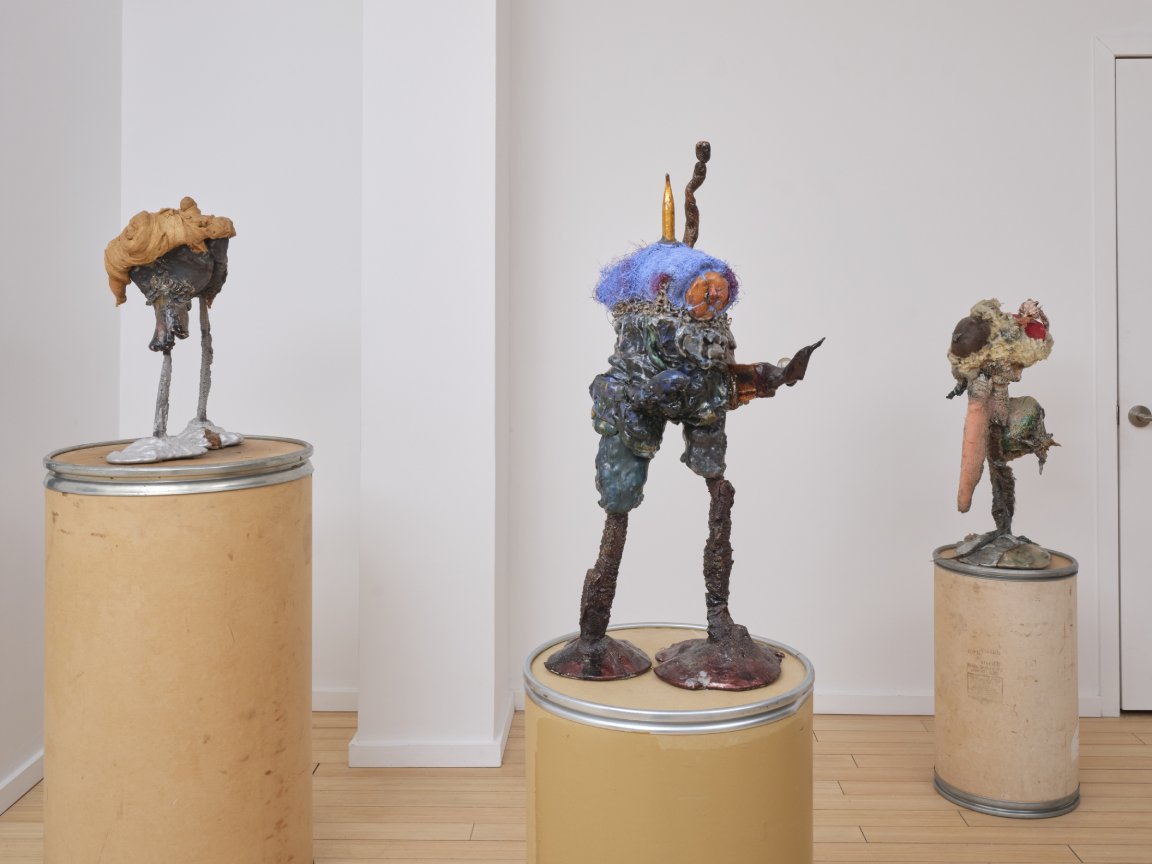 Study for Brother installation view. Image courtesy of the artist.
By ANA MARIA FARINA April 19, 2026.
At Catskill Art Space, Daniel Giordano’s The Greasiest Feast unfolds more like an encounter than an exhibition—one that sticks, stains, and lingers. Speaking the language of memory, affect, and abjection concurrently, the works confuse the senses through fascination and repulsion; organic matter is fused with industrial processes in a mixed-media symphony that once existed only inside Giordano’s peculiar mind.
The work immediately provokes the question: what am I looking at? The viewer is naturally drawn closer into the three series presented—or “veins,” as the artist refers to them. The Pleasure Pipes are installed as a constellation of exotic material combinations, each pipe a universe of its own, exhaling anything from a Christmas ornament to corpses of spotted lantern flies. These works pay homage to the artist’s late grandfather, Frank, known to him only through photographs in which he was always smoking. Nearby, three medium-sized, figure-like sculptures from the Study for Brother series reference Giordano’s deep connection to his brother Anthony and their shared childhood memories. Opposite the pipes, two wall pieces from the My Matmos series—constructed primarily from boat cushions—are infused with tactile memory and craft-based interventions such as felting and tufting.
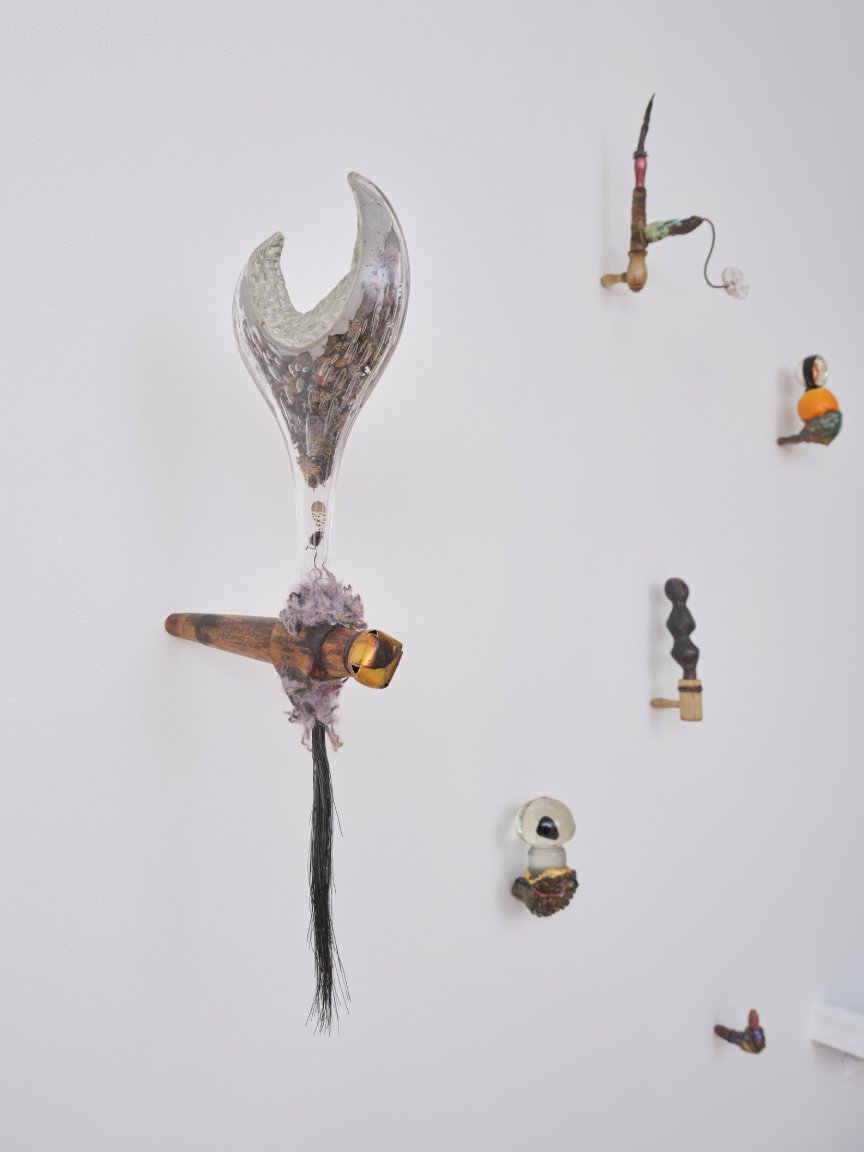 Pleasure Pipes Installation View. Image courtesy of the artist.
The production takes place at Vicki Island, Giordano’s studio in Newburgh, New York, located in what was once his grandfather’s coat factory, Vicki Clothing Company, named after his beloved aunt. The space reads like a surreal, post-apocalyptic Oz: part archive, part laboratory, part shrine. It houses a dense accumulation of materials and references—family history, Italian-American memory, and locally sourced objects from both the natural and post-industrial landscape—forming the raw substrate of the work.
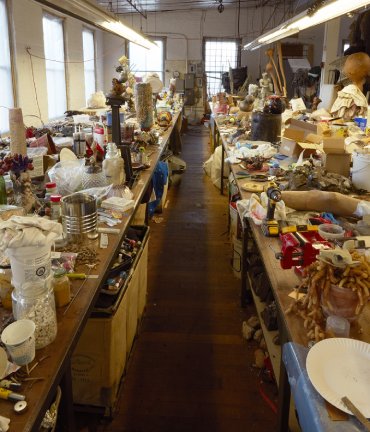 Vicki Island. Image courtesy of the artist.
Julia Kristeva’s notion of the abject—that which disturbs identity, system, and order—finds a vivid material analogue here. The abject is not simply the grotesque; it is what must be expelled to maintain the boundaries of the self. Bodily fluids, waste, decay—these are not just repellent, but structurally necessary exclusions. In Giordano’s sculptures, however, what is typically cast off returns, immobilized and aestheticized.
Giordano’s work refuses the comfort of detachment in a moment marked by instability and unease. Rather than negating the darkness of the present—social, ecological, psychological—it absorbs and metabolizes it, returning it in a heightened, corporeal form. The sculptures feel as though they externalize an internal condition, as if we could see our own guts twisting, our anxieties given texture and weight. The work becomes an ode to madness, chaos, and dirt—not as spectacle, but as lived reality. In this sense, Giordano does not aestheticize crisis so much as embody it, insisting that we confront the messiness we are already entangled in.
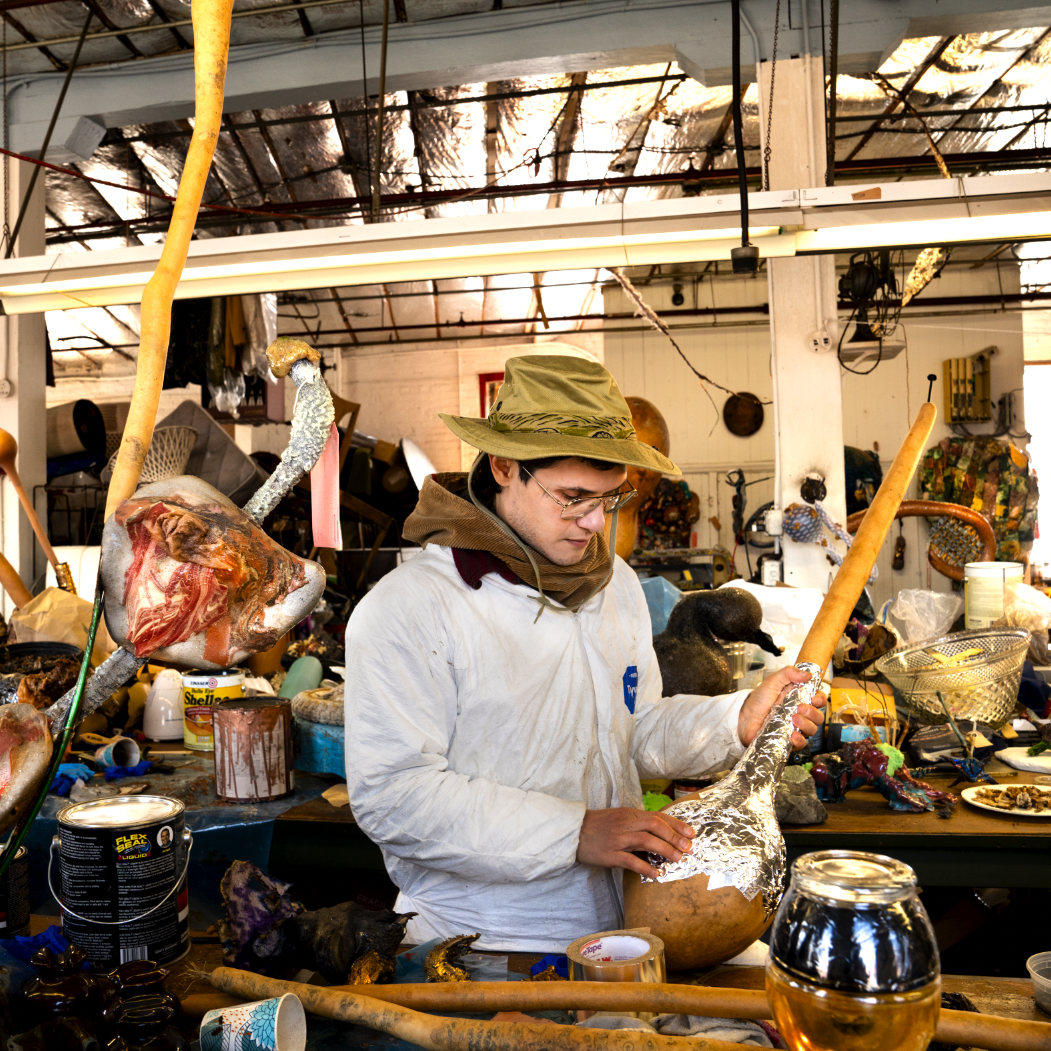 Daniel Giordano working at Vicki Island. Image courtesy of the artist.
The assemblages draw from an unlikely convergence of materials: carved wood, raku-fired ceramic, cast aluminum, and substances such as lipstick, hair, hosiery, marzipan, and urinal cakes. These materials carry traces of intimacy, sweetness, and decay—registers of the body and its maintenance. Encased in resin, they are preserved in a state that feels both fetishistic and forensic, as though the artist were archiving sensations rather than objects.The material list for each piece is a delightful read, in which the process is exposed as a confrontation with what we would rather not see.
Giordano’s surfaces blur distinctions between inside and outside, edible and inedible, sensual and abject. The pairing of marzipan—suggestive of sweetness and celebration—with urinal cakes—markers of sanitation and waste—produces a collision that destabilizes any coherent sensory register. The viewer is caught in a Kristevan oscillation: drawn in, then repelled.
In The Greasiest Feast, Giordano stages a condition in which the boundaries that organize experience—self and other, clean and unclean, natural and artificial—are not simply challenged but rendered untenable. Through a material vocabulary that is at once intimate and estranging, the work embodies abjection while insisting on proximity. No longer hidden at the edges, it is brought to the center, sealed, and offered—like a feast one cannot quite stomach, yet cannot refuse.
The Greasiest Feast is up until April 25, 2026, at Catskill Art Space.
Ana Maria Farina
As both an artist and an educator, Ana is interested in experimentation, experiences of release and constraint, expansion and collapse. Her work investigates themes of hysteria and repression of the feminine, as well as the body and identity through the lens of feminist theory and psychoanalysis. Lately, Ana has been exploring the materiality of fibers and textiles, creating sculptural paintings that visually speak what Elaine Showalter called a “feminine protolanguage.”
view all articles from this author