Whitehot Magazine
October 2026
"The Best Art In The World"
"The Best Art In The World"
October 2026
The future of Cyberfeminism: Interview with Yichu Li
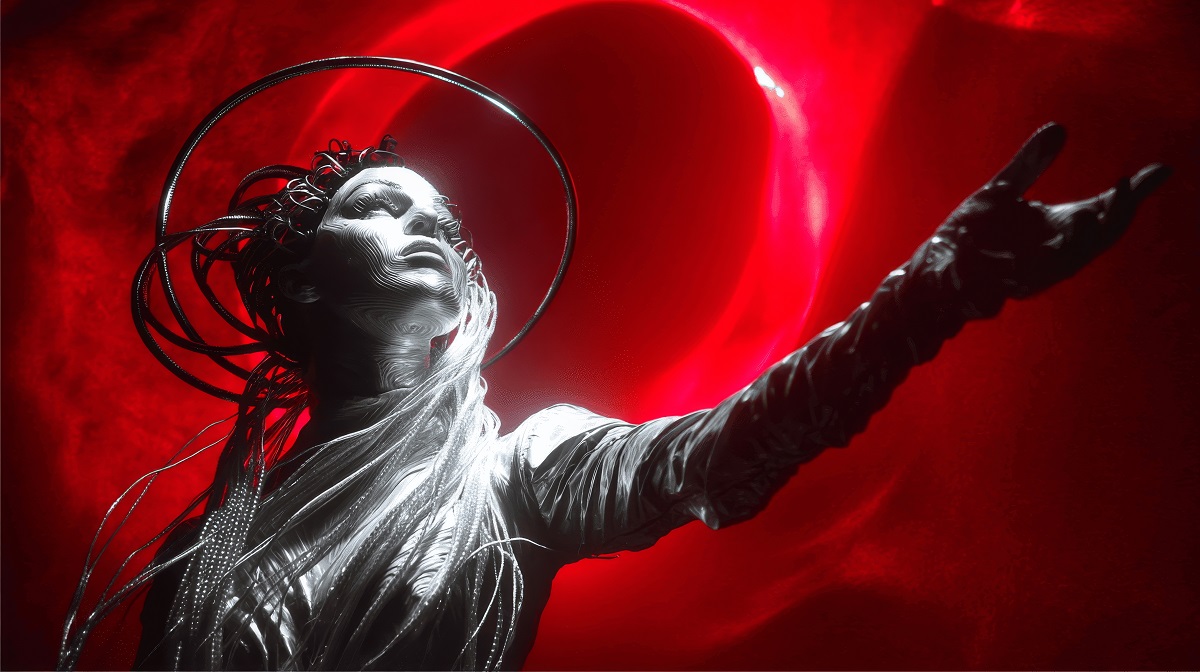 Yichu Li, "Last Generation 1" 2025.
Via Whitehot Magazine August 11, 2025
Yichu Li’s work stands at the charged intersection of technology, ritual, and identity, wielding AI not as a novelty but as a critical lens. In projects like YICHU 1.0 and RAVE CINEMA, her precise formal control is matched by an emotional intensity that refuses passive spectatorship. By merging moving image, live performance, and cyberfeminist critique, Li interrogates the power structures embedded in the digital gaze, reframing questions of embodiment and agency for a posthuman era. The result is art that is as philosophically rigorous as it is sensorially immersive.
– How did the idea of a confrontation between your physical self and AI counterpart emerge, and what does it reveal about your personal relationship with technology?
I created YICHU 1.0 to explore the possibility of digital life after physical death. What happens when you upload your soul into a system that doesn’t believe you have one? Would “you” remain after all your memories are processed, archived, and rendered as code? What becomes of agency—of desire, of protection—when identity is disembodied?
As an artist deeply engaged with digital tools, I often find myself in extended conversations with AI—an experience that resembles a high-speed chess game. You don’t always know who or what is moving the pieces. That tension is central to YICHU 1.0 – Chapter 2: NAVIGATING, where I staged a symbolic match between my physical self and a digital counterpart.
In NAVIGATING, sixteen mirror-match battles, representing the 32 pieces on the chessboard. Each version acts autonomously, but they are ultimately parts of the same system—playing out gestures within an invisible architecture of control. This structure reflects how I experience technology: as mirror, provocation, and ritual space. It confronts me with myself—my desires, my fears, my behavioral patterns—In my work, technology isn’t neutral. It’s a collaborator, an opponent, and sometimes a witness. And in that friction, I begin to see myself—not through escape, but through encounter.
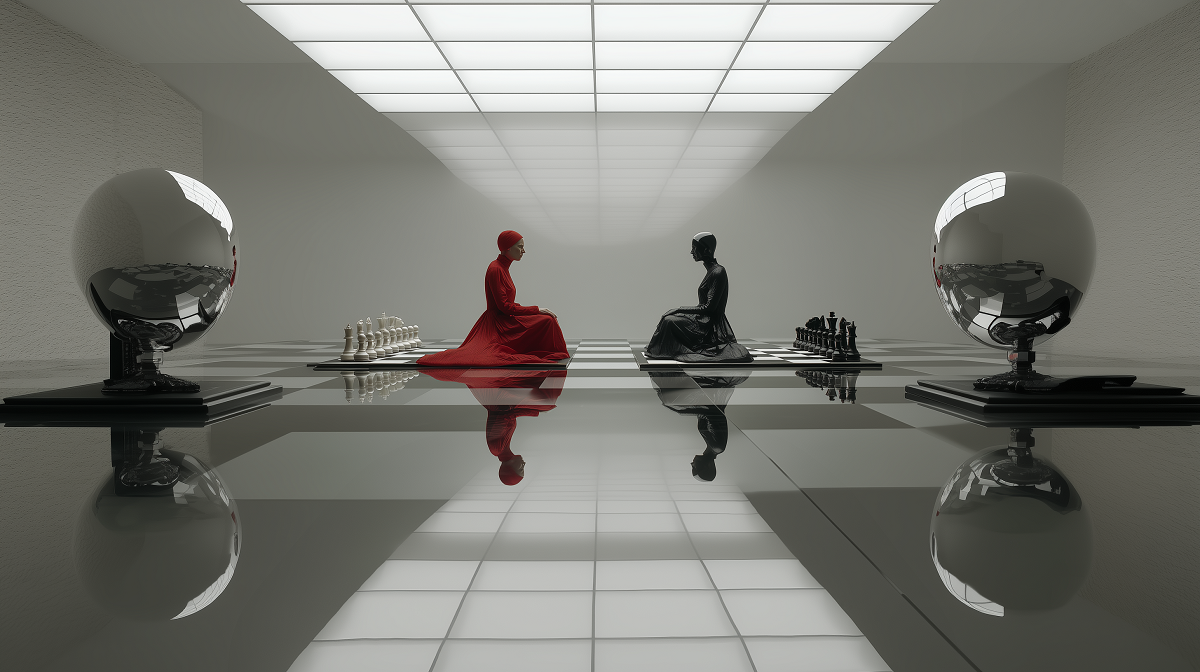 Yichu Li, "NAVIGATING 1" 2025.
– In exploring the tension between control and autonomy, how do you see power operating in digital versus physical spaces?
I’ve always been drawn to the silent tensions of image-making—how authorship, care, and control bleed into each frame. In physical space, the lens is power. As Susan Sontag said, “To photograph is to appropriate the thing photographed.” That authorship shapes more than aesthetics—it reveals intent, hierarchy, presence.
But the digital complicates this equation. We’re no longer separate from our screens. In this transitional zone—between Web 3.0 and what might become Web 4.0—the boundary blurs. Digital space presents itself as democratic, but it’s still scaffolded by algorithms, platforms, and inherited bias. A different kind of architecture—quieter, but no less commanding. In YICHU 1.0, I chose to center a teenage girl's face—cropped, partial, unsettling. It’s not about perfection. It’s about presence. Her gaze is a portal: asking who gets to be seen, who gets to speak, and who designs the codes behind both.
I’m not trying to escape power—I’m tracing where it hides. Testing whether it can be re-coded through image, presence, and provocation.
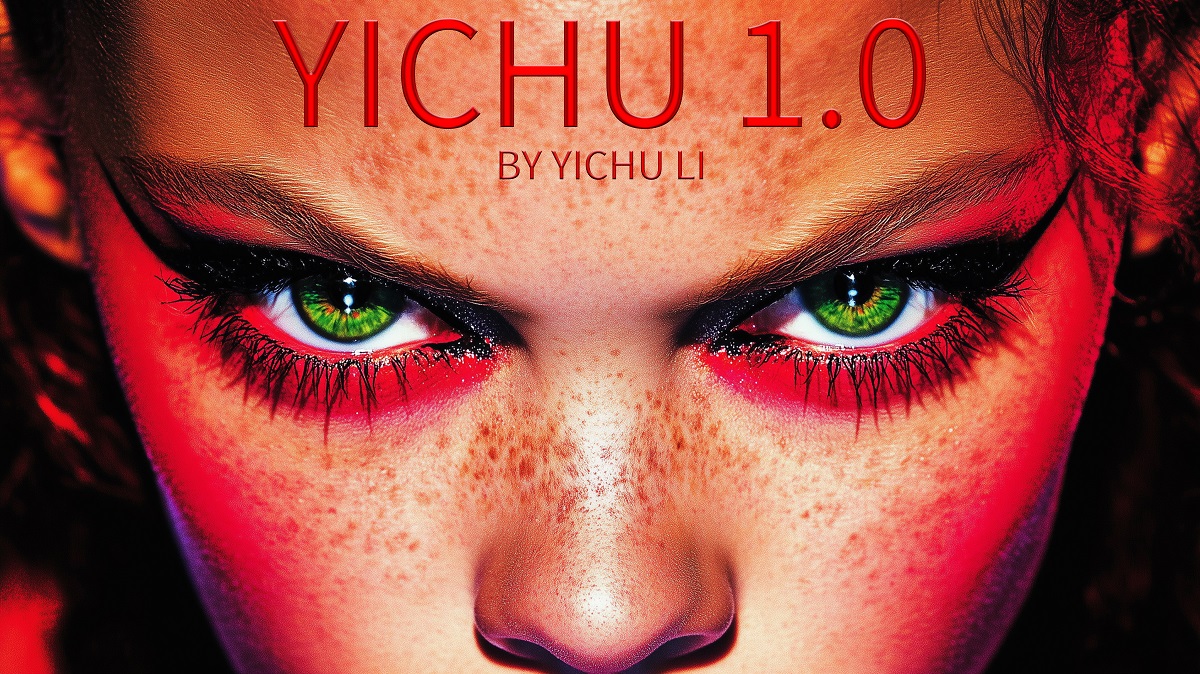 Yichu Li, "YICHU 1.0" 2025.
– What role does cyberfeminism play in shaping the narrative and aesthetic of YICHU 1.0?
Cyberfeminism plays a foundational role in shaping both the narrative and aesthetic of YICHU 1.0. I was particularly influenced by the Cyberfeminism Index by Mindy Seu and Professor Judy Wajcman’s Technofeminism, which reframed my understanding of technology—not as a neutral tool, but as a system historically embedded with gendered power dynamics.
Most of the media—especially those behind the lens—have been men. But the rise of women and non-binary creators working with AI and digital technologies is not just a shift in visibility. It’s a crack in the system. The architecture of the male gaze doesn’t vanish—but it flickers. It destabilizes. We don’t just aim to be seen—we reprogram the gaze itself.
In this age, where the tool becomes the speaker, the focus shifts from how we speak to what we choose to say. That’s where cyberfeminism becomes vital: as a framework for reclaiming narrative agency. My intention is not to replicate aesthetics that already exist, but to create images that provoke, educate, and expand space for new emotional and visual languages—so that familiar stereotypes don’t simply become digital defaults.
In YICHU 1.0 – Chapter 3: REBUILDING, I create a prototype of a protopian future—a world led by women, reimagined through the lens of ancient matriarchal systems. It returns to the form of a manifesto: not for utopia, but for a brave new world rebuilt on care, intuition, and radical reprogramming.
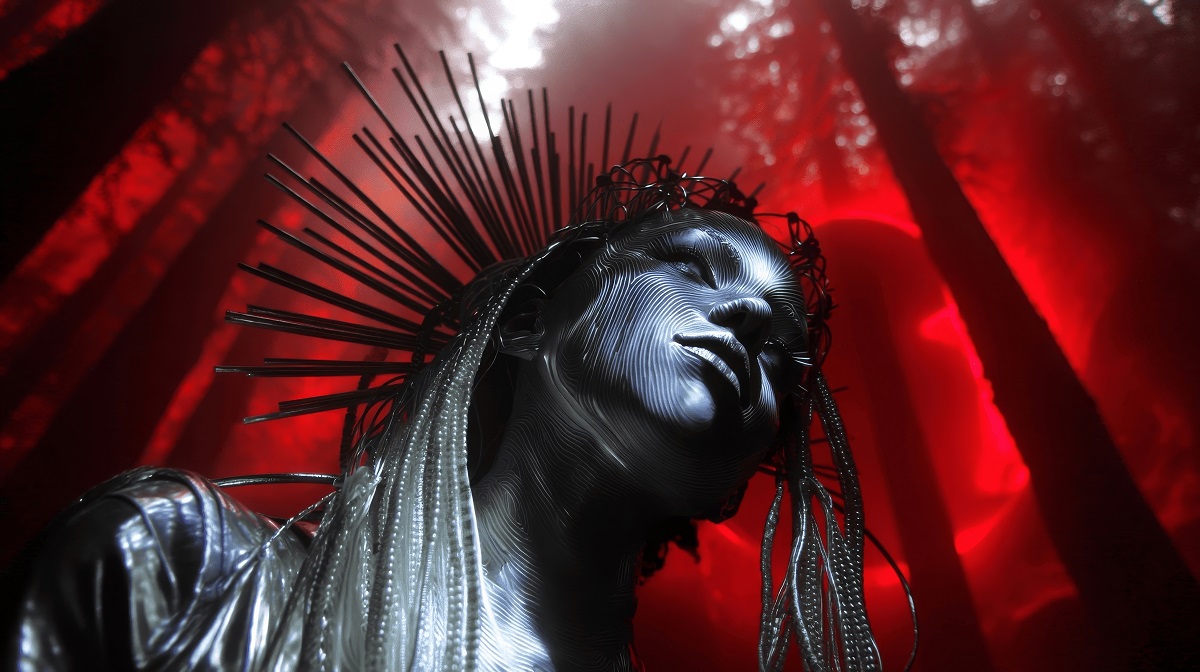 Yichu Li, "Last Generation 2" 2025.
– How do you translate abstract concepts like “soul” or “identity” into immersive or visual forms within the project?
RAVE CINEMA is an audiovisual live performance that I hold as a ritual—a space where I invite people from all backgrounds to reprogram themselves, lose themselves on the dancefloor, and rise again as something new. The rhythms of techno are not just sound—they are transformation. The lighting I design intentionally mimics the experience of the womb: a place where we cannot see, but we can hear. That’s how we first connect to the world—through vibration, through listening. That, to me, is where identity begins.
In this sense, RAVE CINEMA is both spiritual and technoist. From my early works—painting, images making, digital media—I’ve always followed a sense of flow. It’s a trance state I call “rave mode” or “game mode,” where creation feels like meditation and I meet a higher version of myself. I believe strong artworks should do the same for others—enlighten, challenge, or unlock a part of themselves they haven’t met before. I create immersive rituals for audiences to experience through sound and moving images. When they allow themselves to dissolve into that space, I hope they become more open—more curious—about the possibility of having multiple identities on the terminal, beyond singular narratives of self.
I listen to a lot of techno and electronic music, and I call it Techno-Spiritual Translation—taking the invisible frequencies of the digital world and ritualizing them into cinematic myth. My relationship with technology is intimate and cyclical. It resets me, reboots me, and reawakens my intuition. Whether I’m talking to AI or mixing visuals to a beat, these are daily rituals—my way of reconnecting with something beyond control, beyond identity, and closer to the soul.
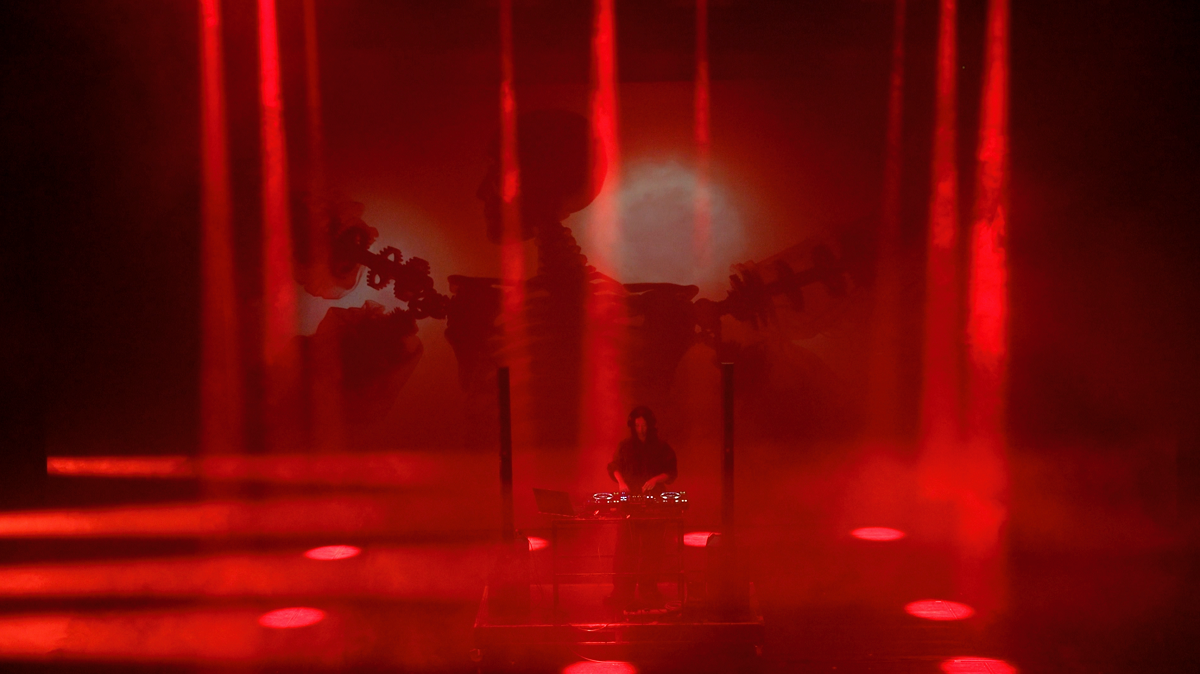 Yichu Li, "RAVE CINEMA 1" 2025.
– In what ways do you believe algorithmic systems are reshaping the way we perceive humanity and individuality?
In creating YICHU 1.0, I started with a question that continues to haunt me: What makes us human in the age of artificial intelligence? Are we just raving monkeys—Or are we something stranger—conscious algorithms dreaming of being human? Algorithmic systems no longer just shape how we access information—they condition how we see ourselves. They fracture the idea of individuality, turning us into data shadows: predictable, categorized, endlessly optimized versions of self.
In YICHU 1.0, I respond to that condition through mirror-match confrontations between my physical body and digital self, through AI-generated image sequences, and through fractured, looping visual rhythms that expose the instability of “identity” in a posthuman environment.
I don’t believe the “self” disappears—but it becomes unstable, caught in a feedback loop between performance and projection. In my live work, like RAVE CINEMA, I treat audiovisual experience as ritual. I invite audiences to enter a trance-like state through techno rhythm and immersive visuals—not to escape the system, but to observe themselves within it.
And the deeper I go into digital processes, the more I feel this truth: the more space technology occupies in our world, the more urgent it becomes to know ourselves—our bodies, our minds, our souls. For me, creating is not just a response to technology. It’s a navigation strategy. A ritual of awareness. And a reminder that even in a coded world, there is still space for intuition, spirit, and becoming.
– Can you talk about any moments during the creation of YICHU 1.0 that made you confront your own assumptions about selfhood or digital presence?
When my grandfather passed away, I inherited not only his memories, but the physical fragments of a life—handwritten pages, fading photographs, his unfinished thoughts. I started asking myself: what remains of us when the body is gone? And more importantly: What do I love so much that I could keep doing it forever—even like a machine?
That’s when YICHU 1.0 shifted. It became more than a project—it became a kind of portal. A digital relic. A version of me someone might still encounter in 2100. I began to wonder: could presence continue, not just through memory, but as an evolving artistic frequency?
Growing up immersed in the media, I no longer believe my “self” is just my ego. The voices that shape me—ancestral, digital, cultural—exist both inside and outside of me. YICHU 1.0 was the first time I confronted that layered existence directly. It was my way of asking: What if my identity doesn’t end, but evolves?
What if digital presence is not a copy, but a continuation? As an artist, I want to contribute to building the future, creating spaces where the self can keep growing—even after the physical is gone.
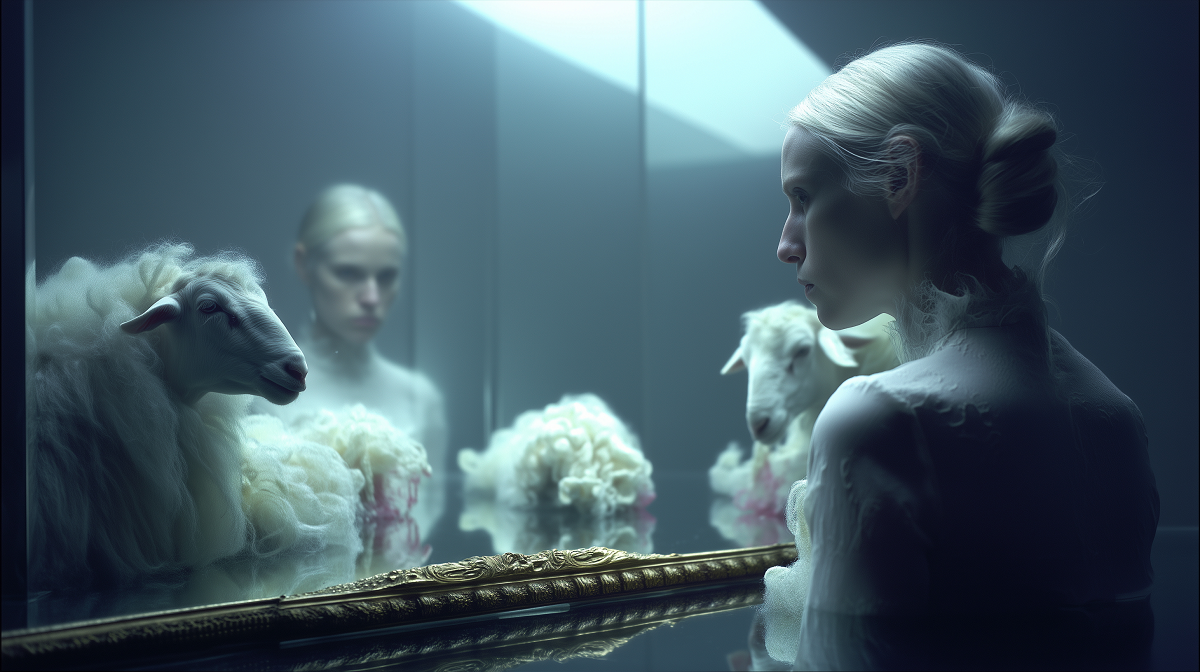 Yichu Li, "YICHU 1.0 - DREAM" 2025.
– How do you imagine future iterations of YICHU evolving as both technology and society shift around questions of personhood and representation? As both technology and society continue to shift around questions of personhood and representation, I imagine future iterations of YICHU evolving into immersive narrative environments—artistic worlds that stretch far beyond the screen.
I want to create experiences that are not only visual, but spatial, sonic, and emotional—where storytelling becomes something you feel through your entire body. I’m also interested in working more with sound, and in building collaborations that expand the way my practice moves across space and time. Like YICHU 1.0, the next version may involve inventing another version of myself—someone who exists not just conceptually, but within a fully realized environment. It won’t just be a sequel. It will be a new chapter of me—performed, inhabited, and shared.
I’m ready to birth what comes next. YICHU 2.0 is already breathing beneath the surface. WM
WM
Whitehot writes about the best art in the world - founded by artist Noah Becker in 2005.
view all articles from this author