Whitehot Magazine
September 2026
"The Best Art In The World"
"The Best Art In The World"
September 2026
TOAF65: An Art Fair That Reflects The Cultural Mosaic of a City In Flux
,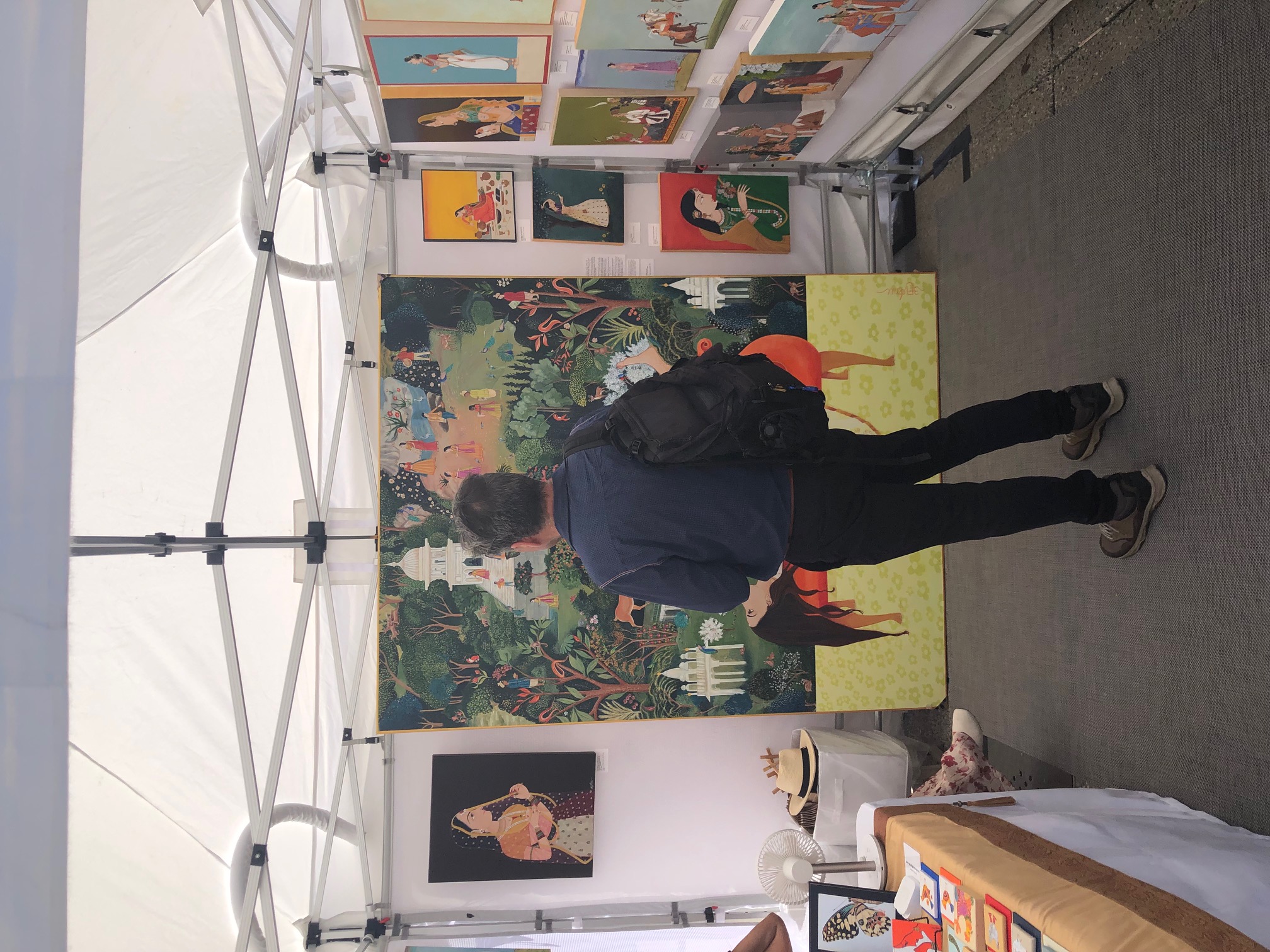 A vistitor to the Toronto Outdoor Art Fair (TOAF) at a booth.| Artwork: Anu Kalra | Photo: Byron Armstrong
By BYRON ARMSTRONG July 25th, 2026
The Toronto Outdoor Art Fair (TOAF) celebrated its 65th year anniversary this month, and I had the opportunity to explore the fair led by the City of Toronto’s Curator at Market Gallery for the City of Toronto, Jesse King. Unfortunately, I am horrible at being led around by my nose, even by as esteemed a curator as Jesse King. There was nothing wrong with the tour at all, but as an Aquarius, I don’t much like following anyone’s prescribed route for anything – this is probably why I take chances sensible people don’t, like choosing to write for a living.
I lasted about two booths before getting the sense that I didn’t want to be toured through an open air art fair in front of City Hall on a glorious summer day so sweltering that sunglasses didn’t make sense. Steamy lens soaked in perspiration, or squinting at artwork up close within a sliver of shade? Choose one. I chose the latter. I can walk around an art fair as well as anyone else and I know what I like. So that’s what I did. I managed to talk to some interesting artists, from the emerging artist and recent art school grad showing work at TOAF for the first time, to the more established careerist who is on their eighth showing at TOAF. Toronto is known the world over as one of the most culturally diverse and cosmopolitan cities in the world. The artists I spoke to were reflective of that, and who better to talk to about an art fair than the artists themselves?
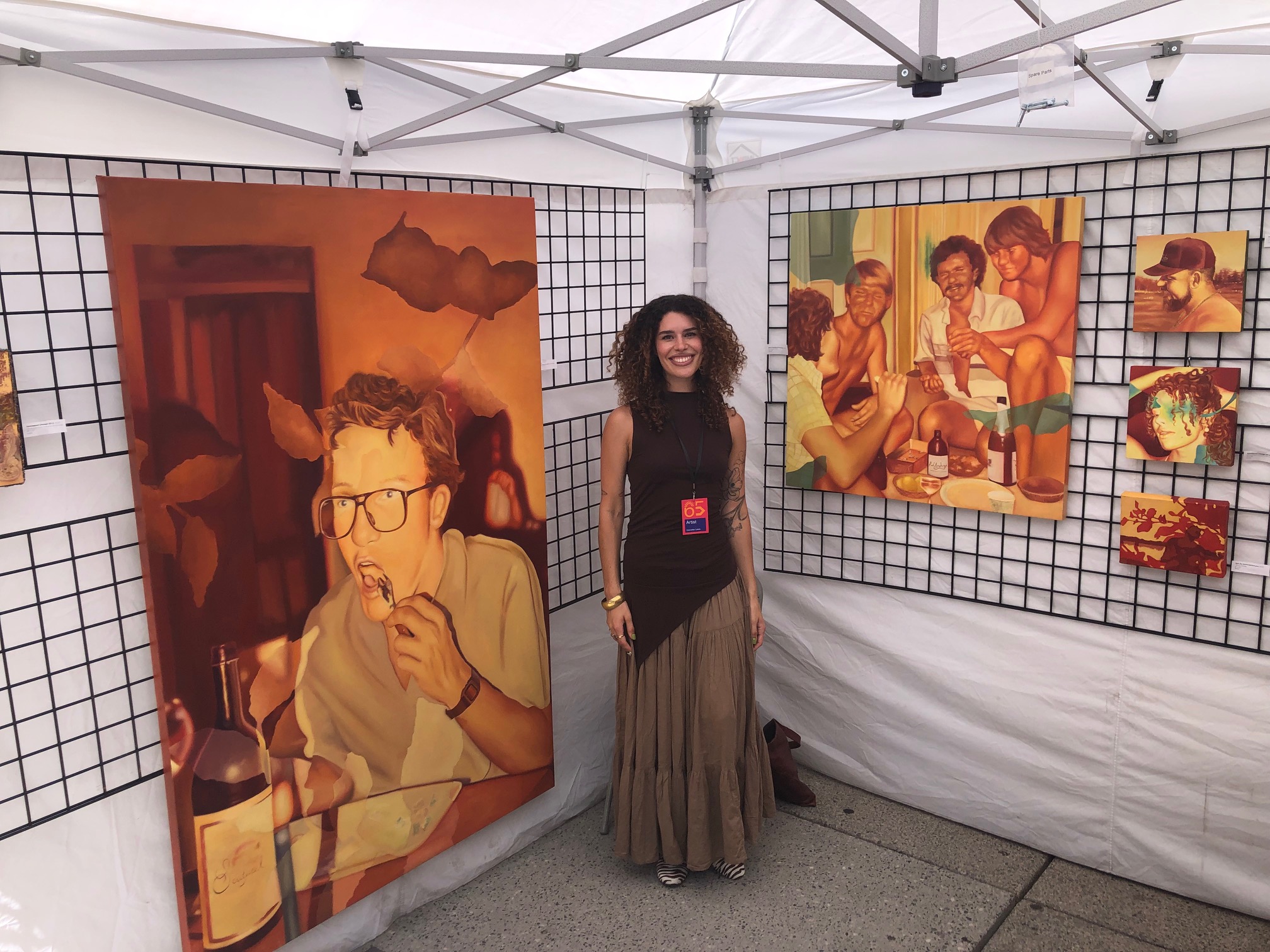 Artist: Emmette Lewis | Toronto Outdoor Art Fair (TOAF) | Photo: Byron Armstrong
Emmette Lewis
My process is intuitive and based on family photographs. I find one that speaks to me and reflects on a memory that I'm trying to access and locate myself in, or there's an idea that just pops into my head and I feel an urge to go and paint it. I try to think of ways to insert myself into that imagery without direct symbolism. I'll insert myself in really unknown ways. For instance, I have my birthday and my mom's maiden last name written in one of my artworks. It's these hidden elements that make me feel like these photographs reflect my family history through my own form of documentation.
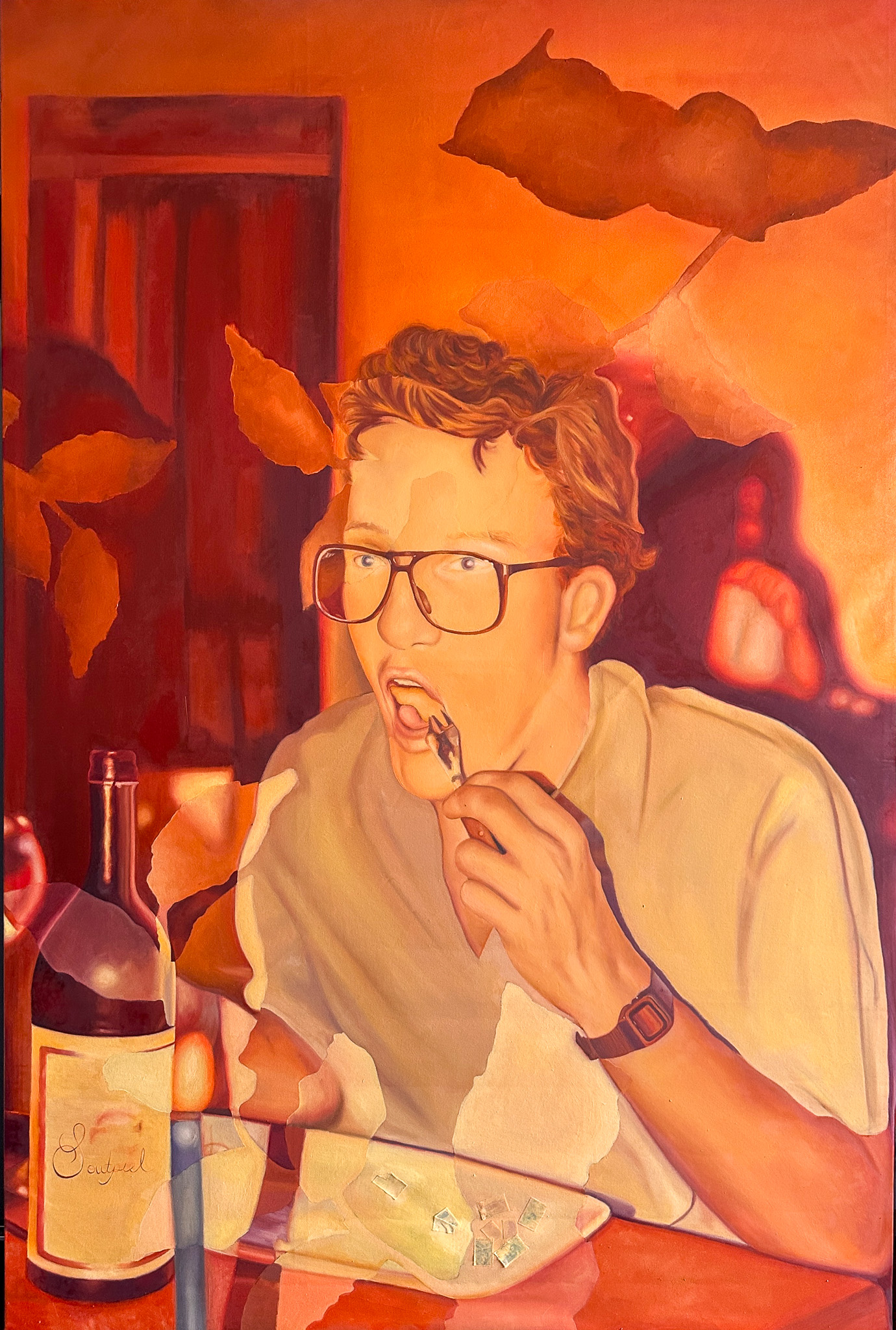 Portions (2026), Emmette Lewis | 121.92 x 182.88 x 5.08 cm | Oil on Canvas.
My work is about finding a way to hold home close to you when home is no longer available to you and when you don't have access to it. So when my parents immigrated to Canada from South Africa, (my mom's Namibian, my dad is from Johannesburg), they made prevalent efforts to keep our South African culture alive in Canada, but whenever I went back to South Africa, I still felt like a tourist. Being here in Canada, I always felt like it wasn't home because my home is there. So I paint ‘absence’ and that grief or longing of home, which helps me find resolve. Having work that is so reflective of my personal lived experience and my perspective, gives me a sense of peace. Like, if there's no sales, that's completely fine, because I showed up and I was representing who I am here.
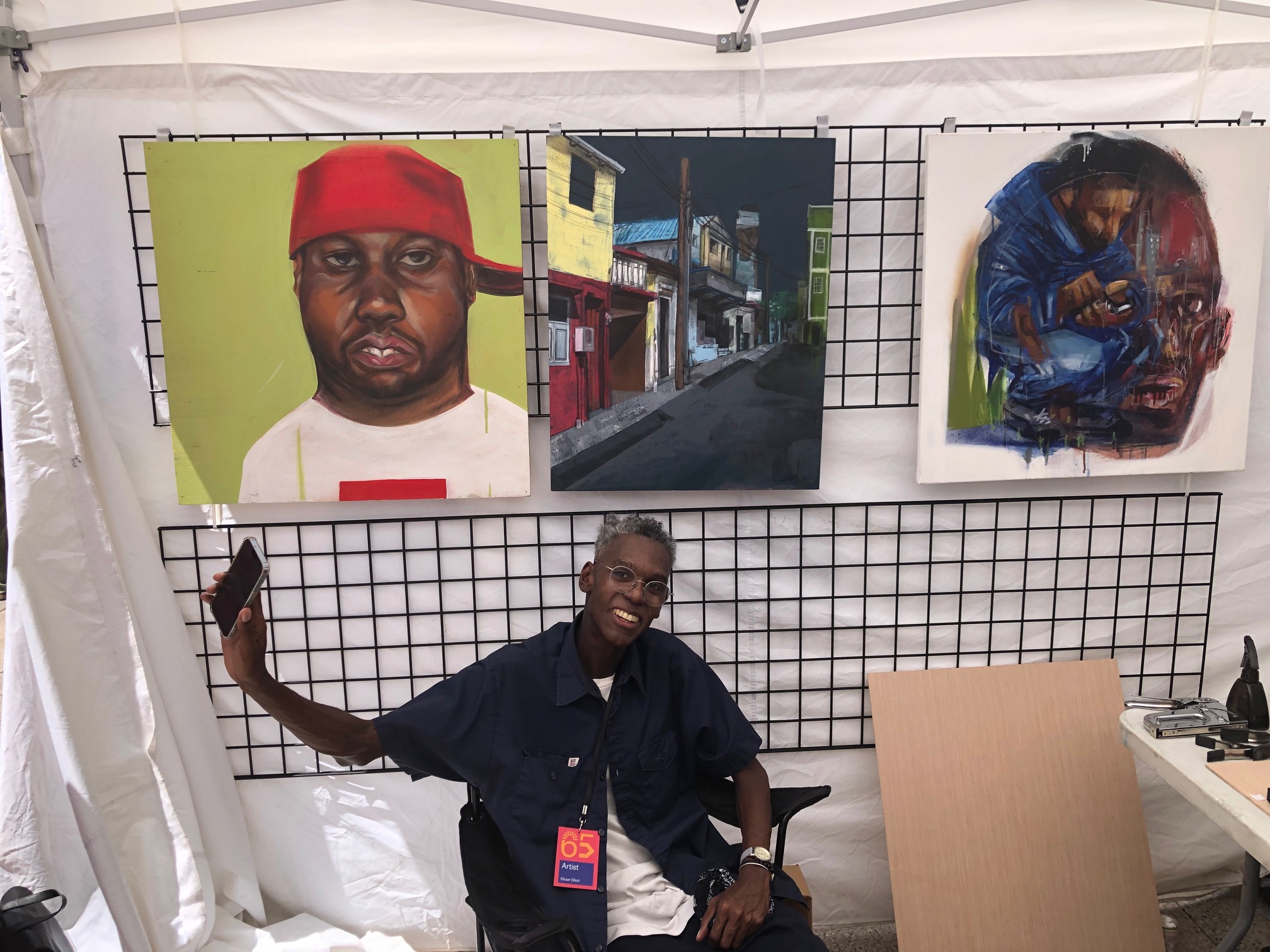 Artist: Elicser Elliott | Toronto Outdoor Art Fair | Photo: Byron Armstrong
Elicser Elliott
I'm Elicser Elliott. I’ve painted graffiti in the city since the 90s. I've been in the fine arts scene for a while now, so I kind of have a foot in each aspect of art. So this is my fine arts stuff here at Toronto Outdoor Art Fair. I found out I was selected for my own booth two months ago or something like that. It's always good to have pieces here. It's additional income, which is really nice, and it allows people to meet me who may have seen my work around the city but now have a face to put to that work.
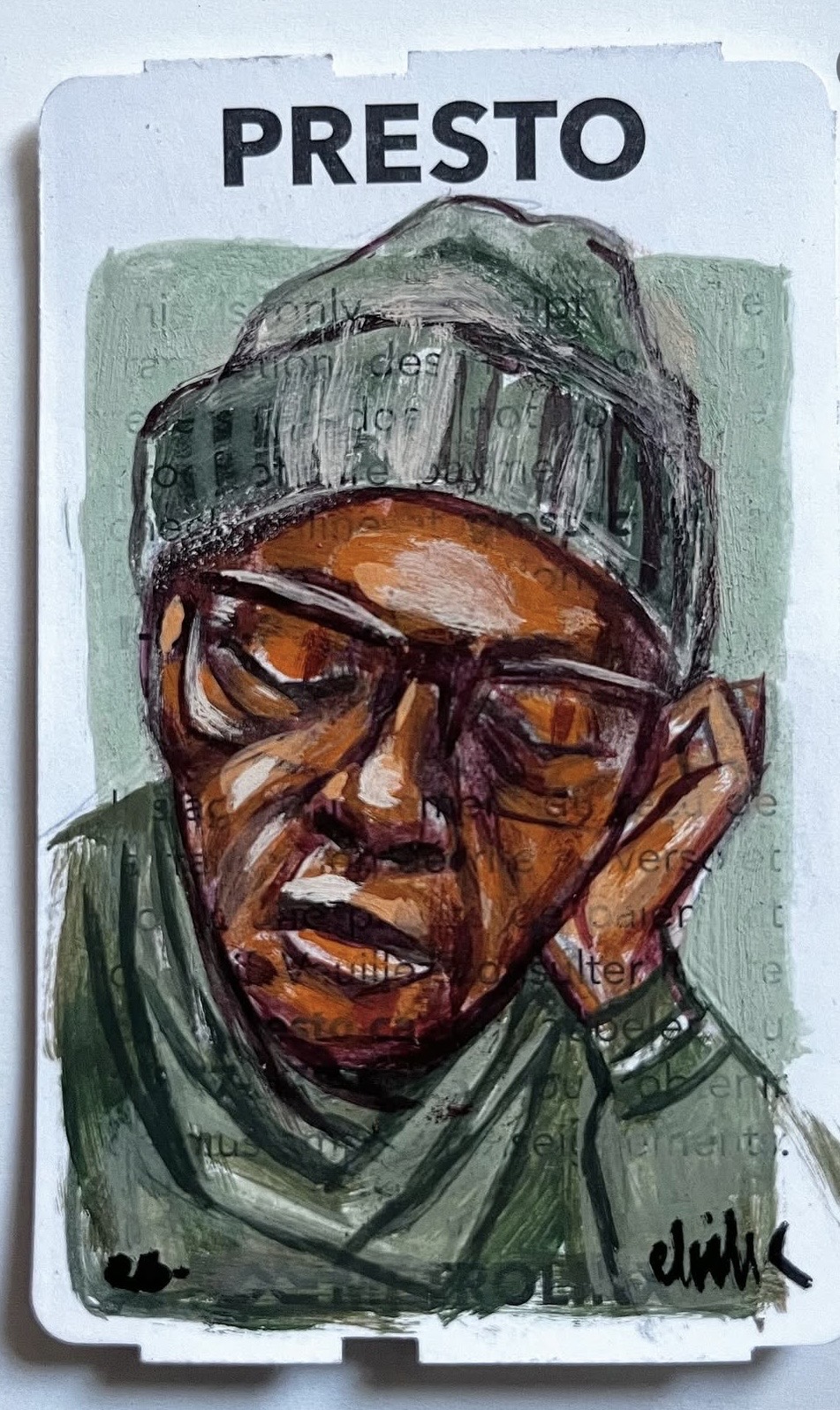 Toronto Every Damn Day (2026), Elicser Elliott | 10.16 x 15.24 cm | Acrylic on Paper | Photo: Byron Armstrong
Fine arts allows me to paint “my insides” or what I want to. With fine art, you just have to prepare yourself mentally to have your concepts be a bit more precise and tighter than stuff on the street. It's a bit closer to the heart because you’re really bringing more of yourself into that practice. The stuff on the street, you kind of have to balance it with the thinking of the people who hired you and what you're thinking. When I'm doing graffiti, I do paint what I want to paint sometimes but I'm usually doing a commissioned mural. So there are more rules or limits placed on what I can do based on what people in the neighbourhood, or the local BIA (Business Improvement Association) I’m working for need. But whether graffiti or fine art, there’s joy to just painting too.
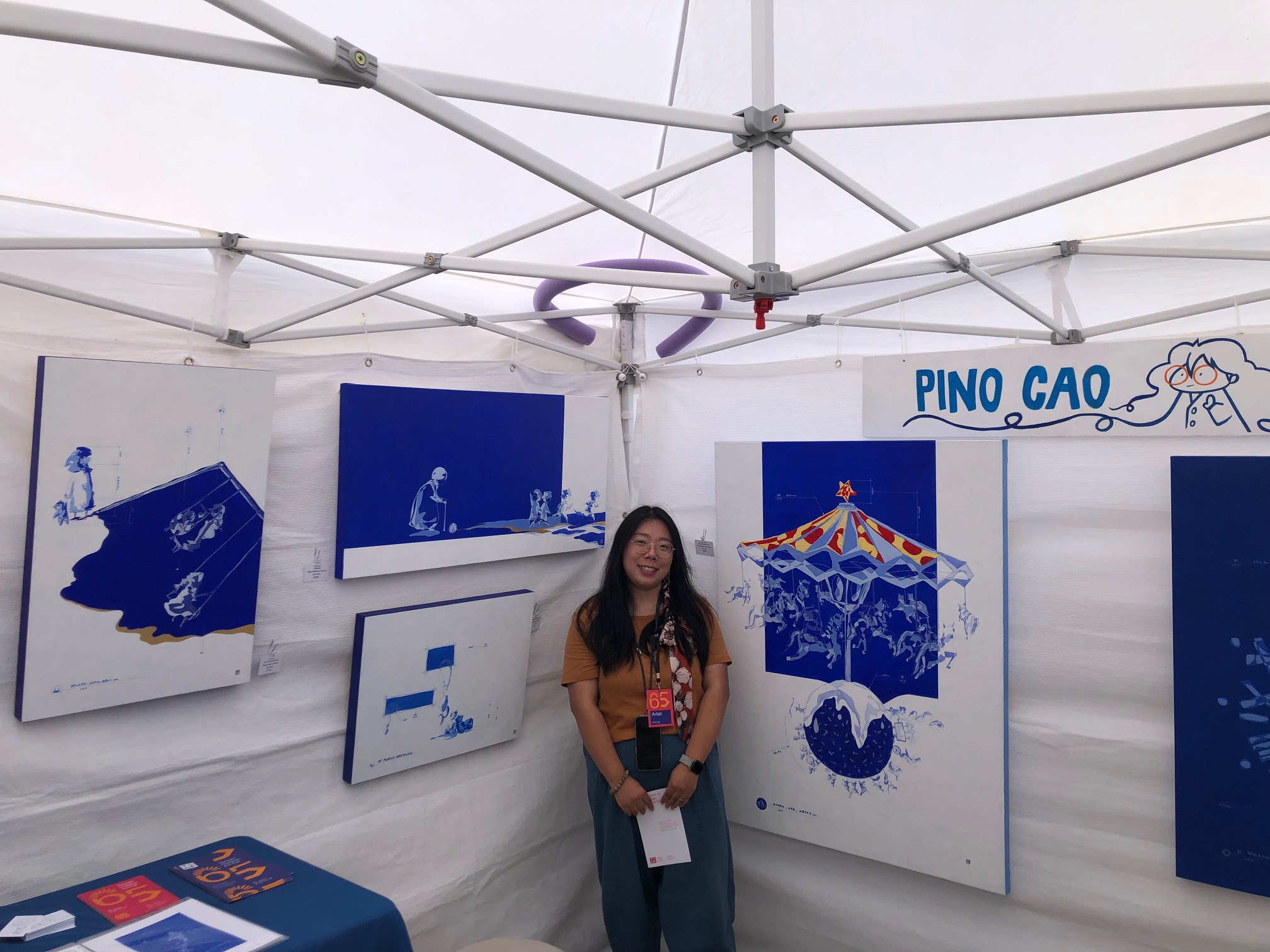 Artist: Pino Cao | 2026 Toronto Outdoor Art Fair | Photo: Byron Armstrong
Pino Cao
I have a background in engineering and animation. I started my professional career as an illustrator of mainly children’s books for publishers. The colors white and blue, as well as the annotations and measurements in my work, are influenced by engineering blueprints. My animation background influences my character illustration with gestures, storytelling, and loose lines contrasting with the organized annotation. I raise the question, is everything measurable, including how we treat our memories, time, or the connection between people? I use acrylic for most of the background. I use colour pencils, soft pastel, and ink to create different shades of blue and white.
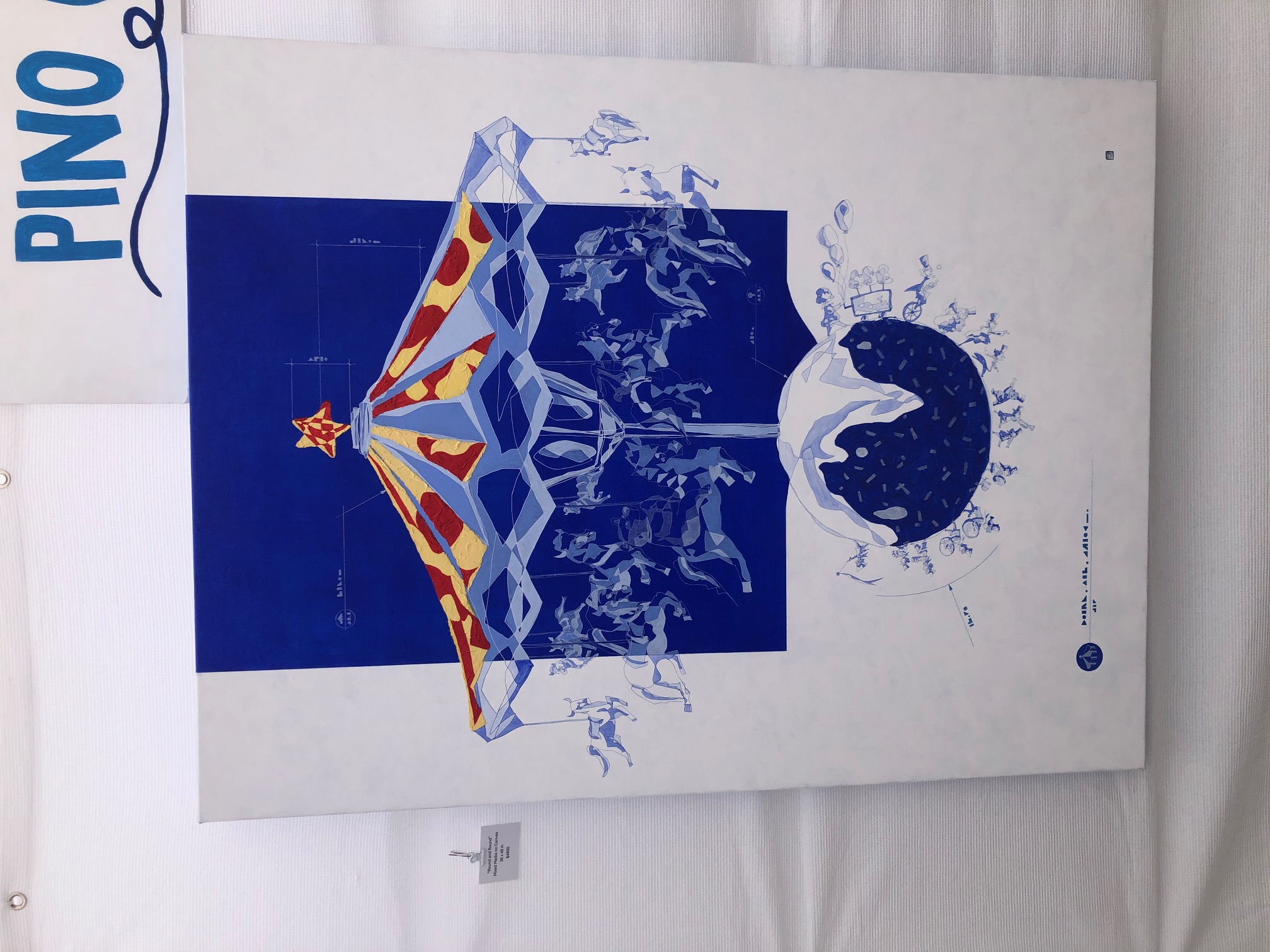 Round and Round (2026), Pino Cao | Acrylic, ink, and color pencil on canvas | Photo: Byron Armstrong
Right now, I'm focusing on childhood, memory, and time. I'm a new mom, so I’m reminded a lot of my own childhood, including memories I haven’t thought about for years. Art helps me to reflect on that. I began a career in fine arts about three years ago, and it's given me more freedom to express what I want to say. It's a little bit of a different career path than illustration. It's given me more freedom to express what I want to an audience. TOAF allows me to do that face-to-face, not just online. I think my work resonates with other people who reflect on some of their childhood memories. They stop and share their own stories, and that's the sweetest part of the show.
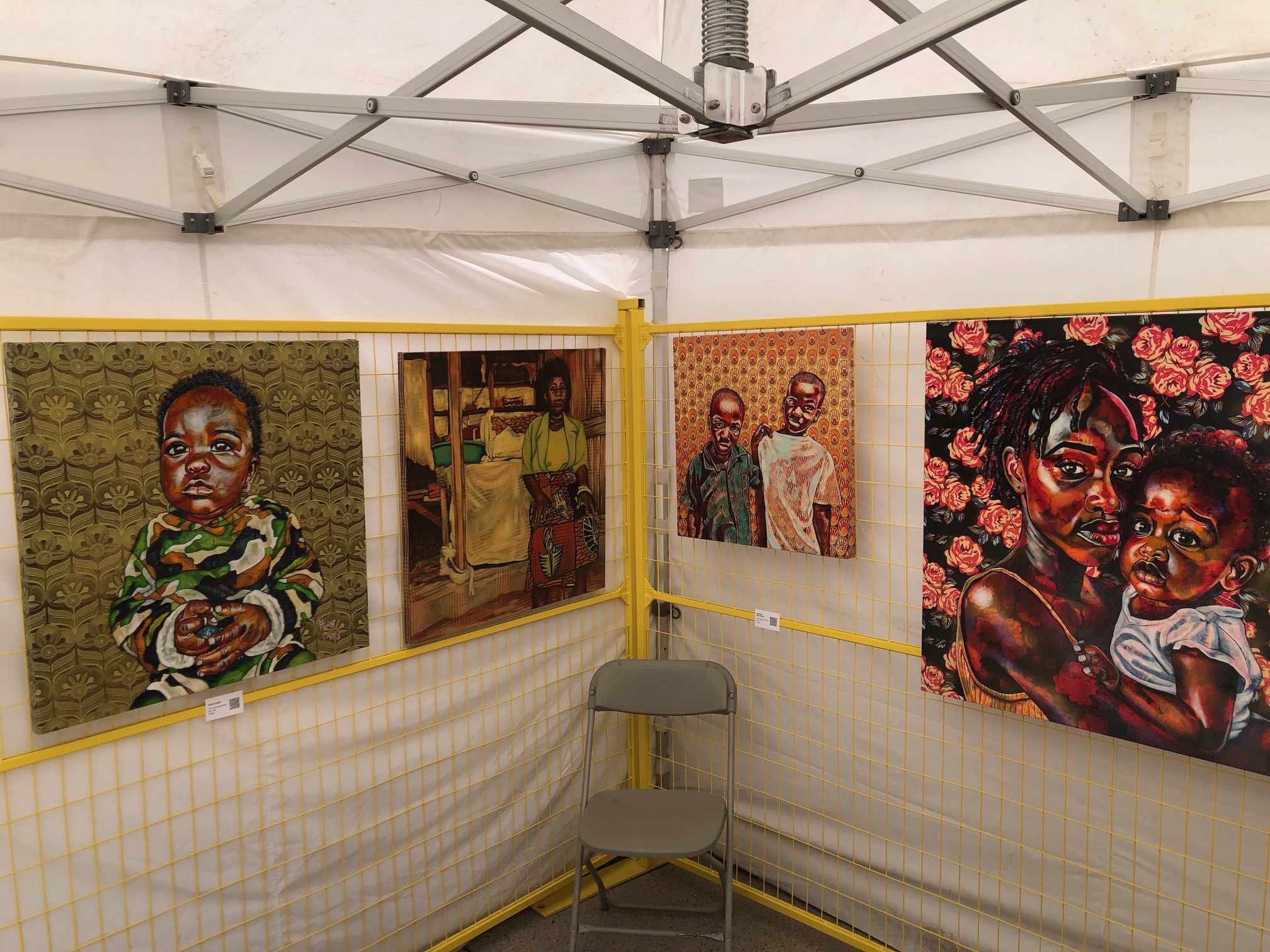 Artwork: Hans Poppe | 2026 Toronto Outdoor Art Fair (TOAF | Photo: Byron Armstrong
Hans Poppe
I was born and raised in Tanzania but moved to Canada when I was 8 years old. Around my mid-20s, when I’d completed my education and started this great job, I couldn’t shake this nagging question in the back of my head: What does it really mean to say you're Tanzanian if you spend more time in Canada than in Tanzania? So I decided to go back for 2 months and ended up staying there for a year and a half. I now go back every couple of years.
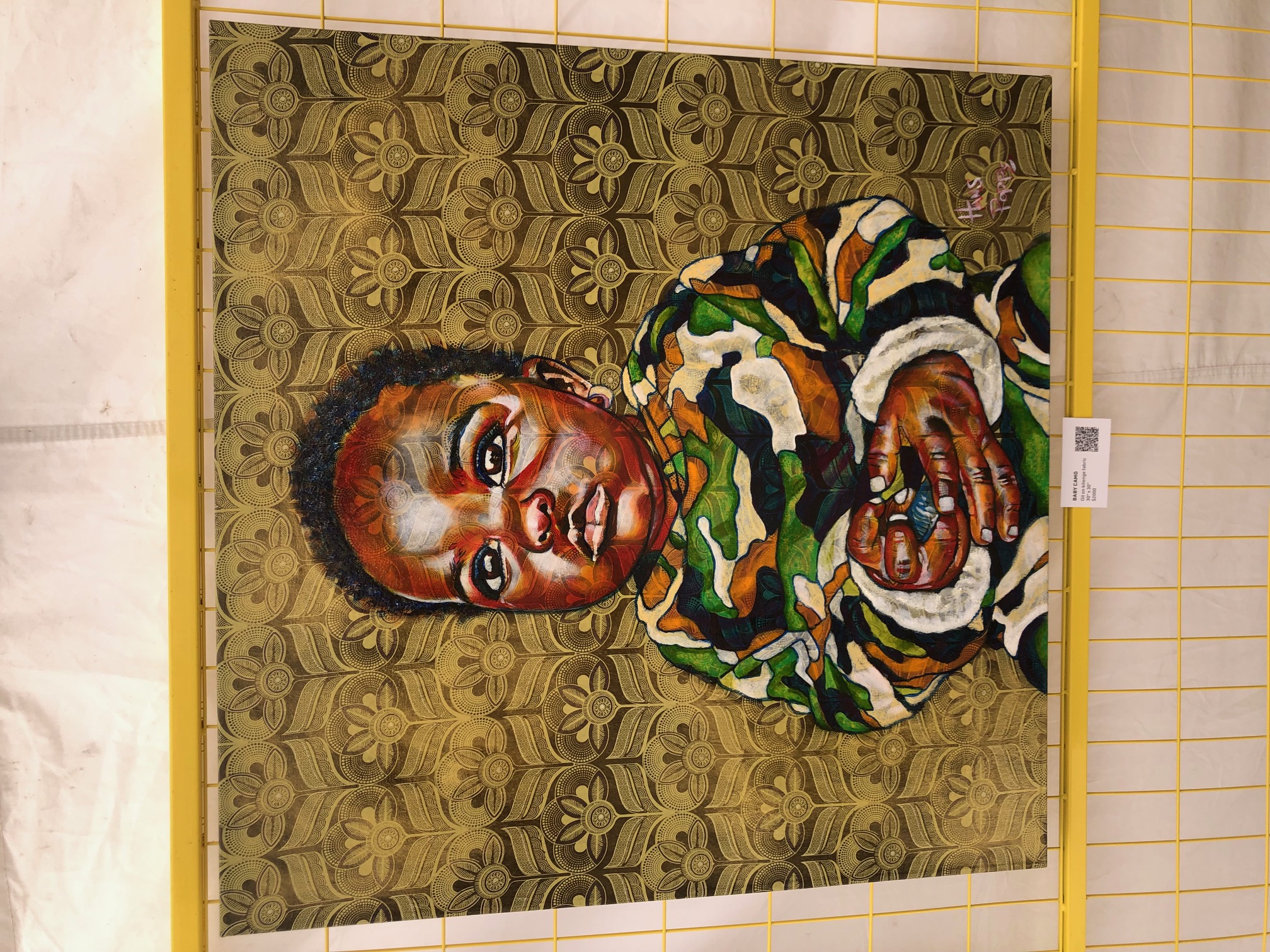 Baby Camo (2026), Hans Poppe | 76.20 x 76.20 x 3.17 cm | Oil paint on Kitenge | Photo: Byron Armstrong
My paintings are based on my travels there. You’ll find colourful flora and fauna all year-round, and life just seems more vibrant. The women wear kitenge cloth on special occasions, which is the fabric I stretch over wood panels or glue to a canvas. After covering it with a gel medium, I apply one layer of oil paint at a time. There are multiple layers of colours by the time you see the 3D contour of a face, most of whom are family. When I was younger, I saw this TV ad with fly-faced children starving in Tanzania. As a Tanzanian, I know how hard you have to go out of your way to find that. Then, ironically, when I went on school trips to galleries, I could never see myself represented anywhere. So I decided, as an artist, I would represent my culture properly, with stories and fabrics and colours that show the positive side of that.
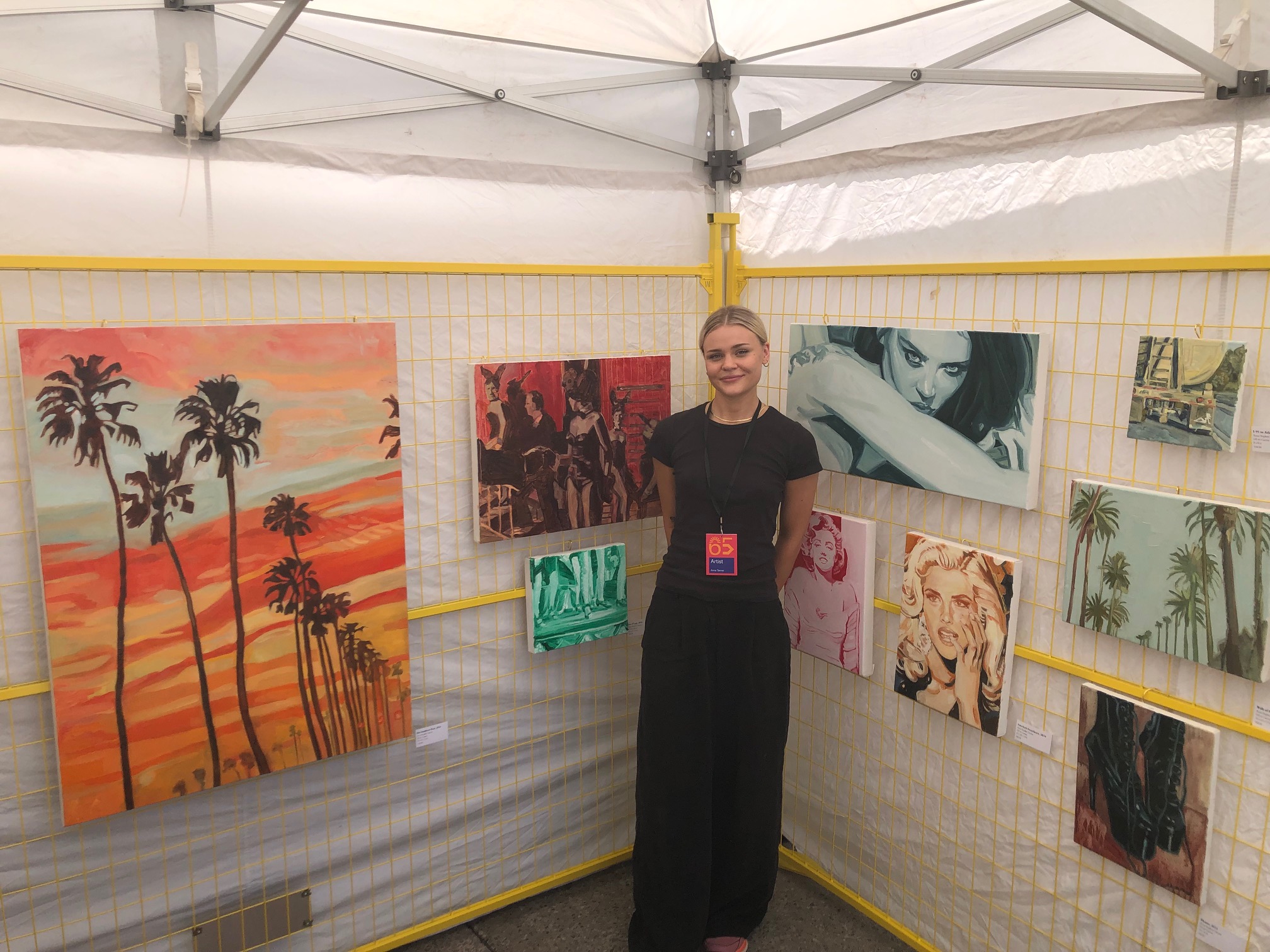 Artist: Anna Tanner | 2026 Toronto Outdoor Art Fair | Photo: Byron Armstrong
Anna Tanner
This is my first year showing at TOAF. My work is inspired by old Hollywood, and iconic females like Marilyn Monroe or Anna Nicole Smith. I’m trying to process growing up around the Playboy-esque hyper-sexualization of the female form. I collect vintage magazines and choose images that I find compelling that might have a hint of the male gaze in them. I'm really just trying to push against the male gaze through a queer lens to kind of reclaim these images and agency in a world where I feel like young women don’t have as much. I’m also drawn to palm trees. I grew up going to South Carolina often so I’m very fond of them.
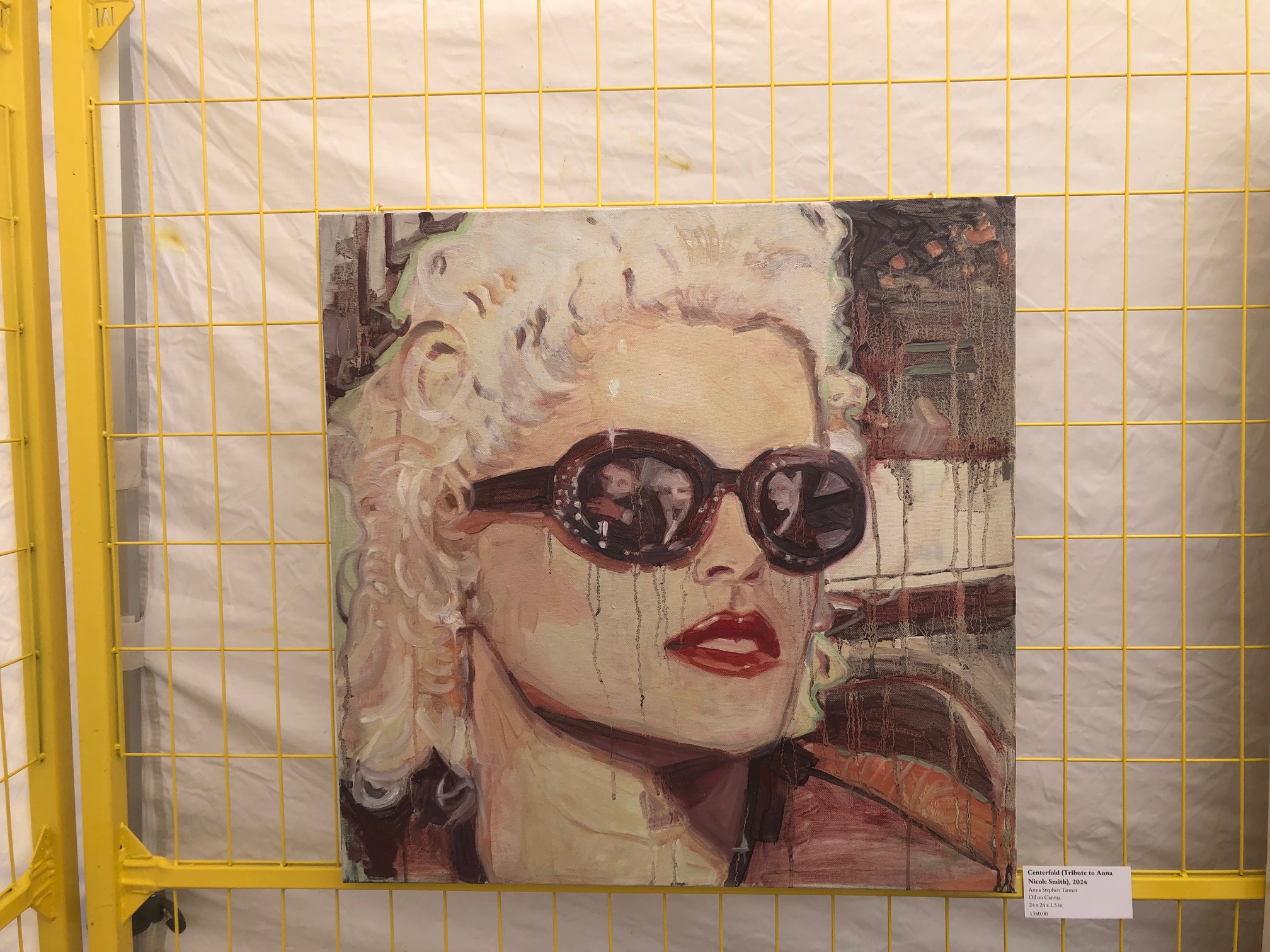 Centerfold (Tribute to Anna Nicole Smith), 2025, Anna Tanner | 60.96 x 60.96 x 3.81 cm | Photo: Byron Armstrong
I have an artwork based specifically on a paparazzi shot of Anna Nicole Smith, who had a tragic death just like Marilyn Monroe. I was drawn to the reflection of the paparazzi in her sunglasses, which speaks to how the paparazzi and her image as a sex symbol was a co-creation by entities that needed each other. It’s interesting that all of these women are perceived as such damsels in distress while cultivating and controlling an image that turns the male gaze into something that benefits them. There’s a lot of power in sexuality. The world runs on sex and I think a lot of people are afraid to say or admit it. Growing up in the American South as a hyper femme, queer, lesbian woman, I’ve been objectified throughout my life. So this work helps me come to terms with my own lived experience without reobjectifying women in my art.
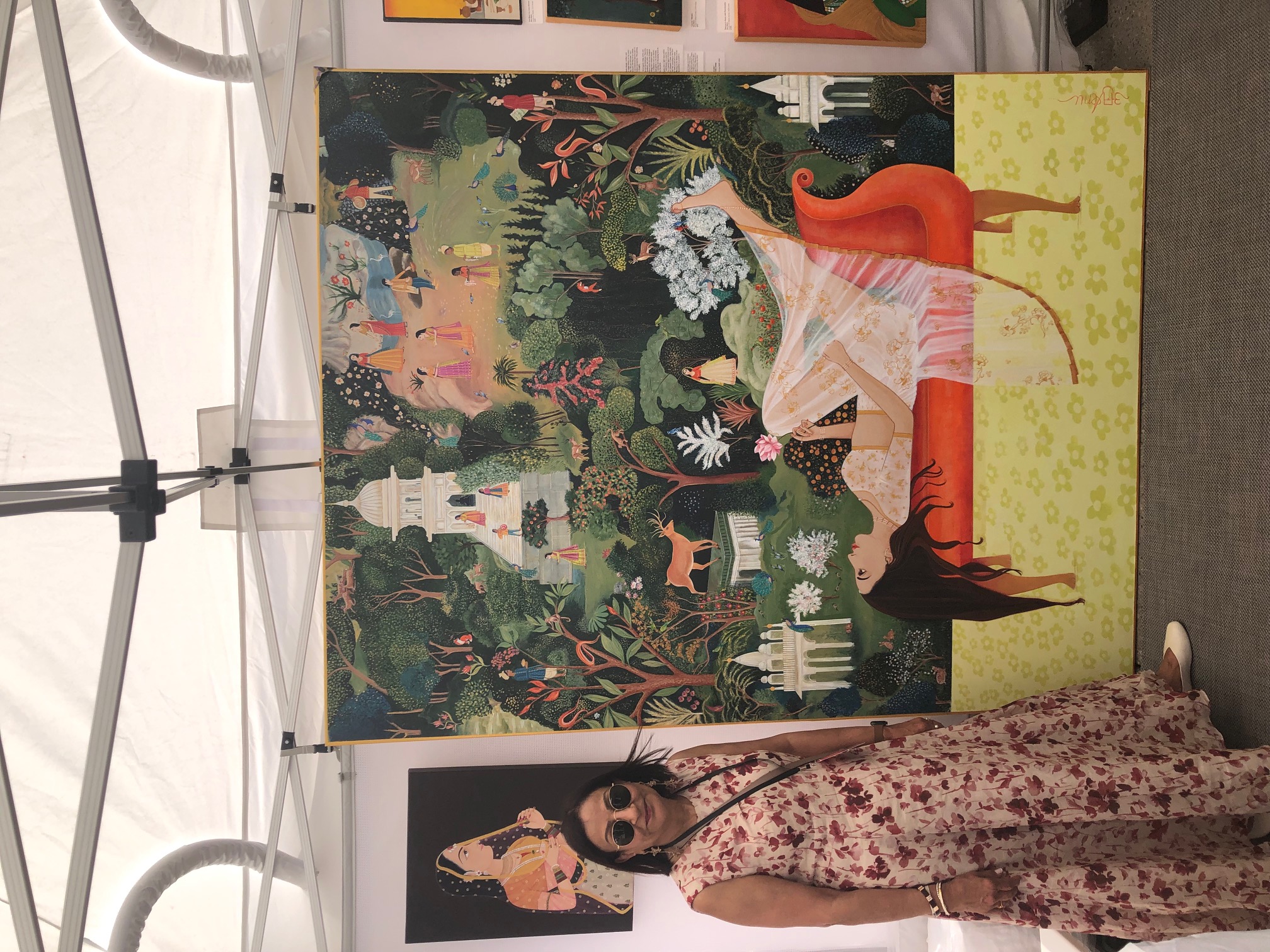 Artist: Anu Kalra | 2026 Toronto Outdoor Art Fair | Photo: Byron Armstrong
Anu Kalra
This is my eighth year, and it’s gotten better every year in terms of talent and cultural representation. The interaction with people in a community-based square like this allows for immediate feedback. I'm originally from India and I’ve been here 41 years now. I was trained and worked as a graphic designer until I transitioned into professional fine art practice. Everything I do is acrylic on canvas or wood panels, and I simplify my subjects to hone in on the message I'm trying to convey. Fleeting moments that seem mundane. A painting of women in the northeastern part of India playing polo on horseback challenges gender and cultural stereotypes, but since these women would be of a privileged class, also brings up the theme of class division. Paintings of girls playing a yo-yo are an ode to the popularity of yo-yos among young women in India, while another painting of a woman relaxing while listening to Spotify presents the culture through a contemporary lens.
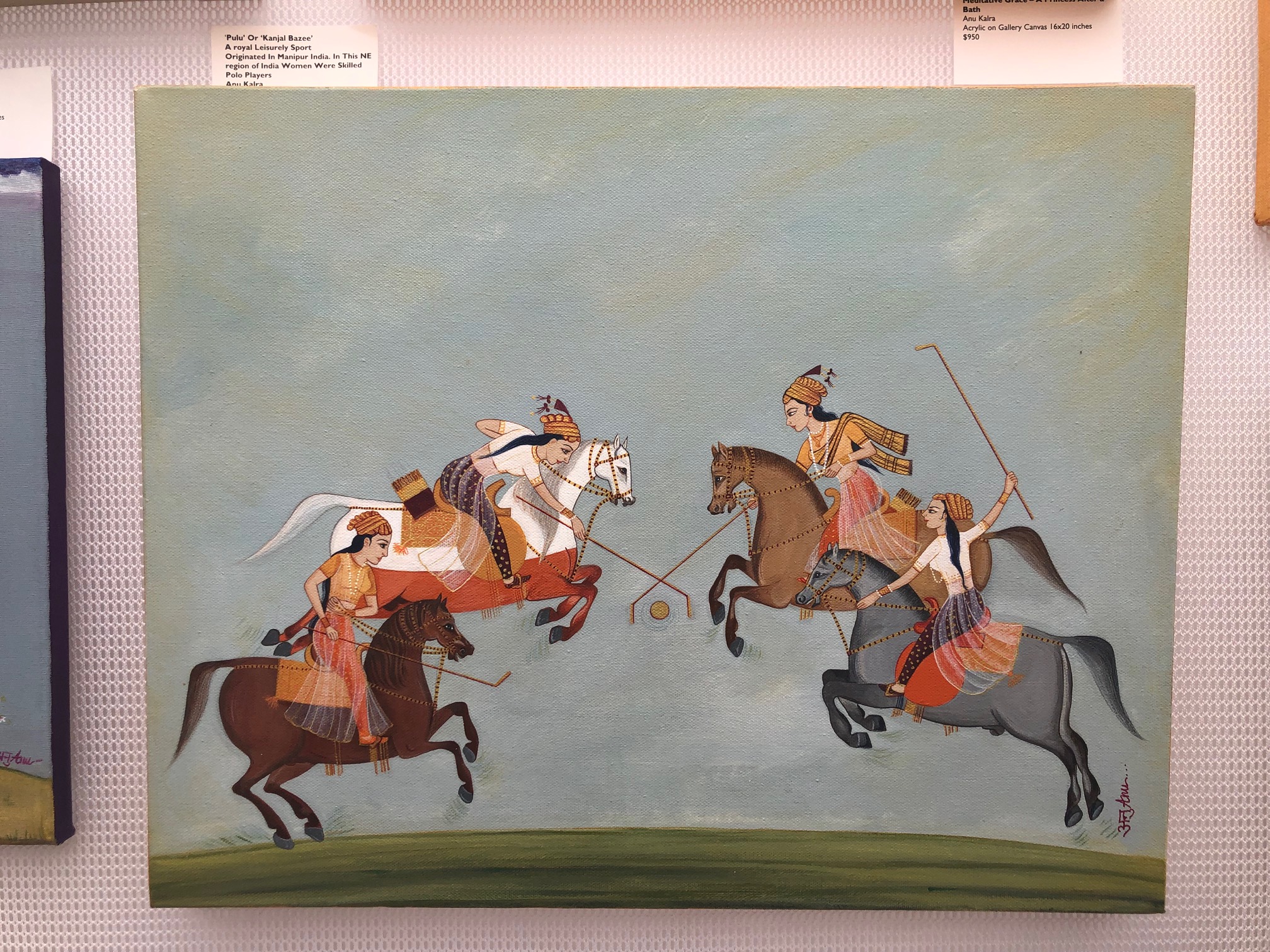 "Pulu" or "Kanjal Breeze"(2022), Anu Kalra | 50.80 x 40.64 x 5.08 cm | Acrylic on Gallery Canvas | Photo: Byron Armstrong
I have a life motto for myself: and this too shall pass. But climate change is not going to pass. I’ve told my children that I’m excited to be a grandma after they get married. And they say, ‘Mom, we're not bringing anyone in this world.’ That really bothered me. And so I painted an idyllic world centering this young Indian woman who represents the future and promise of the earth. She holds a lotus with hopes of renewal. Other figures sow seeds, gather flowers, or gather together. I just wanted to make the luscious world that I hope and pray we have one day.
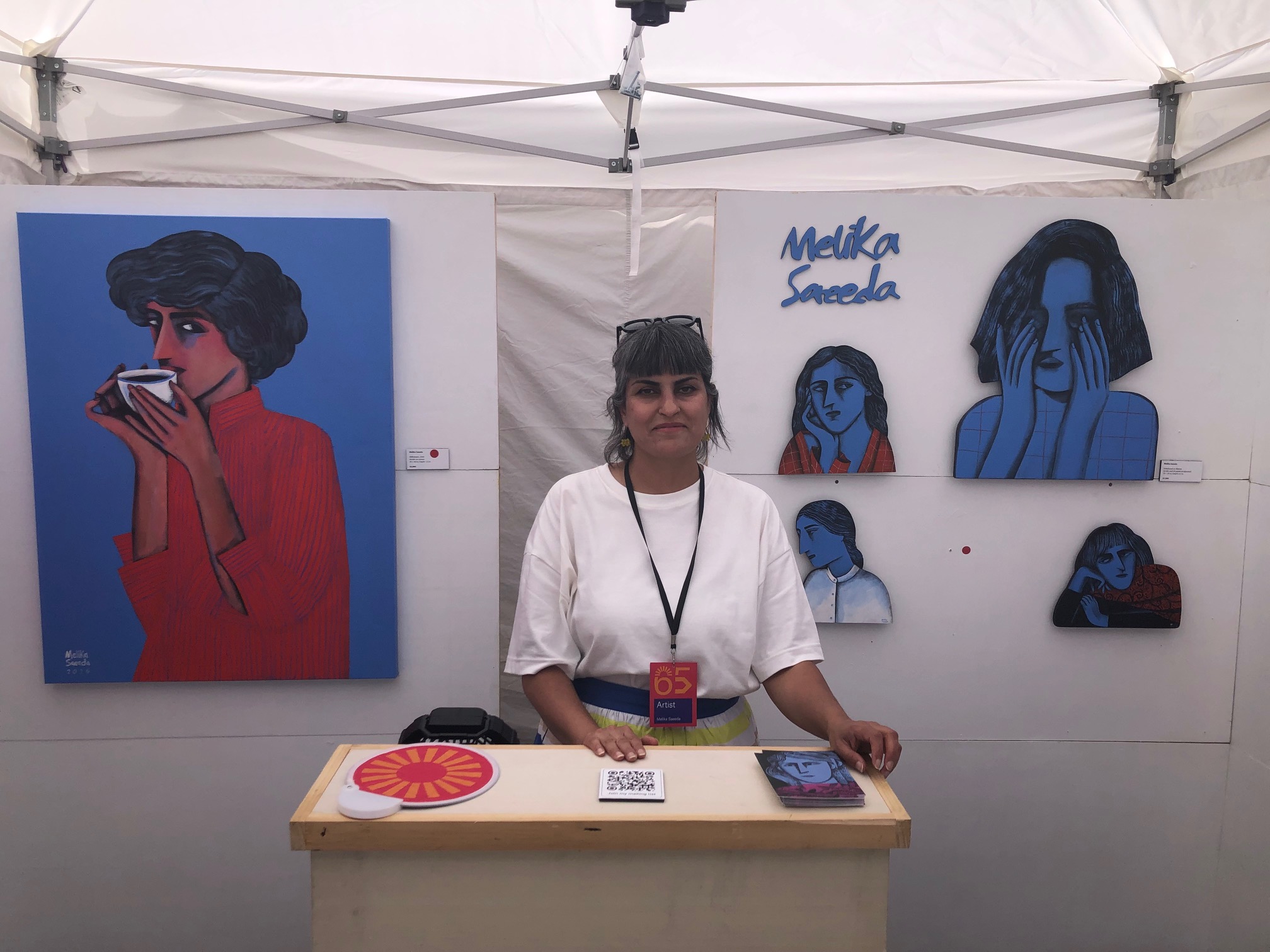 Artist: Melika Saeeda | 2026 Toronto Outdoor Art Fair | Photo: Byron Armstrong
Melika Saeeda
This is my fifth year at TOAF. As an illustrator, I’m used to working with a publishing house and art directors. At TOAF I get the chance to talk to real art collectors and art lovers. Every year my confidence gets a boost from the public and I enjoy seeing how my work resonates with visitors. So I love working as an illustrator but I really enjoy exhibiting my artwork at the art fair. Coming from an illustration background, I love storytelling and playing with figures using limited color palettes and graphics design elements. I have my MFA in visual communication, so I love to focus on the face. My chosen mediums are acrylic and oil pastel on my work on canvas. My hope is that viewers can guess the backstory of the subjects just by following their gaze.
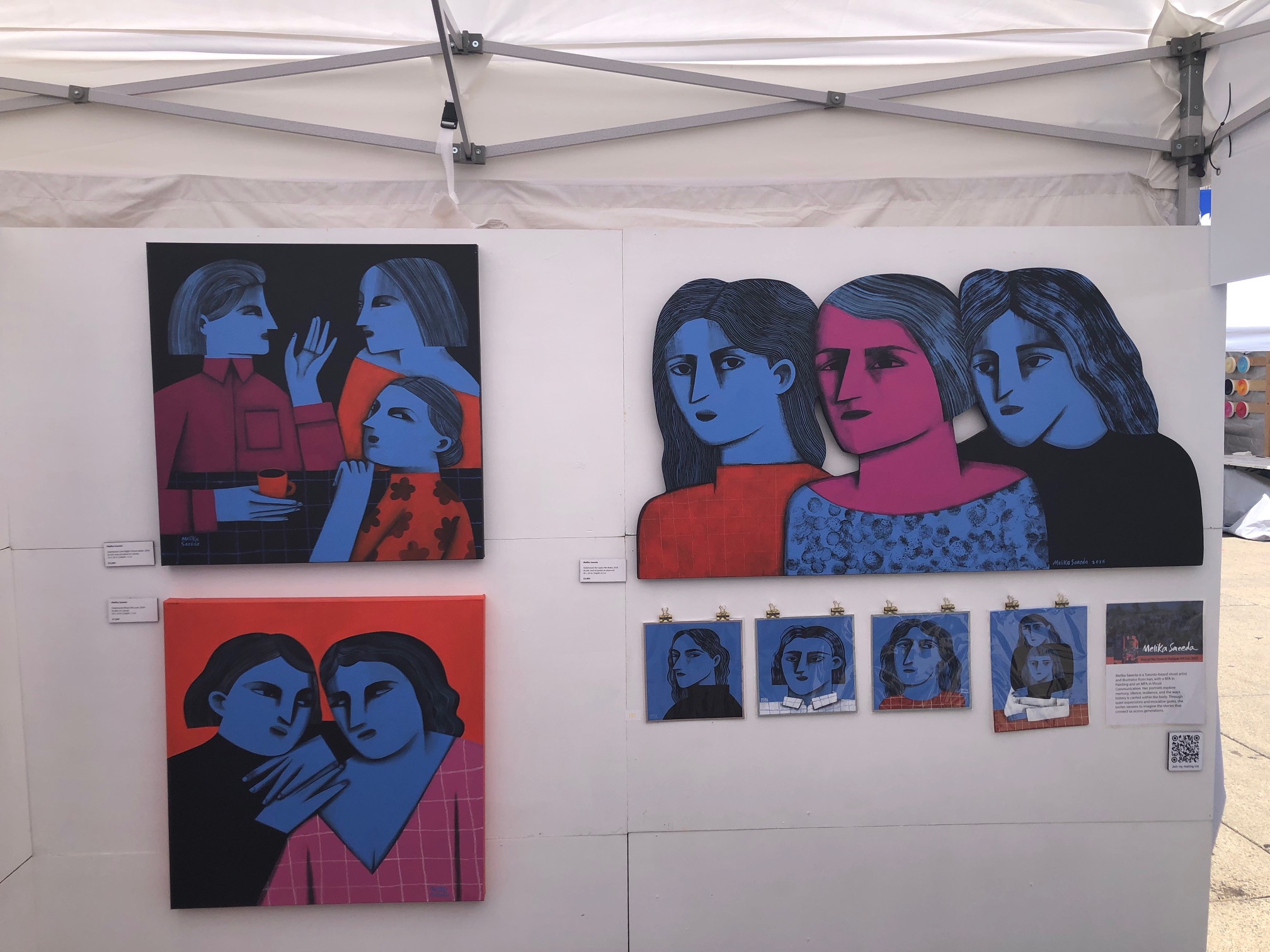 Various Artworks, Sisterhood Series (2025 & 2026), Melika Saeeda | Acrylic on canvas & wood panel | Photo: Byron Armstrong
My recent series of artwork is “Sisterhood.” It’s about the safe, shared space between women that’s inspired by my lived and observed experience. For this Sisterhood collection, I was thinking about how I could remove the background so there’s just the subjects. So there is also work that is cut on plywood, where there’s no background. I also keep my color palette to blue and black to emphasize emotion. Normal, everyday actions like women sitting around together, appearing to be in conversation or offering support, is a big part of my focus. I'm observing and exploring different emotions in ways that aren’t necessarily loud but carry emotional depth.

Byron Armstrong
Byron Armstrong is an award-winning freelance journalist and writer who investigates the intersections between arts and culture, lifestyle, and politics. Find him on Instagram @thebyproduct and on Linkedin https://www.linkedin.com/in/byron-armstrong
view all articles from this author