Whitehot Magazine
October 2026
"The Best Art In The World"
"The Best Art In The World"
October 2026
Miart Celebrated its 30th anniversary with a Bolder Edition and New Structure Amid Cultural and Economic Flourishing in Milan
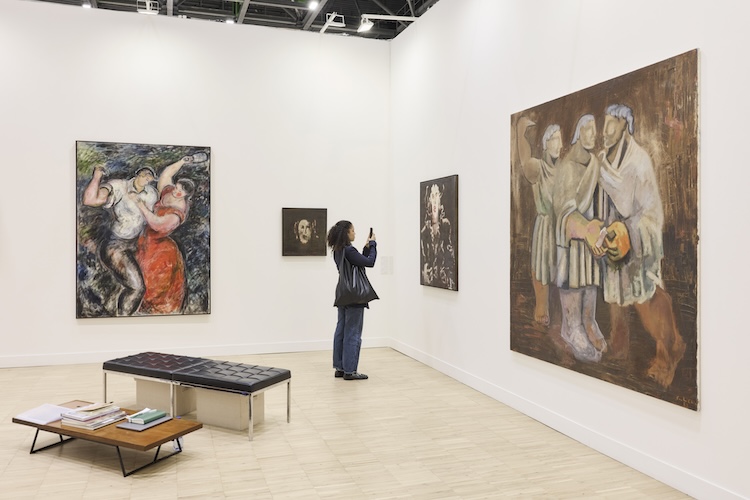 A view of Richard Saltoun Gallery in miart in the Established Anthology section, presenting artists Sandro Chia and Ida Barbarigo. Photography courtesy Nicola Gnesi Studio
By REBECCA ANNE PROCTOR May 9th, 2026
As one strolls through Milan’s streets these days it’s impossible not to remark at the sense of cosmopolitan vibrancy that has taken over Italy’s northern economic capital. Known for its stylish, fast-paced and entrepreneurial spirit, despite a period of global geopolitical uncertainty, Milan is undeniably upbeat and back in Vogue. While a range of languages can be heard in the city’s center, proof of the lure of visitors from near and far, recent rocketing property prices are also proof of the city’s success. The city’s global vibrancy could be undeniably felt at the 30th edition of miart, Milan’s international modern and contemporary art fair, which took place from April 17-19, with a VIP preview on April 16, staged just days before the design crowd flocked to the city for the annual Milan Design Week.
The fair, which took place in the South Wing of Allianz MiCo, was directed again by Niccola Ricciardi, who was appointed Artistic Director in 2021. Titled “New Directions: Miart, but different,” inspired by improvisational jazz music and the creative legacy of icons like John Coltrane and Miles Davis, the fair was staged in a new format across three levels of the Allianz MiCo South Wing. The fair’s new structure marked the expansion of the fair and its 30th anniversary. As visitors moved between three flows, they also could relish views overlooking Milan’s CityLife urban park.
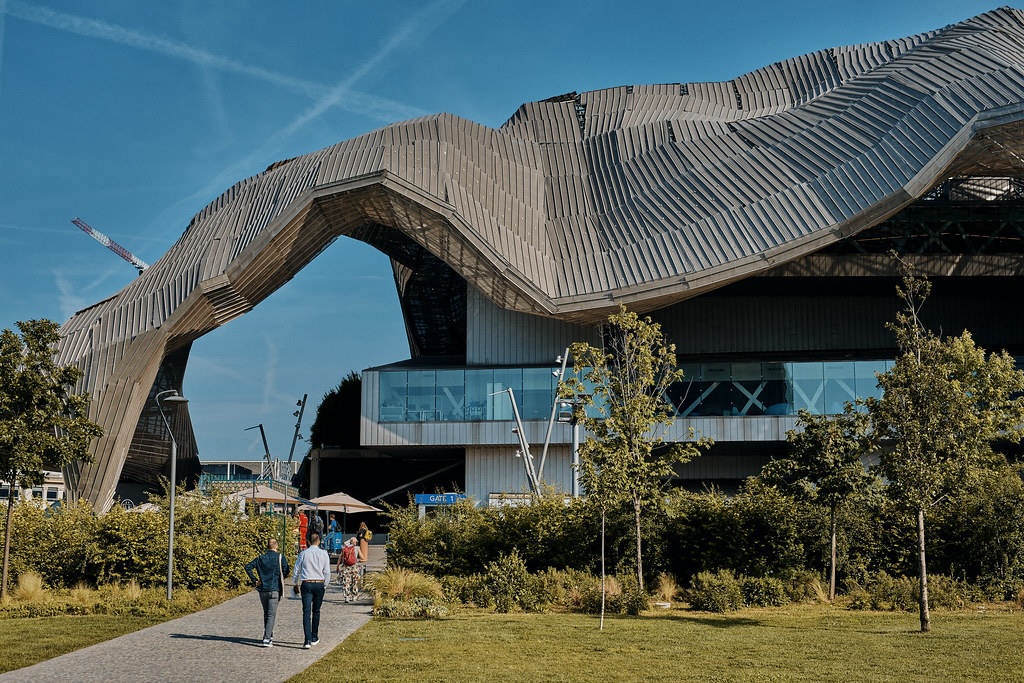 A view South Wing of Allianz MiCo in Milan. Photography courtesy Nicola Gnesi Studio
“I always use the mix of 60 percent Italian galleries and 40 international galleries at the fair,” said Ricciardi during miart. “I also want collectors to find art that they can’t easily find in London and Paris or elsewhere, so we need to offer something new to visitors who don’t travel as often.”
Miart is one of several art fairs that now take place in Italy. Its rival, Artissima, is also dedicated to contemporary art and has taken place in Turin since 1994 and is staged around late October and early November.
“Artissima and miart are very different, not only because they happen at different moments of the year but because Artissima is designed more for experimentation and hence for curators rather than for buyers,” added Ricciardi. “Gallerists often joke here in Italy that you go to Artissima to meet curators and museum directors whereas you go to Milan to make sales. Here, in Milan, is where business happens.”
This year, Milan’s status as a growing European and global haven for contemporary art were bolstered with the presence of the first edition of Paris Internationale, bringing a curated selection of emerging galleries to Milan, running concurrently to miart. Additionally, MEGA Art Fair, marking its third edition this year, also took place for 10 days from April 15 to 25 at SPAZO PROFUMO in Milan’s Navigli district, further establishing itself as a prominent experimental platform for contemporary art.
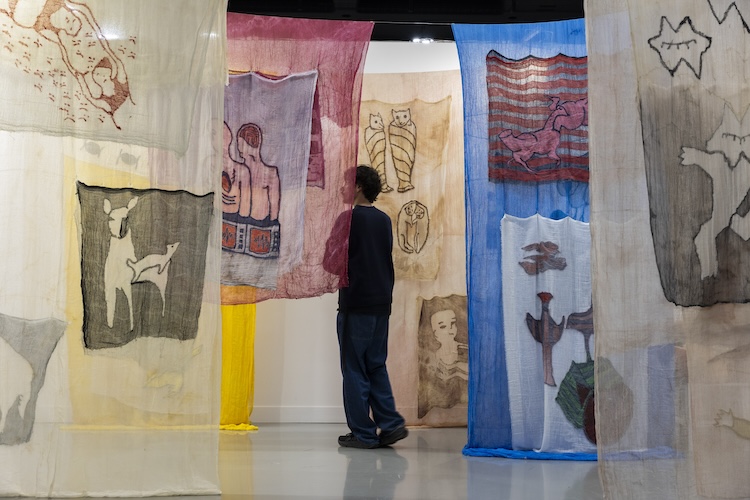 Delicate textile works by Turkish artist Güneş Terkol presented in the Emergent section by Ferda Art Platform. Photography courtesy Nicola Gnesi Studio
“Miart has always acted as a bridge between modern and contemporary art,” added Ricciardi.
This bridge was further emphasized this year with the division of the fair into three distinct sections: Emergent, dedicated to younger galleries curated by Attilia Fattori Franchini and featuring 29 international galleries this year, up from 25 in 2025; Established, the historic section, which presented this year 111 galleries whose programs include 20th-century to present day art second level featuring 20 international galleries a new special project called Movements and the new Established Anthology section stationed on the third level, showcasing just 20 international, largely blue-chip galleries, presenting thematic exhibitions and solo artist presentations to reflect contemporary art history not as linear sequence but one that is accustomed to transformations, returns and adaptations. The latter section included notable global galleries such as Galleria Continua, Galleria Lia Rumma, Cardi Gallery, Galerie Lelong & Co., Mazzoleni and Tornabuoni Arte.
Sales at the fair were slow but steady, reflective, as some dealers noted, of the buying culture in Italy.
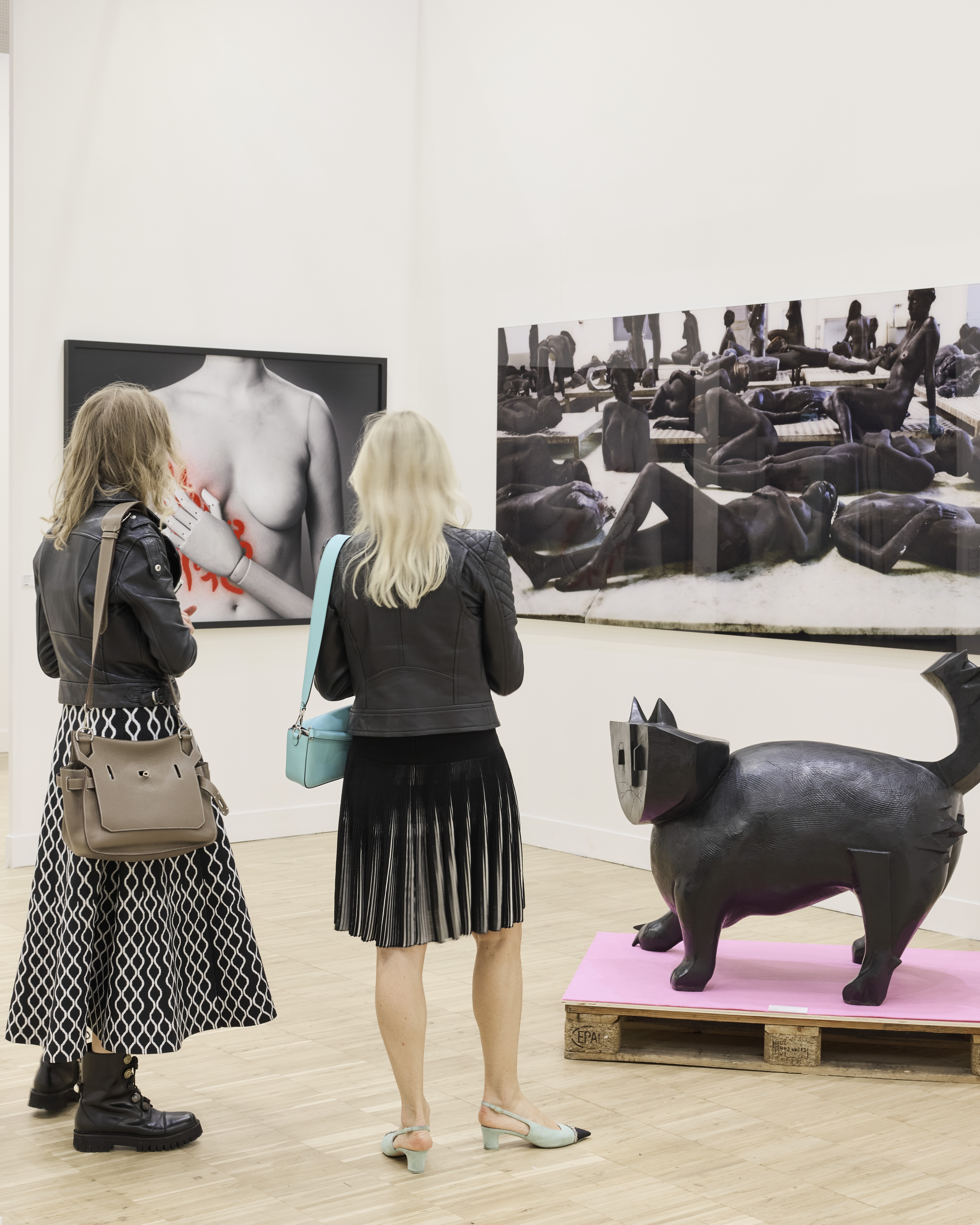 A view of Lia Rumma in Established Anthology, presenting works by Shirin Neshat, Vanessa Beecroft and William Kentridge. Photography courtesy Nicola Gnesi Studio
“Italian collectors don’t rush to buy; they take their time and visit a booth several times before deciding to buy a work,” said Joe La Placa, an American London-based art dealer and Senior Director of Cardi Gallery in London which presented a curated dialogue between Post-War masterpieces and leading contemporary artists, including key works by Jannis Kounellis and Ugo Rondinone, in the Established Anthology section.
Elsewhere in the section works by Shirin Neshat, Vanessa Beecroft, Wael Shawky, William Kentridge, Thomas Ruff and Joseph Ruth at Lia Rumma, a gallery with bases in Naples and Milan, reflected ideas of memory, time and transformation. While at Galerie Lelong & Co. the humble and intimate abstract landscapes of the late Lebanese artist Etel Adnan evoked a sense of nostalgia and the importance of connecting with nature.
Both Emergent and Established featured an expanded selection of international spaces mixed in with prominent and emerging galleries from across Italy.
Cape Town-based gallery Whatiftheworld returned to miart with a booth featuring new works by contemporary African artists, including Mia Chaplin, Cathy Abraham and Chis Soal. Works sold within a price range of €2,000 and €20,000, with approximately 80 percent of the available works selling during the fair, said the gallery.
Also notable were two galleries from Istanbul—Ferda Art Platform and Merkür—participating in the Emergent section each with female Turkish artists. The first exhibited delicate textile works by Güneş Terkol reflecting the relationships between bodies, beings and objects, while Merkur presented abstract paintings by Nilufer Yildirim who resides between Istanbul and Milan.
“Over the last several years Emergent has become a central section of the fair and this year we added more galleries,” said Franchini who has been curating the section for eight years. “The section is also placed at the entrance of the fair reflecting the responsibility we have towards younger galleries and artists. It has also become one of the most international sections. This year out of 29 galleries, 10 are from Italy and 19 are international.”
Galleria Eugenia Delfini, a young Roman gallery based on Via Giulia, participated for the second time in Emergent with the abstract, choreographic paintings in vivid hues of Roman artist Caterina Silva.
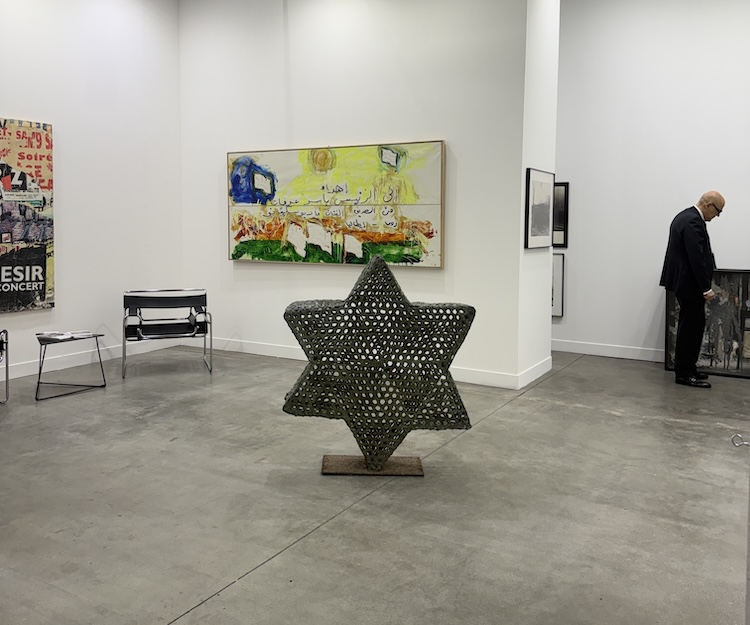 A view of Eidos Immagini Contemporanee in the Established section presenting a curated booth titled "War, War!" Photography by Rebecca Anne Proctor
Signs of present geopolitical turbulence could be found in several presentations. Notably at Eidos Immagini Contemporanee which presented at its booth “War, War!” showcasing works by several Italian artists created over the past few decades in response to war. Of note were abstract expressionist works by Mario Schifano, the late Italian painter and collagist who was born in Libya and lived and worked in Rome for most of his life, becoming known as the “enfant terrible” of the Roman art scene, blending popular culture with mass media often with critique of consumerist culture. His L’Omaggio per il president Yasser Arafat (Tribute to the late President Yasser Arafat) (1994) was displayed, a work created in the hopes of strengthening the recognition of the state of Palestine, painted the same year that Arafat returned to Gaza after 27 years of exile. The gallery also presented a painting by Gianni Bertini titled Quelli che vanno (Those who go) (1969) reflecting the painful reporting of the war in Vietnam.
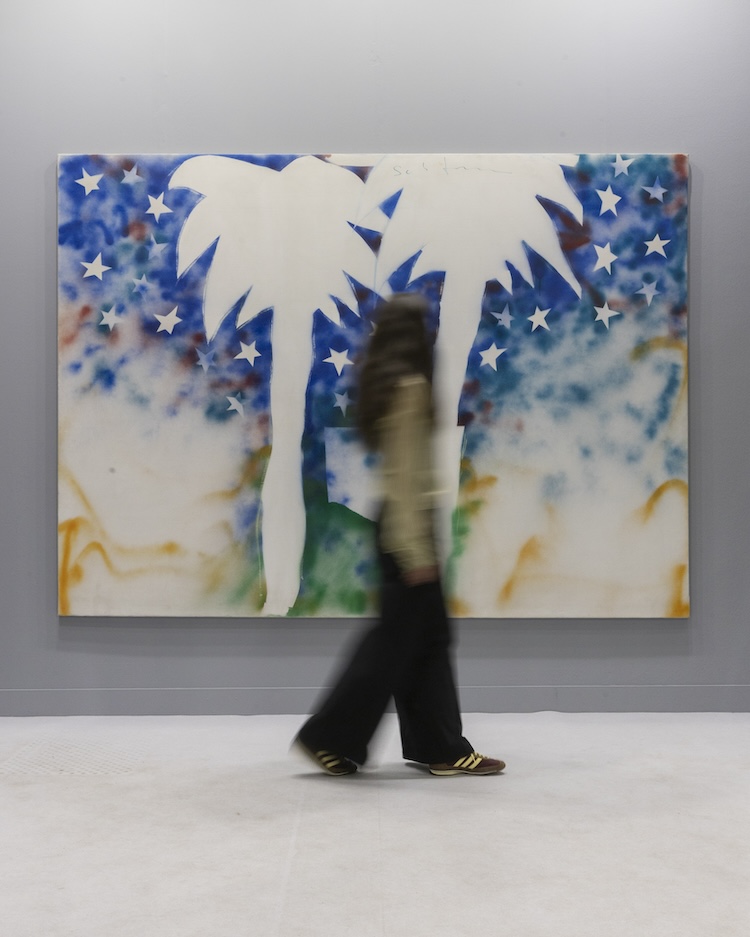 A painting by Mario Schifano dated to cira 1970s in the booth of Campaiola. Photography courtesy Nicola Gnesi Studio
Schifano’s work could be found at several other booths at the fair. His work is also the subject of a major solo exhibition at Palazzo delle Espozizioni in Rome, running until July 12, 2026.
In the Established sections several nods to the African continent could be found through presentations by Milan-based Primo Marello Gallery showing the textile installations of Nigerian Samuel Norom, Joël Andrianomearisoa from Madagascar and Malian Abdoulaye Konaté, among others. 193 Gallery, with branches in Paris, Venice and Saint-Tropez, showed works by Thandiwe Muriu, Sesse Elangwe, Nagabe Shinji and French Tunisian Shourouk Rhaiem.
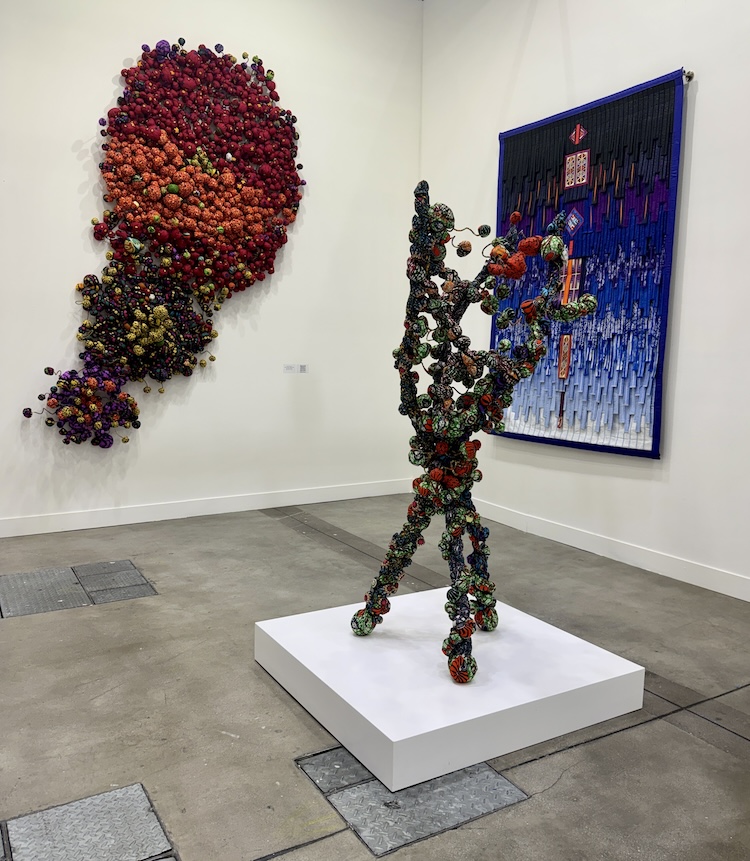 A view of Milan-based Primo Marella Gallery featuring works by Nigerian Samuel Norom and Abdoulaye Konaté from Mali. Photography by Rebecca Anne Proctor
The buzz in Milan during miart and in the lead up to Milan Design Week was undeniable. The city’s rise as a cultural and economic capital is drawing many new residents and returning Italians. One is prominent art patron and collector Valeria Napoleone.
“I want to be more engaged with my country and Milan, specifically,” said Napoleone. “Returning to Italy is an opportunity to do more projects here and support my country. Miart is an important fair for Milan and for many years it has been disregarded but it has been renewed and rejuvenated and it is growing like Milan."

Rebecca Anne Proctor
Rebecca Anne Proctor is a journalist based in Dubai. She is the former Editor-in-Chief of Harper’s Bazaar Art and Harper’s Bazaar Interiors, a role she held since January 2015. Her writing has been published in The New York Times Style Magazine; Bloomberg Businessweek, Architectural Digest, Vogue Arabia, Artnet News, Frieze, BBC, The Forward, Arab News, Galerie, Ocula, The National, ArtNews and The Business of Fashion. She is an international consultant for Rizzoli Books and also regularly writes texts for books and catalogues on Middle Eastern and African art and culture.
view all articles from this author