Whitehot Magazine
November 2026
"The Best Art In The World"
"The Best Art In The World"
November 2026
Closer and Around: Zeng Fanzhi and Cristina Iglesias at Hauser & Wirth
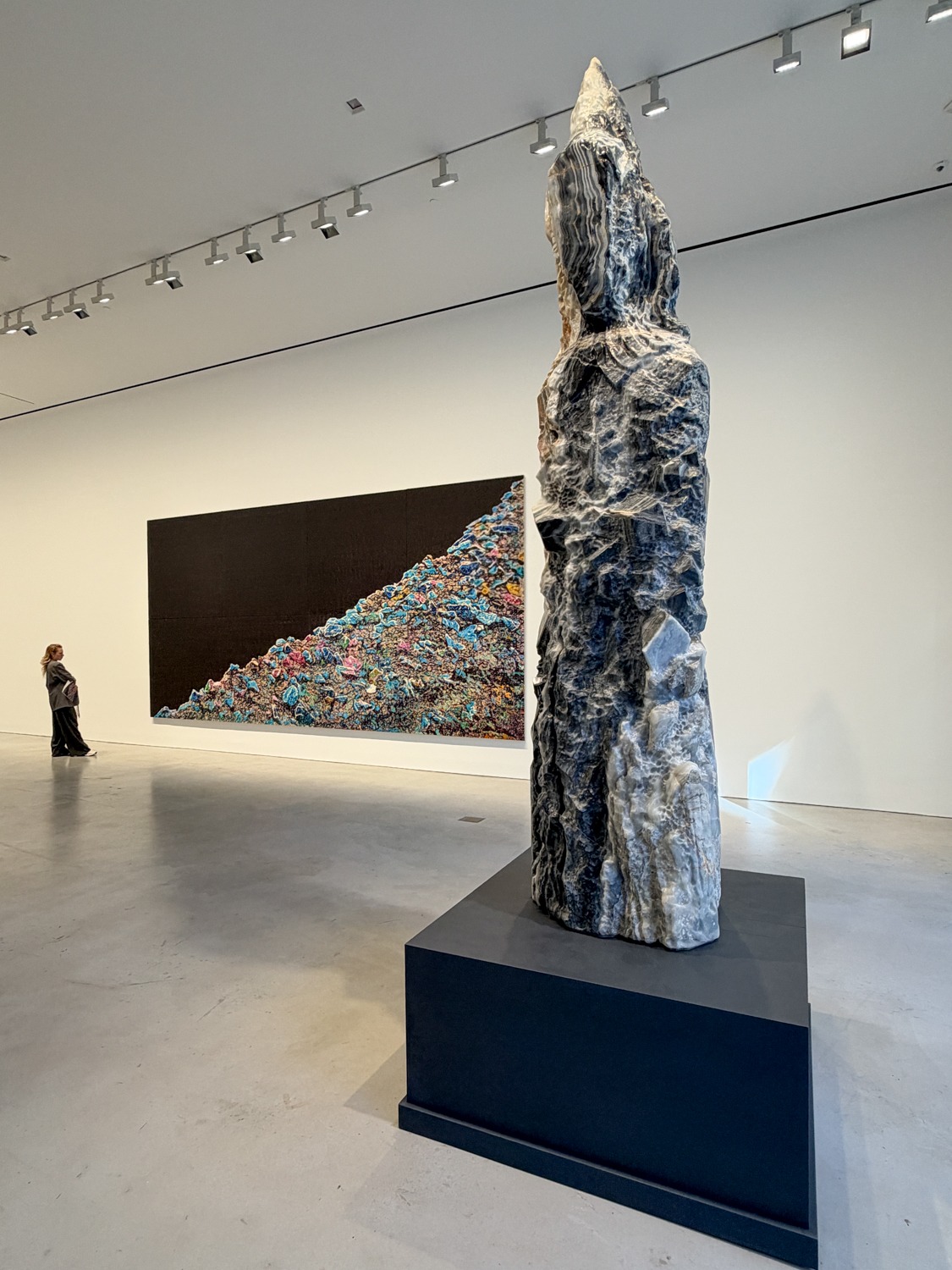 Installation view of Zeng Fanzhi at Hauser & Wirth, New York, 2026, with Untitled (2025–2026) visible in the background. Photography by Peter Koloff.
By PETER KOLOFF, November 16th, 2026
I arrived early for the press preview at Hauser & Wirth, before the rooms really filled up. There was coffee, pastries, people checking in, and that brief period when you can still stand in front of something without feeling anyone waiting behind you.
Two exhibitions had opened at the gallery’s 22nd Street location: Zeng Fanzhi, which Hauser & Wirth calls his first New York City exhibition in more than a decade, and Cristina Iglesias: Possible Matter, her first New York exhibition with the gallery. Both are on view through January 16, 2027.
I started with Zeng on the first floor.
From across the room, several of the paintings almost looked like fabric to me. The surfaces had that kind of density, as if color had been woven together rather than painted. Then I got closer and the illusion disappeared.
Most of the paintings, dated 2024 and 2025, are untitled, so there was no title telling me what I was supposed to see. The gallery describes the new works as imagined celestial landscapes and topographies. Standing in the room, I mostly just kept moving toward them.
Up close, the surfaces became much more complicated. Marks crossed one another. Colors appeared beside and through other colors. Areas that seemed almost calm from several feet away were full of movement when I stood directly in front of them.
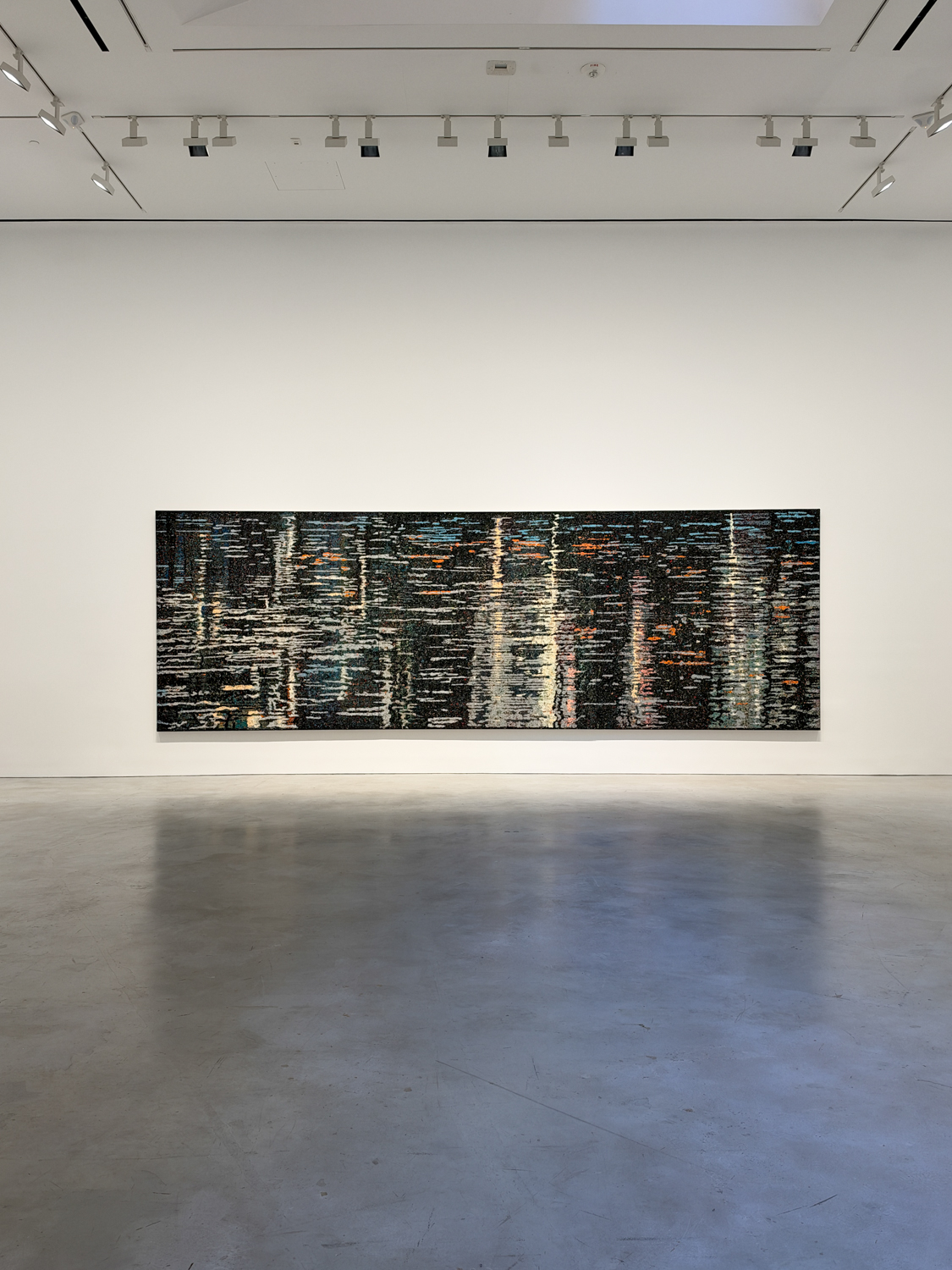 Zeng Fanzhi, Untitled (2024–2025), at Hauser & Wirth, New York, 2026. Photography by Peter Koloff.
Zeng has been working with mélange optique, or optical mixing, placing and layering colors alongside one another rather than blending them on the palette. It helps explain what happens as you approach the paintings. The eye keeps doing the mixing the brush left unfinished.
I didn't know that when I first walked up to them.
During the preview I had a chance to speak with Zeng through a translator. We talked about how his technique developed through years of studying other painters before he found his own language, and about the role his memories play in the work.
Then Zeng told me, through the translator, that he does not use AI in making the paintings.
A few years ago, I doubt anyone would have thought to say that.
Standing close enough to see the physical accumulation of marks, I kept coming back to it. We are at a point where the question of who, or what, made an image has entered the room with us. Some marks in these paintings seemed controlled, and others seemed to escape that control. Together they arrived at something surprisingly peaceful, a resolution that read as the result of someone making decisions over time.
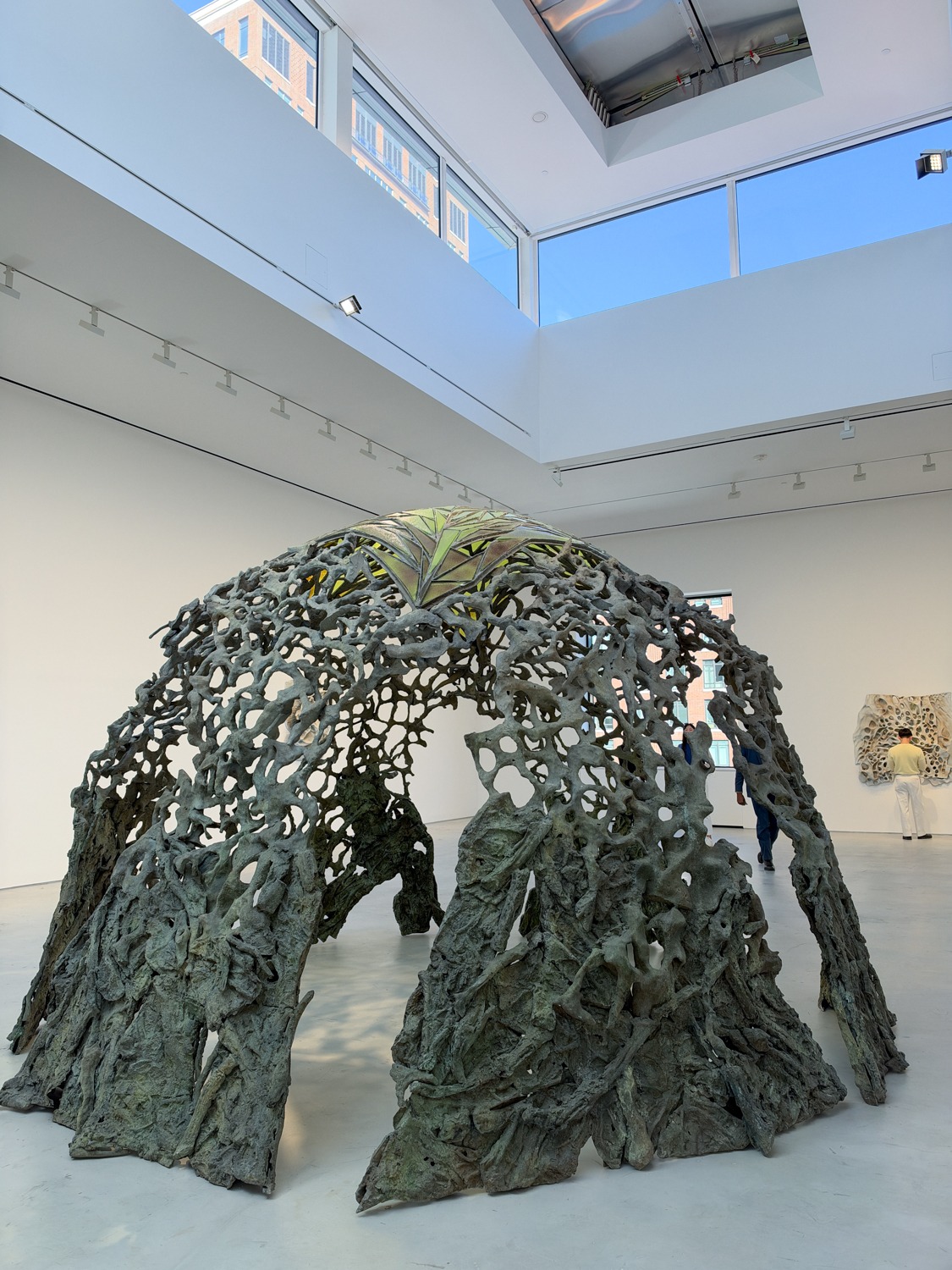 Cristina Iglesias, Dome (2026), from Possible Matter at Hauser & Wirth, New York, 2026. Photography by Peter Koloff.
Then I went upstairs to Cristina Iglesias's Possible Matter, and my relationship to the space changed.
At the center of the exhibition is Dome (2026), a five-meter-wide structure of branch-like cast aluminum rising into a geometric glass cupola. Around it are four wall works from the Possible Matter series, in cast aluminum and transparent resin.
My reaction was immediate. Standing near Dome, I thought about being underwater. Then a cave. Then roots.
I mentioned that feeling when I spoke with Iglesias. Her answer went straight to San Sebastián, where she grew up on the northern coast of Spain. She seemed genuinely excited that I had arrived at the work through water. Elsewhere, she has described growing up in the Basque Country with the sea constantly changing: a surface that holds light, and something unknown beneath it.
Water isn't a metaphor in her practice. In 2010, Iglesias installed Estancias Sumergidas, a permanent underwater work off Isla Espíritu Santo in the Sea of Cortez, Baja California. It was conceived as an architecture beneath the surface that marine life could eventually inhabit.
But Dome did not feel like an illustration of the sea.
It felt more like nature had begun constructing architecture.
At its base, the aluminum carries impressions of roots and organic forms. As the structure rises, those forms become more geometric, almost crystalline, until they meet the glass.
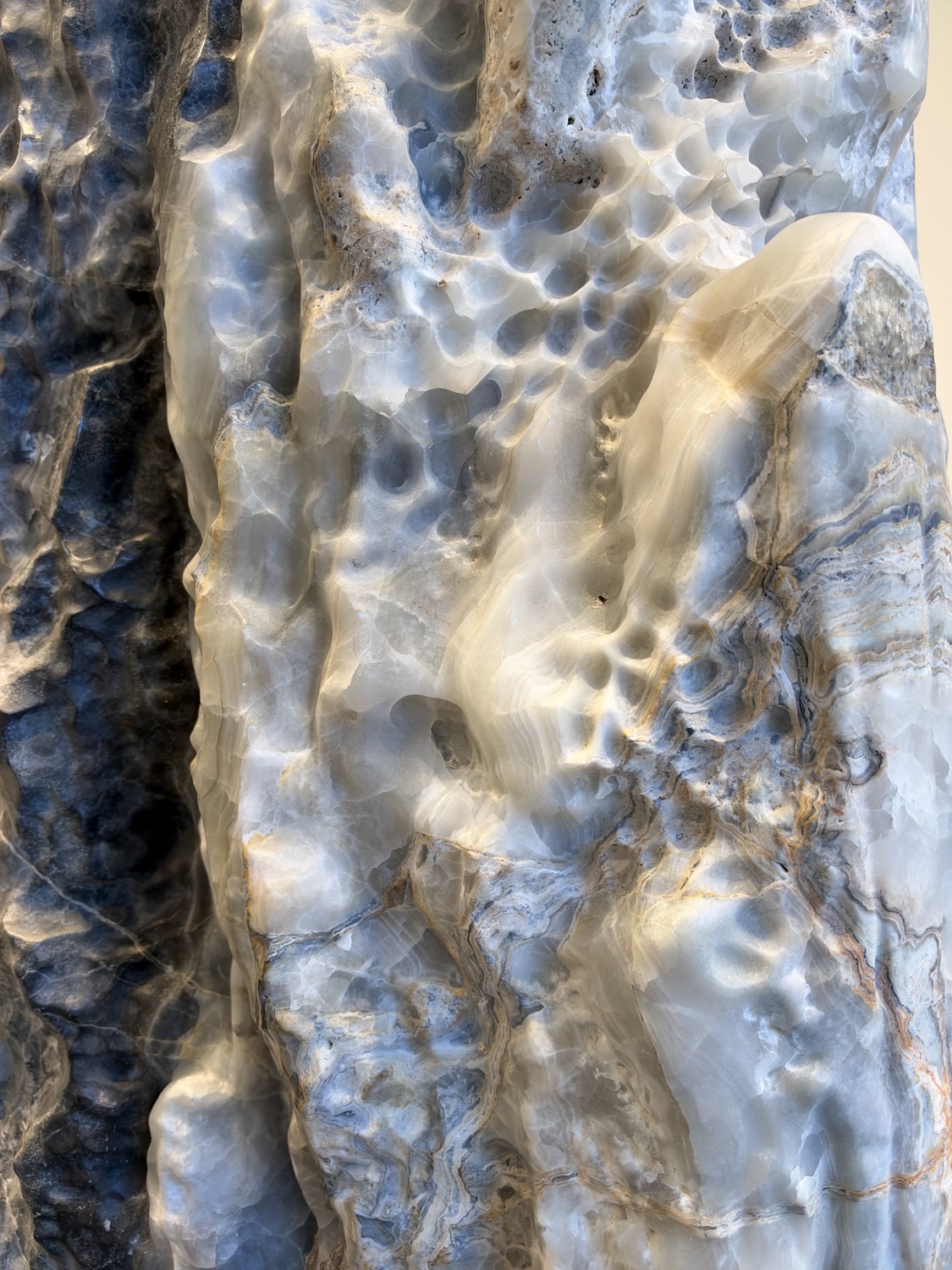 Detail of a wall work from Cristina Iglesias’s Possible Matter at Hauser & Wirth, New York, 2026. Photography by Peter Koloff.
Iglesias has spoken about these works in terms of transformation, with matter moving toward order without ever fully settling into it. That was close to what I felt underneath Dome. It seemed caught between something grown and something built.
Looking upward, I could not decide whether I was beneath the roots of something, inside a cave, or standing under a structure that had somehow formed on its own.
The wall works did something similar. Their surfaces suggested rock, erosion and growth, and they appeared to push against the architecture rather than simply hang on it. At a certain point I stopped thinking about them as individual objects and started thinking about what they were doing to the room.
That was very different from what had happened with Zeng.
In front of his paintings, distance kept changing what I saw. I would step back, then move closer until what had appeared unified began breaking apart into color and marks.
With Iglesias, position mattered more. I had to move around the work. Under it. Beside it. The sculpture changed because my body changed position.
I had gone into Hauser & Wirth expecting two separate exhibitions. What stayed with me was how each one decided where I had to stand.
In front of Zeng, I leaned closer until a landscape almost dissolved.
Under Iglesias's Dome, I looked up and the gallery had become terrain.
Zeng Fanzhi and Cristina Iglesias: Possible Matter are on view at Hauser & Wirth, 542 West 22nd Street, New York, through January 16, 2027.
Peter Koloff
Peter Koloff is a New York-based photographer, filmmaker, and cultural writer documenting the people and experiences shaping contemporary art, fashion, and culture. Combining original photography with firsthand interviews, his work explores the human stories behind creative expression. His editorial coverage spans New York and international cultural events.
view all articles from this author