
Whitehot Magazine
August 2026
"The Best Art In The World"
"The Best Art In The World"
August 2026
“A Talisman of Strength:” Queer Catholic Iconography in conversation with artist Libby Kercher

One of the four illustrations Libby Kercher created for DignityUSA.
BY EMMA CIESLIK January 5, 2025
Libby Kercher (she/he) is a queer illustrator and designer based in the Philadelphia area. Her illustrations explore lived experience at the intersection of gender and faith, religious history and theology within the Catholic Church. He is dedicated to amplifying marginalized voices, especially utilizing queer Catholic art as a tool for liberation, most recently with his piece featuring the Virgin Mary trampling a snake labelled I.C.E. that went viral in far-right Catholic spaces on X. This is just one example of her radical iconography that visualizes Jesus, Mary, saints, and other religious figures as active fighters for liberation.
Currently, she is working on her senior thesis featuring illustrations of saints on the margins, or rather saints that have little to no formal recognition by the Church but whose work is vital to imagining and facilitating an inclusive Catholic Church. Ahead of the publication of his senior thesis collection, I sat down with Kercher to learn more about the power of queer religious art to complicate and deconstruct religious hegemony and draw power from queer Catholic artists and ancestors.
Emma Cieslik: What first drew you to create art, and art specifically that explores queer Catholic identity?
Libby Kercher: It’s definitely been an evolutionary process. I’ve always been interested in art, but I first became interested in art because I used art as therapy growing up, in elementary school, middle school, through high school, and then as I began to polish my skills in illustration and graphic design, I still brought that same kind of methodology that I was introduced to when I first began just doodling and just scribbling.
I grew up going to a Catholic elementary school and so I had a Catholic religious education at a parochial school, and then I went to a public school in middle school and went to CCD. It’s a Catholic education class that’s like an after-school program, and then at the same time, I came out as queer and was rejected from that church community. At that same time, I started to do art and explore religion in art, first kind of processing this experience and then as I have deconstructed and then reconstructed my relationship with Catholicism and religion, my art has come along with it.
Cieslik: One of your most powerful works was an illustrated collection you posted on Instagram in August 2022 titled “Why I am still Catholic.” In it, you recognize how people often ask why you choose to stay in the Church even though it is “unabashedly patriarchal and homophobic.” You respond in the comic by explaining that choosing to stay is not denying the reality of harm that the Church perpetuates but rather a radical act of agency to refuse to disappear, to transform the Church by your presence. How does art do this, and how does art allow you (empower you) to stay?
Kercher: While in the comic I assert that it’s a radical act of agency to stay in the Church, I think that art is also a radical act of agency. You’re using a visual language that you yourself have come up with or you have inherited and for me, that is Catholic symbolism. Catholic iconography is a language that I have inherited, that I use in a way where I can assert my identity and who I am and groups that I belong to, focusing on the very personal but also the very global of those who are marginalized within the Church.
Cieslik: How was art for you a pathway of affirmation in a Church that maintains a homophobic stance? How is your art a space to find belonging and purpose in the Church?
Kercher: There’s this difficult moment with anyone who is LGBTQ+ or a part of a marginalized identity where what you feel within yourself and what you know within yourself is not reflected outside of you, and I feel like that is a really critical moment when you are affirming your identity or discovering who you are within society, within your family, within your religious community, where you feel like you’re going a little crazy. You feel like there’s nothing for you. You’re a misfit. You’re outside of the norm, and for those who feel like they can or want to try to imagine worlds and possibilities in which you are within the society or the religion or family, it can be really important to visualize and to get in writing or in action what you feel inside, to be truthful.
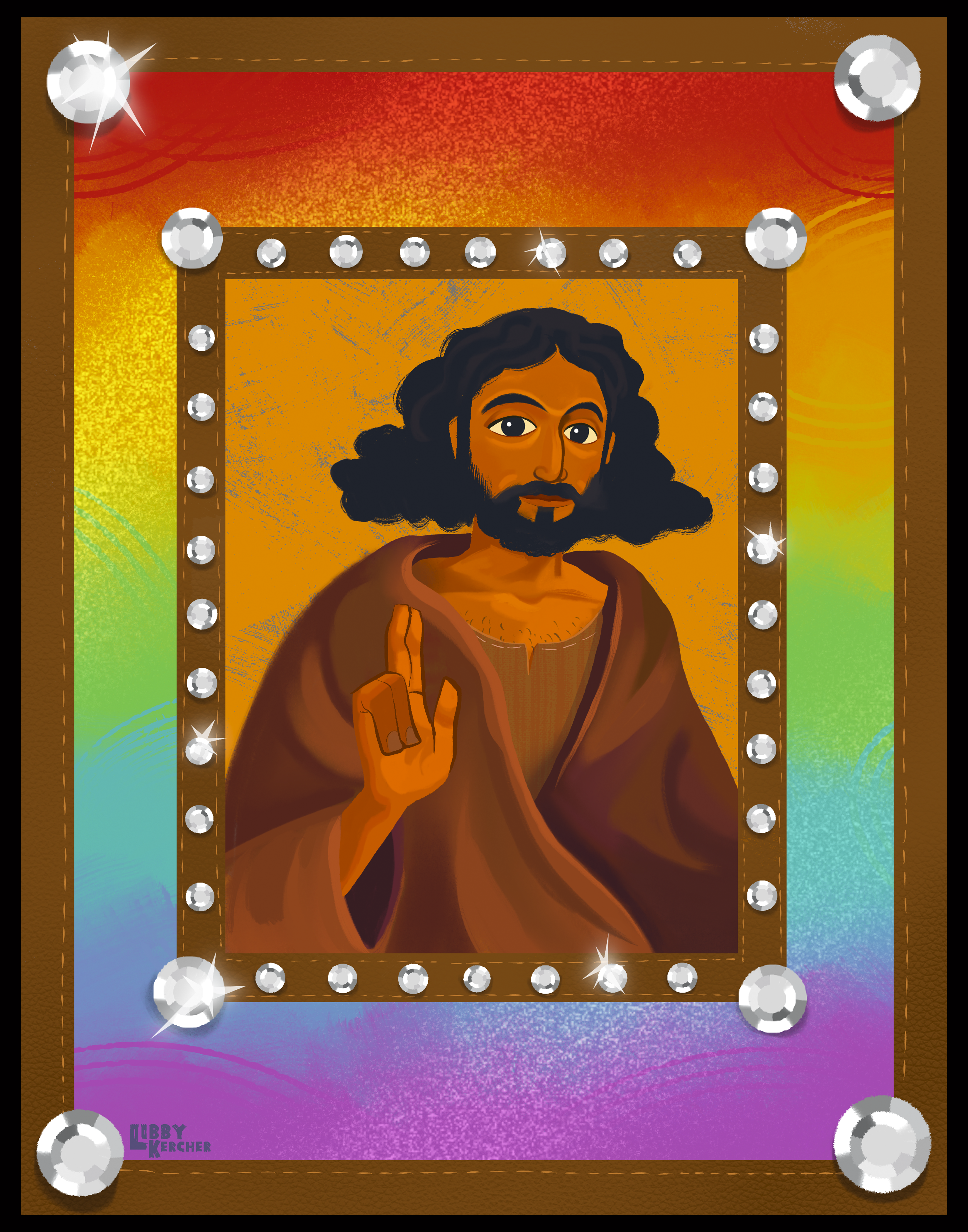
A rainbow icon of Jesus raising his hand in a sign of benediction, by Libby Kercher.
Cieslik: Your art depicts Biblical figures within the bodies and identities that you didn’t see represented in the Church growing up. Why was that important and how is that part of the radical work that you do?
Kercher: When you know who you are, it’s easier for you to see and recognize yourself in other people, while still knowing that they are separate from you. Reading the Bible, reading the lives of the saints, there have been many times where I can see myself in someone on a personal level, but it can be taboo to discuss that, whether it comes to the subversion of gender and sexuality within a lot of Medieval saints--most prominent being Joan of Arc or Saint Sebastian in some regards. Then also the marginalization of the Christ and the early followers of Christ within the Church, and the marginalization and disconnection from the religious hierarchy, their families, and their communities is that something that really resonates with LGBTQ+ people and other marginalized groups so that’s kind of what compels me to say that quiet part a little bit louder where it comes to people who see themselves in the shoes of these [Biblical] people.
Cieslik: How does art hold the Church accountable and hold space for complex truths and realities? Recently, there has been a lot of discussion about how anti-ICE nativity scenes and other forms of liturgical art have been used to start conversations but have been censored by Church authorities. What is the power and potential of art to be part of that process, and also to circumvent certain censorship networks?
Kercher: Art is such a great way to communicate in a way that feels symbolic and cohesive to the human spirit. The Church itself is made up of art--the liturgy, the different colors of the vestments, how we historically before people were widely literate (and still in places with low literacy rates), images are used to communicate and convey. While this can be used to distort, this can also powerfully get messages across quicker than formal doctrine.
I think these anti-ICE nativity displays and the art being used in protests--the religious art currently being used in protests--is just another way to bring that history of performance--I’m using performance in a very neutral term--of religion outwards. I think a lot about Cesar Chavez’s processions where he would carry the Virgin of Guadalupe, processions that are very similar to what happens before Easter and Holy Week. I think these are very powerful tools that can help propel ideas and actions.


An excerpt of Libby Kercher’s 2022 comic titled “Why I am still Catholic.”
Cieslik: One of the best examples is a comic you posted in December 2024 where you explore the experiences of a person named Liz who has epilepsy but believes they are possessed by a demon. This is based in real Church history where people were ostracized and exorcised for real medical conditions. How does your art grapple with difficult Church histories and seek healing? Is art a form of visual and spiritual reconciliation?
Kercher: That comic is actually very personal to me. The comic is really about me. Liz was one of my nicknames in elementary school, and I myself have temporal lobe epilepsy. So my second ever confession, I went and I told the priest, “I think I’m possessed” because I know some of the Biblical stories how epilepsy is treated and the specific words that they use to describe seizures and convulsions, and so I really felt from a young age without knowing and understanding it as I do know as an adult the impact that Church history can have on a person and a person’s understanding of themselves, so at the same time that I understood what epilepsy was, I also understood it was called St. Paul’s Disease. In ancient Ireland, that’s what they used to call it but I’ve heard it a few times in childhood, so I think that art can begin to be therapeutic and recontextualize your own personal history and how it connects to the history of the Church.

An excerpt of Libby Kercher's comic God and Empire.
Cieslik: You have witnessed and been part of the radical work seeking to make the Catholic Church more inclusive, even though this work is slow and often goes unrecognized because of the nature of the Church. This past September, you attended the pilgrimage for the Jubilee Celebration with other members of DignityUSA, an LGBTQ+ Catholic ministry that has been active since 1969. How has art been part of queer Catholic ministry in the past and present?
Kercher: My largest inspiration right now and for quite some time is Father William Hart McNichols. He is a priest. He was a hospice chaplain during the AIDS crisis, an illustrator and a current iconographer. He communicated very poignantly visually throughout the AIDS crisis, he himself being openly gay. He was able to not only create illustrations that brought comfort to those who were infected with HIV and dying of AIDS, but he was able to visually describe very healing images of Christ and of the mystery of the Trinity and of the God in the faith and saints who have worked with those who are sick.
A really great example is him telling people who are dying of AIDS who are scared to pray: “imagine holding Christ as a child. He’s not going to judge you. He’s not going to be angry with you. He might pee. He might poop on you, but he’s not going to do much else.” Just imagine yourself holding him. These are very impactful images that he conjured up for people who have been hurt and for people who were scared of the possibility of a Christian-imagined afterlife, and the fact that he was able to communicate visually verbally and also to communicate visually with his iconography I think is a really great and powerful example of art’s role within this movement.
Cieslk: One of my favorite works you created was a series of digital illustrations for DignityUSA for four weeks of ordinary time (including Corpus Christi Sunday). In it, we see hands raised against a backdrop of flames, an outline of St. Paul’s head against a brick cell with light pouring through an opening, and hands breaking bread above empty bowls. How did you first get involved with DignityUSA and why is liturgical art created by Catholic marginalized voices important?
Kercher: Yeah, so I first got involved in Dignity about a year and a half, two years ago. I started attending the Dignity Philadelphia Masses, and I got to know the members of that community and their histories and what they do, and it was really life changing for me. I finally felt that I had a spiritual home, which is incredibly powerful for LGBTQ+ people. I wanted to do an art internship this summer, and I reached out to DignityUSA, which is the national organization, and asked if there was any availability for an illustrator or graphic designer to help them for several months over the summer.
My favorite assignment from the summer was creating these weekly liturgical illustrations that went along with a homily/reflection written by a member of the DignityUSA community, and these reflections are things I’ve never read before. When there’s only a specific type of person or people that are part of a liturgical committee or are writing the homily, you’re only going to get specific perspectives, and reading these reflections and finding ways that it resonates with my lived experience were really impactful. To have the readings and to then have someone from a community that you’re in or an adjacent community reflect on it is something that you don’t hear in a parish church that often, so I wanted to bring the same kind of outside-the-box perspective into the illustrations and trying to honor the perspectives that were written about in these homilies. I think it’s really important that you get all of these different interpretations of the Gospel, of the Bible, of religious text because if we’re all the Body of Christ, why are we only hearing some people’s interpretations of it?
Cieslik: Absolutely, and I love DignityUSA because they also have the philosophy of everyone leading the liturgy. I know there’s a big push to ordain women within the Church, but DignityUSA is one of the few (if not the only) that uplifts women’s ordination alongside queer liberation. How is being able to create art with Dignity part of that mission and part of being able to engage with liturgy as a queer Catholic person?
Kercher: Yeah, I think this was the first time I’ve been able to interact with liturgy and feel like I’m a part of it. In the traditional parishes that I grew up in, I felt much more like a spectator than I do feel a part of the congregation or the living body of Christ. I think this was the real first time that I was able to experience this type of participation spiritually.

A profile illustration of Fr. John J. McNeill by Libby Kercher. This is part of Kercher's senior thesis collection.
Cieslik: I personally am super excited for your senior thesis. What drew you to the saints you identified for this collection and how do you hope this art mobilizes religious and social change, and recognition of saints often denied recognition in the Church?
Kercher: I really wanted to tackle this topic in my senior thesis because I am interested in the lives of saints and also the canonization process of how a saint gets recognized. How many saints are there that we don’t formally recognize within the Church? This drew me into folk saints. What are the saints that me and people in my life look up to and ask for guidance, even if it’s not in the canon of the Catholic Church? The first person I illustrated was Father John J. McNeill who was one of the founders of Dignity New York and was a gay Jesuit priest who wrote a lot about gay issues within the Church in the 1970s and 1980s and faced a lot of crap from Church authorities because of it. I thought that was for the first person I illustrated being that that was my immediate connection to somebody that I consider guides me spiritually.
I’ve also illustrated other people, including Cesar Chavez and Sister Bernard Ncube, a nun from South Africa who advocated for the end of Apartheid.

A profile illustration of Sr. Bernard Ncube by Libby Kercher. This is part of Kercher's senior thesis collection.
Cieslik: Why is it important to recognize and uplift the lives of the folk saints that do not get recognition within the Church?
Kercher: One of the best things that has come out of the Second Vatican Council is more of the recognition that the Holy Spirit works within us and within the living body of Christ, aka Catholics around the world. I think as much as the Catholic Church is an institution--we can’t deny that--it’s also the people that make it up, and I believe that we have the agency to discern spiritually who is guiding us.
There are people who have advocated for people in their lives, being guided by their religious beliefs and to then to not have that recognition for the reasons that might be informed by a political agency is really unfortunate and is hurtful to the people who they served. I believe it’s right to give them recognition.
Cieslik: It’s creating this spiritual and communal ancestry for queer Catholics who are trying to imagine their place and representation in the Church. How is the art you are doing for your senior thesis a way to connect with queer Catholic ancestors?
Kercher: It is hard to live in a world where it is often not possible to live and that is something that I am reckoning with as I create this art, as I graduate from art college and get older. How do you go ahead when you feel like there’s no clear path for you? And then you realize, I might need to create my own path? But I’m not alone in that. People beyond the grave who have existed like me before and there are people still alive and there are people yet to be born who are like me and also not like me at all but can still help me. I believe art is a really great way to connect and synthesize the past, present, and future within your own history, within your own community’s history, within a larger community, and I think art is a way to bring that into one image and one timeline and in many ways, it’s can be a talisman of strength to keep going forward. 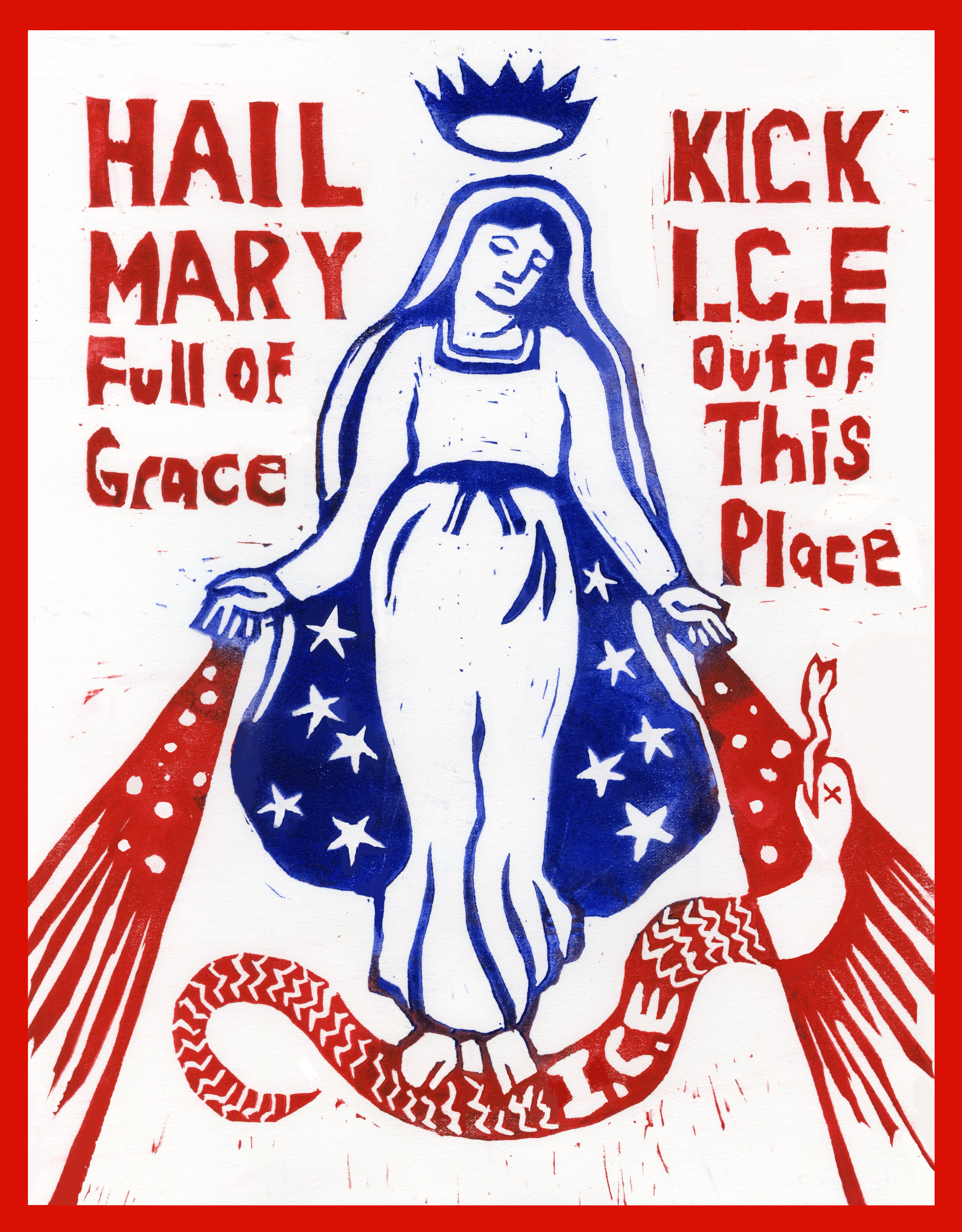
A portrait of the Virgin Mary created by Libby Kercher that went viral in conservative Catholic circles online.

Emma Cieslik
Emma Cieslik (she/her) is a queer, disabled and neurodivergent museum professional and writer based in Washington, DC. She is also a queer religious scholar interested in the intersections of religion, gender, sexuality, and material culture, especially focused on queer religious identity and accessible histories. Her previous writing has appeared in The Art Newspaper, ArtUK, Archer Magazine, Religion & Politics, The Revealer, Nursing Clio, Killing the Buddha, Museum Next, Religion Dispatches, and Teen Vogue
view all articles from this author



