Whitehot Magazine
November 2026
"The Best Art In The World"
"The Best Art In The World"
November 2026
Krasner and Pollock: Past Continuous, The Metropolitan Museum of Art
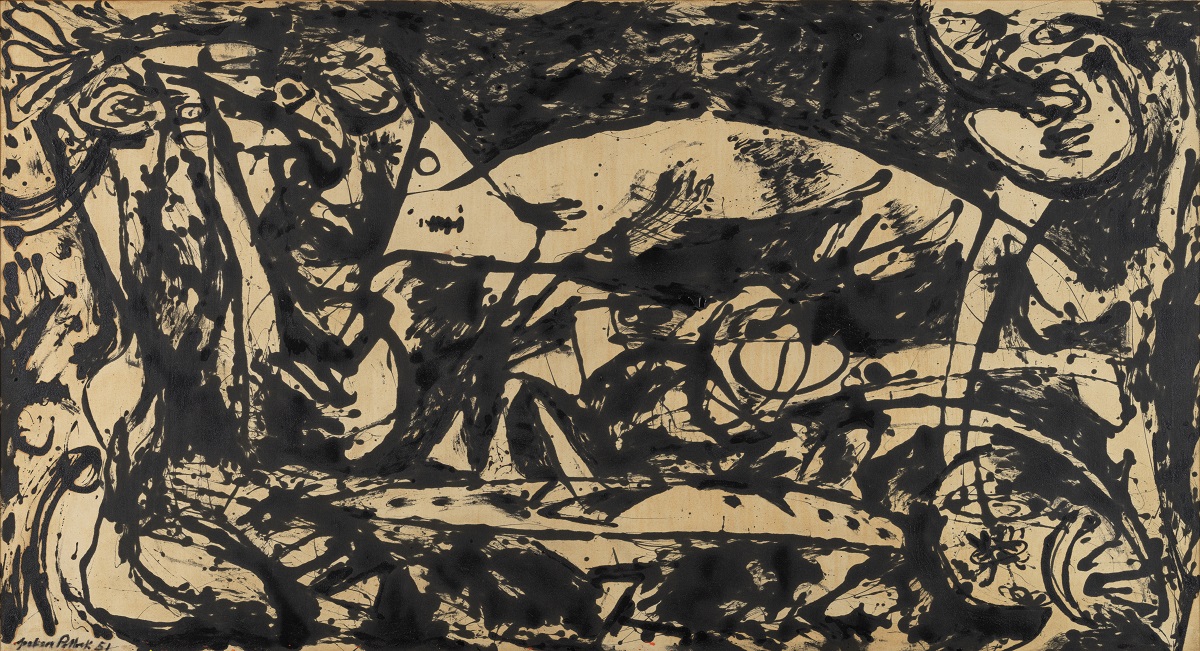 Jackson Pollock (American, 1912–1956), Number 14, 1951. Oil on canvas, framed: 58 3/4 in. × 8 ft. 11 1/8 in. × 2 1/2 in. (149.2 × 272.1 × 6.4 cm).
By SAUL OSTROW, November 20th, 2026
The problem with pairing Lee Krasner and Jackson Pollock is not simply that the story of their marriage threatens to overshadow their paintings; it is that the differences between their practices so readily become yet another account of their relationship. Krasner and Pollock: Past Continuous offers an occasion to consider two practices that developed in proximity without becoming equivalent. Although their life together lasted fourteen years, from the beginning of their relationship in 1942 until Pollock’s death in 1956, that shared life remains the implicit ground of comparison, even when the paintings suggest otherwise. The question is not whether their lives were intertwined, but where that circumstance ceases to account for what they did. Their proximity establishes a point of departure for comparison but does not establish that they shared a common artistic undertaking.
The exhibition’s own arrangement complicates a chronological account of their development. It opens with a room devoted to Krasner’s collages from the early to mid-1950s, rather than with the artists’ earliest works. From there, the exhibition moves largely chronologically, returning to Krasner’s earlier work before proceeding through the careers of both artists. This initial displacement gives Krasner’s practice a point of entry not defined by its relation to Pollock. It also postpones the early paintings, which arrive without the weight of what follows.
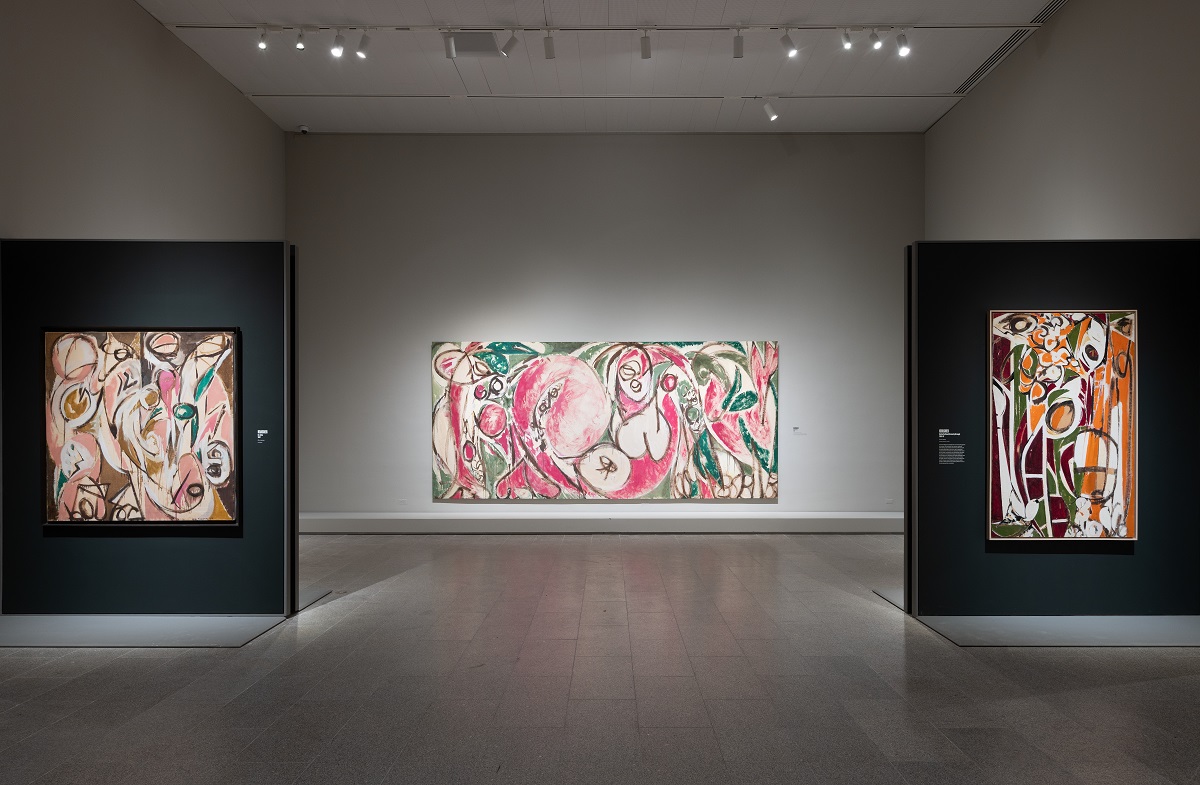 Installation view of Krasner and Pollock: Past Continuous, on view at The Metropolitan Museum of Art from October 4, 2026–January 31, 2027. Photo by Anna-Marie Kellen; courtesy of The Met.
In the late 1930s and 1940s, before they had acquired the identities through which their work would subsequently be read, both belonged to a common pool of painters in New York working through the possibilities of abstraction. Both had been included in the exhibit French and American Paintings curated by the painter John Graham for McMillen Gallery in 1942, which provided the occasion for their meeting. To read these early paintings solely as precursors to what each would become is to let the outcome explain the process—to treat what was still ahead of them as if it had already been determined. Their work belongs to a field of possibilities still open to negotiation. The exhibition is most revealing when it allows this uncertainty to persist rather than making every early decision appear inevitable.
The difference in their training offers one place to begin a comparison. Pollock studied with Thomas Hart Benton at the Art Students League in the early 1930s, learning, most significantly, a way of organizing pictorial space through rhythmic, interlocking forms. Krasner studied with Hans Hofmann from 1937 to 1940, where her encounter with Cubism and European modernism contributed to a revision of her visual language. Benton and Hofmann provide different points of entry into the problem of pictorial organization. Meanwhile, the arrival of European Surrealists during the war brought automatism, the unconscious, and symbolic imagery into greater prominence in the United States.
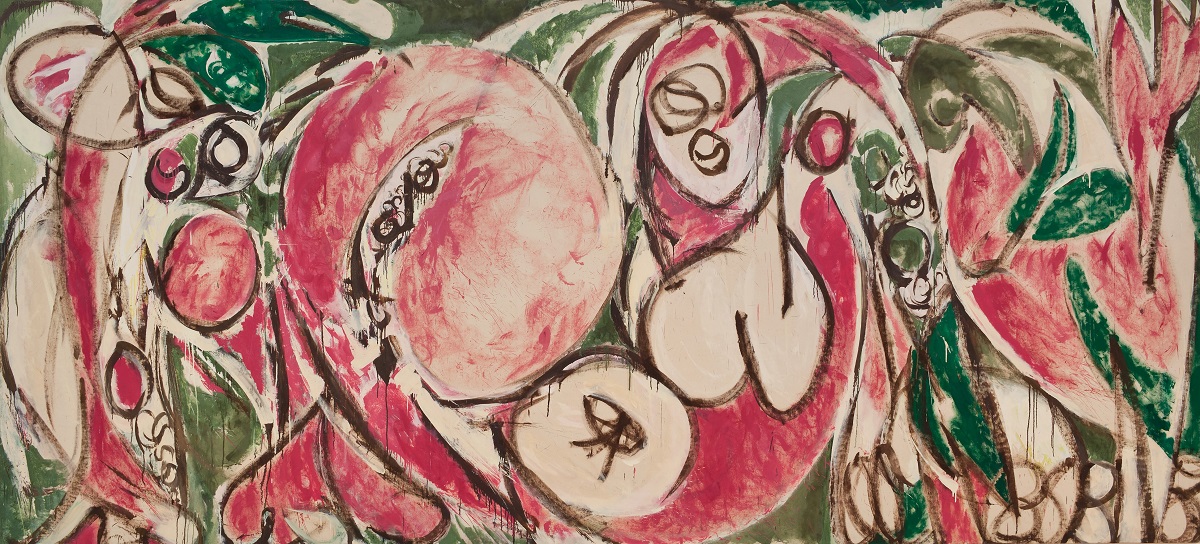 Lee Krasner (American, 1908–1984), The Seasons, 1957. Oil and house paint on canvas, 92 3/4 in. × 16 ft. 11 7/8 in. (235.6 × 517.8 cm). Whitney Museum of American Art, New York, NY. Purchase with funds from Frances and Sydney Lewis by exchange, the Mrs. Percy Uris Purchase Fund and the Painting and Sculpture Committee.
It matters that Pollock’s signature paintings are abstract rather than abstractions. They do not require a prior image whose transformation accounts for their forms; what appears comes into being through the process of their making. Likewise, Krasner’s characteristic organizations through fracture and collage need not be understood as derived from an underlying representation; they are abstract images. Yet their pictorial aims and means are not equivalent. Abstract is a category, not a singularity. To identify two paintings as abstract tells us little about the coherence they seek, the authority they assign, or what each sets forth.
Between 1947 and 1950, Pollock’s poured and dripped, all-over paintings advance a proposition that changes the terms by which his work, and increasingly that of others, will be understood. The grid ceases to be an explicit scaffold and becomes an underlying condition of distribution. Line no longer describes an image but generates a field in which incidents acquire significance through their relation to one another. This achievement supplies a criterion against which Pollock’s subsequent work—and too often Krasner’s—is measured. What begins as one painter’s departure is converted into a standard. The breakthrough itself thus becomes the measure of artistic consequence, in a narrative that makes rupture the condition of significance.
Working with the canvas on the ground, Pollock made gravity and the lateral extension of the surface integral to the organization of the painting. All-overness establishes a distributed continuity in which the grid operates without appearing as a lattice. The poured line differentiates the field without overturning this premise. Density, interval, direction, and overlap produce local events, but their force depends on their participation in a larger order. What appears to dissolve structure becomes a means of sustaining it. Differences contribute to a continuity that cannot be reduced to an arrangement of discrete parts.
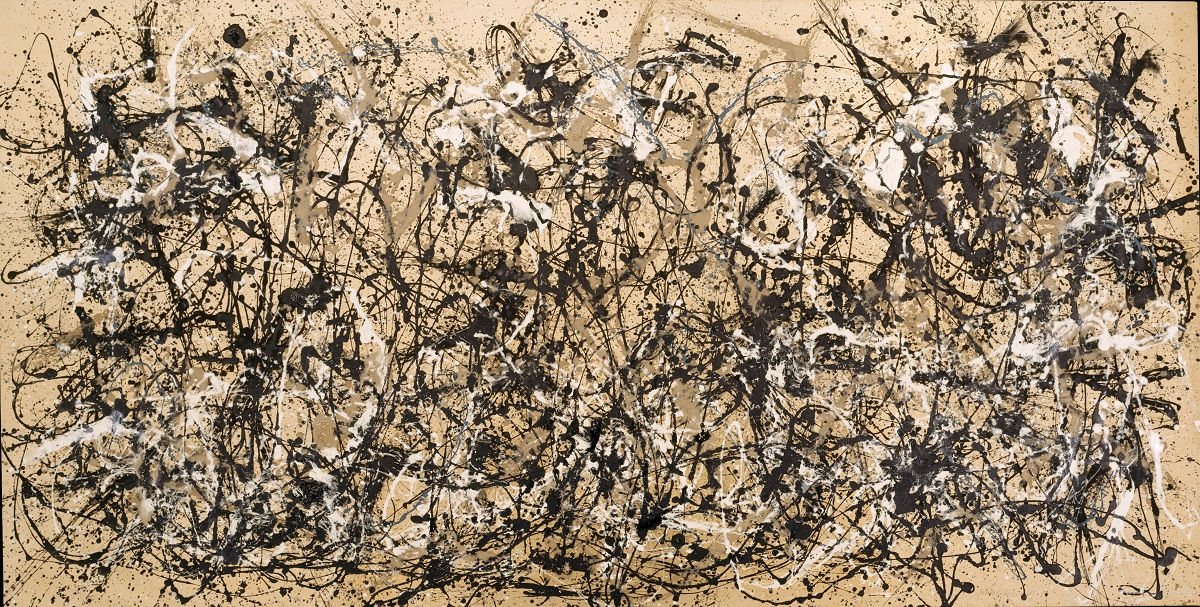 Jackson Pollock (American, 1912–1956), Autumn Rhythm: Number 30, 1950. Oil-modified alkyd resin on canvas, 8 ft. 9 in. × 17 ft. 3 in. (266.7 × 525.8 cm). The Metropolitan Museum of Art, New York, George A. Hearn Fund, 1957. © 2026 Pollock-Krasner Foundation / Artists Rights Society (ARS), New York.
A skein of paint may arrest attention, but its significance is not confined to the incident; attention returns to the field through which it becomes consequential. The eye follows a line, loses it, discovers another, and encounters an organization that cannot be taken in all at once. Too little differentiation would leave the surface inert; too many events would allow an incident to detach itself from the field and become a figure. Pollock’s coherence is produced through this relation, in which movement is neither incidental nor opposed to organization. It is through movement that the organization becomes perceptible.
Fracture establishes another criterion in Krasner’s work. Her fragments possess edges and orientations through which they enter into relations within the painting. Where Pollock’s all-overness makes distinct incidents continuous, Krasner’s cutting and recombining make continuity something constructed through relations of parts to whole. What would interrupt one organization can become the means of organizing another. Krasner’s whole does not entirely absorb the divisions through which it has been made; its organization remains legible as something constructed, rather than appearing an inevitable condition of the painting’s making. Her collages make this difference apparent. A fragment cut from an earlier painting or drawing no longer performs the work it performed before. Its origin persists but does not determine its function. Krasner herself acknowledged Matisse’s influence, particularly that of his late cut-outs. What matters here is not simply the resemblance between their uses of cut forms, but how cutting and repositioning alter the relation of a form to the whole in which it appears. Cutting separates the mark from the continuity of its production; repositioning makes it answerable to another order. A prior act becomes material for a subsequent determination.
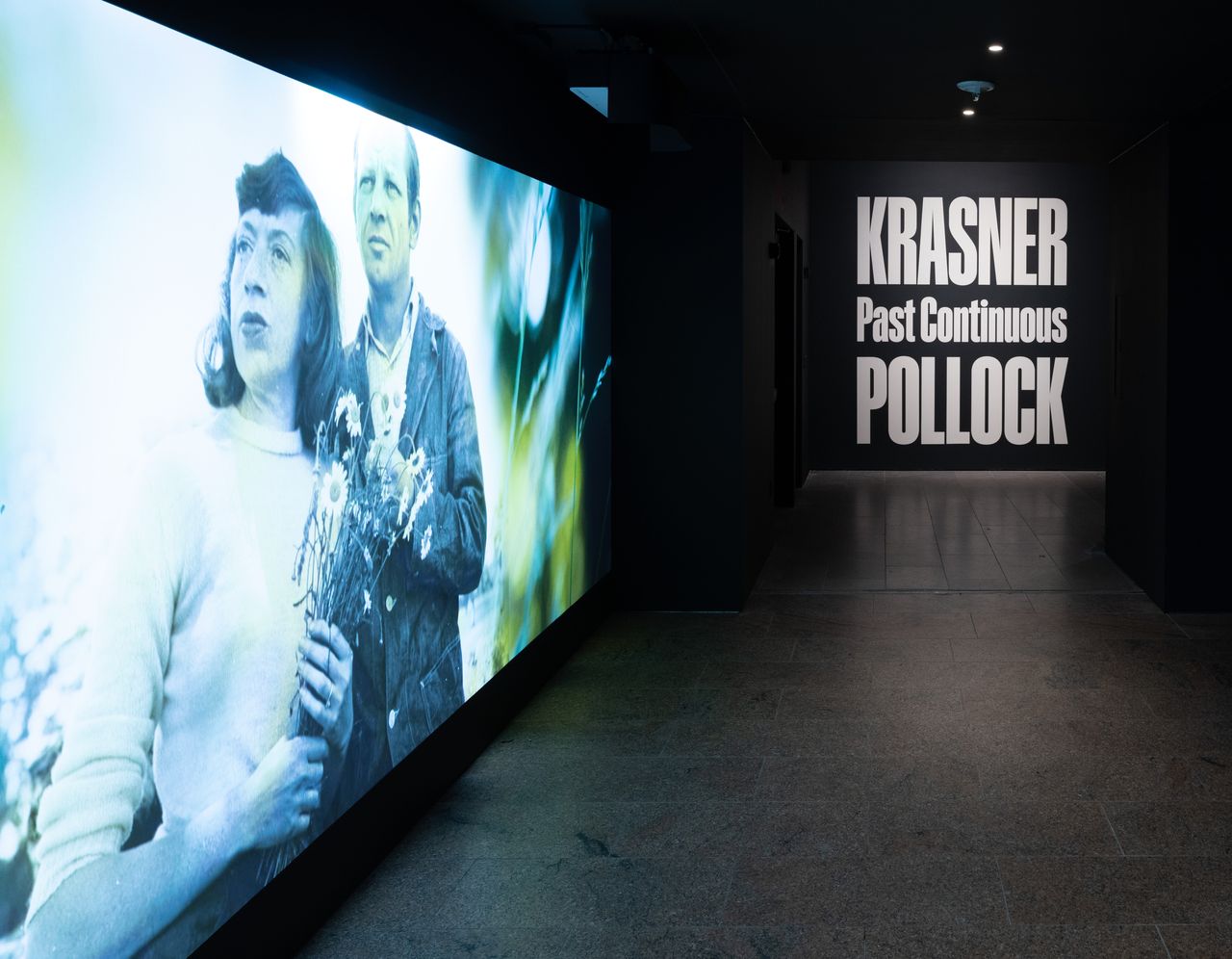 Installation view of Krasner and Pollock: Past Continuous, on view at The Metropolitan Museum of Art from October 4, 2026–January 31, 2027. Photo by Anna-Marie Kellen; courtesy of The Met.
This difference in how forms are brought into relation also bears on how the two practices are understood. Seen in the context of Surrealism, Pollock’s all-over fields need not be treated as the culmination of a purely formalist project; Krasner, by contrast, can best be understood as primarily a formalist, provided formalism is not taken to exclude the associative. Her paintings locate authority in relations rather than in the presumed authenticity of an idealized, self-referential form. The gestural can be present without functioning as autograph or as merely self-referential. A sweeping mark matters for what it does pictorially, not because it certifies the artist’s presence. Revision is not merely preparatory activity that the finished painting conceals; it can remain constitutive. Krasner’s work registers an assertion and its reconsideration without requiring either to cancel or take precedence over the other. What emerges, then, are two different ways of organizing the relation between form, gesture, and association.
There is also a difference of approach here. Pollock is the adventurer on a grand scale; Krasner proceeds more methodically. Pollock tests how far a pictorial proposition can extend before losing its capacity to hold together; Krasner tests what different relations permit and what changing them makes possible. Where he risks intelligibility, she repeatedly reopens its construction. This does not make him uncalculated or her cautious: his adventure requires judgment, and her method can produce radical departures. They differ in how risk enters the work, not in whether either undertakes it.
Nor can these differences be assigned to gender. Continuity is not masculine, fracture not feminine; expansive ambition and methodical inquiry are not complementary sexual attributes. Gender conditions the reception and recognition of the work, but it cannot substitute for an account of the criteria through which the paintings operate. To assign expressive authority to Pollock and deliberation to Krasner would be to explain their work through identities at the very point where its organization demands examination. To reduce their differences to temperament would be to lose the decisions through which they become pictorial rather than merely personal.
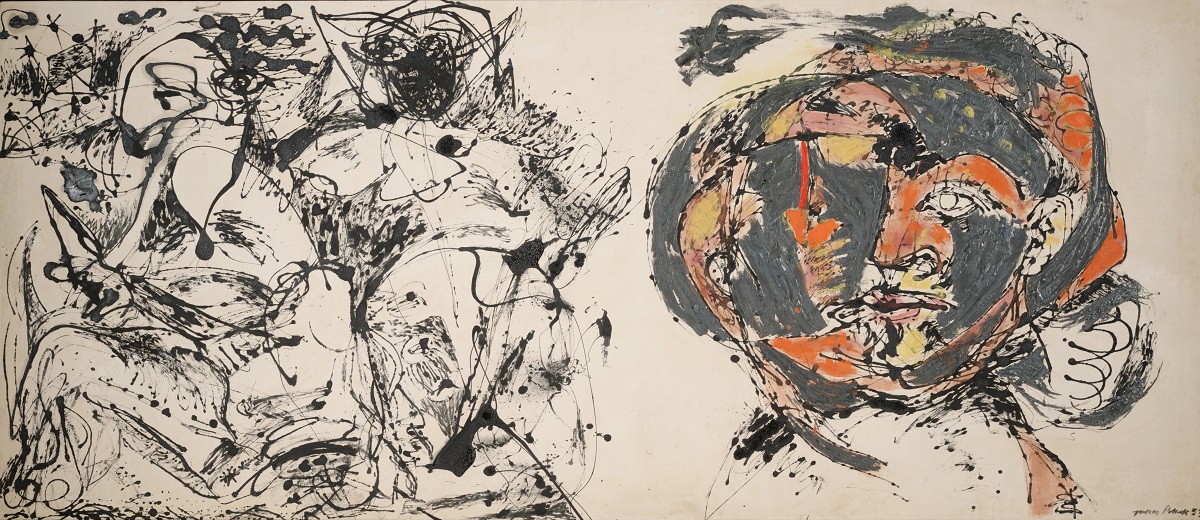 Jackson Pollock (American, 1912–1956), Portrait and a Dream, 1953. Oil and enamel on canvas, 58 1/2 in. × 11 ft. 2 3/4 in. (148.6 × 342.3 cm). Dallas Museum of Art, gift of Mr. and Mrs. Algur H. Meadows and the Meadows Foundation. © The Pollock-Krasner Foundation / Artists Rights Society (ARS), New York.
Any account that makes the all-over field Pollock’s final position is complicated by his later works in which, from 1951 until his death in 1956, he had reintroduced imagery into his work. In Portrait and a Dream (1953–54), the juxtaposition of a head and an abstract configuration does not reconcile the two into a single pictorial order except by process. Imagery is not simply evidence of failure; it becomes an unresolved possibility within a practice whose public identity had seemingly in mid-career been secured. The difficulty was that a departure from the position through which Pollock had become recognizable could be understood as a departure from himself—the predicament of an innovation reified as a style.
This is also why all-overness, provisionally a common denominator within Abstract Expressionism, cannot serve as the criterion of the success or failure of their work. Pollock distributes difference across a continuity; Krasner makes the consequences of division the basis of another continuity. Here are two differing projects assigned the same name. That designation brings them together without establishing that they undertake the same task. Though these painters emerge from a common pool, their departures do not carry them toward a common destination. Pollock’s breakthrough makes their divergence conspicuous; it does not make his criteria hers. The pairing in Krasner and Pollock: Past Continuous allows this divergence to be followed through the work itself. What initially appears as common ground becomes the means through which their different aesthetics and intentions come into view. WM

Saul Ostrow
Saul Ostrow is a critic and curator whose writings have been published in the United States and Europe. Since 1985, he has curated more than 70 exhibitions, most recently Building Models: The Shape of Painting at the Milton Resnick and Pat Passlof Foundation in New York. He a contributor to BOMB, The Brooklyn Rail, and Tussle.
view all articles from this author