Whitehot Magazine
September 2026
"The Best Art In The World"
"The Best Art In The World"
September 2026
Container: Two Artists, One Space
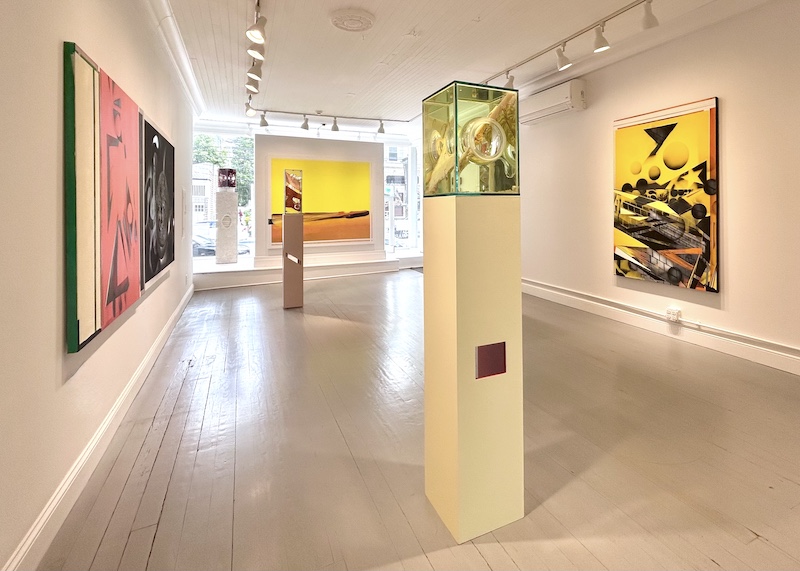 Installation view, Container, Marquee Projects. Courtesy Marquee Projects.
By PAUL LASTER, June 30, 2026
In 2022, gallerist and artist Mark Van Wagner hosted a group show at his Bellport gallery featuring Nola Zirin's paintings and took part in a group show swap with a Manhattan gallery, where he discovered Jennifer Sirey's sculptures. Both exhibitions left a lasting impression on him, and he couldn't stop thinking about the two artists, which eventually led to the “Container” exhibition, on view at Marquee Projects through July 5, showcasing five exceptional works by each artist.
In literature, the term "container" is an important metaphor that depicts a poem as a vessel that holds, shapes, and arranges intricate emotions, ideas, or fragmented experiences. In this exhibition, the container is the gallerist’s mind, the gallery space, and the realm of each artwork on view. Selecting works that explore geometric abstraction and the tension between the exposed and the hidden, Van Wagner paired the pieces in dialogue with one another so that the ideas, emotions, and fragmented experiences conveyed by the artists could coalesce into a gesamtkunstwerk, or complete work of art, for the viewer.
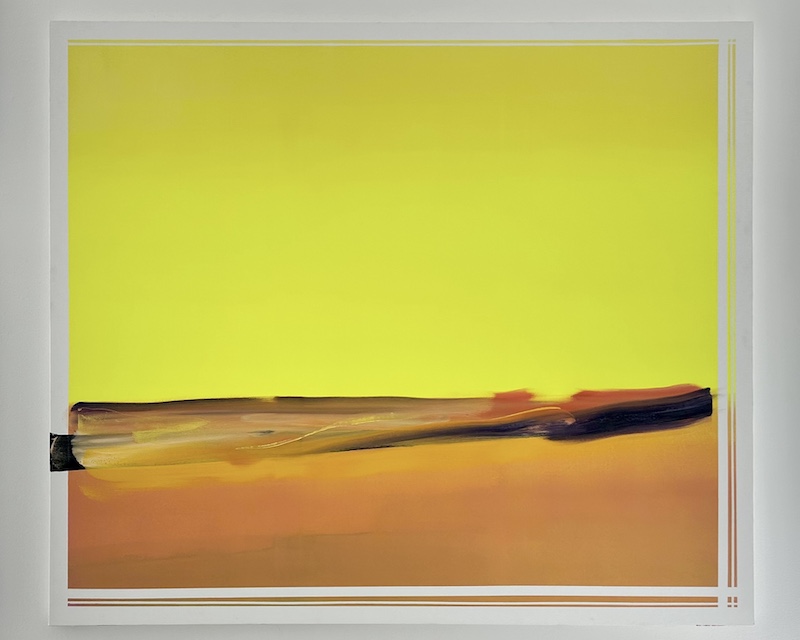 Nola Zirin, Divine Light, 2024. Oil and acrylic on canvas, 60 x 70 inches. Courtesy the artist and Marquee Projects.
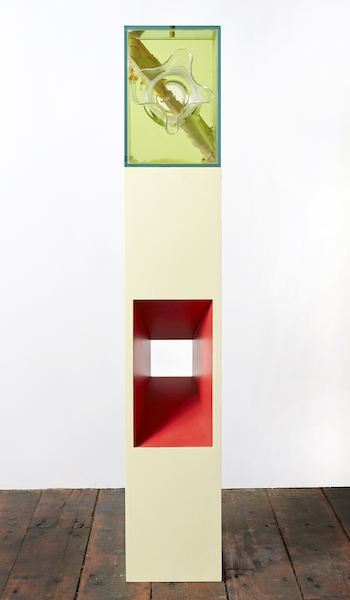 Jennifer Sirey, Swiile, 2019. Glass, blown glass object, slumped glass object, wax, bacteria, vinegar, water, monofilament, food coloring, painted MDF, 62.5 x 11 x 11.5 inches. Courtesy the artist and Marquee Projects.
A lifelong abstract artist whose work is in the permanent collections of the Metropolitan Museum of Art, the Museum of Modern Art, the Brooklyn Museum, the Phillips Collection, and the Hudson River Museum, Zirin investigates the limits of space, light, and visual perception. Her creative process is deeply influenced by synesthesia—a sensory condition in which she sees color when she hears a sound—allowing her to transfer the rhythms of jazz music and the energy of her urban upbringing directly onto her canvases. Her work often examines how color fields influence the perception of time, making viewers feel as if they move more slowly or faster through celestial-inspired illusions.
Working primarily with oil, acrylic, and spray paint on canvas and wood panels, the Oyster Bay-based artist constructs her improvisational images by layering non-traditional textures, including stenciling, glitter, flocking, and collage. She inventively employs a vocabulary of primary shapes, floating orbs, rigid architecture, and sharp borders to craft asymmetrical spatial compositions. Her process is intuitive, without preliminary sketches, allowing each brushstroke to lead to the next, then refining her rhythmic shapes with tape or masking. Having trained with master printers such as Bob Blackburn, she approaches her work like a printmaker, using dense, multi-layered registration, tonal compositions, and ink-like drips.
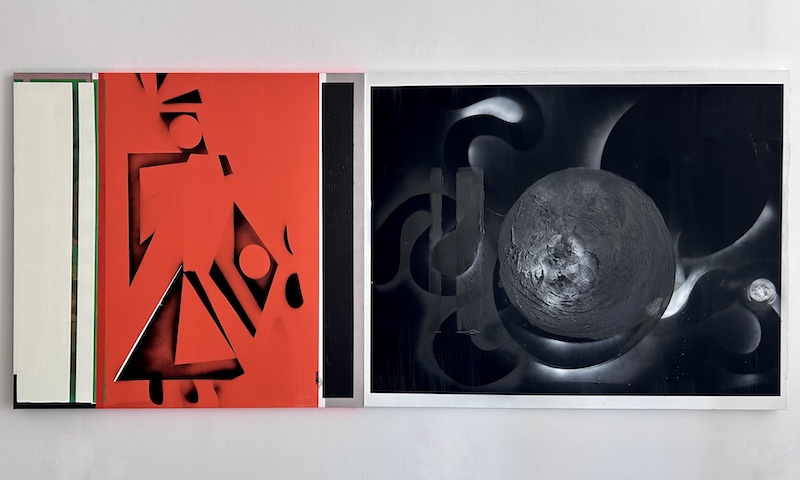 Nola Zirin, Hecate, 2025. Oil, acrylic and acrylic spray on canvas, 54 x 110 inches. Courtesy the artist and Marquee Projects.
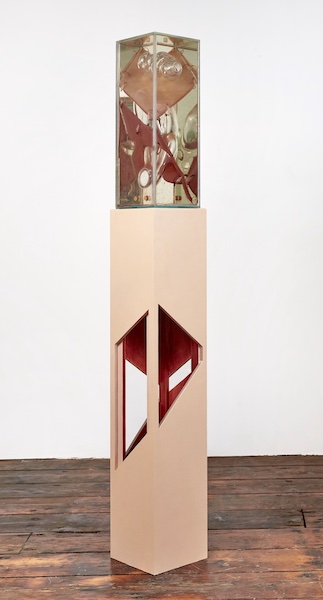 Jennifer Sirey, Three Holes, 2013-2020. Glass, bacteria, blown glass objects, water, vinegar, monofilament, painted wood, 66 x 8.5 x 8.5 inches. Courtesy the artist and Marquee Projects.
Sublimely matched in this show, Sirey is a Brooklyn-based mixed-media sculptor, a 2024 Guggenheim Fellow, a 2021 Hopper Prize winner, and a current artist-in-residence at the Sharpe-Walentas Studio Program in Brooklyn. She develops what she calls living sculptures through collaborations with live bacterial cultures. Her work merges art, biology, and architecture, using a fermentation culture called Acetobacter, or the "mother of vinegar," to cultivate flesh-like shapes within abstract, structured settings.
Creating captivating custom glass tanks and vitrines, she embeds geometric armatures, blown glass, monofilament rings, and found objects within them. She then fills the tanks with a mixture of wine and her bacterial mother culture. By tilting the tanks at precise angles, she shapes the liquid surface into defined geometric boundaries. The bacteria grow along these lines, forming dense, leathery, or translucent planes. After achieving the desired structure, she uses vinegar to preserve and stabilize the environment. The living microbes enter a state of hibernation, remaining permanently suspended within her liquid-filled monoliths.
Sirey characterizes her imaginative aesthetic as a tension between the rigid geometric containers and the raw, organic appearance of the materials growing within them. Besides the bio-matter, she casts molten wax onto water surfaces, forming textured, contorted planes that become part of the tanks. The bases supporting her tanks are themselves highly stylized artworks, constructed intuitively from materials such as wood scraps, cement, fabric, and metal, reflecting the raw energy contained within the tanks.
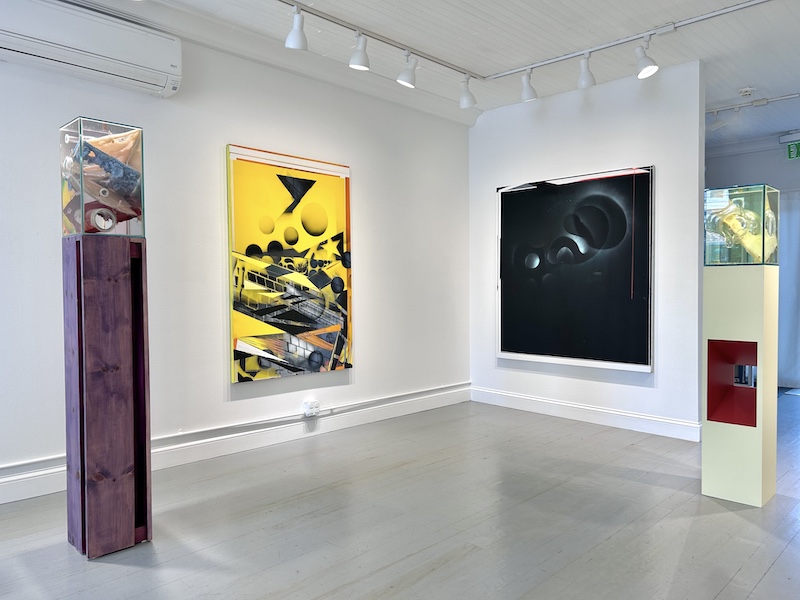 Installation view, Container, Marquee Projects.Courtesy Marquee Projects.
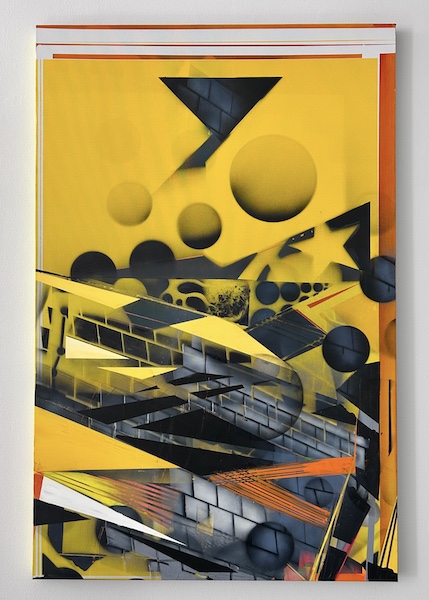 Nola Zirin, On the Way to Coney Island, 2025. Oil and acrylic on canvas, 60 x 39 inches. Courtesy the artist and Marquee Projects.
Zirin’s painterly process is driven by continuous experimentation, with each work shaping the next. Paintings like Divine Light fuse landscape with abstraction, as a vibrant field of bright yellow hues is overlaid with umber tones and wet-on-wet brushwork, while her diptych Hecate pairs a geometrical figure assembled from abstract shapes on a graphic ground with a black globe rhythmically rotating through blackened realms. Her spontaneous actions trigger reactions, gradually building her picture plane. She uses spray-painted stencils over brushwork and sands colors to soften them and highlight contrasting textures. Her richly layered On the Way to Coney Island composition recalls her youthful train rides to the waterfront amusement park, with its buildup of vibrant colors and forms capturing the sense of motion and excitement. By assembling panels at varying depths, she creates sculptural structures and seamlessly combines media and marks to produce a persuasive, diverse range of images.
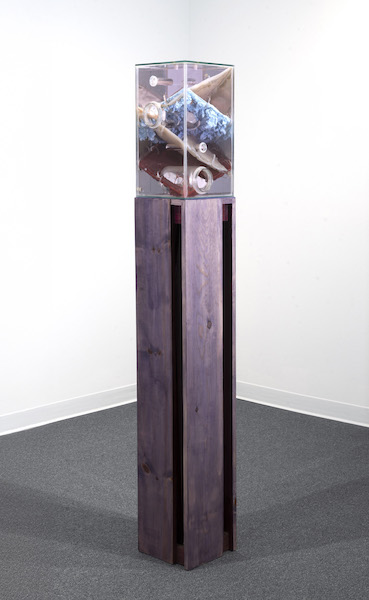 Jennifer Sirey, Butterfly Pea, 2024. Glass, wax, butterfly pea flower tea kombucha SCOBY, jars, test tubes, vinegar, monofilament, wood. 68 x 10 x 10 inches. Courtesy the artist and Marquee Projects.
Developed slowly over weeks and months, Sirey’s sculptures involve the careful interplay of breeding and assemblage. Before turning to art, Sirey studied science and architecture; she now integrates all three fields into her sculptural practice, creating works that are both body-like and sci-fi dioramas. Pieces like Swille, with its intestinal-like entanglement of bacteria and wax, have blown-glass portals attached to cutout holes, allowing spectators to peer into them with their eyes and penetrate them with their fingers, as the tank rests atop a skyscraper-like pedestal with a blood-red rectangular opening. Her Three Holes piece employs blown-glass vessels attached to cut holes in the tank's interior glass walls to probe the wine-stained angular planes, which are repeated as cutouts in the wooden plinth; but her Butterfly Pea sculpture juxtaposes shifting membranes of Butterfly Pea Flower kombucha and blue bubbly wax with penetrating glass jars and test tubes to create a purple-plinthed sculpture that would be right at home on the U.S.S. Enterprise.
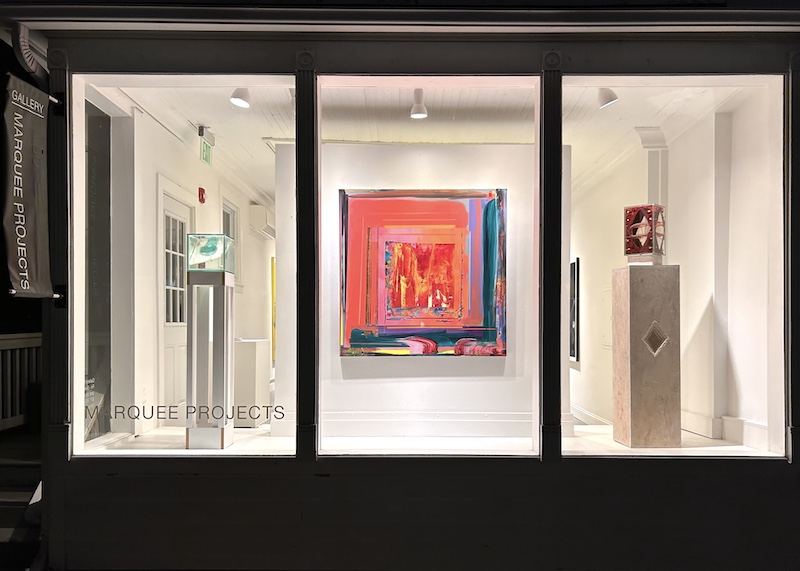 Installation view, Container, Marquee Projects. Courtesy Marquee Projects.
Both artists employ a basic language of geometry, yet their media, methods, and materials yield entirely distinct bodies of work. Sirey investigates "living architecture" through three-dimensional, process-based sculptures, while Zirin creates two-dimensional, rhythm-inspired "urban abstractions" on canvas. In their collaborative exhibition, their art forms a dialogue of opposites around a shared underlying theme. Sirey employs clear, literal glass containers to reveal evolving biological forms, whereas Zirin uses painted, symbolic containers that layer, conceal, and safeguard her spiritual and psychological geometries. The pairing of these artists and their artworks is a perfect match. WM

Paul Laster
Paul Laster is a writer, editor, curator, artist and lecturer. He’s a contributing editor at ArtAsiaPacific and Whitehot Magazine of Contemporary Art and writer for Time Out New York, Harper’s Bazaar Arabia, Galerie Magazine, Sculpture, Art & Object, Cultured, Architectural Digest, Garage, Surface, Ocula, Observer, ArtPulse, Conceptual Fine Arts and Glasstire. He was the founding editor of Artkrush, started The Daily Beast’s art section, and was art editor of Russell Simmons’ OneWorld Magazine, as well as a curator at P.S.1 Contemporary Art Center, now MoMA PS1.
view all articles from this author