Whitehot Magazine
October 2026
"The Best Art In The World"
"The Best Art In The World"
October 2026
Exhibition Review and Studio Visit Feature: Contemporary Color Field Painter Vanessa Johansson
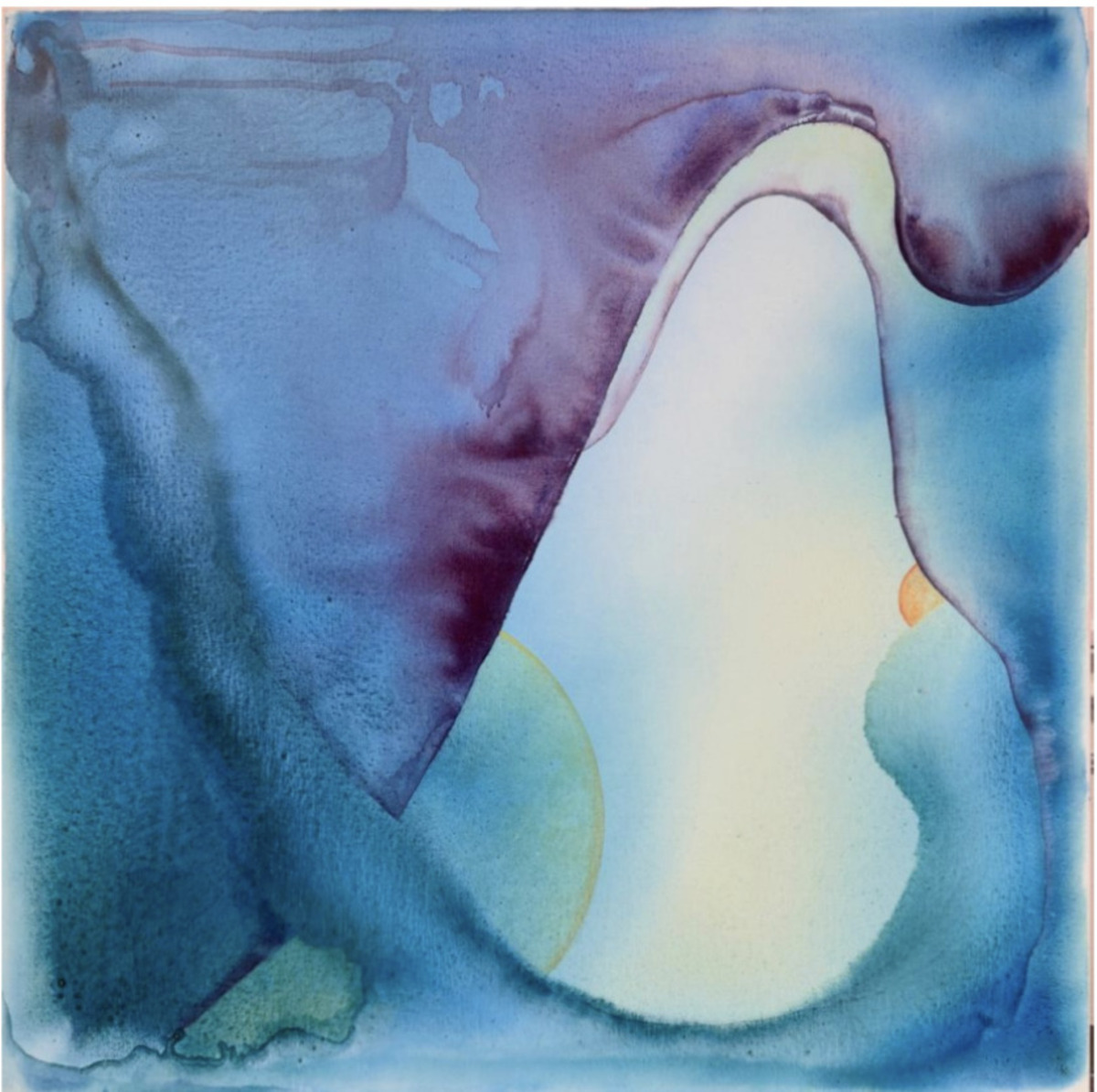 Vanessa Johansson, Encounter, 2025, acrylic on canvas. 36 x 36 inches. Image courtesy of the artist.
By LIAM OTERO April 5th, 2026
New York native Vanessa Johansson emerged with her very recent debut solo exhibition that was held in the Sky Garden Penthouse, 200 East 20th Street in Gramercy Park (just east of The National Arts Club). Johansson is a classic example of an abstract painter whose visual language and style can be spiritually likened to that of the giants of mid-20th Century abstraction, with Color Field being the closest connection. Let it be known that Johansson is not producing painterly simulacra of what came before, but instead is forging her own artistic path fueled by an openness of heart and an intuitive sophistication.
There is something freeing about engaging with art when removed from the context of the gallery or the museum, as Johansson’s paintings were a delightful burst of color and light in the auspices of a $7.5 million penthouse with beautifully scenic views of Manhattan. Her exhibition was curated by Jenny Mushkin Goldman of Agency Esta, a public relations and creative marketing firm that frequently produces projects involving the intersections between luxury real estate and art.
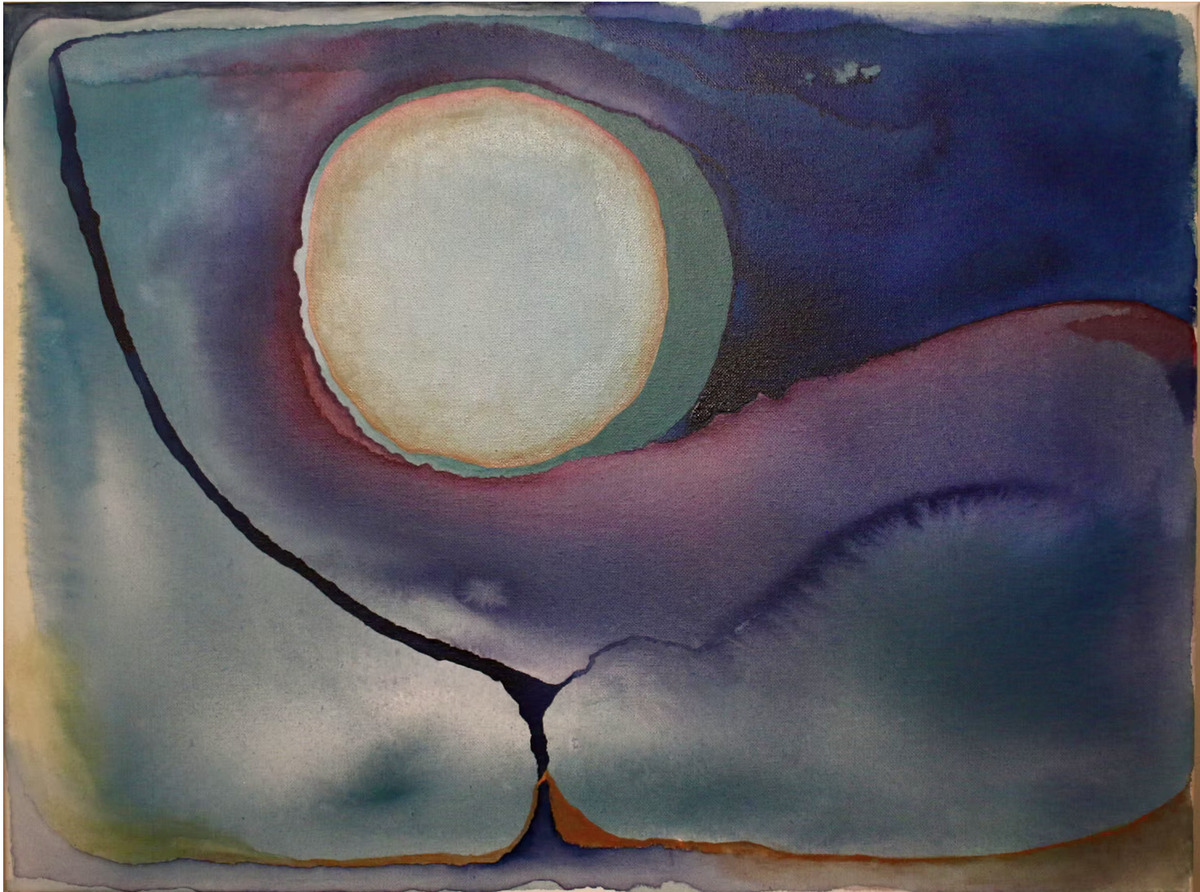 Vanessa Johansson, Beginnings, 2025, acrylic on canvas. 24 x 18 inches. Image courtesy of the artist.
When faced with Johansson’s paintings, you may initially find yourself thinking these are watercolor paintings with their transparent, liquidy flows of paint that bleed into multiple layers or create pooling effects. These are not watercolors, but acrylic on canvas paintings. Her enchanting compositions are imbibed with a feeling of careful motion that can aptly be described as seeping, flowing, or shifting across space. Sharpness and angularity are out of the question, for curvaceous forms and buoyancy are the predominating characteristics found here. The complementarity of these visual elements evokes scenes of calm and meditation whose appearances could be evocative of a place, an idea, or purely an expanse of color.
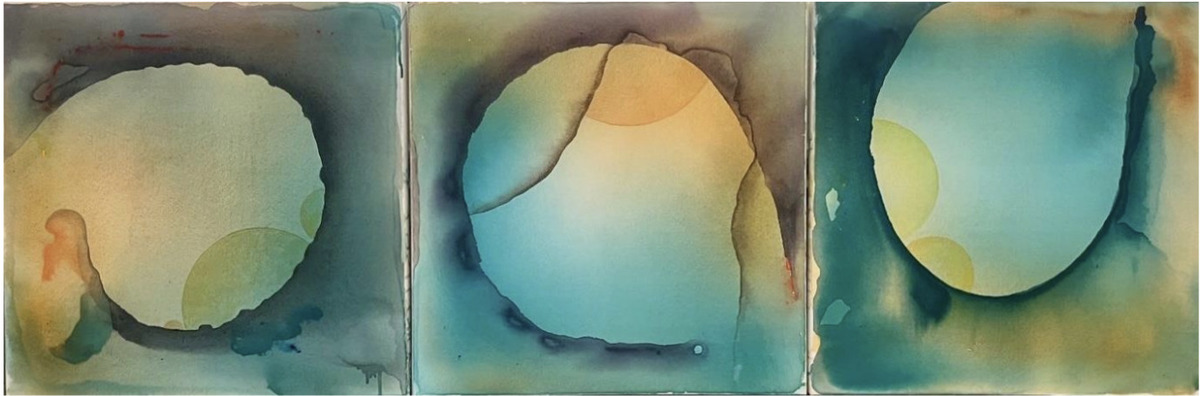 Vanessa Johansson, Windows, 2025, acrylic on canvas. 24 x 24 inches (each) / 24 x 72 inches (total). Image courtesy of the artist.
Frank Stella’s “What you see is what you see” is a perceptual philosophy that can be applied to studying Johansson’s work. My mind found landscape-like elements to certain images. The aquatic-hued triptych Windows (2025) felt like an impression of a beach cove seen from a bird’s eye view. But since it is a triptych, the changed directions of the C-shaped stroke can just as validly be accepted as a tumble or rotation of color seen in a three-part sequence.
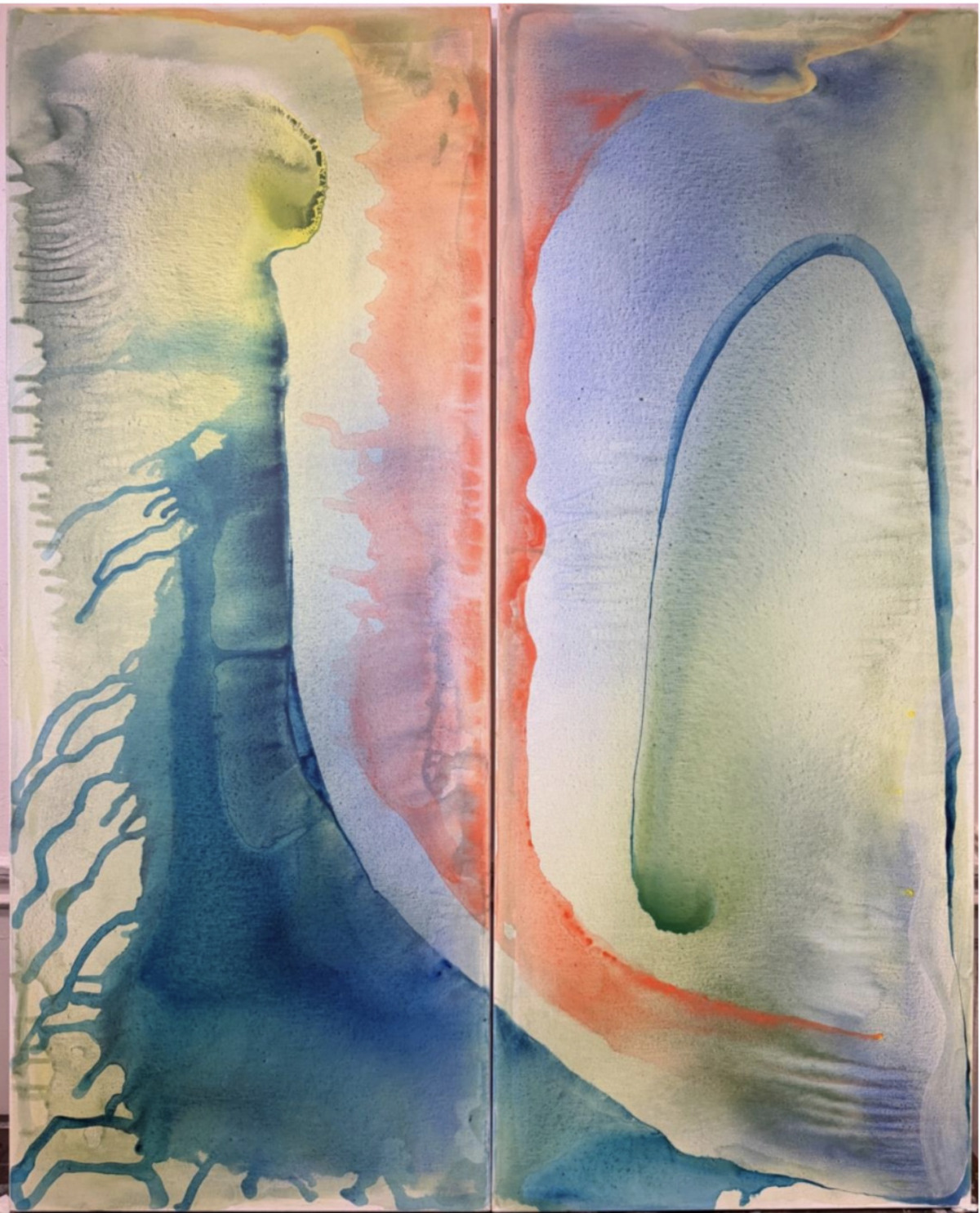 Vanessa Johansson, Flow State, 2025, acrylic on canvas. 60 x 24 inches (each) / 60 x 48 inches (total). Image courtesy of the artist.
The verticality of the diptych Flow State (2025) is a magical handling of paint to produce an awesome explosion of color that feels closer to a fireworks display. Just look at the wide swath of blue that flows downward and is framed directly above and alongside by an equally energetic thrust of orange, while stage right is occupied with an arched stroke of blue as if frozen mid-motion.
A mesmerization of perspective also pervades most of these paintings as one will notice the recurring appearance of circular or orbital shapes that poke in and out amidst the painterly flows. In Opportunity (2025), a reddish-orange moon-like figure is partially concealed by a veiling of smoky blues, while in the diptych Concealer (2025), a blue circular mass is clearly visible but also divided through in the top third of the circle by the cut-off point of the upper half of the diptych. The result of the latter painting simultaneously operates like a cavernous view out into a dawn-hued sky or even be an abstract take on painterly reflectiveness.
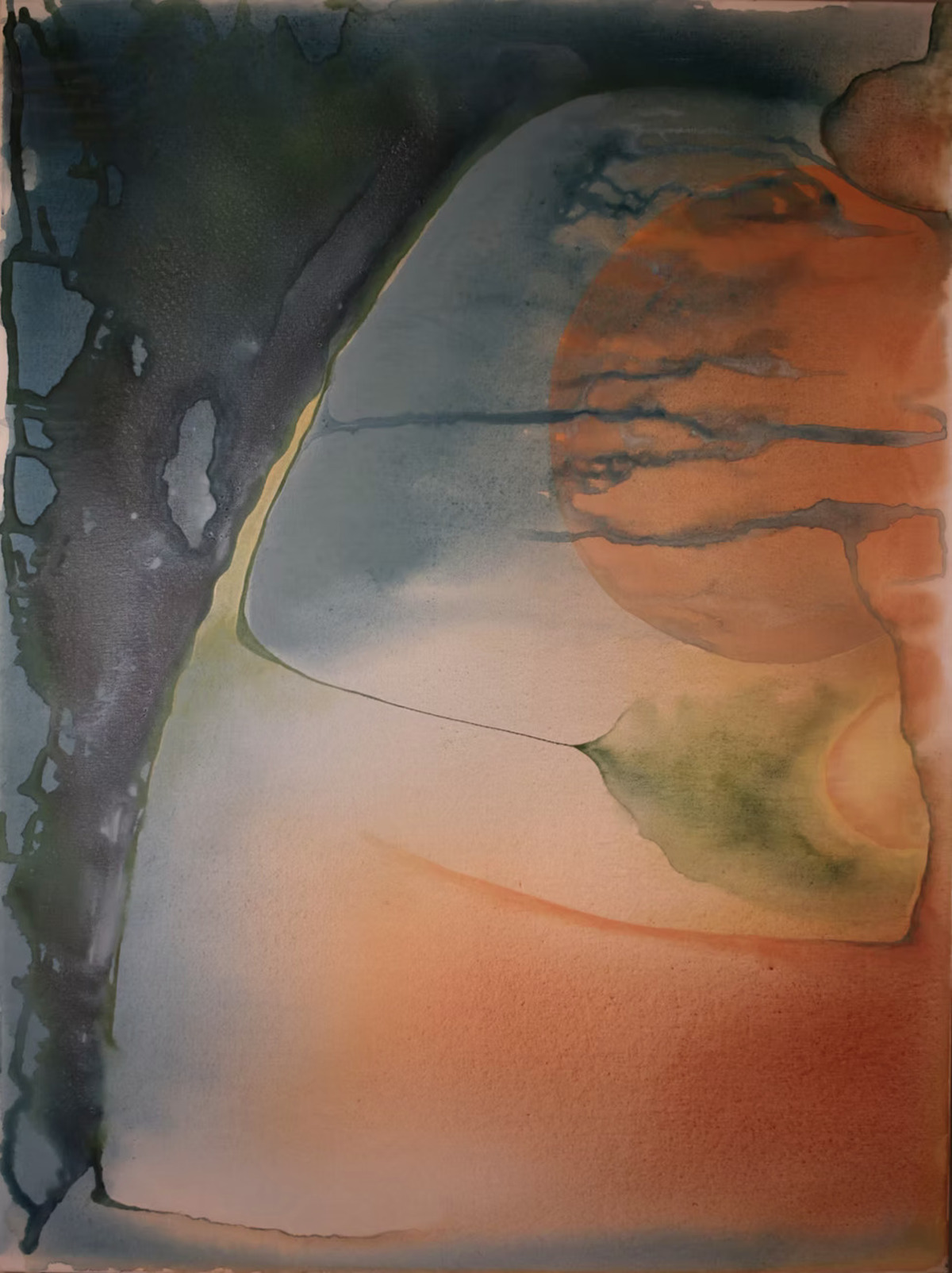 Vanessa Johansson, Opportunity, 2025, acrylic on canvas. 40 x 30 inches. Image courtesy of the artist.
Much is to be gained from seeing Johansson’s paintings, but since these were exhibited in a domestic setting, there is also the added benefit of recognizing how such paintings can live within one’s home. Even as I write this piece and revisit my photos of Johansson’s paintings, I perpetually discover new details, colors, or movements. This right here is an excellent example of active abstraction - the work continues to entice the eye even after you’ve studied these paintings on multiple occasions and at great length.
Additionally, Johansson will be participating in a three person group exhibition, Women and Abstraction, at Pierre Cornette de Saint Cyr (in partnership with Barter Art Advisory) in Paris this June.
Studio Visit Highlight
When not painting at the Art Students League (where she obtained her formal training), Johansson works from her cozy studio in the middle of Tudor City. I had the benefit of getting a behind the scenes glimpse into her creative mind by observing both works-in-progress (WIP) and already completed paintings, an experience that only furthered my appreciation for Johansson’s painterly language in tandem with her stellar show.
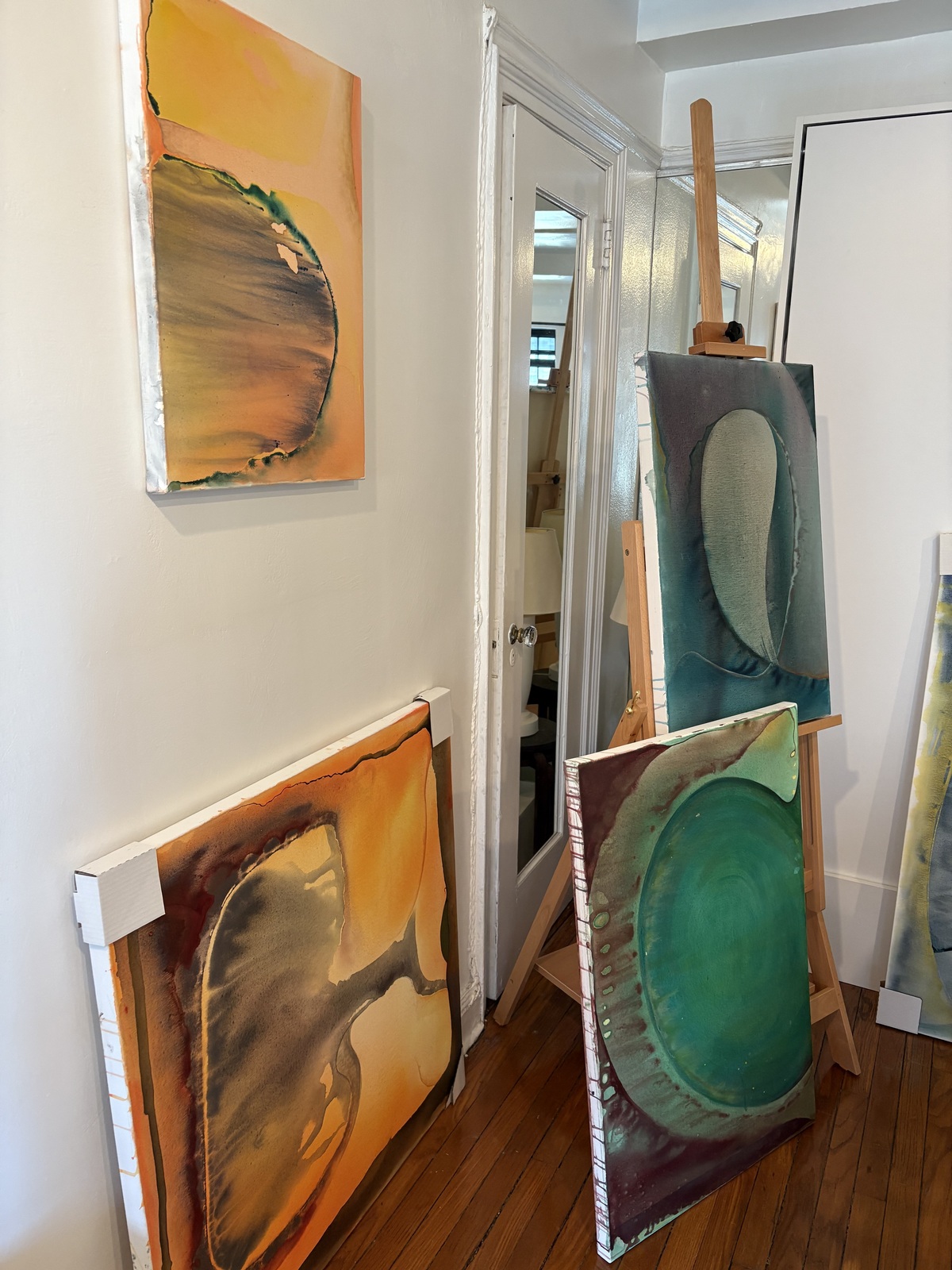 Several of Vanessa Johansson's paintings as seen from her studio in Tudor City.
Considering the pools of acrylic paint that appear to have been pulled by gravity within her compositions, I like to ask abstract painters how they position their canvases when creating. Janet Sobel and Jackson Pollock often worked with the drip technique, while someone like Helen Frankenthaler had her soak-stain method, and then reams of other painters opt for the more conventional painting from the easel. Johansson is more open to applying multiple ways of going about her creative process. She has her easel, but she also spends much time resting the canvas (or canvases for the diptychs and triptychs) on a table. Even here, she is not working from one orientation, but a 360-degree outlook on how the colors and paints mesh. There’s even the occasional tipping or gentle movement of the canvas to get certain paints to change direction or simply even to test out a potential gesture.
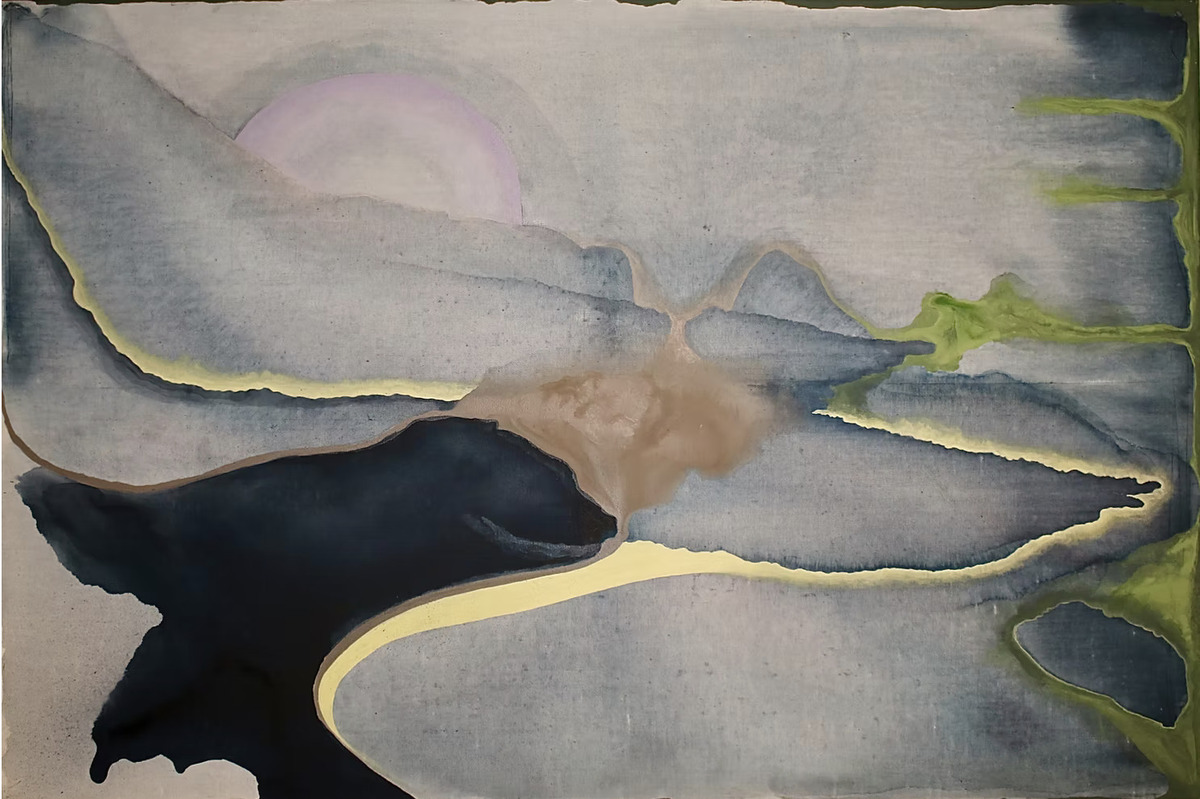 Vanessa Johansson, Escape, 2025, acrylic on canvas. 36 x 24 inches. Image courtesy of the artist.
Acrylic dries faster than oil paint, but something I appreciate about Johansson’s method is that she sometimes treats the acrylic process akin to oil. What I mean here is that she does not rush anything or even presume that once the paint has hit the canvas and settled into its surface that the process is finito. Instead, there is ample room in which Johansson pauses and takes a reprieve from certain paintings before returning to them for further work / reworking. An improvisatory approach to see where the mind and the paintbrush wanders has clearly done wonders for the work she has undertaken thus far.
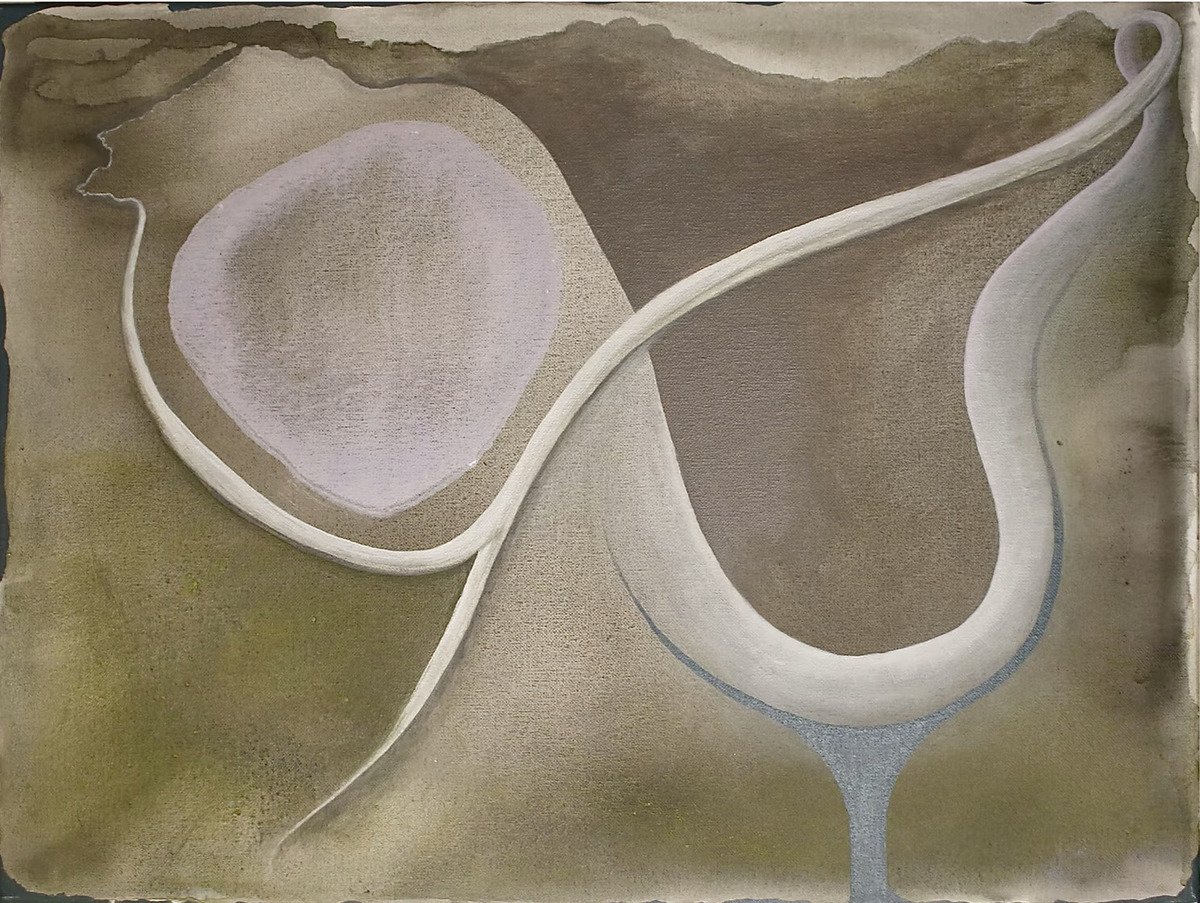 Vanessa Johansson, Lovely Bones, 2025, acrylic on canvas. 18 x 24 inches. Image courtesy of the artist.
Before pursuing painting, Johansson worked as a professional theater and voice actress for years (she is also the sister of actress Scarlett Johansson), and much of her work is affiliated with the Scandinavian American Theater Company. Whenever I meet with an artist, I enjoy learning about from whence that need to create originated. The artistic mindset runs very deep in the Johansson family blood. She grew up in an atmosphere where arts appreciation was encouraged and never mind the fact that this was in New York. Her father, Karsten Olaf Johansson, is an accomplished architect originally from Copenhagen, Denmark. Johansson’s grandfather, Ejner, was an art historian, filmmaker, and writer who published extensively on Danish Art History, including books on the painter Richard Mortensen and the sculptor Robert Jacobsen.
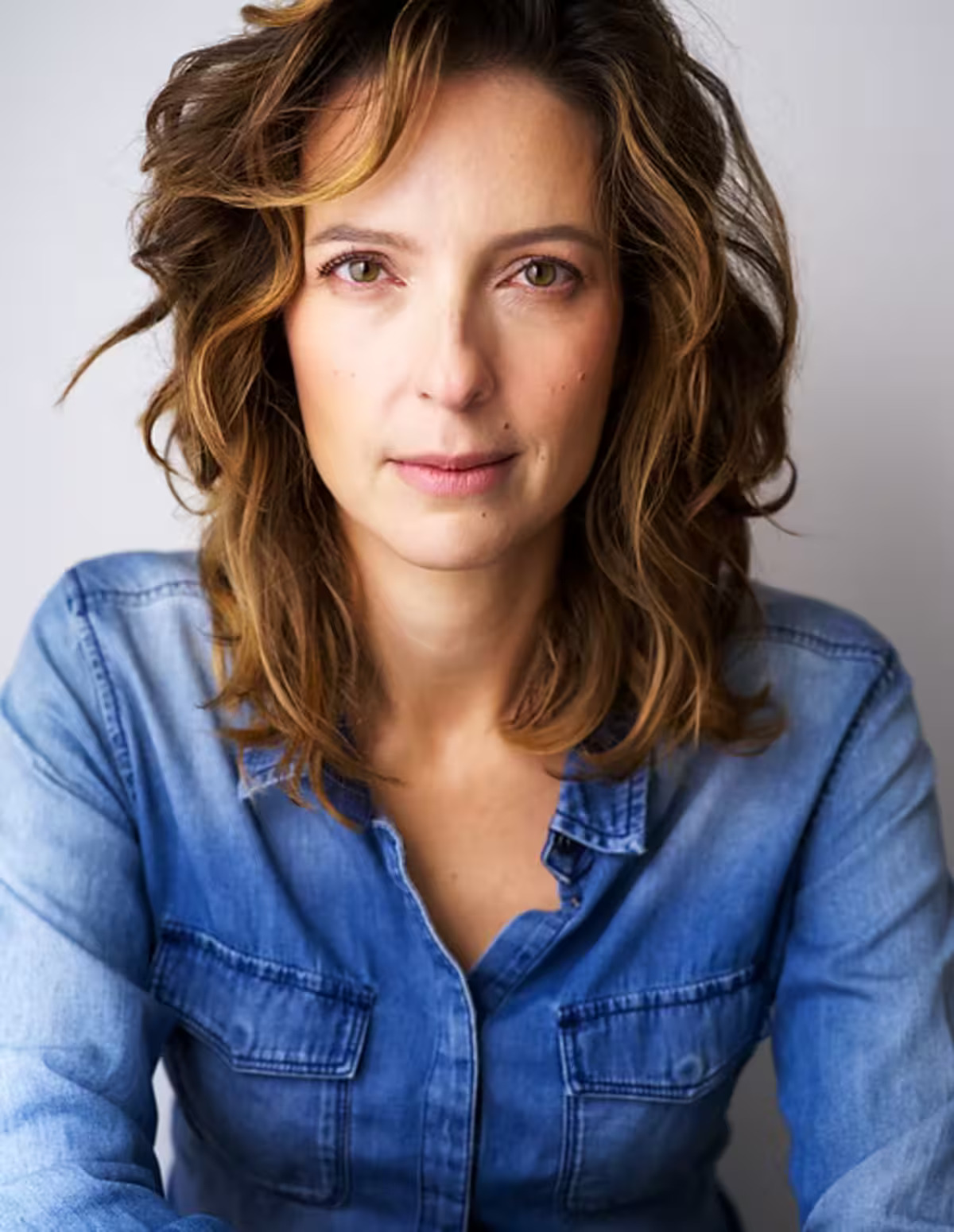 Vanessa Johansson. Image from the artist's website
Johansson and I had a fabulous conversation on her working methods, artistic motivations, and our favorite painters. Her sincerity in speaking so openly about her work and the clear excitement she exudes for this new trajectory of her career was something I especially valued and can only look forward to seeing what new strides Johansson will make in Contemporary Color Field painting. WM

Liam Otero
Liam Otero is a freelance art writer in NYC. He was recently named New York Editor of Whitehot Magazine.
view all articles from this author