Whitehot Magazine
November 2026
"The Best Art In The World"
"The Best Art In The World"
November 2026
‘Poetry is the Light in Which We Scrutinise Our Lives’; Interview with PONKS Collective for the Maltese Pavilion, Gwangju Biennale
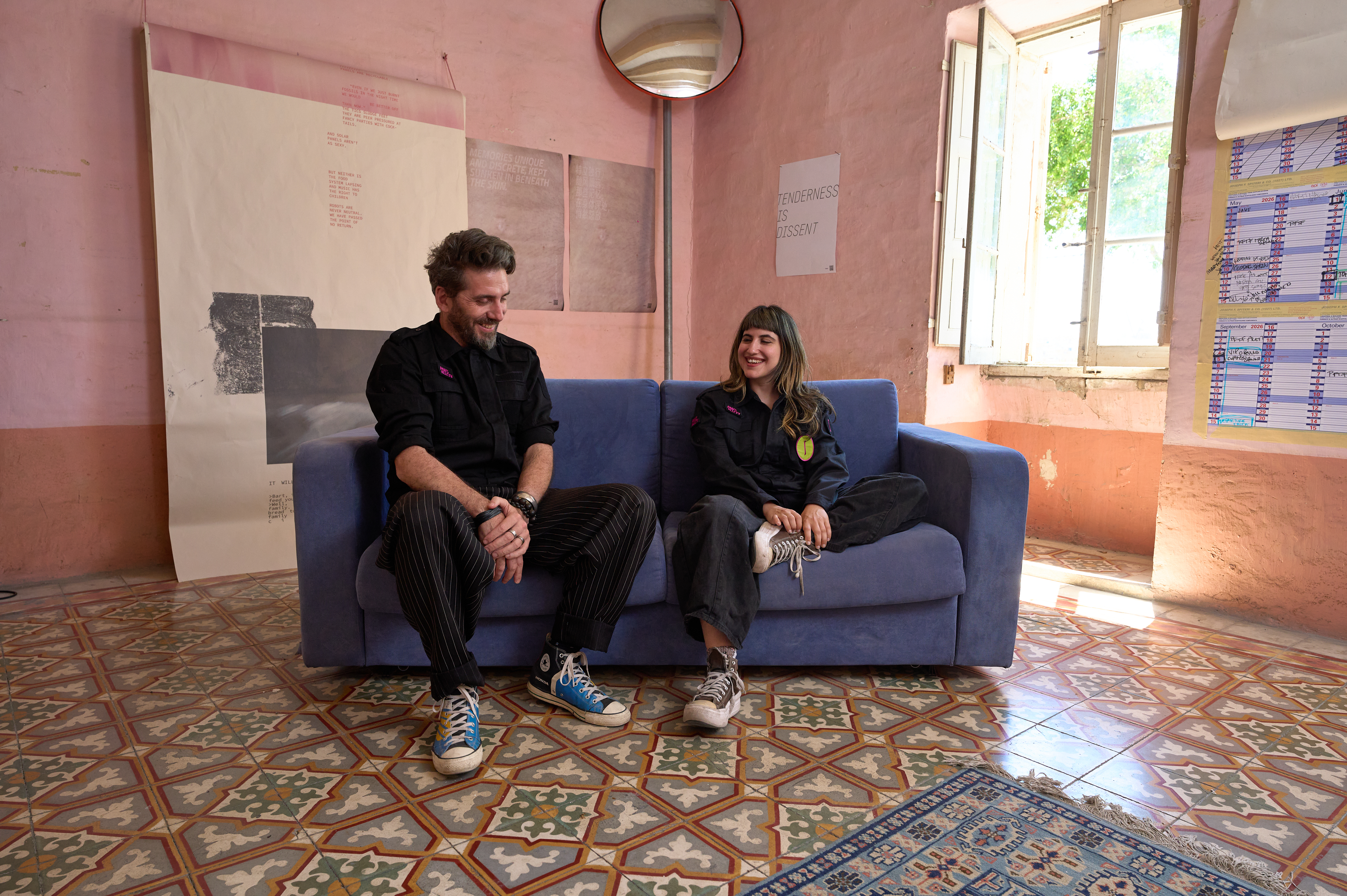 Studio Shot – PONKS Collective, ‘BEJN/IN-BETWEEN’ Pavilion. Photography © Edward Degabriele
By GRACE PALMER November 2, 2026
“The BEJN/IN-BETWEEN project strongly reflects just how art can create bridges between different cultures and create opportunities for shared understanding.” Maltese Minister for Arts and Culture, Dr Malcolm Paul Agius Galea, highlights the overarching impetus behind Malta’s debut pavilion at the Gwangju Biennale: celebrating cultural collaboration and didacticism. Titled in both Korean and English, BEJN, or IN-BETWEEN, forges a dialogue between the two countries, embracing the unformed space where shared community and ritual exist. Commissioned by Arts Council Malta, PONKS Collective is one of the four Maltese representatives at this year’s Biennale. Formed by artist duo Sam Alekksandra and Julien Vinet, PONKS explores the multidisciplinary intersection of poetry, visual arts, installation and video. Their contribution to ‘BEJN/IN-BETWEEN’ is ROPE TEMPLE, named aptly for the hundreds of ropes hanging from the Glass Polygon’s ceiling. Working closely with Maltese and Korean artists, poets, and other collaborators, the collective has covered the installation’s walls with poetic responses. I spoke with Sam and Julien about the important process behind ROPE TEMPLE, their relationship to the flâneur and the prevalence of the Gwangju spirit.
Palmer: PONKS is an artist collective, established by you (Julien Vinet and Sam Alekksandra) to convey the “morphing intersection of poetry, visual arts, installation, performance, video and sound.” What initially drew you to this collaborative, multi-media engagement with art? How has your practice changed as you've worked across different media? Both of you come from a visual arts background, but Julien, you are more rooted in installation, whilst Sam, you come from a poetic background. Have these different backgrounds allowed you to learn from one another and develop new, unprecedented ideas you would not have had individually?
Sam: We are always interested in expanding what we do and finding what the work wants in its mediums. I think of myself as a poet first and foremost; secondly, an artist, so I feel like my contribution anchors with poetry. We love site-specific work; we began as a poster collective. It was always collaborative, always multidisciplinary, and it's about world-building.
Julien: The very first thing that occurred was Sam reacting to some installations I had done, and she wrote about them. Eventually we decided to create a poster series from this interaction. It was a way for both of us to dive into this new practice, to regenerate ourselves. In my own practice, I've mainly focused on painting and installations - Sam gives me the freedom to go further. I bring the visual part, the installation, the textures, the mediums. Sam brings the poetry, the sound, the musicality, the wording, the compositions. We don't always express ourselves perfectly in one medium. We bring to each other strength, curiosity and a different set of skills.
Palmer: Your manifesto sets in stone the belief system that drives PONKS’ work. Tell me more about how this manifesto came into being. What key rules, ideals, and beliefs were at the core of this manifesto?
Sam: Our overarching raison d'être is to have a better present and better future. It considers how we can come together as people and artworks to create something better. It is based on humanistic values. When we began as a poster collective, it was a natural response against the noise of advertising. It provides solace, moving beyond a transactional consumerist archetype. PONKS is about collaboration, not just between Julien and me, but with other poets, artists, practitioners.
Julien: There is a raison d'être, but there is also a mal-être. Establishing a humanistic policy is extremely important, at least for me. We're not trying to profit from our art, but we're trying to share it as much as possible. We are against the idea that art is a consumerist value. Art is a medicine for the soul. Many discourses have alienated art from its real purpose: to connect people, to touch them somewhere they don't understand, to feel this idea of magic, an idea of magic that we desperately need in this world. This is why Sam uses the word re-enchanting, because it is at the core of our practice.
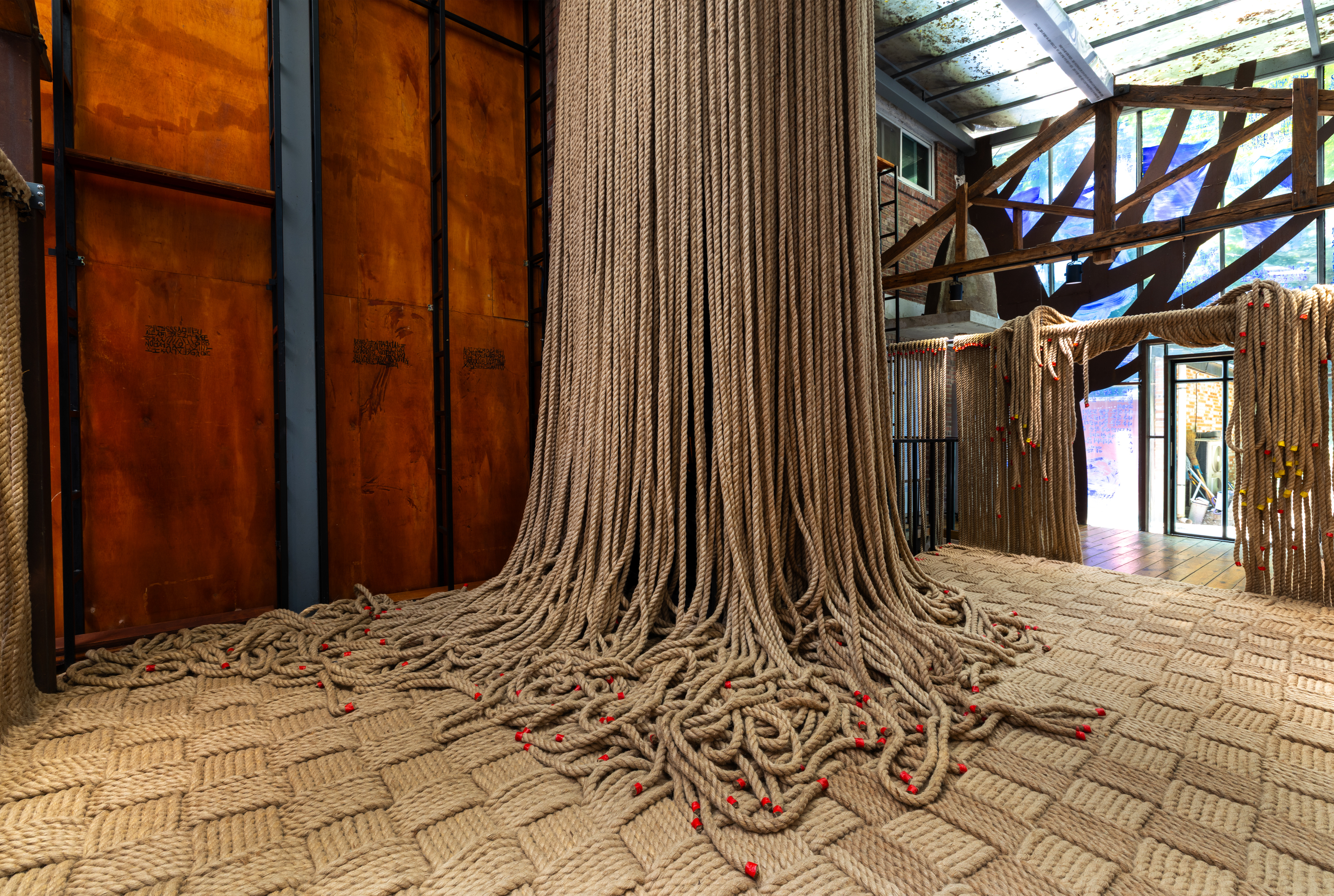 Rope Temple by PONKS for BEJN / In-Between, the Malta Pavilion at the Gwangju Biennale 2026. Photography © Ahina Archive.
Palmer: Your projects, particularly your films, draw on the flâneur. In your film, Dimensional Fruits, you adopt this flâneur perspective, wandering through Shanghai, confronting mass tourism and over-consumption. This notion of the flâneur comes from the Baudelairean 19th-century framework, which carries with it beneficial ideals of the spectator, artist and dandy. Yet it also carries the restrictiveness of a particular gaze that seeks only what he deems beautiful. How has this notion of the flâneur changed through your engagement in these spaces?
Julien: The flâneur is pretty much the way we live. We love to go on adventures. It is the same in our physical engagement with a city, especially here in Gwangju. The flâneur takes time to look around and connect to his immediate surroundings. During our residency in Shanghai, we uncovered this process of rediscovering your own city through poems. We would give you 10 verses, and you create the poem however you want. You’d then find those 10 posters in the city in the order of the poem that you created. It's your own travel, your own journey, your own poem, and a way to rediscover your city. It is not utilitarian; it’s trying to offer a different method to connect with yourself and your surroundings.
Sam: PONKS focuses on world-building and meaning-making. Dimensional Fruits was at the centre of that exhibition. Videos are an integral part of our practice now; they match with the spontaneity of being a flâneur. You can stumble upon a place, rather than rely on these Instagram lists that tell you the top five places you have to go. We're increasingly living through other people's experiences online instead of taking the time to be vulnerable and scared or make a new friend. Something as simple as being a flâneur is somehow radical. That is the re-enchantment of the everyday.
Julien: The idea of flâneur brought us to a café in a pigeon club owned by a man who hates pigeons. We’re trying to help people connect with themselves, but also with our own work. We are trying to talk to people who might be interested in a situation where you are in a pigeon club, surrounded by pigeons, and the guy tells you, I hate pigeons. And they go, What? Talk to me more. Explain what's happening. Why did you force yourself into this? How masochistic!
Palmer: This year’s Maltese Pavilion is BEJN/IN-BETWEEN, revealing the unexpected yet deeply rooted connections between Malta and Korea, especially themes of ritual, resilience and community. How has the three-month residency in Gwangju altered the trajectory of your site-specific work? How has your engagement with the culture, people, space and artistic environment played a role in the development and construction of ROPE TEMPLE?
Julien: This is a big collaboration. We're working with more than 120 poets. In Malta, we organise Poetry from the Future, a monthly event where we give the mic to people who love poetry. The same with the Korean poets we meet and don't understand. We know the translation in part (thanks to our curator), but we both believe poetry does not have to be translated. We translate poetry to communicate, but it isn’t necessary because poetry exists in the musicality of its own substance. In the three years of Poetry from the Future, we’ve had up to 22 languages speak about poetry.
The in-between we talk about keeps us out of boxes and says you don't have to understand everything happening around you. I am French; as a kid, I would listen to English music on the radio and never understood what was happening. The idea of the in-between is letting go and developing our own feelings and ideas.
Sam: Poetry is inherently an in-between. I read a poem today, and it means one thing. Tomorrow I meet the love of my life or somebody I love dies, and suddenly the same poem is a completely different poem and yet it has remained the same. This is how Poetry from the Future got its name. It is this sense of constantly returning or constantly coming from the future with every new happening. If one poem can offer that possibility, what happens when we bring many into a space and when we create another layer of these ropes? In every sacred space, you always have that room within a room as the most important part of the space. ROPE TEMPLE carves out this physical in-betweenness so that it can be more than symbolic.
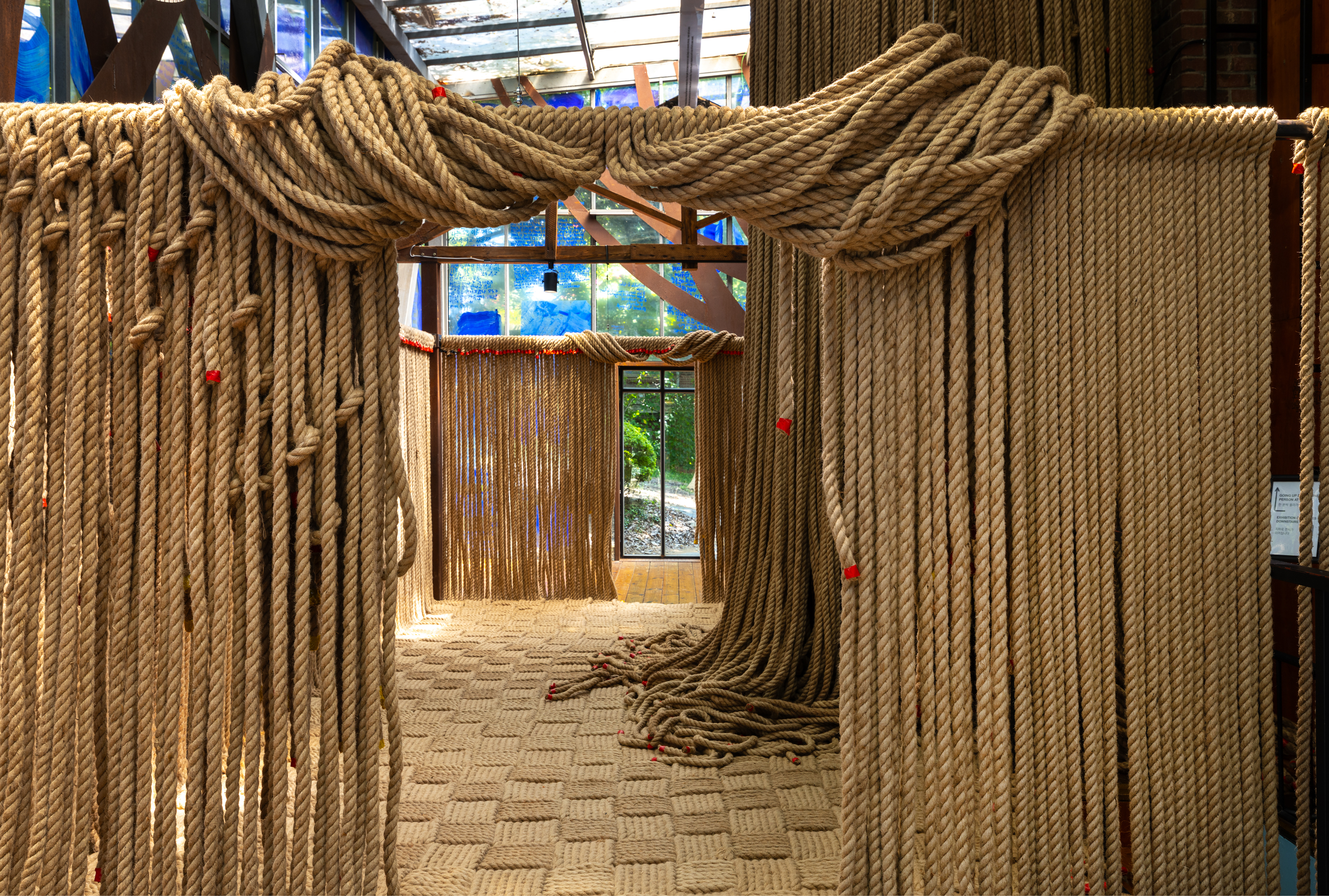 Rope Temple by PONKS for BEJN / In-Between, the Malta Pavilion at the Gwangju Biennale 2026. Photography © Ahina Archive.
Palmer: The Gwangju Biennale is founded on the Gwangju Spirit of the May 18 Democratisation Movement; a spirit that champions universal messages of democracy, human rights, peace and hope. Do you find that the Maltese Pavilion’s exploration of Bejn/In-Betweenness embraces this spirit? Has your time spent in Gwangju been stimulated by the Gwangju spirit?
Sam: The spirit of Gwangju is constantly discussed in the city – a collective myth. It’s in the monuments, museums and people’s everyday lives. When we came first in October last year, I saw that this spirit was alive, but I wondered whether it was present. If it's just historical, then it’s a fairy tale, almost dead. If you're proud, you have to keep it alive by continuously exercising those values. Through the poets, artists and collaborators we've met, this spirit of Gwangju lives on. The first poet we met, Kwak Jaegu, was present during the Gwangju massacre. His work asked: What happens now after this massacre? How do we build, how do we keep our hope? That element of resistance in these new stories and myths is very much alive.
Palmer: After the Pavilion, what comes next for PONKS? Do you tend to take a break after these residencies, or are you already beginning your next project? How does each project initially begin? Where do your ideas come from, and how do you let them percolate?
Sam: I believe that art-making and being an artist is about the process. I try to embed myself in the moment as much as possible because that's the whole point. Art is all about the process and how making something can change you. I'm happy to see all the parts finally coming together, and I'm very proud of what we've managed to do.
“Poetry is the light in which we can scrutinise our lives.” Audre Lorde is my favourite poet, and I really resonate with her message here. To that end, we're not going to take a break. We love what we do so much. I hope we don't stop. We have an exhibition, residency and a few other things in the pipeline that I can't reveal now. I hope I get to do this till the day I die.
Julien: We're in love with the process, and the process, by definition, is an in-between. The process can be frustrating, exhausting, and exhilarating. It should bring out different feelings. I'm currently doing the ROPE TEMPLE floor. I tend to do that in the evening as a meditation. I am truly immersed in it, despite there being 1.5 tonnes of rope to hang.
After this, we want to bring opportunities to Maltese artists to work with Korean artists. We have hired our associate curator to work with us on a show in Malta. The art world and market in Malta are tiny. If Maltese artists are given opportunities to work with Korean artists, we can connect with their incredible contemporary art culture. Before that, I'm curating a show for another artist. After that, there's a book to make. After that, there are some Biennales.
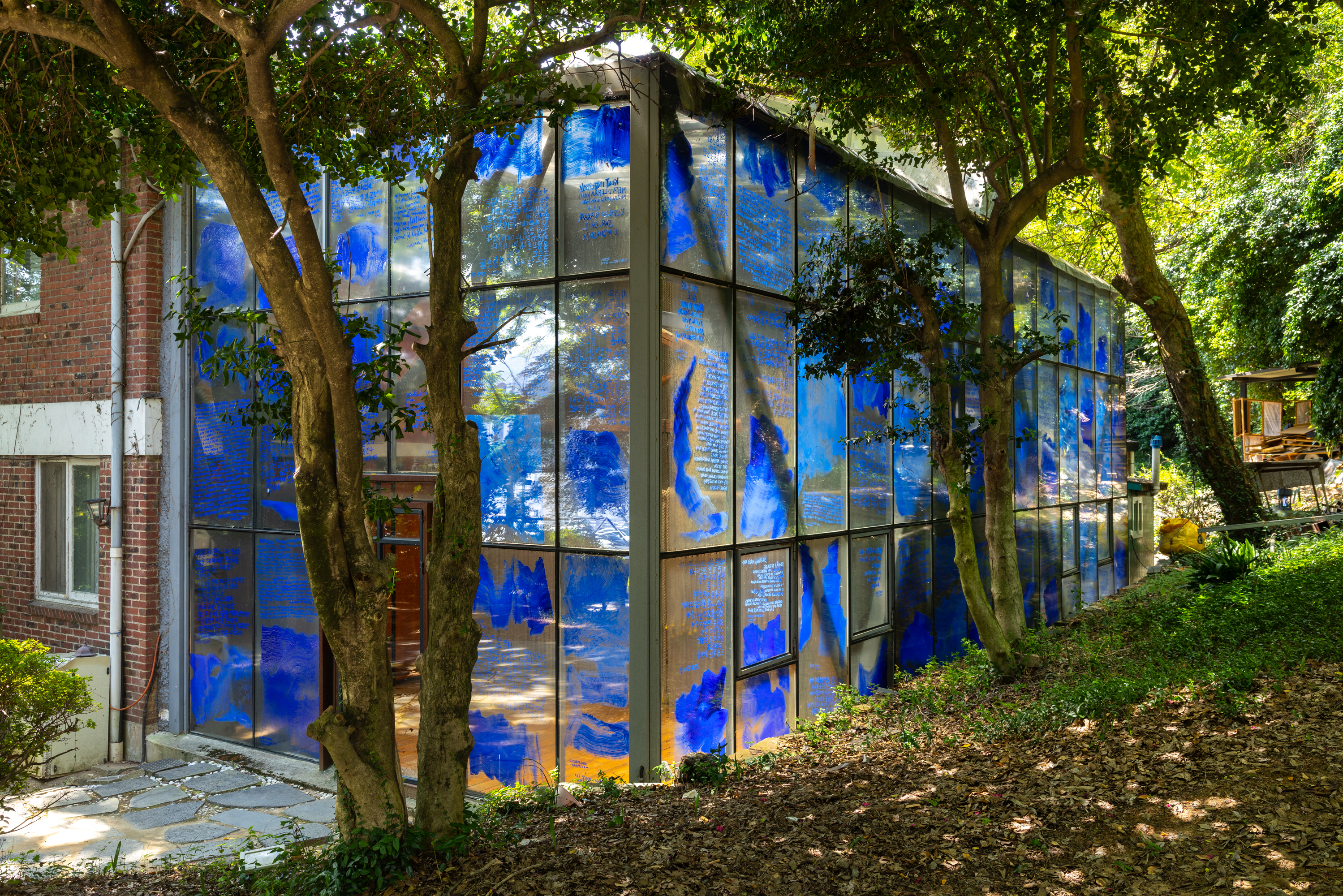 Rope Temple by PONKS for BEJN / In-Between, the Malta Pavilion at the Gwangju Biennale 2026. Photography © Ahina Archive.
My thanks go to Sam Alekksandra and Julien Vinet for taking the time to talk about their work and their involvement in the Gwangju Biennale.
The Gwangju Biennale runs from September 5 – November 15, 2026, in Gwangju, South Korea.

Grace Palmer
Grace Palmer, an art historian and writer, specializes in the history of contemporary art and 1960s New York performance art. She contributes to Whitehot Magazine and is currently located in London, England.
view all articles from this author