Whitehot Magazine
August 2026
"The Best Art In The World"
"The Best Art In The World"
August 2026
Care After Collapse: A Conversation With Sining Zhu
By YEZI LOU April 5th, 2026
When encountering an ongoing performance, one might feel like an intruder, or an awkward passerby unsure whether to stay or walk away. When art unfolds beyond the legibility of still images, why do we devote time to movements that resist immediate comprehension? In Sining Zhu’s practice, one may find a certain comfort within this anxiety of modern spectatorship. Her work offers a way of perceiving performance not as something to decode, but as something to inhabit.
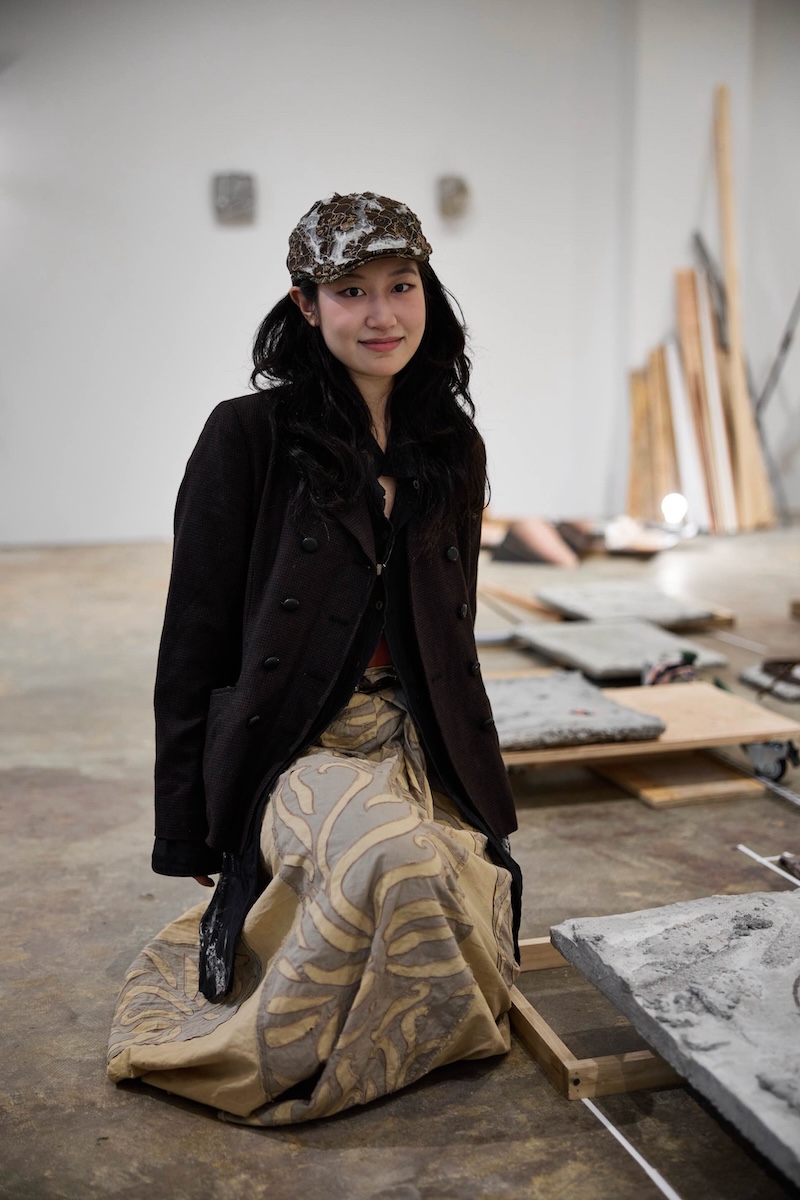 Portrait of Sining Liu. Courtesy of the artist
Sining Zhu (b. China) is a Los Angeles–based interdisciplinary artist working across sculpture, installation, video, performance, and sound. Her practice examines how fluid states of identity are inscribed and reshaped within contemporary social structures. Through material reconfiguration, fictionalization, and subtle misalignment, she investigates how structures sustain experience and how emotional, spatial, and temporal are activated. Rather than resolving tensions through narrative, Zhu constructs situations that can be entered, allowing latent relationships to surface through experience.
In Zhu’s practice, geography becomes perceptible through visual and spatial terms. Beyond utilitarian function, sound, movement, and space operate as signifying elements, while the body reimagines space beyond its basic expansiveness.
Drawn to neglected spaces and marginalized communities, Zhu traces how bodies, objects, and memories carry residues of displacement. On March 1st, 2026, she presented Delay of Termination (2026) at The Reef as part of the Anti Frieze+ LA performance festival. In this work, Zhu repeatedly attempted to relight discarded fluorescent tubes sourced from vacated shops and her apartment building. After replacing wires and switches and testing them multiple times, she realized the tubes were beyond repair. Yet her focus shifted away from restoring light itself toward the act of persistence, continuing despite the inevitability of failure, prolonging an action within darkness.
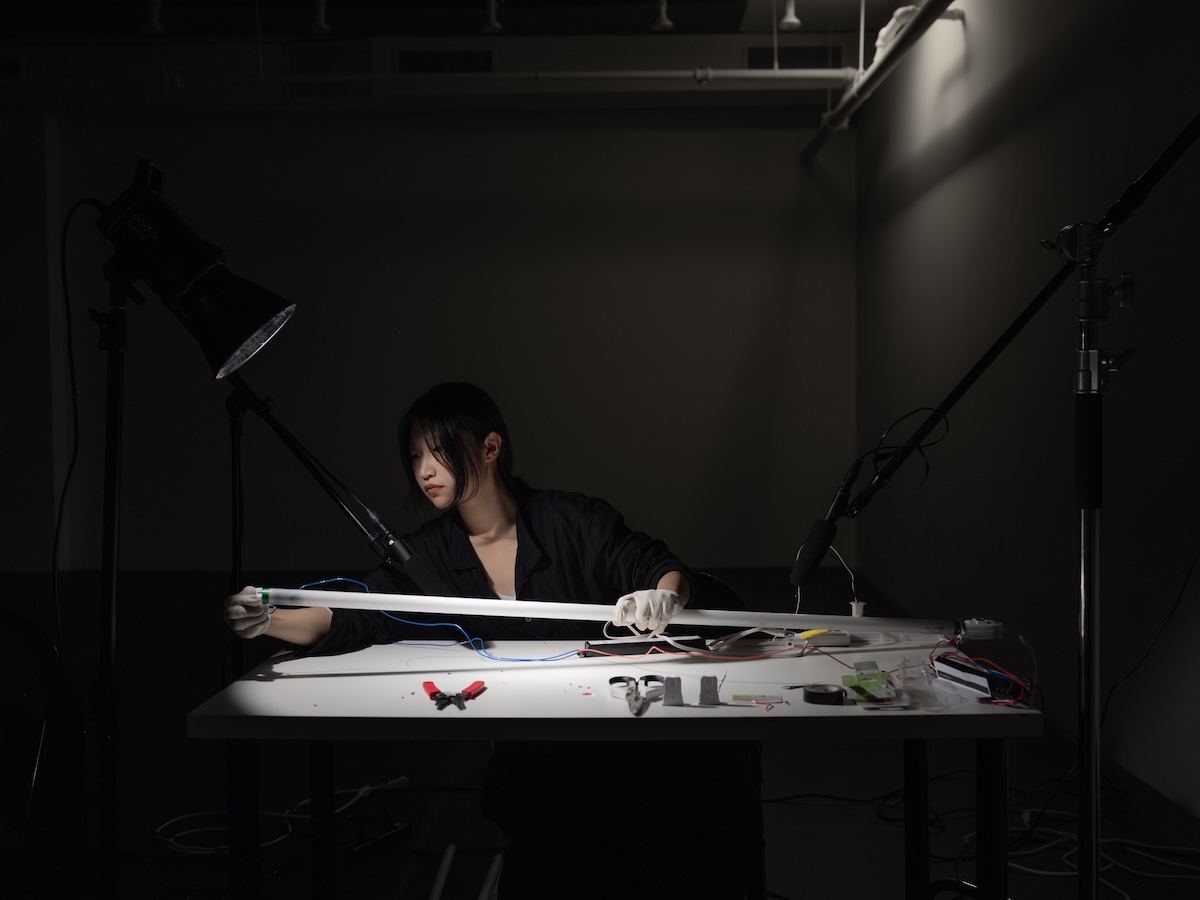 Sining, Zhu, Delay of Termination. Performance view at the Reef, Los Angeles, 2026. Courtesy of the artist and the Reef. Photography by Zengyi Zhao.
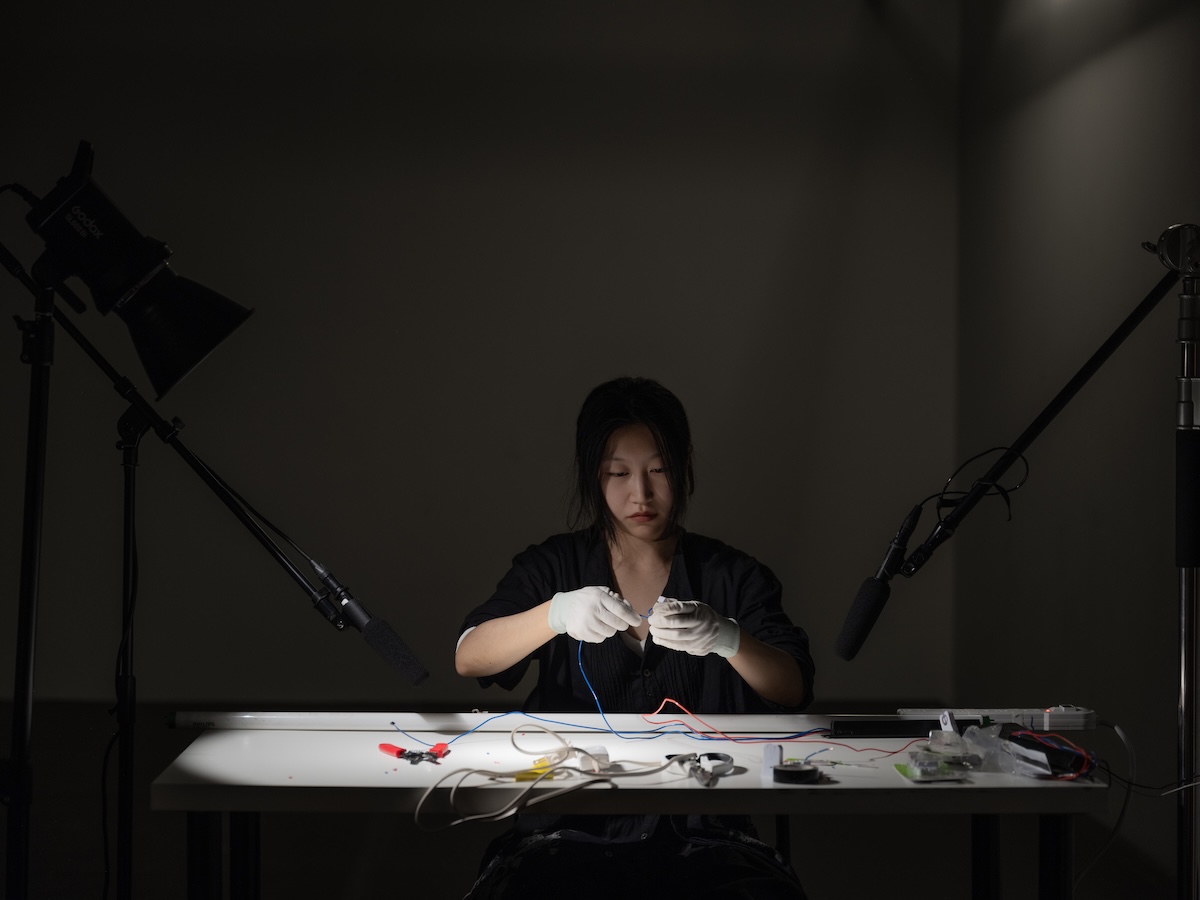 Sining, Zhu, Delay of Termination. Performance view at the Reef, Los Angeles, 2026. Courtesy of the artist and the Reef. Photography by Zengyi Zhao.
The performance unfolds without speech or music. Instead, sound emerges from the friction of wires, switches and glass that amplified through shotgun microphones. The faint hum of electricity, the sliding of glass tubes, and the repetitive clicking of switches accumulate into a fragile sonic field. These mechanical sounds resemble murmurs, almost like the breath of something barely alive, forming a perceptible language. Rather than illustrating the process, they translate its internal states: hesitation, repetition, exhaustion, and persistence. Through sound, duration becomes palpable without requiring visual resolution.
Duration becomes a central gesture in Zhu’s practice. As she notes, “A simple action can become strange when it’s repeated over time. And then, after a while, it becomes familiar again, but in a different way.” Through repetition and slowness, familiarity destabilizes. Small gestures expand, and time accumulates into a dense field shaped by pauses, persistence, and fatigue. The question of whether an action “works” gradually dissolves, replaced by the experience of doing.
As the performance unfolds, viewers begin to question what they are witnessing—whether it carries meaning or leads anywhere. Some stay briefly, others remain for its full duration; each encounters a different temporality. This uncertainty is not incidental but integral. It resists conventional expectations of efficiency, productivity, and value.
Delay of Termination (2026) extends Zhu’s earlier project Still a Long Dream (2025), also presented at The Reef. The installation draws from the architectural mapping of Dynasty Plaza in Los Angeles Chinatown, constructing a landscape suspended between endurance and erasure. Concrete slabs hold imprints of discarded commodities, preserving blurred afterimages of vanished lives. Structures, debris, and fragments converge into a fragile archaeology in which foundation and ruin, memory and forgetting, become indistinguishable.
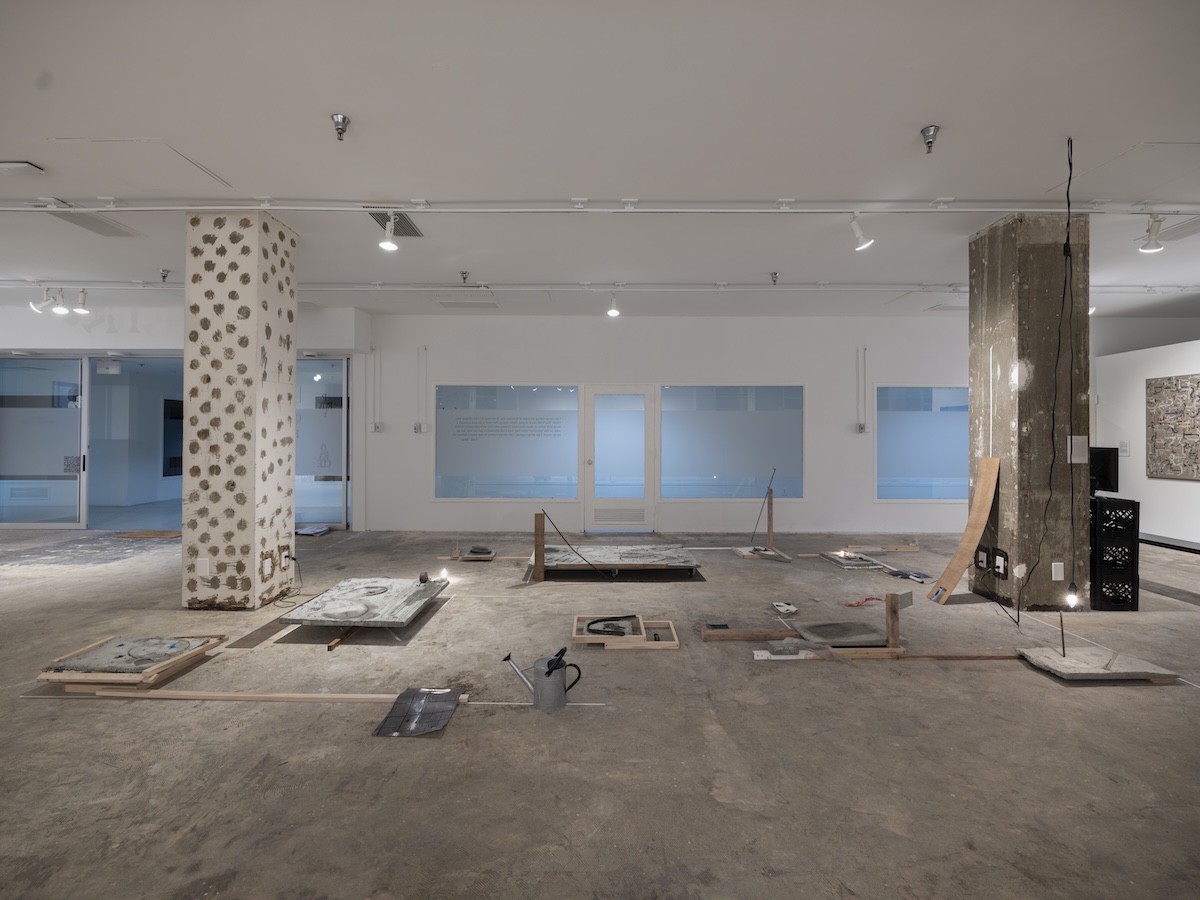 Sining Zhu, Still a Long Dream. Installation view at the Reef, Los Angeles, 2025. Courtesy of the artist and the Reef. Photography by Sight Photography Studio.
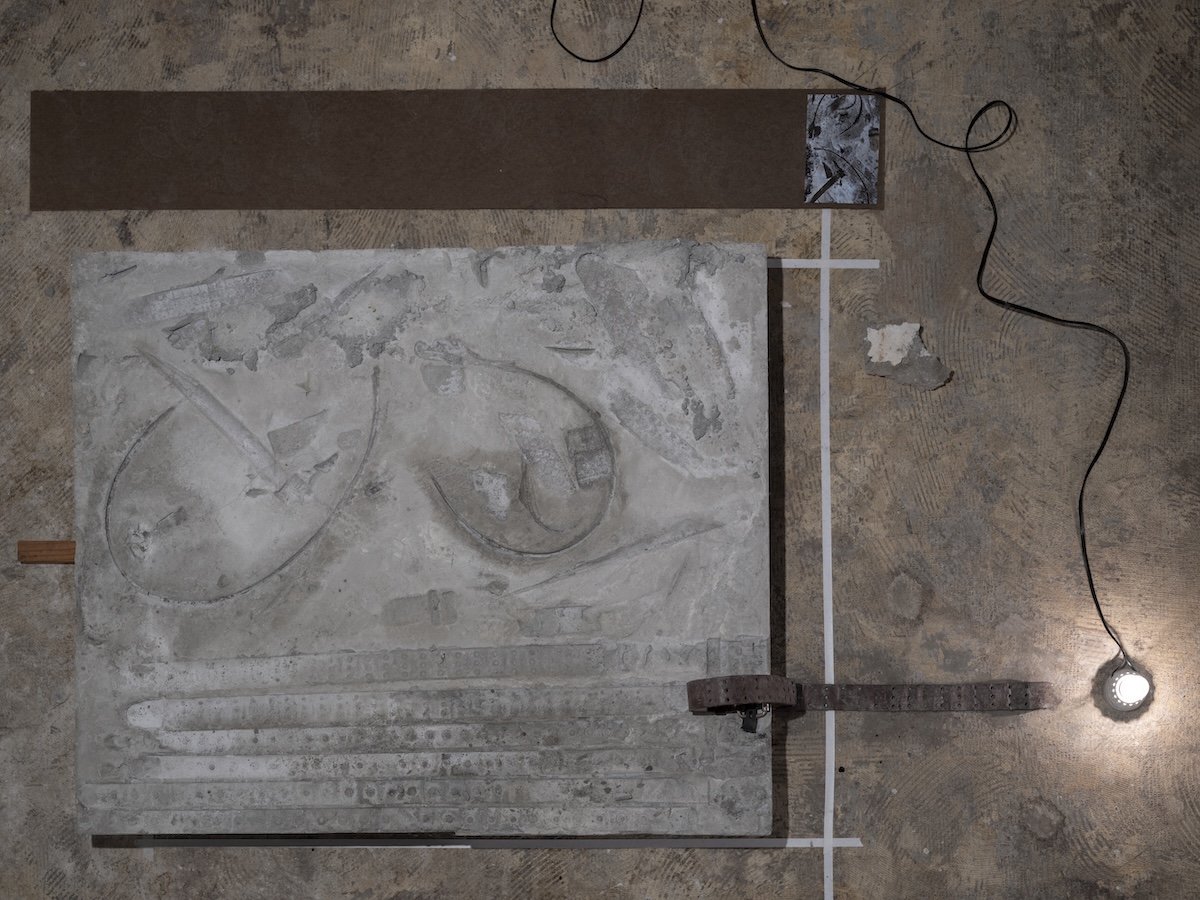 Sining Zhu, Still a Long Dream, 2025. Courtesy of the artist and the Reef. Photography by Sight Photography Studio.
These impressions function like fossils of a living economy, balancing safety and precarity, permanence and ephemerality. As the work evolves, it echoes cycles of redevelopment and displacement, hovering like an unending dream.
Across Zhu’s practice, space and territory remain unstable. Boundaries shift, geographies are continuously redrawn, and spatial definitions tremble through bodily movement. Memory and history are reorganized through chosen sites, while the body becomes embedded within larger systems of power and categorization.
Within this framework, care emerges as a recurring yet unstable concept. Maintenance persists even after its original purpose has collapsed. The repeated attempt to repair broken fluorescent tubes is neither purely an act of care nor a straightforward gesture of resistance. Instead, it occupies a space where action continues without resolution. Here, maintenance becomes a temporal structure that persists despite failure and produces no definitive outcome. It is less about sustaining life than about extending the threshold before disappearance, prolonging the moment before an ending fully takes place.
In this sense, Zhu’s work asks us to reconsider our relationship to the present. It resists dismissal of slowness, of transition, of instability, of what appears useless. It insists on attending to these conditions as constitutive rather than negligible.
This understanding of care was further activated in 24 HOUR CARE, a performance project initiated by the artist collective FXR at the Getty Center. As part of the AAPIAN Open Mic, Zhu responded to the question, “What is care?”—a prompt that extends beyond her work into broader considerations of lived experience.
In her response, Zhu drew from both personal experience and artistic practice. She described sleep as a fundamental form of self-care, while also considering care as an act directed toward non-human objects. Referencing Delay of Termination, she reframed care not as restoration or protection, but as the act of “delaying termination” sustaining what is already in the process of being consumed through continued, repetitive engagement.
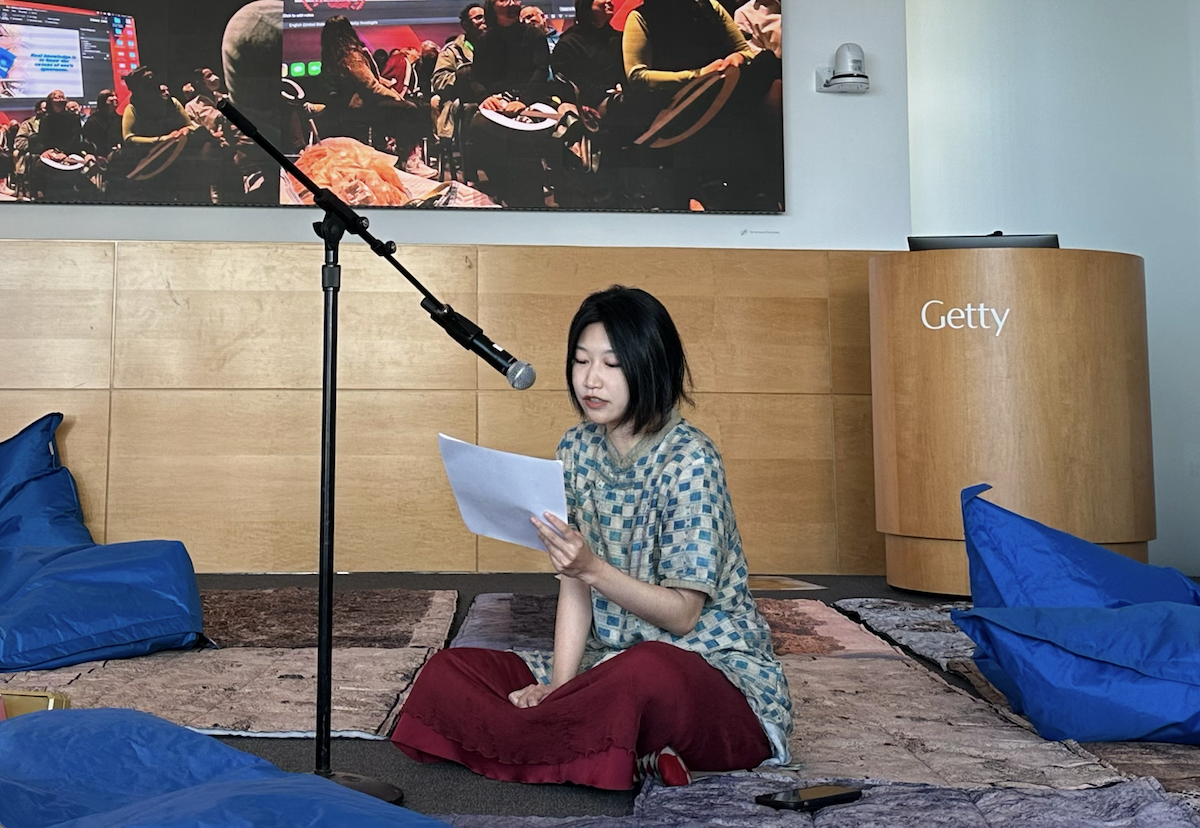 Sining Zhu, performing at the Getty Center, 2026. Courtesy of the artist and the Getty Center.
YL: Your recent performances Delay of Termination and Still a Long Dream both revolve around prolonged actions and suspended resolution. What initially drew you to performance as a medium for exploring time and persistence in these works?
SZ: In my practice, I often use bodily action to activate material and spatial conditions. Whether I am performing myself or inviting others to participate, the body functions as a medium. It is fluid, unstable, and capable of both defining and dissolving spatial boundaries.
As a non-trained performer, I am acutely aware of the awkwardness and limitations of my own body, as well as the repetitive nature of everyday gestures. This has made me more attentive to parts of the body that often go unnoticed, such as the toes, the inner and outer sides of the knees, the weight of the arms, or the rhythm of breathing. In this sense, performance is also a process of re-sensing and reconfiguring my own body.
In Still a Long Dream, I use actions such as walking, pushing, watering, humming, and tapping to activate the installation. These gestures introduce a sense of latent movement into an otherwise static structure, almost as if revealing an invisible vitality. At the same time, they reshape the relationship between body, space, and time.
In Delay of Termination, the body becomes more constrained and is reduced to repetitive gestures of the hands, head, and upper body. I collect discarded fluorescent tubes from old storefronts and residential renovations, and I repeatedly attempt to repair and test them in order to relight them.
Here, performance is no longer about activating a system. It becomes an ongoing process without completion. Through repetition and duration, time is stretched, and the action gradually detaches from its original function. It becomes a way to explore persistence and continued existence.
YL: In Delay of Termination, the action of repeatedly attempting to light broken fluorescent tubes becomes the core of the performance. At the end, the light was restored unexpectedly. At that point, was the tension of repitition diminished by such restoration?
SZ: I do not think the tension disappears. If anything, it shifts.
The unexpected moment when the light turns on does not resolve the repetition. Instead, it heightens my awareness of the role of uncertainty within the performance. For nearly an hour, I continue the action without expecting any result. Then suddenly, something changes.
In that moment, all the previous repetitions no longer feel meaningless. They begin to register as a form of accumulation, almost like an anticipation I was not fully aware of while performing.
It also opens up a new set of questions. If one tube can light up, what about the others? What happens after that moment? And what about the fifty minutes of failure that came before it? Rather than closing the work, that moment extends it. It leaves me with the desire to repeat the performance again, not in order to achieve the same result, but to re-enter that condition of uncertainty.
For me, the meaning lies not in whether the light turns on, but in everything that happens before and after that moment.
YL: The moment when one tube unexpectedly lights up at the end of the performance introduces a sudden shift in the narrative. How did that moment reshape your understanding of the piece, and how do you interpret that fragile success within the work’s larger framework?
SZ: I see this fragile success as both minimal and sharp. In the moment it happens, it is undeniably affecting. But whether the light turns on or not, the work is never about the result. It is about the process of attempting to light it.
That moment does not resolve the piece. It clarifies it. It makes me realize that what matters is the persistence of the action itself. It is a continuous attempt that reshapes how we perceive value and time through small gestures.
Within this framework, success is only a brief deviation. It is unstable, and it cannot be sustained or reproduced. Instead, it retroactively intensifies all the repetitions and failures that came before it.
This is also why I have been thinking about translating the performance into a video work. Through editing, I can construct multiple outcomes or even remove the ending altogether, so that the viewer encounters an ongoing sequence of attempts and adjustments. In that sense, success is no longer an endpoint, but something constantly deferred and reconfigured.
YL: Fluorescent tubes are everyday, replaceable objects designed for efficiency and easy substitution. What interested you about using such ordinary materials to question systems of productivity and value?
SZ: I was first drawn to the flickering fluorescent tubes on the ceiling of an old storefront. As they were about to fail, they would continue flickering for a long time, yet no one replaced them. That condition simply persisted.
Later, a film crew came into the space at Dynasty Plaza. For the shoot, they replaced all the tubes with new, bright ones. The old tubes were immediately discarded, and the entire space became clean and evenly lit, almost as if it had been renovated. But in reality, the place was still about to be relocated and demolished.
That shift made me think more deeply about these everyday, replaceable objects. On one hand, they signify cleanliness, renewal, and efficiency. On the other hand, they function as traces of a system that constantly replaces itself. They are marks of an ongoing cycle that often goes unnoticed.
What interests me about fluorescent tubes is precisely this condition. They are both necessary to the system and instantly disposable. It is that tension between necessity and replaceability that continues to hold my attention.
YL: Your work often focuses on objects that exist in states of abandonment, malfunction, or obsolescence. What do these marginal objects reveal about larger social or economic structures?
SZ: These objects come from everyday life. They are common, mass-produced, and constantly circulating. At the same time, they exist within continuous cycles of iteration and are replaced by new technologies, trends, and updates.
What interests me is not that these objects directly illustrate larger social or economic structures, but how they are overlooked, replaced, and assigned positions within hierarchical systems of value. Their disappearance seems to parallel a diminishing sensitivity to what is nearby. This disappearance does not occur as a singular event, but unfolds slowly and continuously. In this sense, I relate to Sam Han’s notion of “continuous catastrophe,” not as a sudden rupture or natural disaster, but as an ongoing, everyday condition that often remains unnoticed. What I want to continue exploring, then, are the forms of vitality and the subtle melancholy that persist within such a condition.
YL: The title Still a Long Dream suggests a suspended or ongoing state rather than a completed event. How does the idea of dreaming, or lingering, inform the conceptual framework of the work?
SZ: The title is, in some ways, an aspiration for the work itself. I am interested in constructing a landscape that is both real and fictional. It exists in a continuous cycle between disappearance and formation, like a ruin, a construction site, or an archaeological field. I am not interested in offering a fixed conclusion. Instead, I want viewers to move through the space by walking, observing, and lingering, and to gradually form their own interpretations that extend beyond the given traces, clues, or geographic references.
For me, “dream” suggests suspension, ambiguity, and incompletion. I have been influenced by writers such as Haruki Murakami, especially works like The Elephant Vanishes and The City and Its Uncertain Walls. In his writing, the boundary between reality and dream is constantly dissolving. His characters are drawn into these states and trapped within them, while also attempting to escape. That tension between immersion and detachment is very important to me.
At the same time, the work engages questions of gentrification, identity, and mobility. I see dreaming, suspension, and lingering as reflections of the contradictions and uncertainties people experience in relation to reality, identity, and belonging today. In this sense, the dream is not an image, but an ongoing structure within the work.
YL: Your performances often unfold in silence or minimal narrative, allowing small gestures and sounds to become central. How do you think about the audience’s role in witnessing such subtle, slow actions?
SZ: For me, the audience is always part of the performance rather than external to it. During the performance, I move between two alternating states. In one state, I completely ignore the audience and their reactions, allowing the action to unfold according to its own rhythm. In the other, I begin to observe them and engage in subtle, natural interactions.
In Still a Long Dream, for example, I place tape on the floor around a viewer’s feet, creating a temporary boundary. People respond very differently. Some move away, some remain still, and some later express frustration or curiosity about not being included in the interaction.
These responses begin to affect one another, creating a shared emotional atmosphere in the space. For me, the audience is not simply interpreting the work. They are actively shaping its temporal and relational structure through their reactions, hesitation, and presence.
YL: Many viewers might initially perceive these actions as futile. Is that sense of futility important to the work, or do you see the repeated attempt itself as generating a different form of meaning?
SZ:If viewers perceive it as futile, that’s precisely the point. I want to amplify that condition. But futility is not where the work ends—it’s where it begins to transform. Through repetition, the action loosens itself from the logic of success or failure, and starts to produce another kind of meaning—one grounded in duration, in persistence, and in the ongoing condition of being.
YL: In your performances, the ending often seems uncertain or contingent. Do you design these works with an anticipated resolution, or do you allow the performance to evolve unpredictably?
SZ: Before the performance, I usually rehearse and establish a loose structure or possible resolution. For me, this is a way of taking responsibility for the work and ensuring that it holds together as a form. However, once the performance begins, it opens up. I cannot fully control how my body responds in the moment, nor can I anticipate what might happen within the space. This unpredictability is precisely the strength of the body as a medium.
Under different conditions, including time, temperature, environment, or even the presence of different audiences, the body responds differently and gradually guides the direction of the performance. In a sense, the body determines how the work unfolds, rather than my deciding everything in advance. So the ending is not fixed. It emerges through the process. It is in that unfolding that the relationship between the work, the space, and the audience takes shape and becomes specific.
YL: What are you most drawn to explore next?
SZ: Recently, I’ve been interested in how objects continue to exist beyond their designated functions—what remains once they stop operating.
I’m thinking about how to construct a system that draws viewers into ongoing processes of misreading and reimagination, rather than leading toward a fixed interpretation. I’m also drawn to material states as works in themselves—wet cement, pseudo-traces, fossil-like forms, residues of images, or gestures that resemble archaeology without actually being it. Routes, baselines, markers, and signs begin to slip from their assigned roles and shift toward something else. More broadly, I think of reconfiguration as a method—a way to consider how one continues to live within subtle, repetitive, and delayed forms of instability.

Yezi Lou
Yezi Lou (b. 1997) is an artist and independent writer based in Los Angeles. Her research centers on material culture, social phenomena, and syncretic spiritual practices in East Asia. She earned her MFA in Painting and Drawing at UCLA.
view all articles from this author