Whitehot Magazine
October 2026
"The Best Art In The World"
"The Best Art In The World"
October 2026
The archetype of the sacred and of matter: Inma Barrero’s maternal choir in the exhibition MOTHERS
By Manuela Annamaria Accinno October 2, 2026 at 5:00 p.m. EST
At Lévy Gorvy Dayan (19 East 64th Street, New York), Inma Barrero’s exhibition MOTHERS, constitutes a complex sculptural and philosophical meditation on the primordial figure of the generative matrix. The exhibition brings together eight monumental, previously unseen works that are arranged throughout the exhibition space to form a veritable sculptural choir, in which the individual maternal figures engage in dialogue and respond to one another across the gallery.
The Great Mother archetype conceptually represents the Whole, embodying the beginning and the end of all things. Carl Gustav Jung explored the profound psychological significance of the Great Mother archetype in the collective and individual unconscious, examining how the fascination and mystery surrounding the origins of life have been regarded, since the dawn of time, as the greatest of existence’s mysteries.
This sacred awe has given rise to cults and rituals which, whilst differing in their outward manifestations across different cultures, share a universal archetypal root. The primal force of creative nature, understood as the perennial and infinite totality from which the finitude and transience of life spring and to which they return, has thus been represented in a multitude of visual images, yet always with an awareness of its inherent ambivalence: an entity capable of welcoming and nurturing, but also of reabsorbing and transforming.
Barrero’s exhibition project fits within this tradition. The eight sculptures on display draw their inspiration from a symbolic and aesthetic repertoire spanning prehistory, antiquity and modernity across all continents. Brought together within the gallery space, the sculptures move beyond their role as mere objects of contemplation to become active ‘witnesses’, forming a collective architecture that directly engages the visitor.
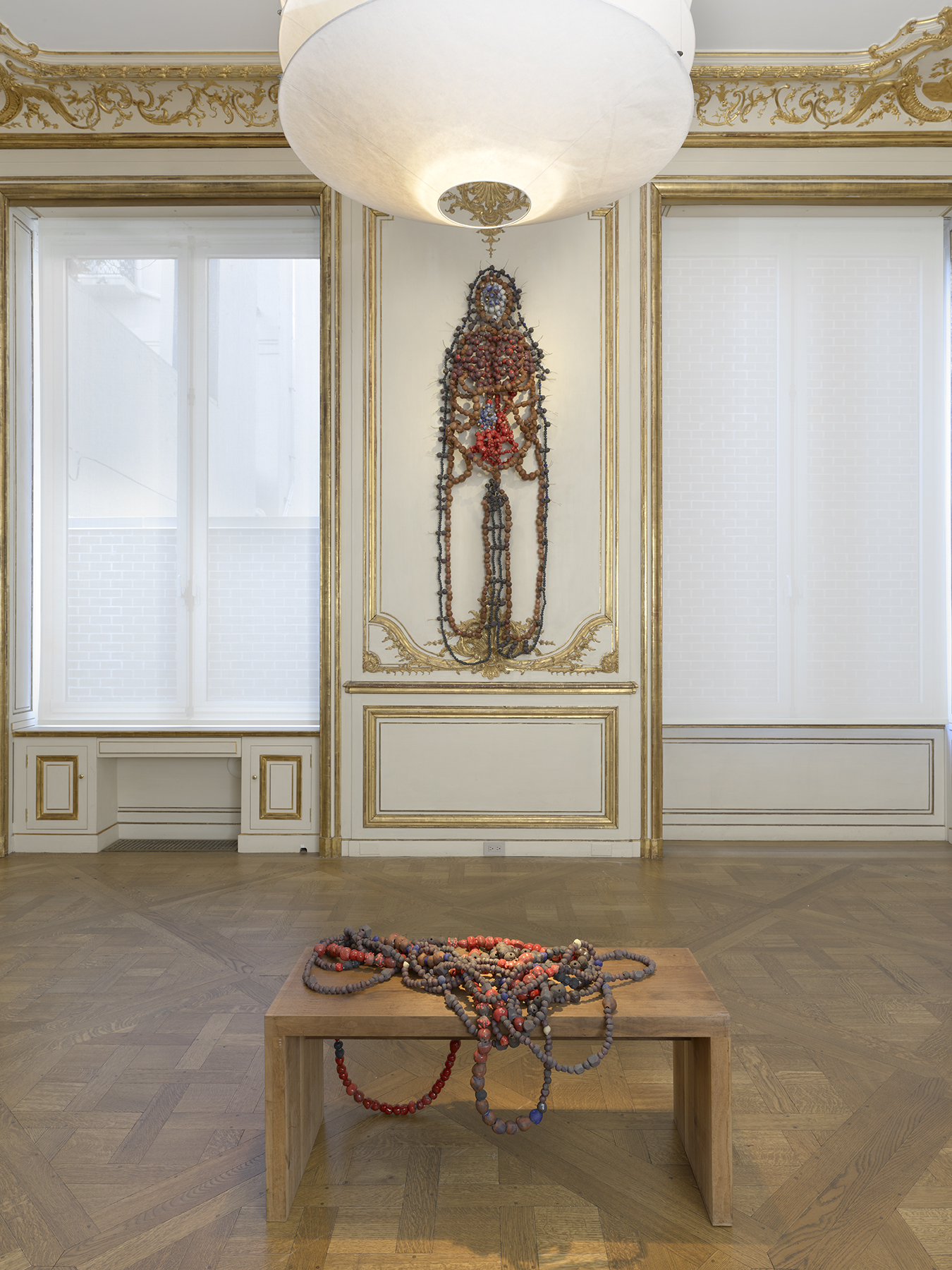 Inma Barrero at Lévy Gorvy Dayan, 2026. Courtesy of the artist and Lévy Gorvy Dayan. Photo by Elisabeth Bernstein.
In the contemporary context, characterized by technological excess and a progressive dematerialization of everyday experience, the figure of the artist is transformed into a sort of intertemporal navigator. The artist does not draw upon mythology or archetypes to indulge in a nostalgic reverie of the past, but rather to trace the ontological coordinates of a contemporary self that is often fragmented, uprooted and disoriented. Navigating the flow of archetypes means traversing the layered repository of the collective unconscious to pose radical questions to the present: who are we at the very core of our being when we strip identity of its contingent superstructures?
Through her evocation of the Great Mother, Inma Barrero does not merely celebrate motherhood in a biological or anecdotal sense, but invokes the primordial womb as a mirror of the human soul. The artwork thus becomes a gnoseological device in which ancestral memory re-emerges to bring order to the chaos of the present. To explore the maternal figure is to grapple with our material and spiritual origins, with a sense of limitation, vulnerability and belonging to a broader cosmic design.
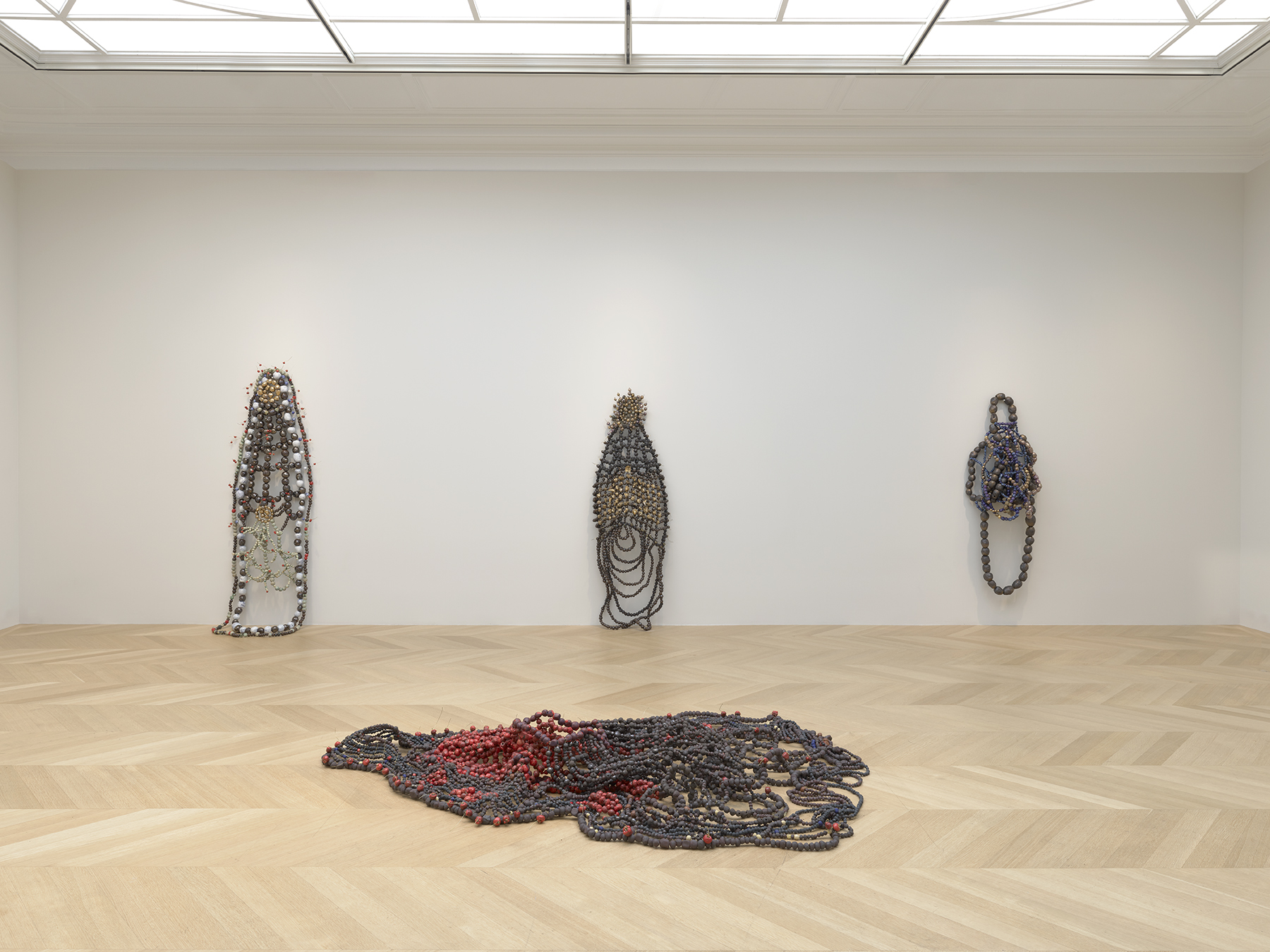
Inma Barrero at Lévy Gorvy Dayan, 2026. Courtesy of the artist and Lévy Gorvy Dayan. Photo by Elisabeth Bernstein.
The cornerstone and most fundamental element of Barrero’s artistic practice lie in the hand-modelled ceramic bead. Thousands of these small spherical units are shaped individually, transforming the artistic process into a repetitive, almost mantric sequence. This technical choice embodies a profound meditation on the relationship between the part and the whole, between the ceramic atom and the monumental sculptural form that emerges from it.
From a conceptual perspective, the bead encapsulates a network of spiritual and personal associations of extraordinary breadth. It evokes the affectionate, familiar memory of her grandmother’s rosary, but also the centuries-old tradition of the Greek komboloi, an instrument for releasing tension, its rhythm marked by touch, and the meditative solemnity of the Buddhist rosaries the artist observed during her stay in Kyoto.
The act of running one’s fingers through the ceramic beads becomes a bridge between religions, geographies and daily rituals. The bead becomes a timekeeper, a secular liturgy imprinted in the material, where each element bears the artist’s fingerprint and the physical pressure of their touch. The artist rejects the use of a single, homogeneous clay mixture, preferring to combine porcelain, faience and traditional terracotta.
To this malleable clay mixture, she adds natural clays sourced from distant geographical regions, including Japan, Mexico and Spain. This technical gesture carries profound symbolic and geopolitical significance: bringing together different sources of earth within the sculptural form of the mother signifies unifying the very substance of the planet.
The maternal figure is literally transformed into a physical and spiritual vessel in which geographical boundaries dissolve within the high temperature of the kiln. The various clays, fused together through complex glazing and firing techniques, react to create varied chromatic surfaces, rough or vitrified, which evoke the geological stratification of the Earth’s crust and the diversity of human skin tones.
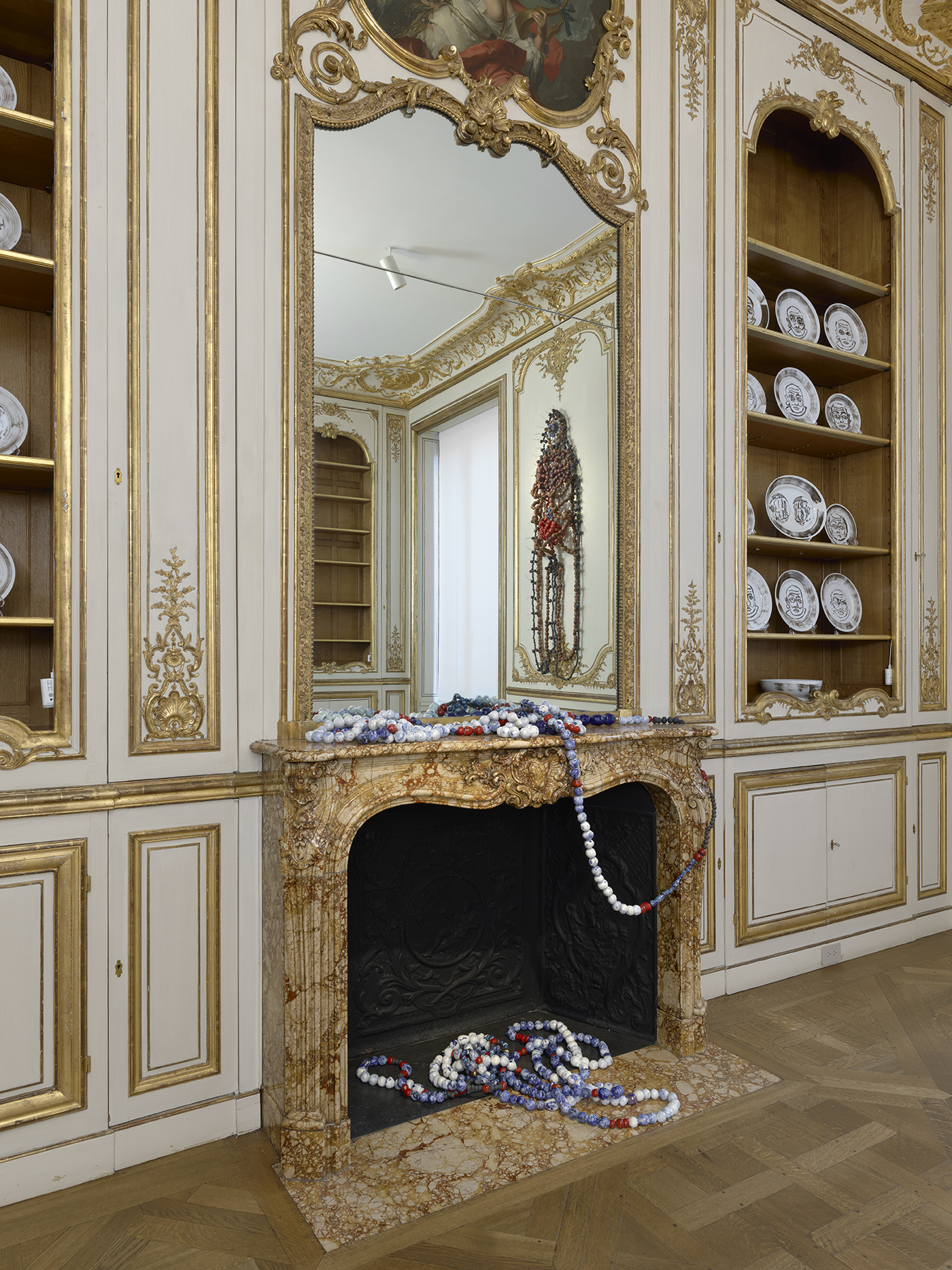
Inma Barrero at Lévy Gorvy Dayan, 2026. Courtesy of the artist and Lévy Gorvy Dayan. Photo by Elisabeth Bernstein.
By integrating the philosophy of lañado and kintsugi into the very structure of her sculptures, Barrero does not intervene retrospectively on a broken vase, but constructs the sculpture itself through the logic of repair. The metal wire supporting the beads acts as a nervous framework and a visible scar. This procedural choice powerfully reflects on the condition of the contemporary self: our identity is not founded on the illusion of integrity or perfection, but rather on the ability to gather up our inner fractures and stitch them back together.
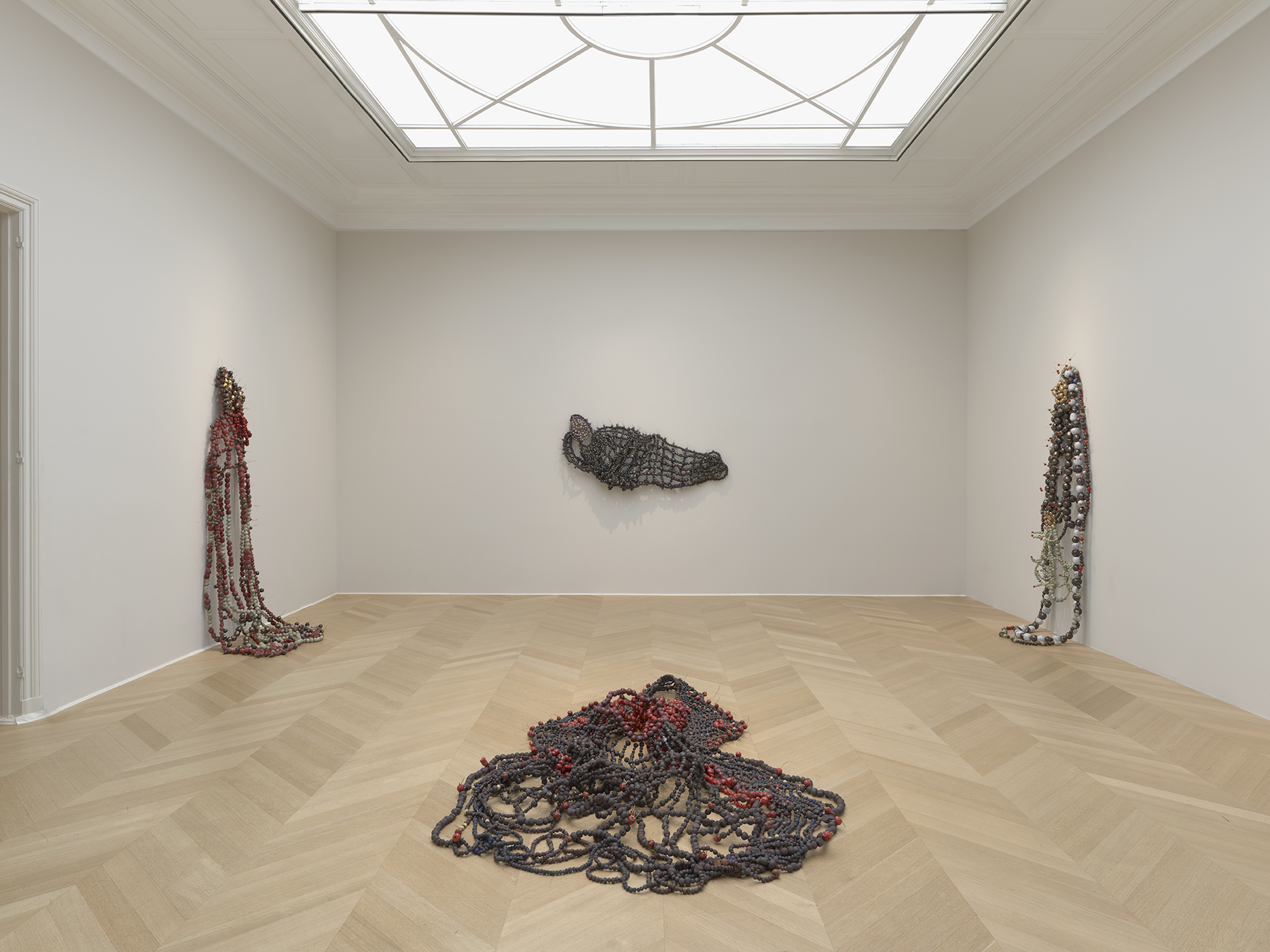
Inma Barrero at Lévy Gorvy Dayan, 2026. Courtesy of the artist and Lévy Gorvy Dayan. Photo by Elisabeth Bernstein.
Barrero’s Mother is a presence that embraces the wound, reveals it and transfigures it into a supporting structure. In giving form to her majestic anthropometric abstractions, the artist rejects the mediation of preparatory drawings or design sketches. The sculptural process is guided by a dynamic of direct accumulation and a response to gravity, summed up by the artist’s statement that the sculptures always emerge before their very names.
The ceramic forms accumulate in space according to an articulated spatial and corporeal syntax: there are figures that rise vertically like stelae or totems; others that stretch out across the ground like landscape reliefs; and still others that seem to carry, enclose or pour ceramic material outwards.
Although the titles chosen by the artist evoke mythical images and historical sources, they remain deliberately open-ended, eschewing any dogmatic or didactic pretensions. The artwork thus presents itself as a space of resonance into which the visitor is invited to immerse themselves to reflect on their inner self, reconnecting the fragments of their own existence with the eternal origin of the Whole. WM
The exhibition is on view until October 17, 2026.

Manuela Annamaria Accinno
Manuela Annamaria Accinno, born and raised in Milan, is an art historian and critic with a degree from the University of Milan. She has been actively collaborating for several years with radio stations and magazines specializing in the field of art.
view all articles from this author