Whitehot Magazine
August 2026
"The Best Art In The World"
"The Best Art In The World"
August 2026
Your cost benefit calculations: Gabriel Kuri at kurimanzutto
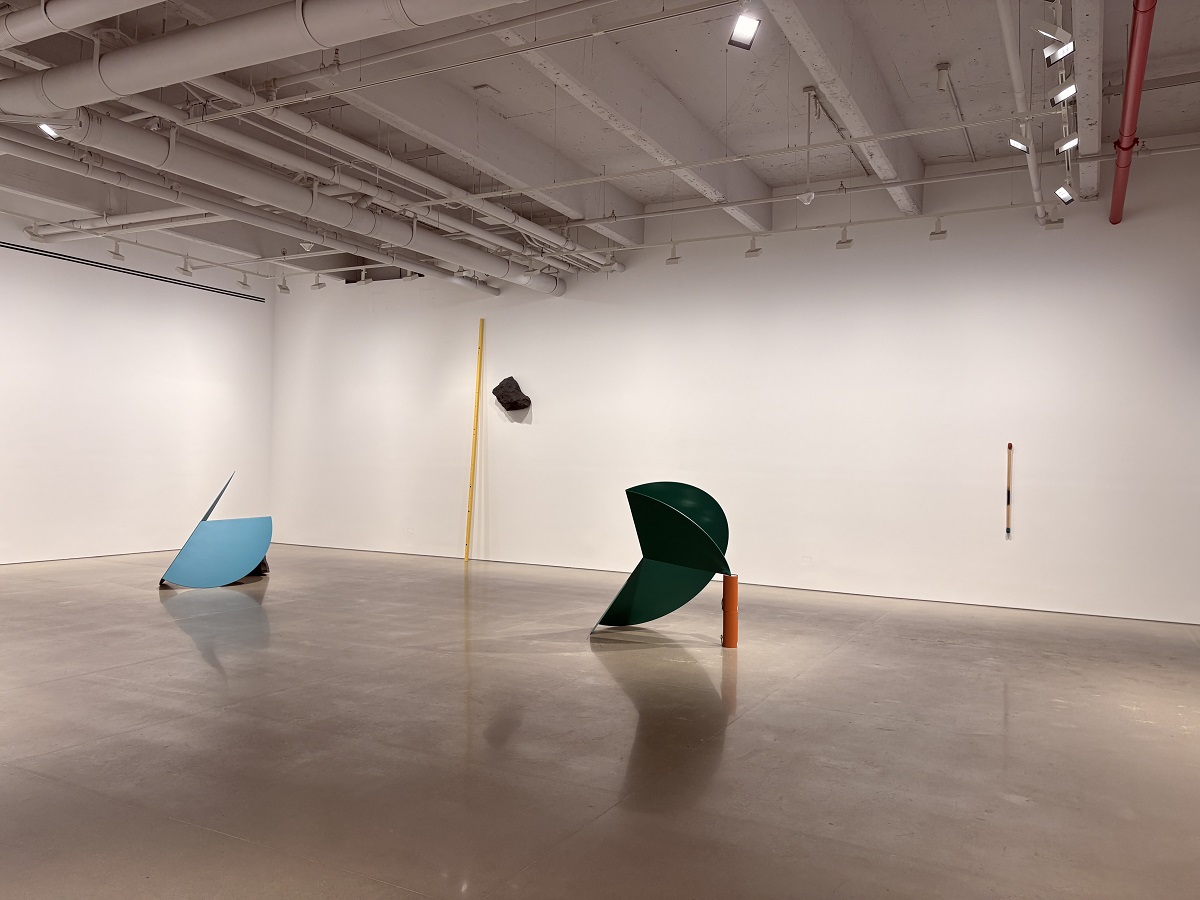 Installation view, Gabriel Kuri at kurimanzutto, New York, NY
By SARA CEMIN February 12th, 2026
In Your cost-benefit calculations, we witness a performance of artifacts that signal towards another abstract dimension. Gabriel Kuri’s first solo show in New York at kurimanzutto walks us through the disintegration and readjustment of quotidian objects, an installation of concepts turned life-sized. There is an overarching sentiment of the uncanny that pervades the space as one paces through these foreign chimera of somewhat recognizable objects.
Three-dimensional pie charts, folded and reposed on volcanic rocks (or a stack of fireworks) in unwonted equilibrium signal a new found order between the organic and the conceptual. These pieces are first introduced by oversized matchsticks placed on the first wall, burnt in the middle but untouched at the tips, and a large yellow ruler beside another volcanic rock also balancing itself on the wall. This offers an eerie first impression, like entering a laboratory of material dissection. What we are meant to recognize is subverted by a subtle defiance: there are no numbers on the rulers but dashes and shapes, the rocks violate the laws of gravity, and the space is curated with a planned disorder.
Three large pill-shaped cylinders — two orange and one red — hang on a wall, respectively bearing volcanic stones, conch shells, or eggs, and face three more towering rulers accompanied by two large volcanic stones in a kind of elemental duel. The unexpected juxtaposition of these natural, fabricated, and concept-heavy objects feels like an echo of our universe from a different dimension; as if the primal elements of our world were disassembled and reattached in alternative ways, playing with the realm of possibility. The primality of the colors — deep blue, green, red, orange, yellow — reinforce the essentialist atmosphere that pervades in this parallel universe.
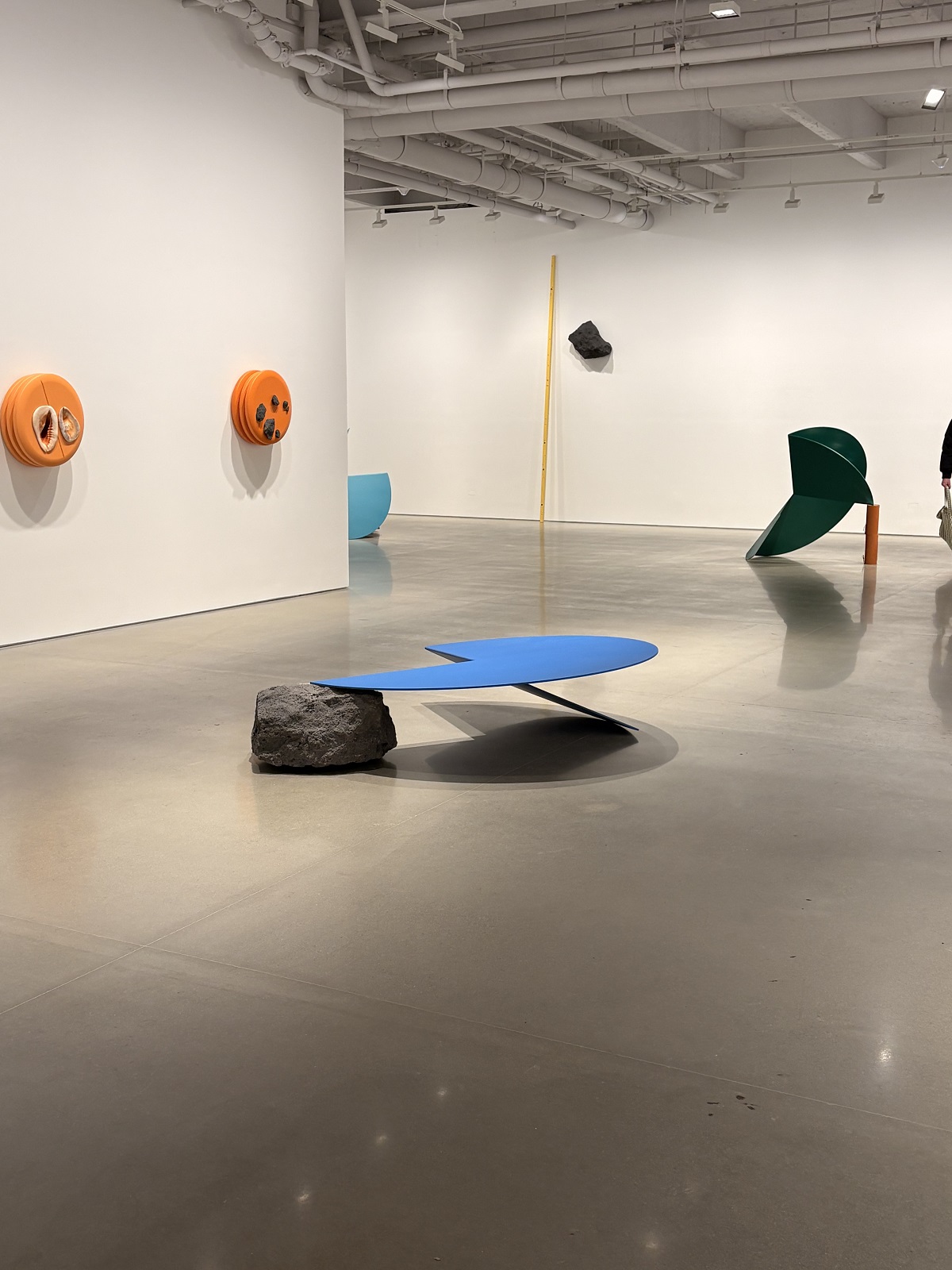 Installation view, Gabriel Kuri at kurimanzutto, New York, NY
There seems to be a mystery to be uncovered: clues tease us into accepting this uncanny assemblage of elements, each seemingly symbolic and yet self-contained. Purposely ill-folded green and orange orthogonal fabrics reveal numbers — percentages, probabilities? — written on the wall, implying some underlying structure to the installation, reflecting back to its mathematical title. The cost-benefit calculations in question seem to take in account color, material, space, and time. These objects and hybrids appear in various iterations, the two-ended colored matchsticks reflect a passage of time, when fire had burned, and their linearity parallels the large rulers, or poles, which seem to regulate the space around us. These material motifs give shape to the larger idea of possibility, the way things and concepts can be used, reused, and interpreted.
In this sense, the reiterative dimension of the installation, the various combinations in which these objects and colors combine and take space, generate a familiar yet eerie feeling that excites our sense of the metaphysical. More than a comment on decision making, or the possibility of an event — rendered by the latent box of explosives and extinguished matches — the cost-benefit calculation seems to explore the variability of matter.

Sara Cemin
Sara Cemin is a writer based in New York. She holds an MA in English Literature and History from the University of Edinburgh, where she also directed several plays. After working in film production, she now manages the studio of sculptor Saint Clair Cemin and publishes a Substack newsletter which explores storytelling across film and literature and features some short fiction. Her work in literature, performance, and visual art informs a critical practice attentive to the intersections of aesthetics, history, and cultural context.
view all articles from this author