Whitehot Magazine
October 2026
"The Best Art In The World"
"The Best Art In The World"
October 2026
Against Dissolution: Sean Cairns at 12.26, Dallas
By IAN ETTER October 3, 2026
The trees in Red River, 2026, are carved into a gritty surface. Sean Cairns begins by laying down a mixture of sand and oil paint. This gives the canvas a slight relief and granular resistance that diffuses his brushwork. In the upper third, branches and foliage were painted while the surface was still wet, leaving his marks embedded in the slurry mix. In this way, the upper portion of the painting has been decisively set with little margin for revision. Throughout his exhibition, And when morning comes it comes in the morning and never at night, at 12.26 in Dallas Texas, Cairns’ landscapes hold because they refuse to choose between deciding and allowing.
The dominant colors in Cairns’ large, vertical landscape paintings are familiar—not to the genre, but to the painter: cadmium orange, sap green, rose madder. But these quickly give way to hues that land just off the tip of the tongue—beigy-olive sky scumbled over a sticky pink ground, an undulating brown that oscillates between warm and cool. This perceptual slippage establishes a larger instability within the paintings. They hover between what can be named and what can only be felt.
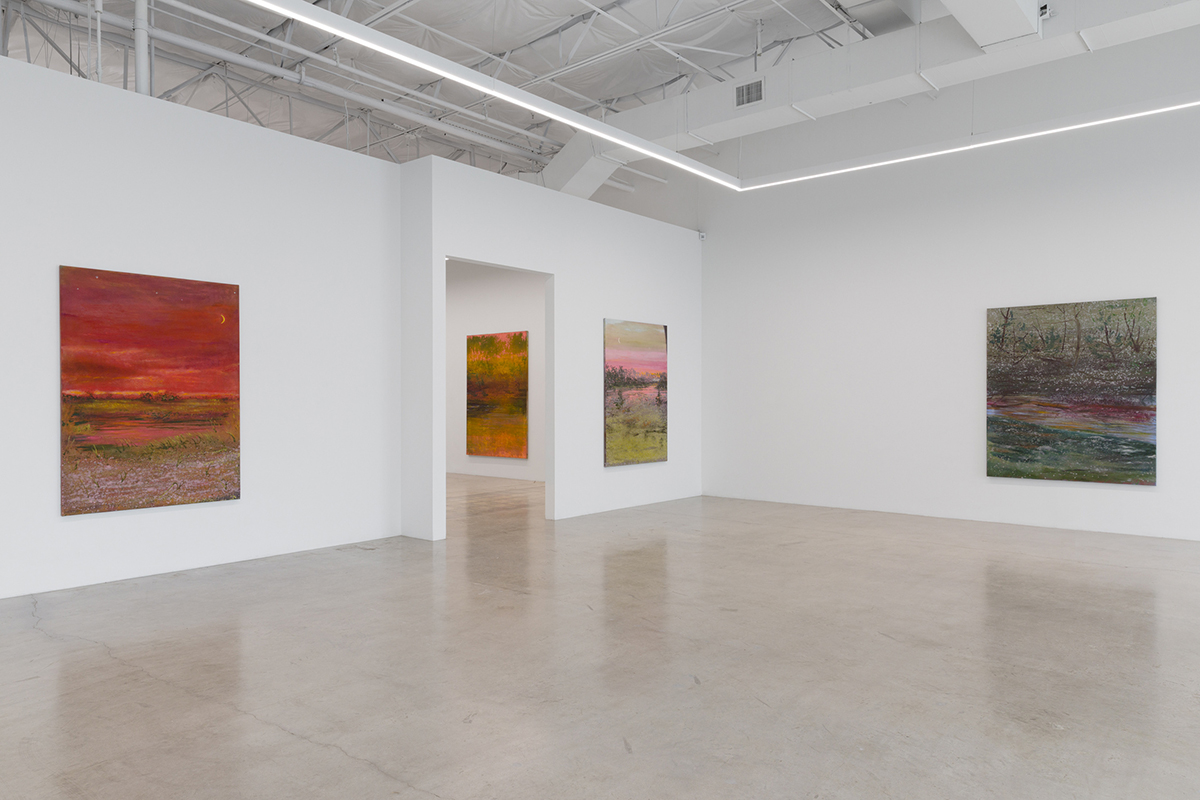 Installation view of Sean Cairns' exhibition at 12.26. Image courtesy of 12.26, Dallas TX
Cairns’ paintings exist within a spectrum: the pictorial, where his decisions around the image are clear; the conjured, where process takes hold; and the threshold, where these two intermix. For Cairns, these states are linked to his interest in the relationships between the human, the natural, and the spiritual. The human is deliberate construction; the natural is the possibilities of paint; and the spiritual is an aspiration for what can arise between them. The pictorial and the conjured are the two poles of the spectrum. The threshold is not a third equal category, but the condition produced when those poles intermix.
Cairns has described his interest as narrowing around Transcendentalism and Expressionism, specifically, where these two overlap. He understands his work through a lineage of painters like Charles Burchfield and Edvard Munch to later figures like Rothko, situating his landscapes within a history in which material sensation and spiritual aspiration are hard to separate.
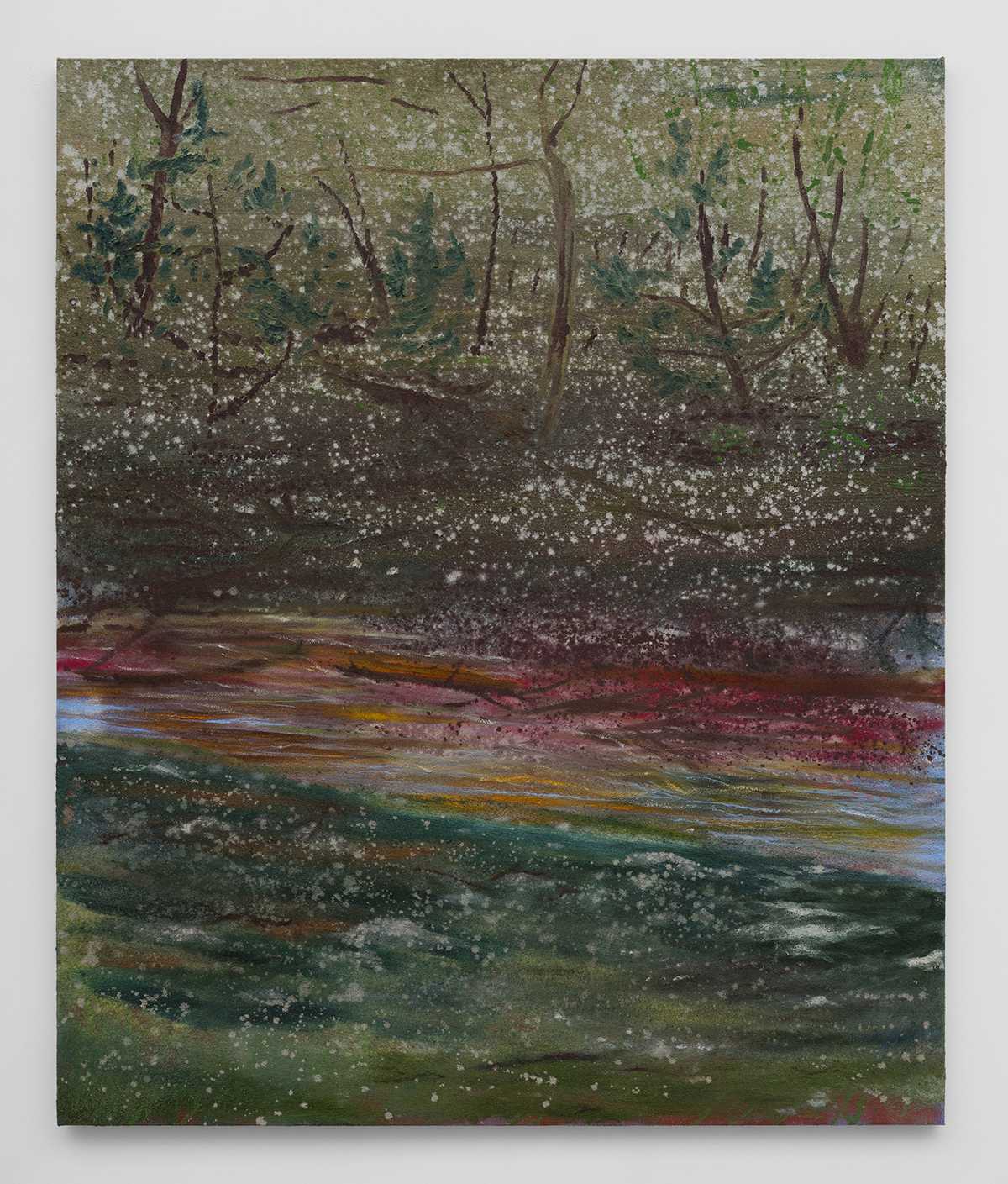 Red River, 2026, oil and sand on canvas, 72 x 60 inches. Image courtesy of 12.26, Dallas TX
Red River is structured vertically in thirds, not purely as a compositional tool but to reinforce this threshold. Areas of the painting appear as recognizable passages—the bark of a tree or patch of earth. Other areas remain as pure paint, as if evoked through an automatic process. The two remain in tension. The divisions are not absolute: each area is dominated by one pole while retaining traces of the other.
The bottom third of the painting is a brew of phthalo and olive greens that have been stirred just enough to resemble a mossy ground. The surface catches and scumbles Cairns’ gestural tree branches, breaking them up and pushing them into the boggy mix. Whereas the upper canvas is marked by deliberation, this bottom third has a more natural sense of emergence. We are aware of Cairns’ decisions as he paints the upper forest, but here, paint itself seems to have agency over its placement. In this foreground, Cairns does not render as much as create the conditions for the image to grow, and then tends to it carefully.
The middle ground functions as a threshold. Paint is whipped back and forth across the canvas, forming loose boundaries between river and bank. Atop the river, clear details in cadmium orange and sky blue depict the rippling current. Branches are carefully portrayed. To the right, splatters of alizarin and damson plum intermingle like a gash or bruise in the landscape, bringing the upper and lower parts of the canvas together. This is where two states visibly meet. Subtly, this cluster of splotches shifts from existing within the image to existing on top of it, as if we are witnessing a point of clarity take shape.
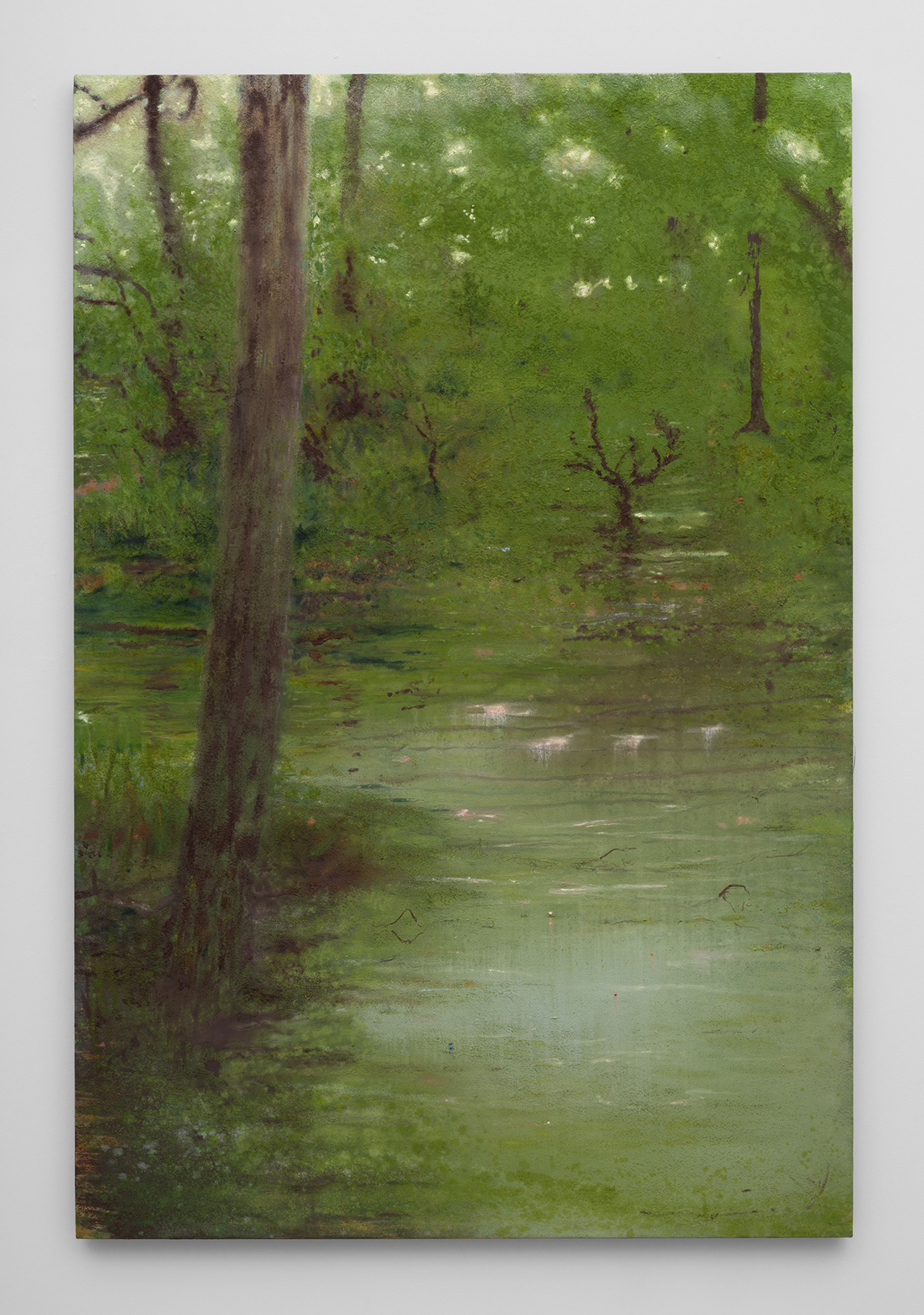 Witching Tree, 2026, oil and sand on canvas, 72 x 48 inches. Image courtesy of 12.26, Dallas TX
In Witching Tree, 2026, light beams through a dense coverage of leaves, leaving a pointed halo around a small, branchless tree. The canvas is engulfed in a sap green field, lit by a soft-white glaze that traces a meandering river. The density of the green is almost confrontational and such a stark depiction of foliage that it keeps the viewer from fully entering the painting. The rendered trees move in and out of this space, sometimes falling back into it and sometimes asserting themselves, indifferent to perspectival logic. The green is modulated: some areas are drawn taut and assert themselves directly while pockets collapse into the painting, giving the feeling of a supported tapestry with sagging areas. Where Red River organizes these conditions into differentiated bands, Witching Tree disperses them across the surface. They alternate and overlap like uneven terrain.
There are a few paintings that sit at the edges of the spectrum, and while they remain within this dialogue, their position at either end keeps them more firmly rooted in either the specifics of landscape or the possibilities of process.
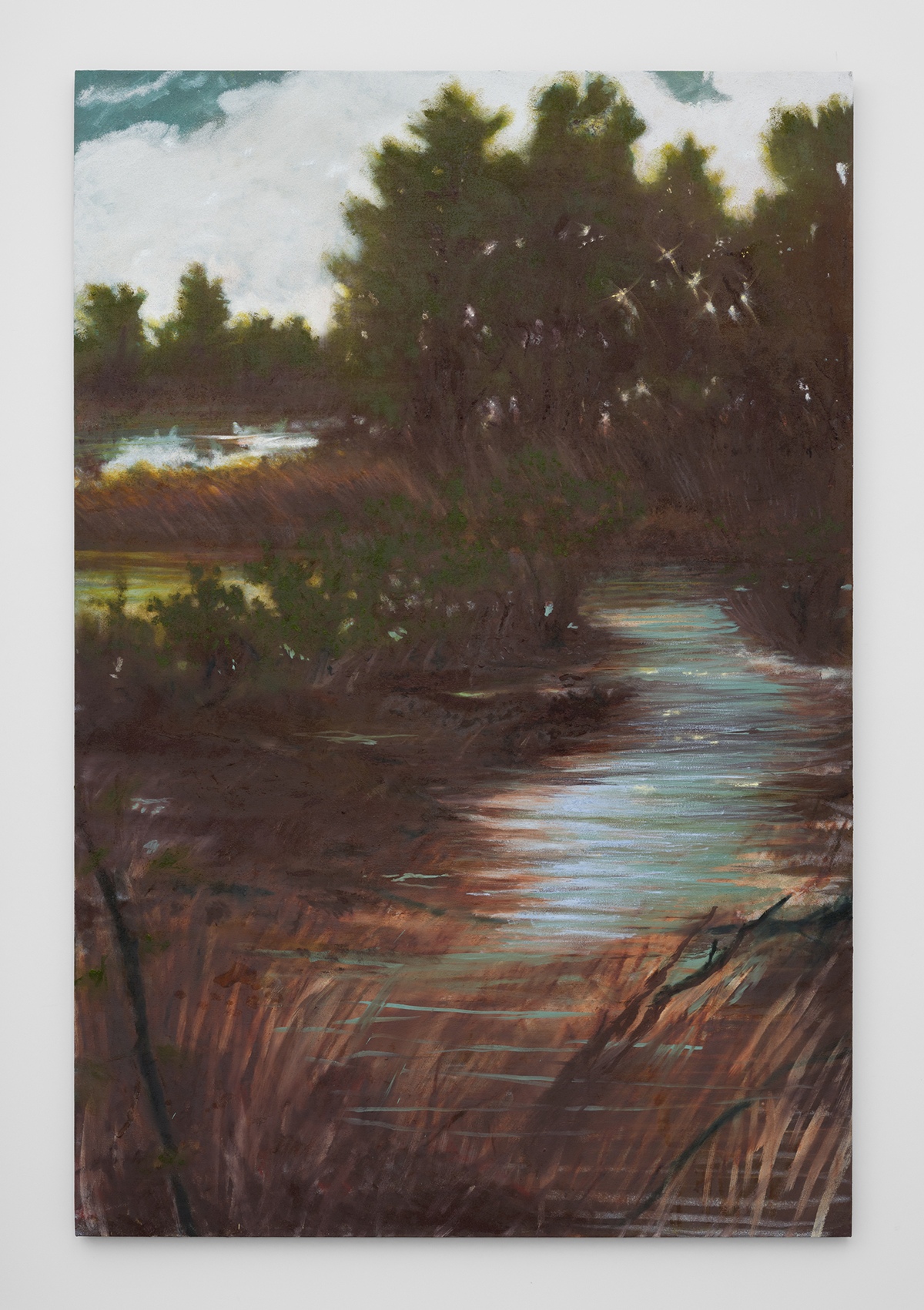 Mudlark, 2026, oil and sand on canvas, 72 x 48 inches. Image courtesy of 12.26, Dallas TX
We overlook the bank of a river in Mirror, 2026. Radiant pink cuts through a band of treetops, creating a dissonant push and pull between sky and foliage. Both are created in highly chromatic, splotchy washes. Through an almost alchemical handling of paint, layers of olive and hot orange-pink have been pulled from one another. The entire canvas is awash in experimentation. At the horizon, we can just make out the hazy details of a riverbank where a few deer mingle—a mere glaze of detail and too faint to push back against the paint. In Mudlark, 2026, the image is far more fully present. We stand at a riverside, tall grass swaying at our knees. It’s a clear day and we can almost feel the breeze. But the paint never complicates the view. Every stroke serves the depiction. With little at stake in the paint, it stays legible and pleasant, never contesting the image.
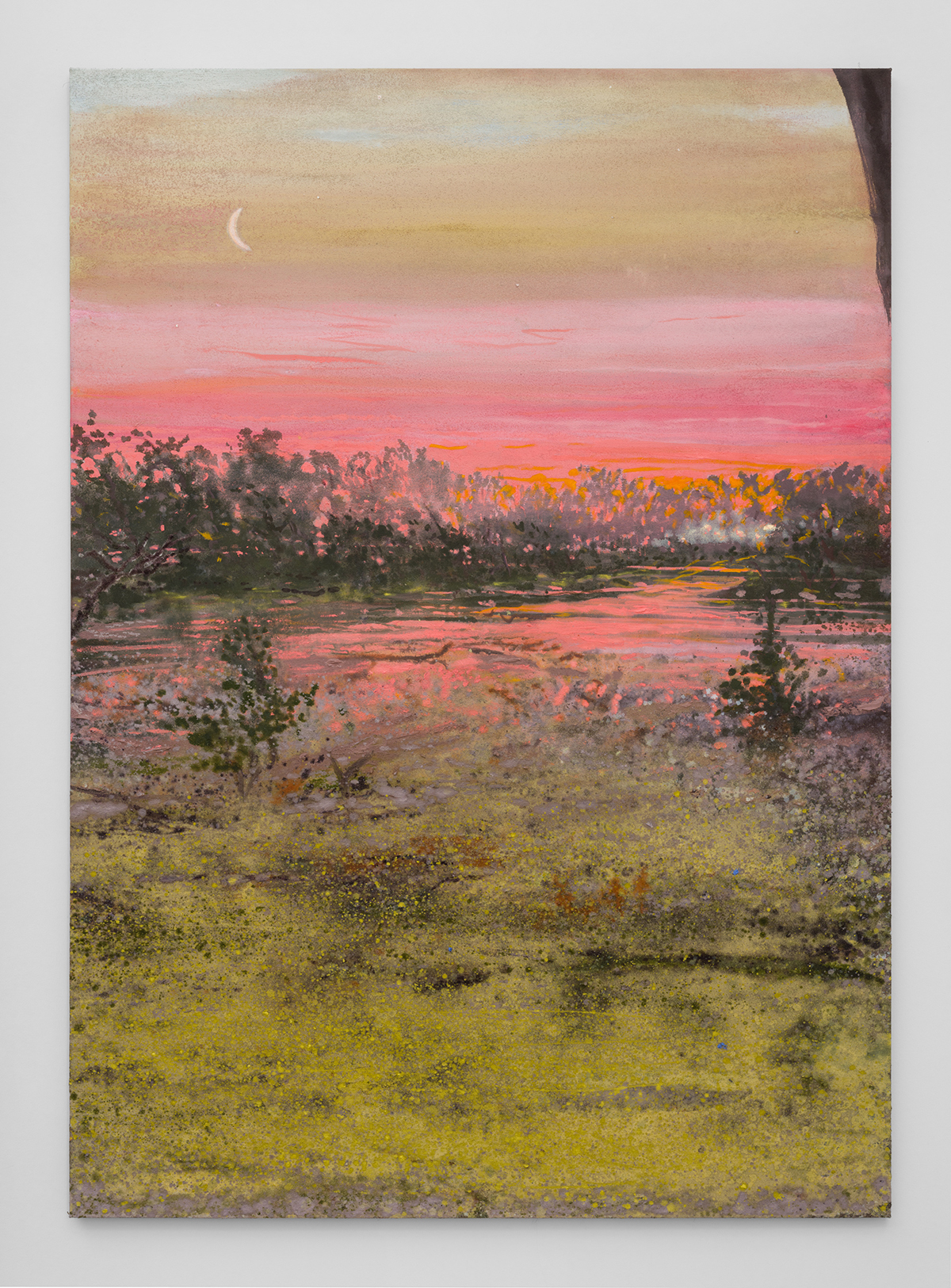 Morning Crescent, 2026, oil and sand on canvas, 70 x 50 inches. Image courtesy of 12.26, Dallas TX
Cairns’ strongest paintings do not resolve the distance between pictorial intention and material contingency; they keep each vulnerable to the other. Color and surface threaten to pull apart the legibility of the image. This exchange slackens when process risks becoming effect and depiction becomes scenery. In Morning Crescent, 2026, a thumbnail-clipping of a moon hangs in a pink and beige sky. The ground congeals through a cacophony of olive and lavender flecks. On the horizon, where these two fields meet, a cluster of light glows—a stubborn act against a ground that could dissolve it.
And when morning comes it comes in the morning and never at night is on view at 12.26 through October 17th, 2026.

Ian Etter
Ian Etter is a Dallas-based artist, critic, and educator who received his MFA in Drawing and Intermedia from the University of Iowa. His work has been exhibited at Tiger Strikes Asteroid, The Wassaic Project, Ortega y Gasset Projects, Spring/Break Art Show. His writing has appeared in Artforum, Glasstire, and Patron, and he teaches art at the University of North Texas.
view all articles from this author