Whitehot Magazine
October 2026
"The Best Art In The World"
"The Best Art In The World"
October 2026
Keya Tama: Tied by Time at The Tampa EDITION
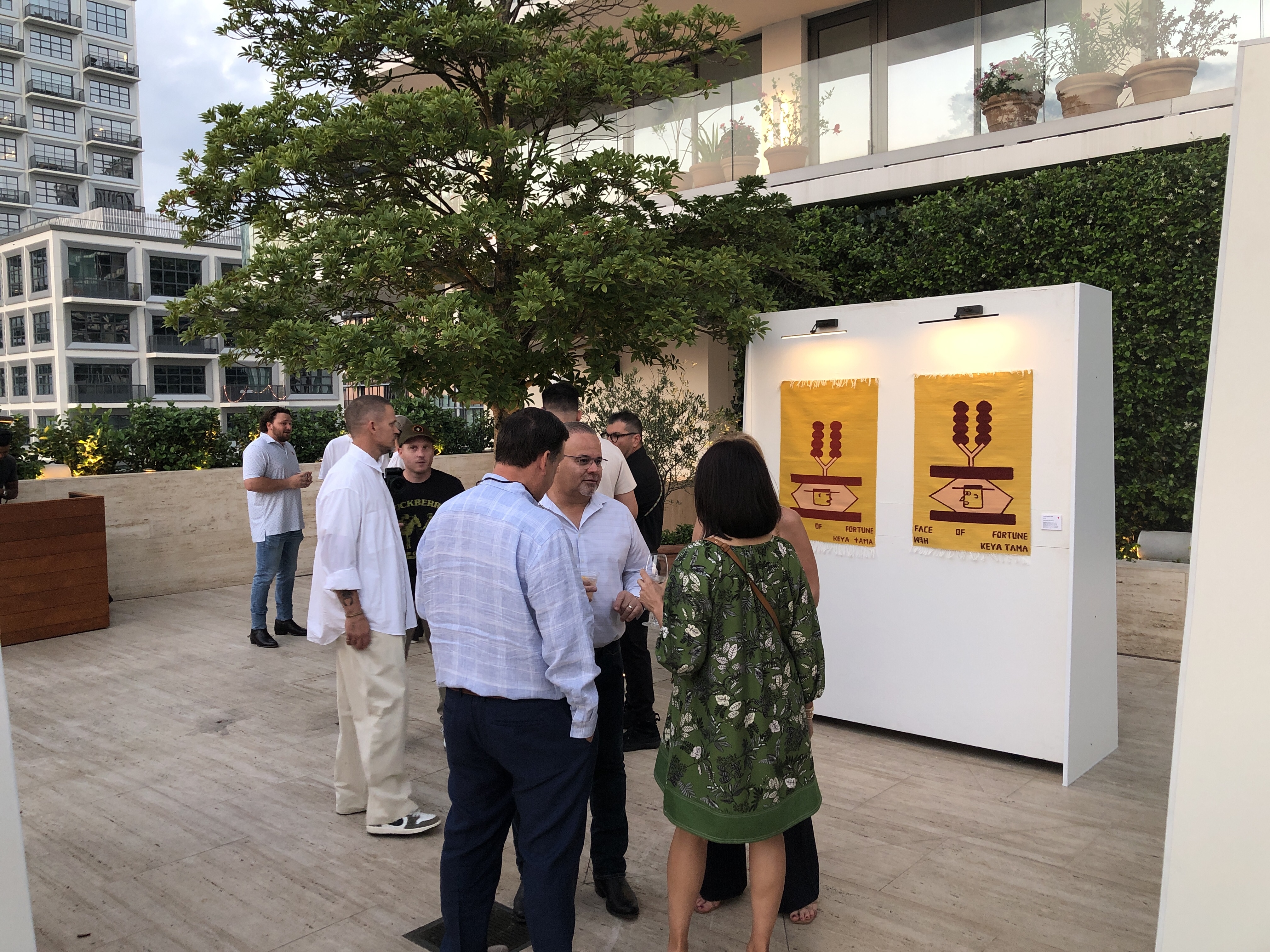 Attendees of the launch of Keya Tama: Tied by Time at The Tampa EDITION | Background art: "Face of Fortune 2x2, 24x36, Loom woven wool tapestry.
By BYRON ARMSTRONG April 30th, 2026
“My parents were always around subcultures like graffiti, skateboarding, and hip-hop,” says Keya Tama of his upbringing by a pair of artists in South Africa. “They both met painting trains together as teens, and my dad taught my mom to paint. They had me super young, so I was always at mural jams, just painting walls to kill time.” His family’s move to Los Angeles in 2016 would be just the beginning of Keya Tama’s jaunts as a global citizen artist, and it’s here where a 19 year old Keya would find a community of creatives that shared his artistic impulses. “I started building a career without realizing it was even an economic thing,” he says. “I was just so focused on the art that money didn't matter, and I still try today to keep my practice to what I’m inspired by first, and then everything else comes second.” While that practice began with street art and murals, over the years it’s grown to include textiles, sculptural installation, and digital illustration. The ethos of street art as a meritocracy that anyone can enter challenges the tension between street art and gallery artworks. “I don't actually think street art needs to be limited to any aesthetics or roles,” he answers. “What's great is that it can still be anything, with tapestry or sculptural elements, or whatever becomes possible with the future of technology.”
This was the beginning of an insightful tableside conversation with South African via Brooklyn-based artist, Keya Tama, the morning after an artist panel where he spoke about his artwork incorporating symbols, iconography, the human figure and animal motifs to create stories connecting the contemporary to the past, and the morning before the one-night only vernissage/finnissage of his show “Tied by Time”; an excavation of how meaning emerges through repetition, attention and time.
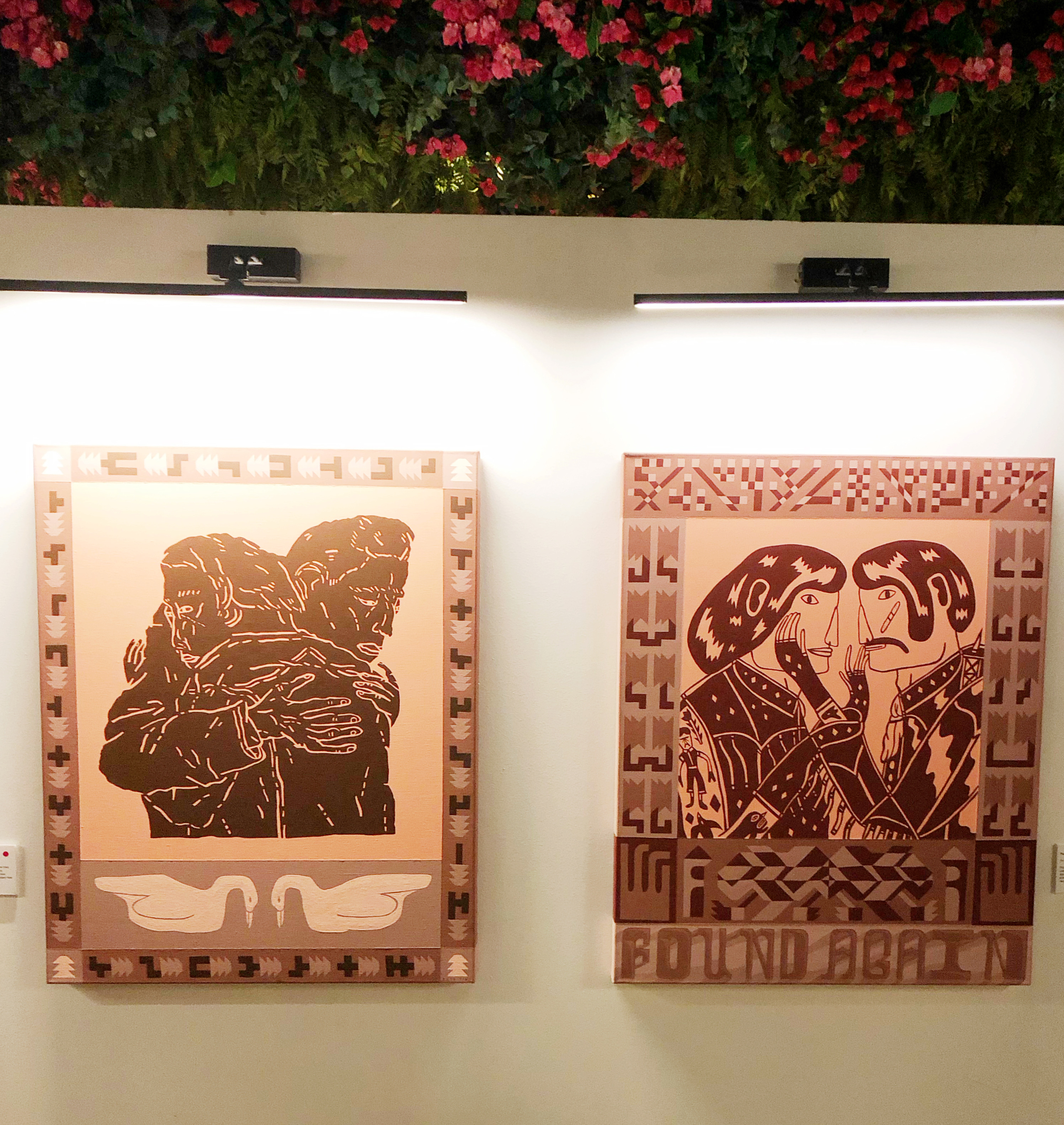 L to R: Keya Tama, "Sweet to Remember" 24x30 Acrylic on canvas | "Found Again" 24x30 Acrylic on canvas.
So yesterday, during your panel discussion, you mentioned that you worked with Shepard Fairey. What knowledge did you glean from that experience that you took into your own career as an artist?
I was very inspired working as part of this huge production team because they were very much running a factory. I always imagined myself to be extremely hardworking, but the work ethic of just having set hours really translated. Also, the scalability of everything and the way that we thought about projects; there would be a small concept, but it would never really have limitations. All this work would function in a very thoughtful, design-principled way that heavily influenced me to look for artists who do that well, and historically speaking, movements that sort of blurred the lines between fine art and mass production while making the world more beautiful. I think you want to make work that is both beautiful and thoughtful. I think in some ways, it also made me realize I didn't really want to do things at that scale.
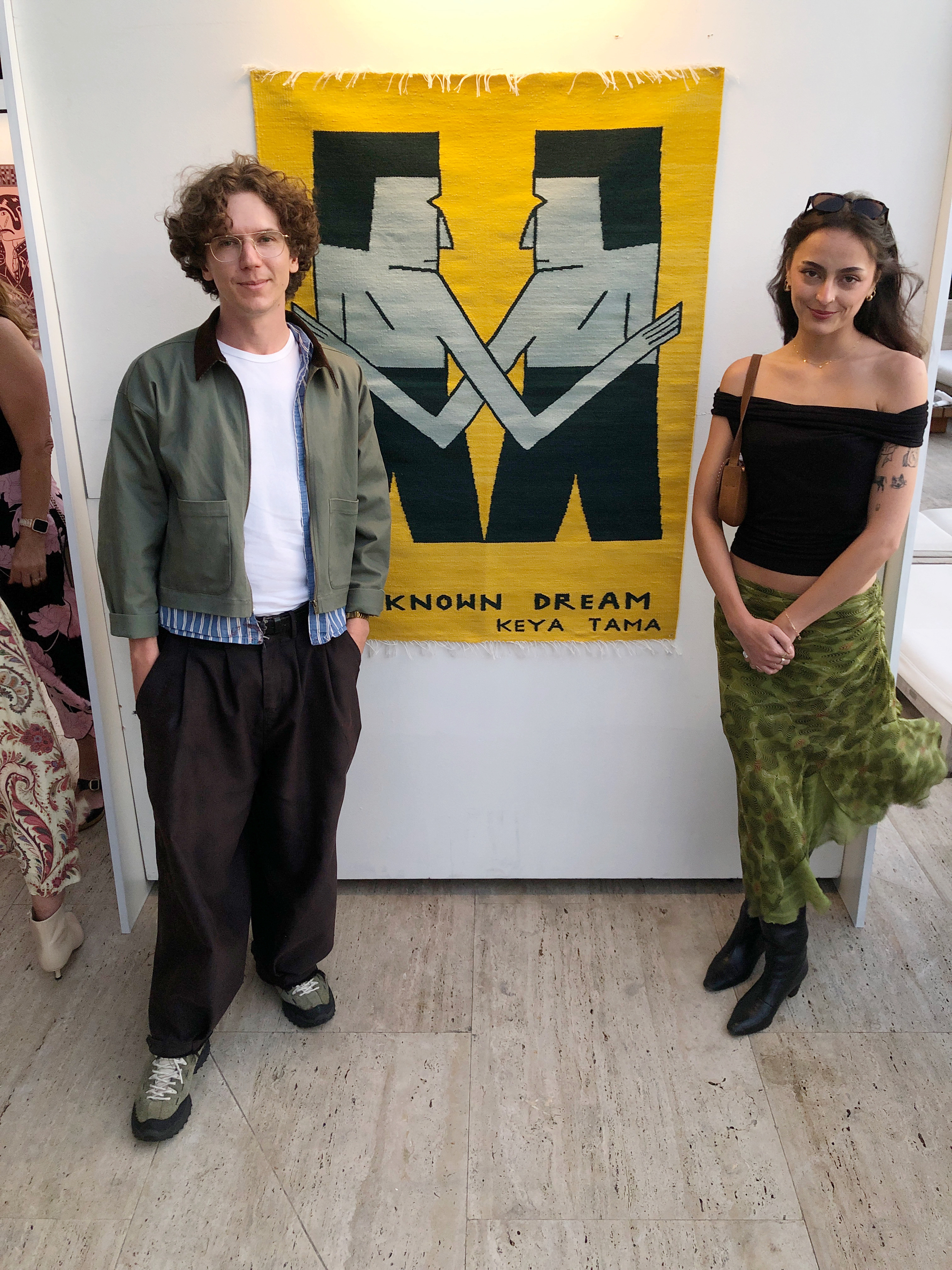 Keya Tama and Guest | Artwork: "No Known Dream" 35.5x37, Loom woven wool tapestry.
Shepard Fairey is also a pretty political artist. How does your art engage with that? When I look at some of your work, like “Tied by Time” yesterday, it feels like it speaks to the movement of people and congregating in communities. As you sit in this current moment in the United States of America, do you feel like your work, any of your work, speaks to anything that's going on today?
Well, I think it's not necessary that my work has to be political to have a very positive intention behind it and be informed by the current state of the world. Basically, since the start of my creative process as a muralist and painter, I've been a traveller. When I was 16, I went on this one trip with my mom where we were working on a mural project at the UN. After we received a hurricane warning, we flew back to New York at the last minute. I ended up painting a mural at the New World Trade Center with a bunch of artists and, for me, this represented an extreme contrast of environments. It became incredibly apparent that if you could just translate stories consistently without focusing on any one country— just the contrast of rural environments to cities—with some emotional weight is a political practice in and of itself.
I believe in echo effects of sentiment, and something that inspires me is just like the intensity of care, and really making work while appreciating the stories you're around. I actively collect sayings from around the world, wherever I go to get a sense of the culture. There are so many endless commonalities and symbolic overlaps that you'd never expect, and it just really excites me. So I think my work sort of speaks to the fact that, although this is the current moment, in every place the future and the past is occurring relative to where we are right now in America, and there's so much to be learned from that. I think without physically traveling, you can do that through art, and it's almost just the price of admission is to patiently explore those layers in the work.
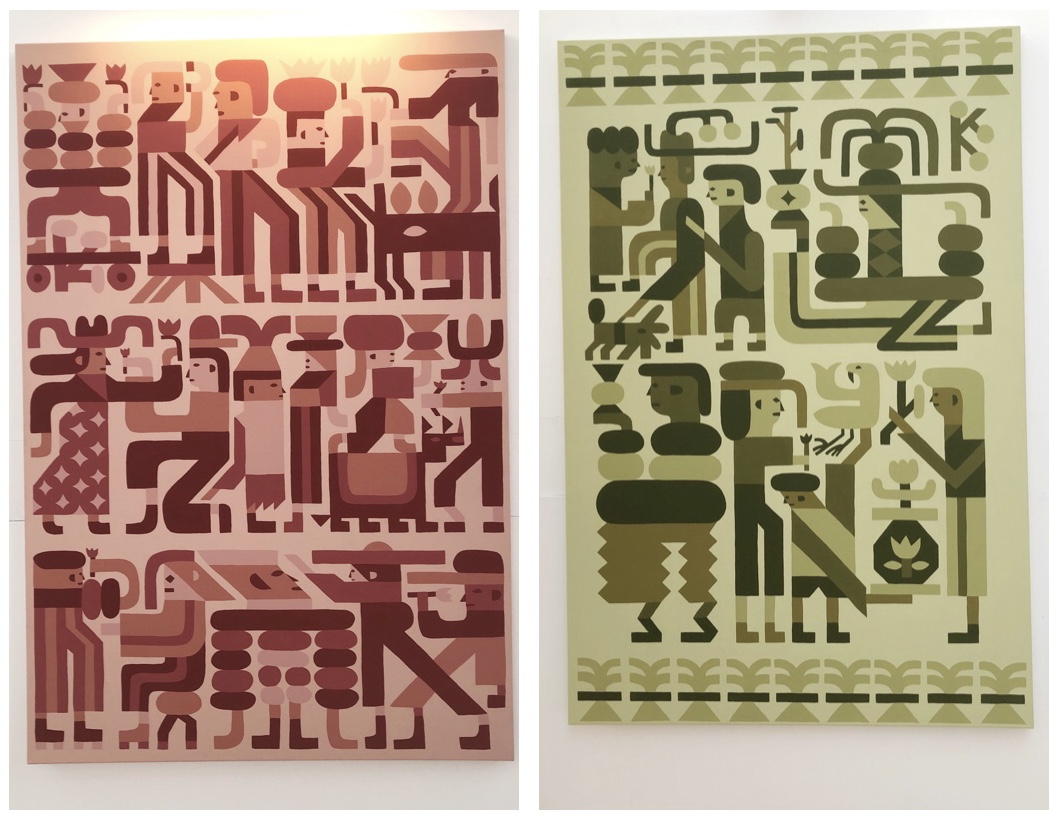 L to R: Keya Tama "Told By Time" 40x60, Acrylic on canvas | "For Flowers" 40x60. Acrylic on canvas.
So you're an artist with a practice that includes large-scale murals, textiles, digital illustration, and painting. Are there any challenges with operating within all these different disciplines?
When I was a kid, making art was so electric that it felt almost like a race against time to keep my imagination alive because adults would always say that when you get older, you kind of compromise. While there’s a growing art movement* in South Africa now, at the time, there was very much this feeling of scarcity that was so intense that you don't realize it until you leave the bubble. Wanting to break boundaries by using different mediums and learning the histories of those mediums has been very empowering and meaningful. It also feels so necessary. For instance, the history of ceramics is completely being articulated now. What is seen as important is still being legitimized, and then there's various other craft movements that the fine art world still considers illegitimate. However, all of them have parallel histories and influences.
In South Africa a lot of the most important painters never got to live long enough to be recognized but are now in museums. The same thing is occurring with ceramics where there's endless names of people all over the world who had massive influences in culture and design, but they never actually got to see their influence be gratified, and I think it's not so much for me, it's just about honoring the craft as a whole to experiment and learn more and keep them alive. It feels like a natural focus over a digitization of reality, and just having more of a sense of tactile influence is really important, and all of that seems to be more and more useful as a balancing tool, as a focus.
*[Author’s Note: This includes Johannesburg’s Inside Out Foundation and South Africa’s Art Week.]
How did coming to the U.S. influence your practice?
Yeah, and I mean, moving to America, the folk art movement here has been very inspiring because it's so interwoven with music and a lot of culture that seemingly still exists through speech and oral traditions, through just people. Or even indigenous cultures. Yeah, yeah. I mean, it's across the board, but I guess what I'm saying is there's a universal necessity to care and make things by hand and pass that on to generations that my work speaks to and I'm very interested in. That's why I don't necessarily feel like I have to be an expert in everything, but I just want to be humbled and learn a little bit of everything.
I don't want to say that this is the case, but it feels to me that some of your work, like “Told by Time” or “For Flowers” is influenced by indigenous cultures; by that I mean like Aztec or Egyptian hieroglyphics. Going back even further, cave paintings. Can you pinpoint any specific cultures that you feel are a heavy influence or even like a subconscious influence on your work?
So there isn't one singular point, but I think it's an intentional mix of many things because, traveling so much when I was young, I saw and was influenced by a lot. But, yeah, there isn't just one singular point. But, yeah, I think I was very, yeah, very inspired by just in general, like, the idea that all of time is kind of like, works in waves, and that there's almost a need for a more ancient-looking, calm, simplified patterning to exist in a world that once almost goes so far forward that we're forgetting everything at once.
A lot of my style is inspired by visiting the catacombs and seeing wood carvings, or sculptures I’ve seen made by people in small towns that no one knows with a decorative ornamental structure in front of someone's house. Regardless of the skill level, it's made compelling by the amount of effort and the love inside of it. I've had experiences in Haiti, Athens, South Africa, and all over Europe where all the elements of that love of craftsmanship has inspired me.
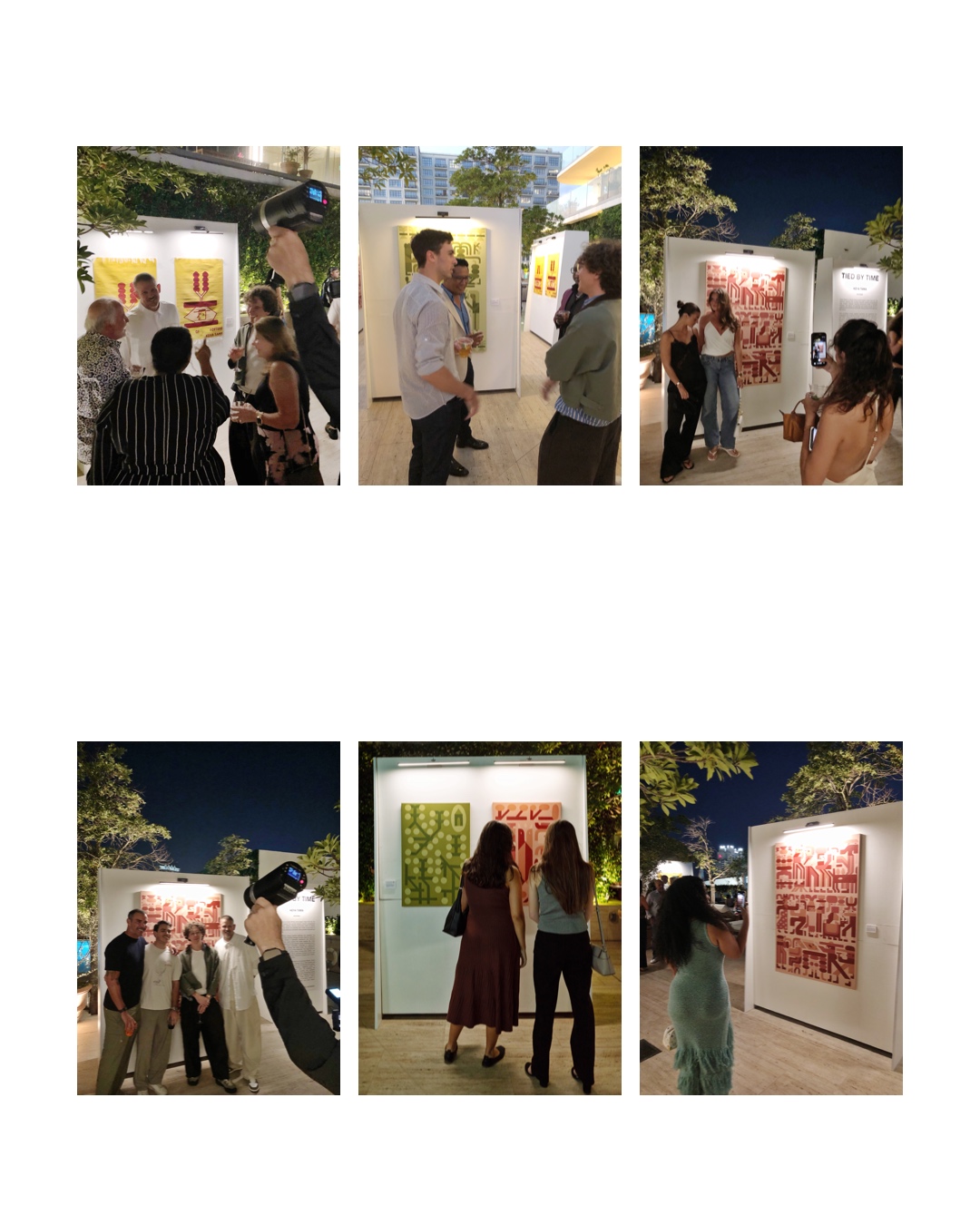 Attendees at Keya Tama: Tied By Time
You talked a little bit about integrating yourself into different arts communities while moving from place to place at last night’s panel. What is something that you've taken from all of your journeys through these different arts communities that you can say are integral to building an ecosystem for the arts?
I think that there's this feeling sometimes that all of your efforts have to make sense and that all these different attempts are to build something; it has to immediately transcend and pick up pace and become something bigger. But what I’ve realized is everyone who's tried to make a difference with anything creative and community-based, especially in projects I've been a part of, is that it lives on in younger members of those communities so deeply.
That's part of why I feel very motivated to be a part of communities where I go. I really do think you owe back the inspiration you receive, and I think it's an integral thing to give it back in some way. I also feel that, whether or not people can give it back, it's a human need. I feel honored to have that debt in terms of the amount of abundance and love I've received traveling and seeing all these people do cool, innovative things; things that are quite difficult to do and hard to believe in, but that I really see making a huge difference. It's not necessarily a numeric metric , it often lives in people in ways that can't be seen for decades.

Byron Armstrong
Byron Armstrong is an award-winning freelance journalist and writer who investigates the intersections between arts and culture, lifestyle, and politics. Find him on Instagram @thebyproduct and on Linkedin https://www.linkedin.com/in/byron-armstrong
view all articles from this author