Whitehot Magazine
October 2026
"The Best Art In The World"
"The Best Art In The World"
October 2026
Bentley Brown & Brandon Alexander: Now, Off Time
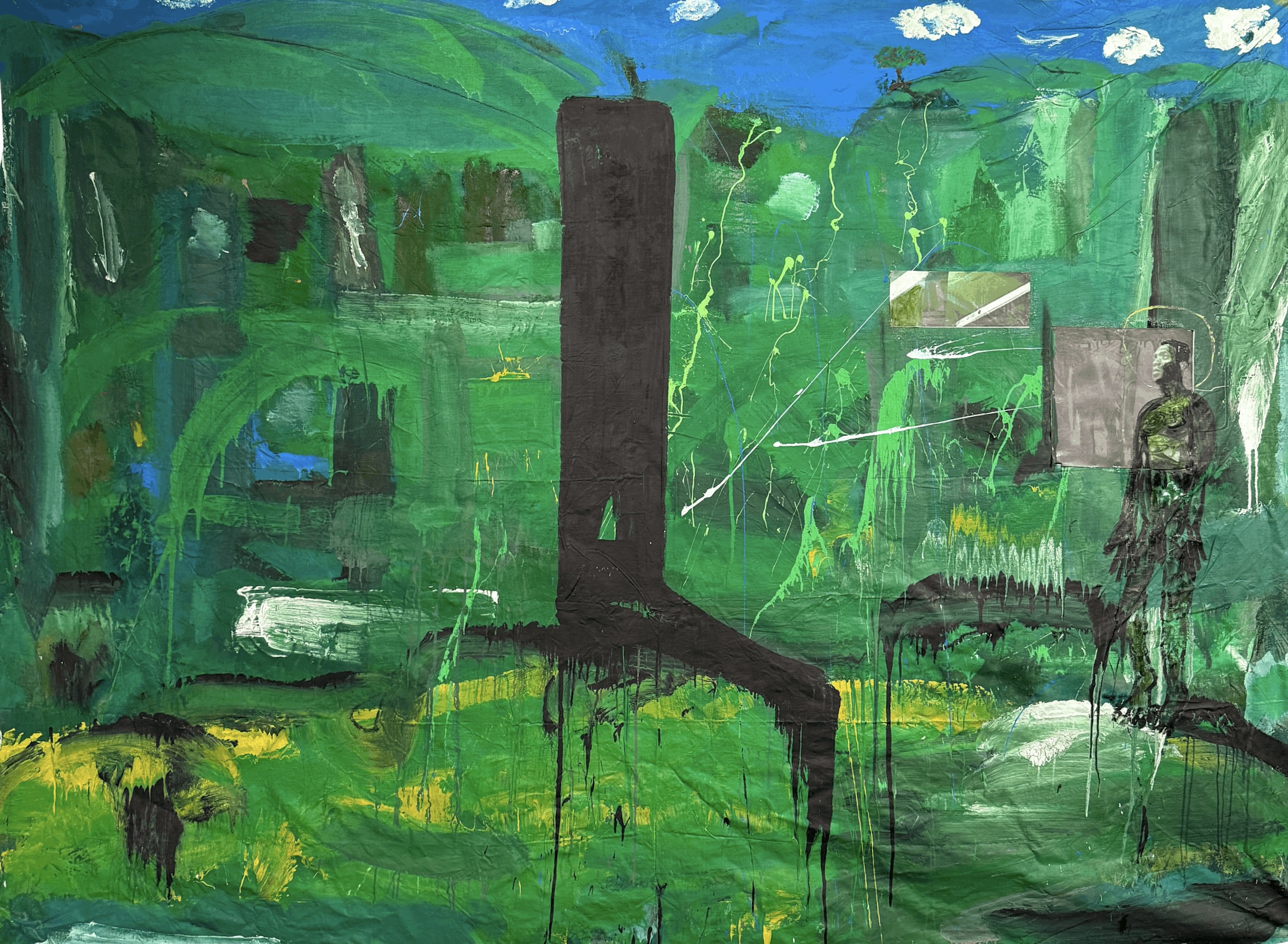 Bentley Brown, Alpha and Omega, 2026
BY: MYLES FUCCI October 12th, 2026
Walk through NYC's Title of Work Jewelry, up the stairs, and you will find the Mackcut video editing satellite office space. Here, Now, Off-Time is being displayed, featuring work by Bentley Brown and Brandon Alexander, until October 17th.
What does it mean for us to think of rupture as a medium of blackness and dynamism? This is what Brown and Alexander’s work is asking us to do. Blackness, as it is being discussed and represented in Now, Off-Time, moves beyond the epidermal and shifts into something that is ontological with regard to subject and medium. While both artists create works using different mediums, we witness a conversation between Brown and Alexander that uses the medium of improvisation in an attempt to capture discontinuous moments between the two of them.
Immediately upon entering the space, you bear witness to Bentley Brown’s Alpha and Omega as you ascend the staircase. Created shortly after the passing of Brown’s father, the piece captures the weight of that loss while simultaneously marking a rebirth from it. In the piece, there is a black obelisk in the center representing the weight of the experience, while to the right of the obelisk, we see a presumptively black male figure with a thin halo representing the rebirth of the experience. The figure stares up towards the obelisk, giving the viewer a sense of hope and embracing this monolithic event it has borne witness to. Alpha and Omega leaves you with a sort of haptic hope that drops you off at the question: "Where do we go from here?"
As you move through the space, you encounter the triptych SAILORS, MANNEQUINS #1, and HAT #1. Alexander’s work functions as a negotiation between the legible and the illegible: a dialogue that extends to his process, as all the photographs in this exhibition were pulled from his archive to see how they might respond to the present moment. The gap between capturing an image and retrieving it from the archive highlights how rupture operates throughout the exhibition.
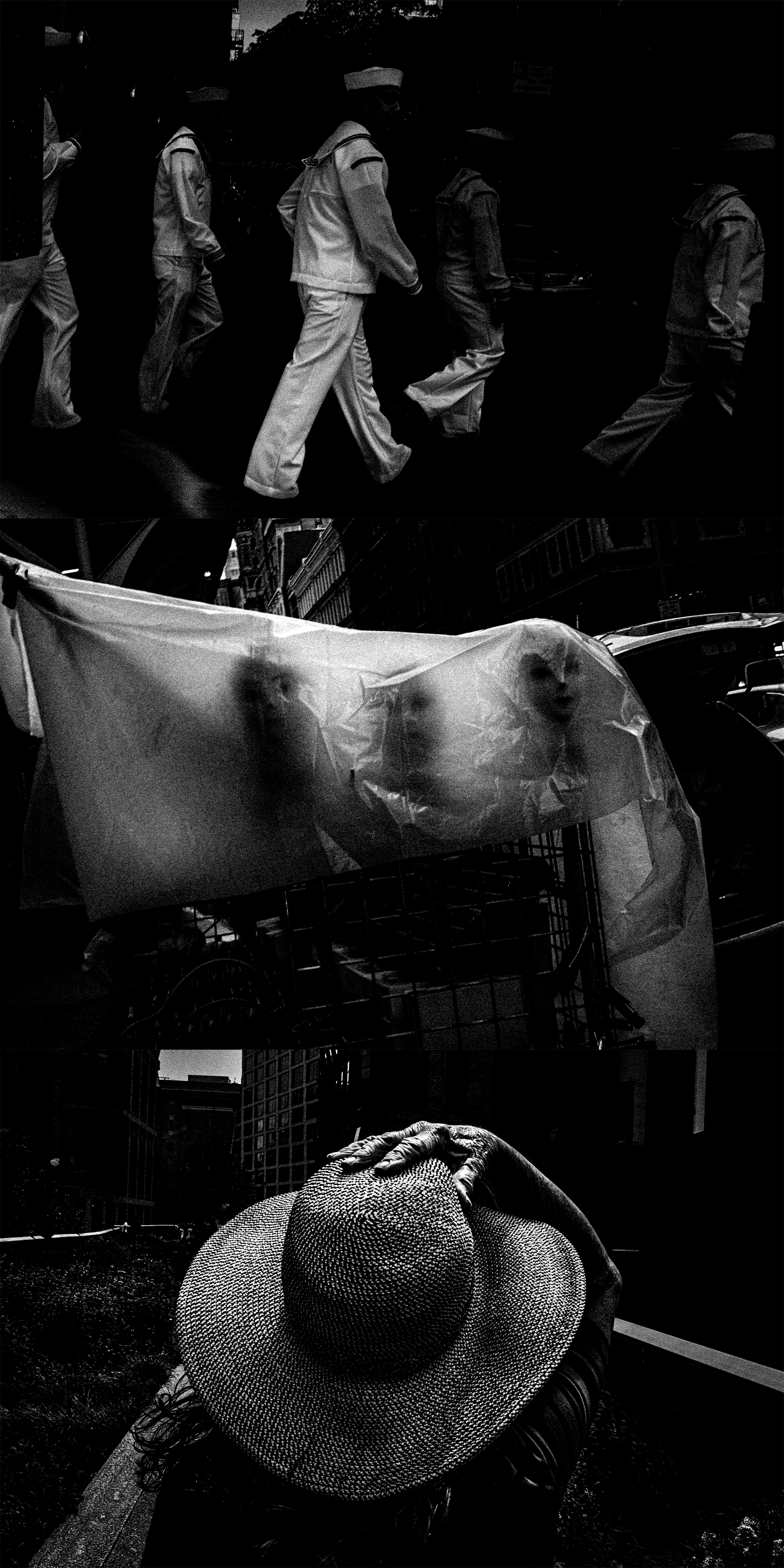 Brandon Alexander, top to bottom: SAILORS (2024), MANNEQUINS #1 (2024), & HAT #1 (2025)
In this series, Alexander engages deeply with the themes of dress and fashion. SAILORS embraces an ambiguity that forces the viewer to focus on a subject evading full capture: though a group of sailors walks down the street, only one emerges as the primary focus. This motif carries into MANNEQUINS #1, where discarded mannequins draped in plastic similarly resist complete legibility, yet come into sharper focus than the sailors. Backlighting and rich blackness illuminate their inanimate faces, making the mannequins feel as if they're being given life. By HAT #1, the image reaches full clarity, drawing us entirely in, yet the subject still evades capture, leaving us to wonder who sits beneath the hat and whose hand holds it. Ultimately, all three images utilize blackness to help their subjects evade capture while simultaneously asserting their existential presence within the space.
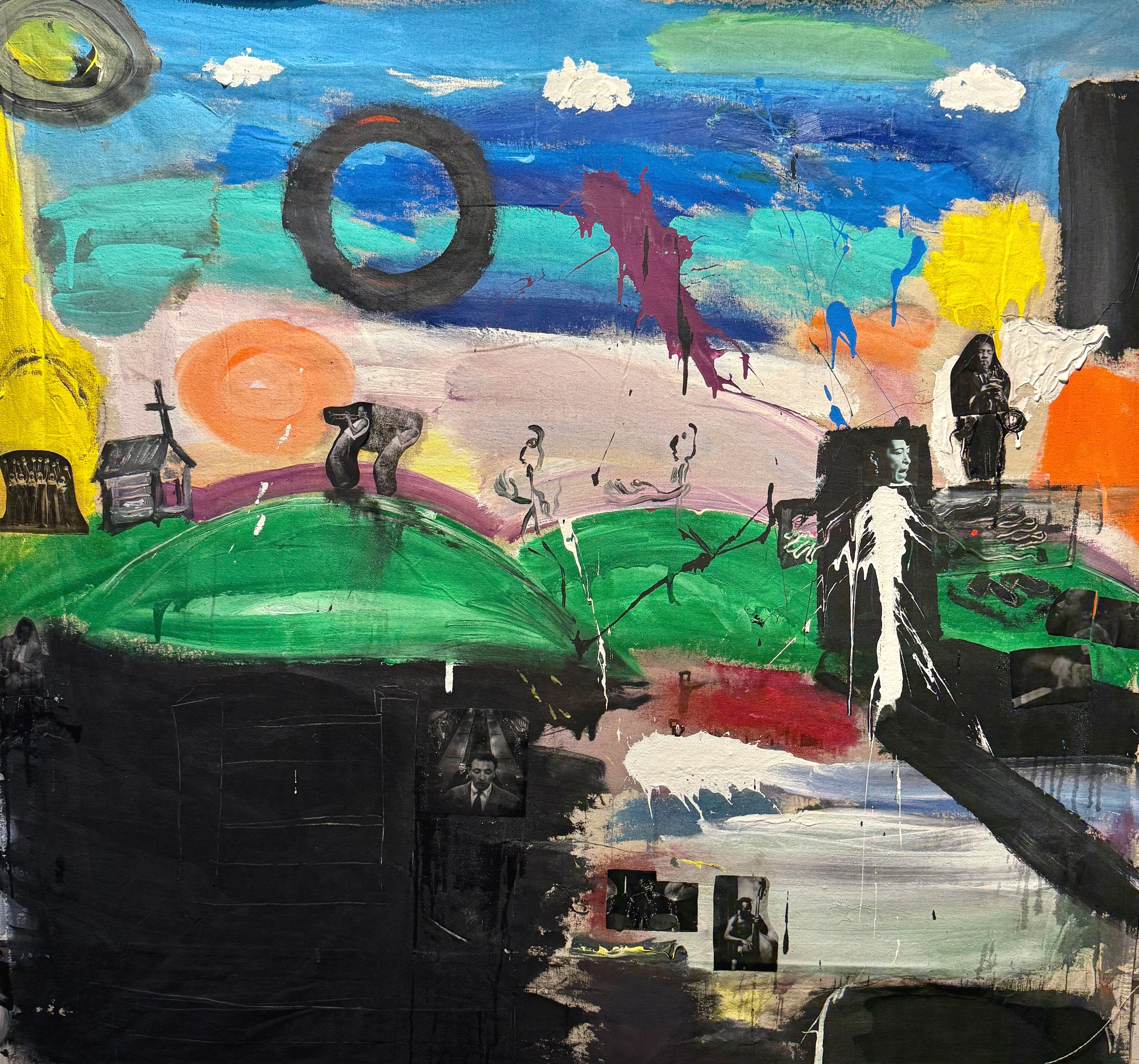 Bentley Brown, Revelations, 2026
There was one set of works by Brown and Alexander that captivated me for the majority of my time at the exhibition: Revelations and EYES. Like many of Brown’s photo collage pieces, Revelations presents a colorful landscape that creates a striking juxtaposition between invisibility and visibility. Numerous prominent Black figures are depicted throughout the image, but the cutout of Billie Holiday caught my attention most. Holiday’s head is fixed to what appears to be a black crucifix, alluding to the severe backlash she faced upon releasing her iconic protest song, “Strange Fruit.” She endured heavy censorship and resistance, including radio bans, for exposing the harsh reality of lynchings in the United States, a violence rooted in the history of chattel slavery.
Directly above Holiday stands John Gilmore, the acclaimed saxophonist who dedicated much of his career to performing with the Sun Ra Arkestra. Though criticized for not prioritizing a solo career, Gilmore remained devoted to Sun Ra’s vision, believing it to be expansive and transformative within the jazz tradition.
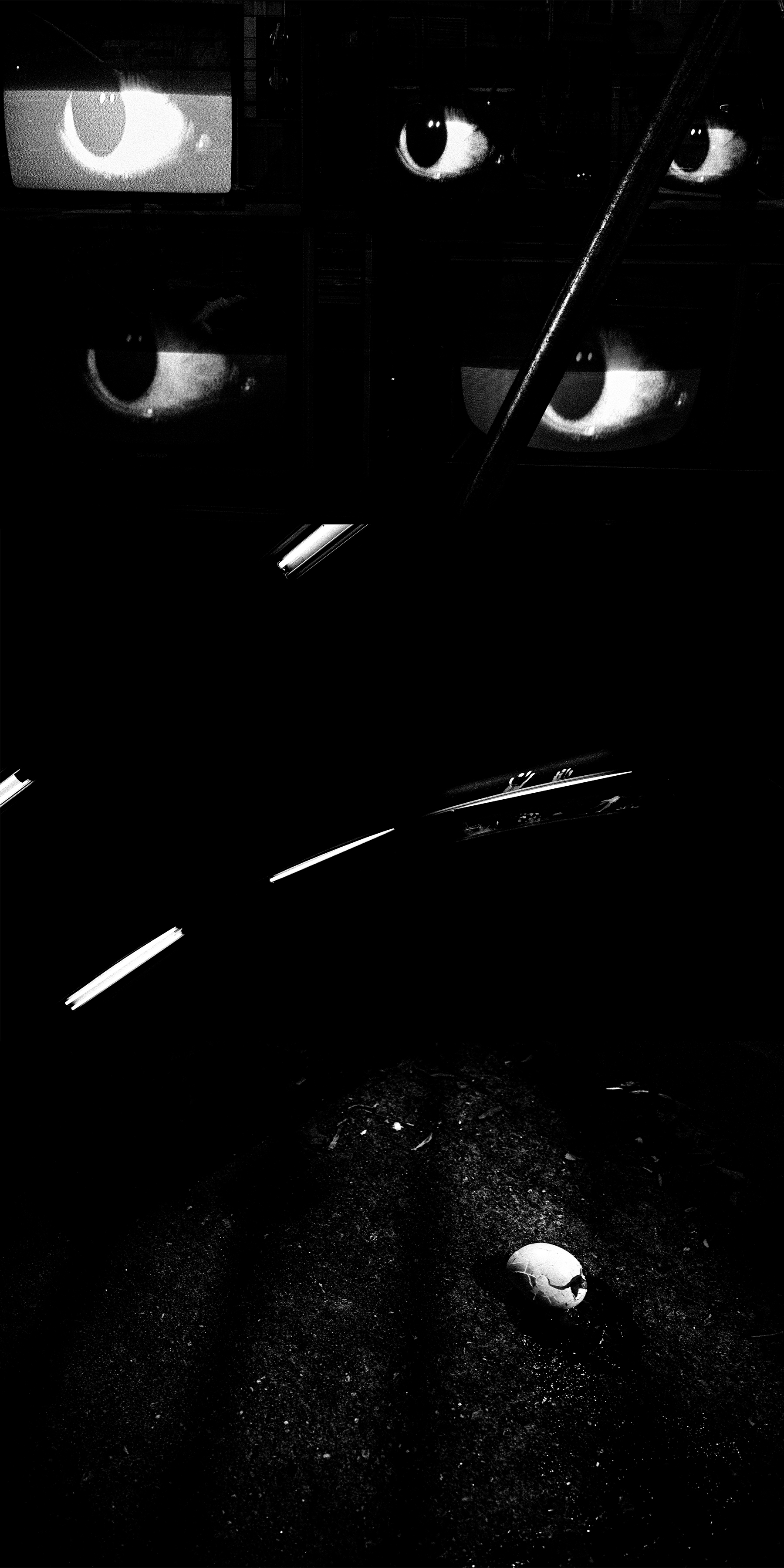 Brandon Alexander, top to bottom: EYES, HANDS, & EGG, 2024
Both of these figures, alongside others in the collage, are observed by Alexander’s EYES, which responds directly to the visceral scrutiny endured by Holiday and Gilmore. These eyes are rendered without a distinct racial identity, fully enveloped by the surrounding black space. Are they the eyes of supporters, or are they critics? Ultimately, they stand as a powerful testament to Brown’s work, articulating the unique pressure experienced by Black figures when making choices that may be unpopular yet remain profoundly authentic and aligned with something greater than themselves.
The combination of Brown and Alexander’s work in a somewhat unusual exhibition space provides insight into their individual practices while establishing an ongoing conversation between the two artists. Blackness, to me, is synonymous with discontinuity in that it is non-linear. Experiencing blackness both epidermally and ontologically as an expanse and a continued rupture is exactly what this exhibition presents: a rhythmic dialogue capturing blackness in its many forms.

Myles Fucci
Myles Fucci is a curator, writer, and model based in Brooklyn, New York. His interdisciplinary practice explores discontinuous Black diasporic narratives and the ways memory, kinship, and archives shape our understanding of the past and possibilities for the future. While grounded in an interest in Black diasporic life and cultural production, his work remains attentive to broader questions of history, relation, belonging, and symbolism.
view all articles from this author