Whitehot Magazine
October 2026
"The Best Art In The World"
"The Best Art In The World"
October 2026
Exhibition Review: "Leslie Wayne: The Unintended Blues" at LMCC, Governors Island
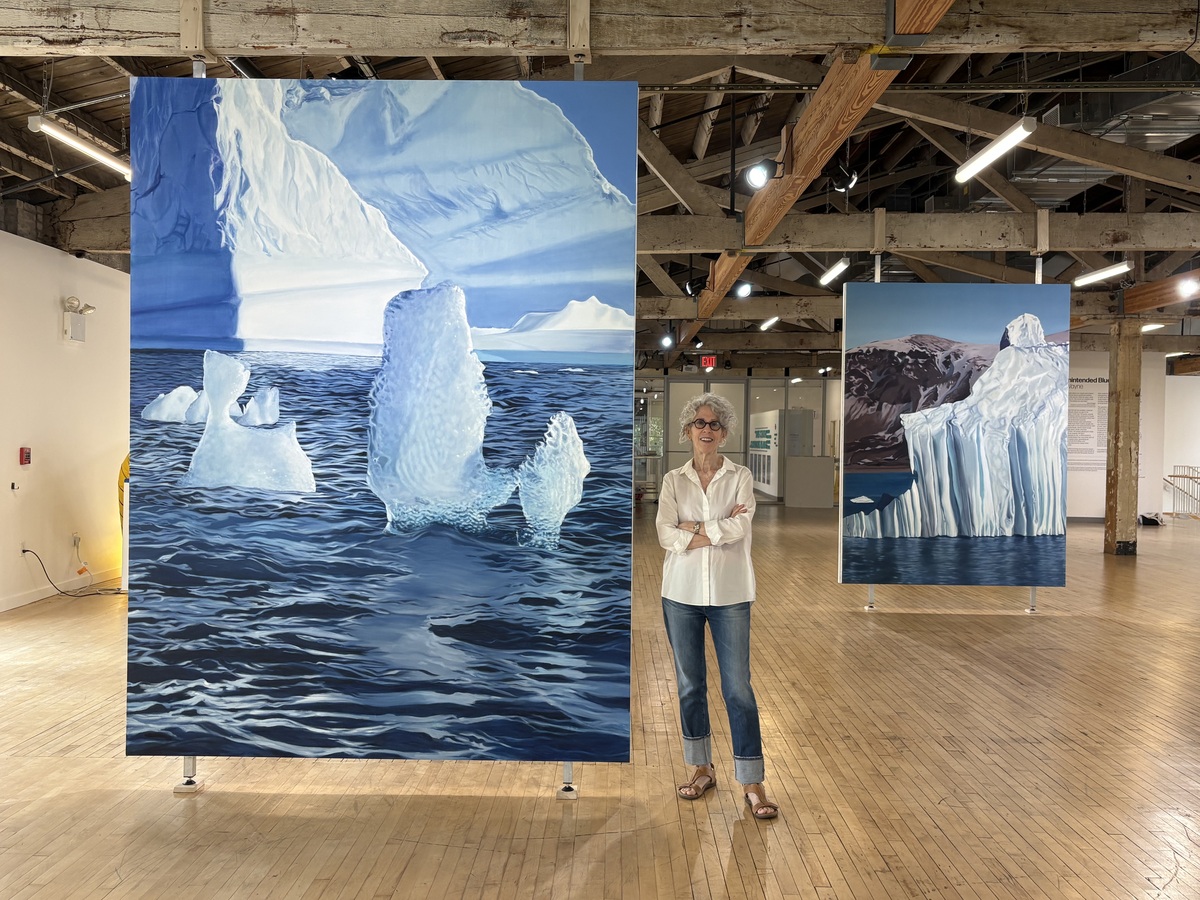 Leslie Wayne posing with her painting Melville Bay (2025) at her solo exhibition, The Unintended Blues, at LMCC (2026).
By LIAM OTERO October 23, 2026
Ecological art must not be confused with landscapes. The former is in reference to art whose purpose is to address environmental themes with an eye toward climate justice, biodiversity, the Anthropocene, and other interrelated topics. Landscapes can apply to these ideas, but are often more grounded in pictorial and / or narrative strictures that may not have anything to do with the environment as its subject. The German-born, New York-based artist Leslie Wayne (b. 1953) recently embarked on a new series of paintings that are a potent rallying cry about climate change’s deleteriously irreversible transformation of the landscape.
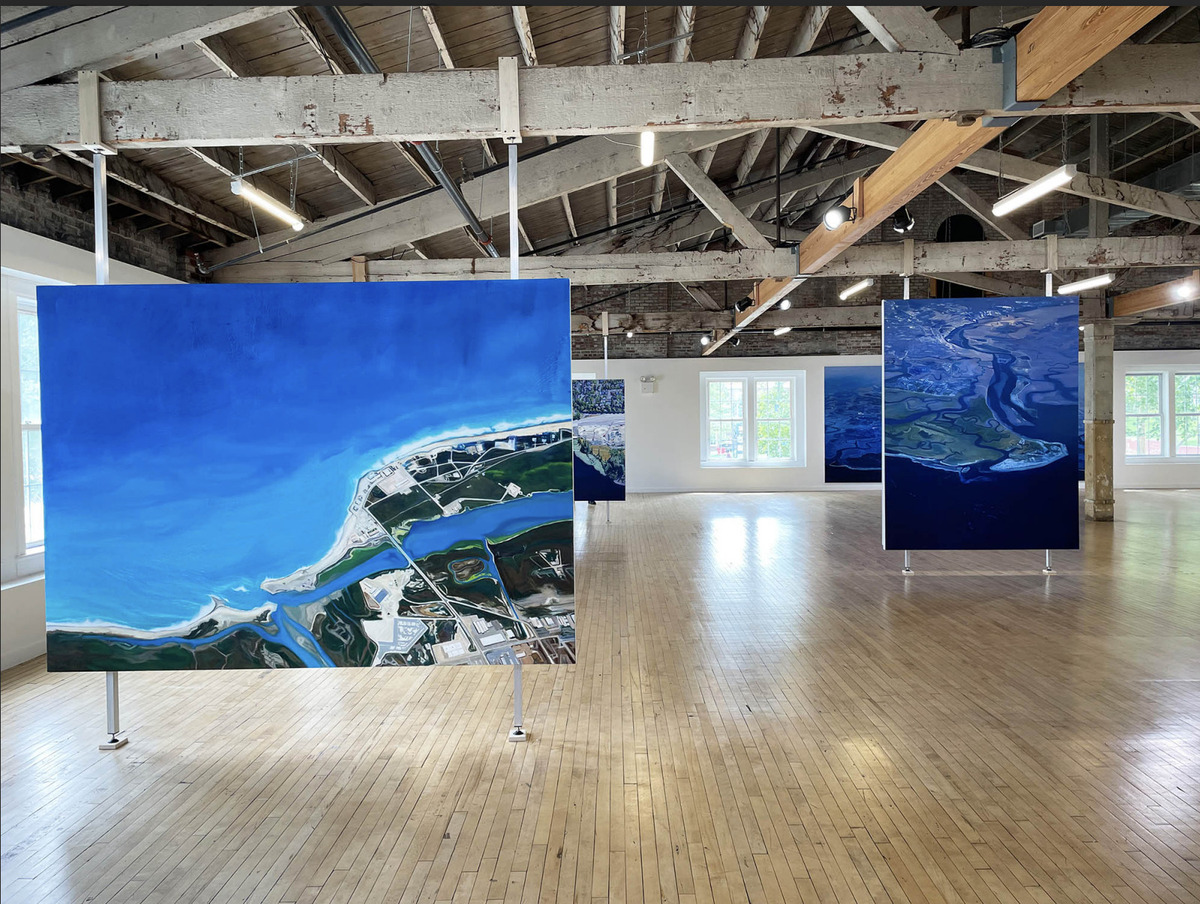 Installation view of Leslie Wayne: The Unintended Blues at LMCC, Governors Island. Photo credit: Cole Witter. Image courtesy of the artist.
The Unintended Blues directs our attention to coastlines that have been significantly altered by coastal erosion, pollution, and rising sea levels. Wayne’s paintings are enormous in scale, practically washing over you with a seismic intensity that matches the urgency embedded into them. This body of work originates from early-2024 when Wayne was returning to New York from the Yucatán. On the flight home, what began as a passing glance swiftly turned into a startled look at the dangerously encroaching tributaries along the Chesapeake Bay. There was a duality to Wayne’s reaction - a recognition of sublime beauty for the awe and might of the landscape, but also an awareness that the sea levels were at risk of further elevation.
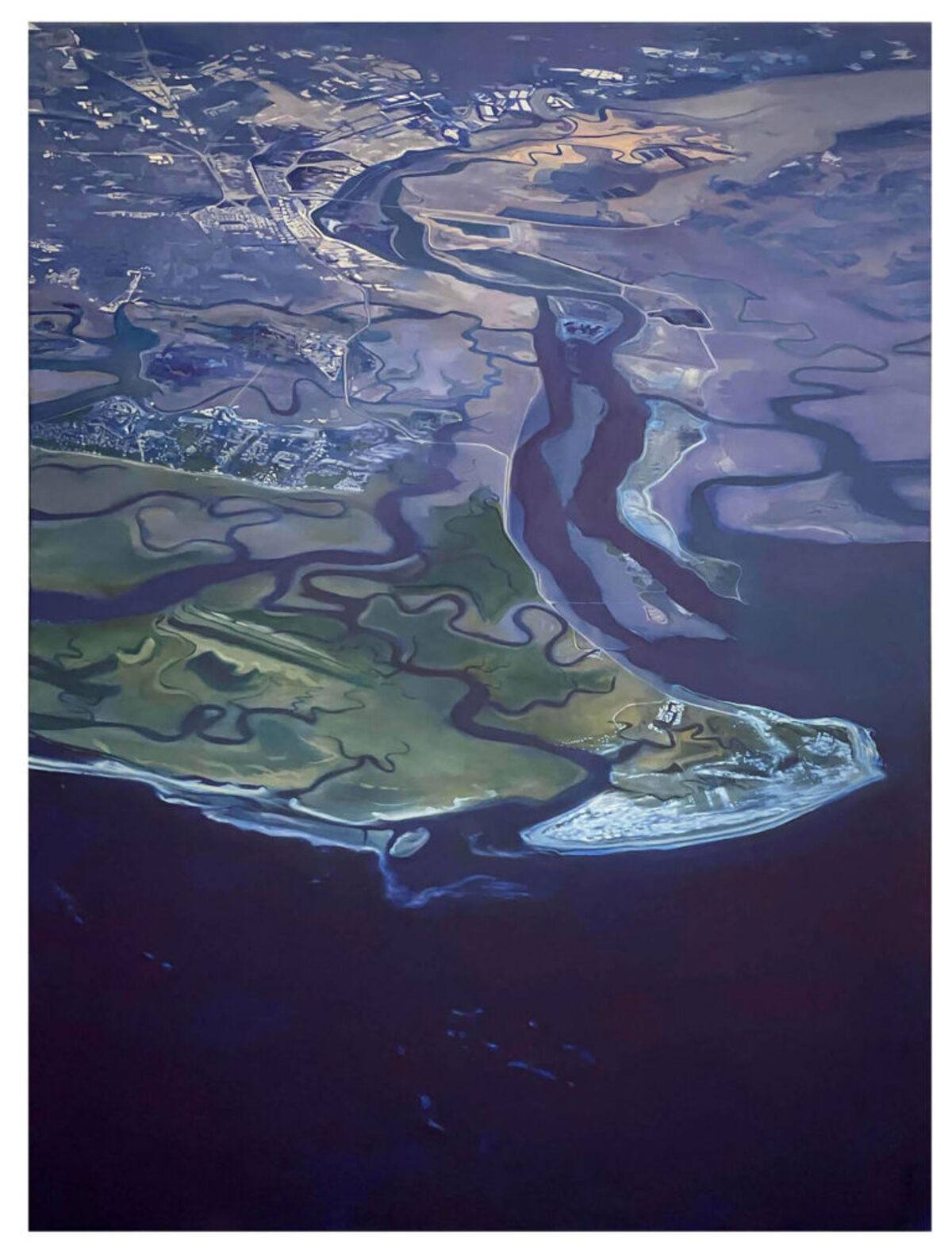 Leslie Wayne (b. 1953), Chesapeake, 2025, oil on canvas. 100 x 175 inches. Photo credit: Cole Witter. Image courtesy of the artist.
Like the painter Yvonne Jacquette, Wayne is an artist with a sharp sense of perception for the world around her, particularly when seen from a literal big picture perspective. Working from reference photos of coastlines, Wayne took creative liberties to expand the images of these much-transformed natural sites from around the continental United States and Northwest Passage near Greenland to monumental proportions.
The subjects are split between all-natural environments alongside those where human encroachment is glaringly present. For the settled scenes, one can discern the difference between naturally occurring water sources from artificially constructed ones - asymmetrical, windy passageways of water enmeshed within the landscape contrasted against the ordered linearity of manmade interventions.
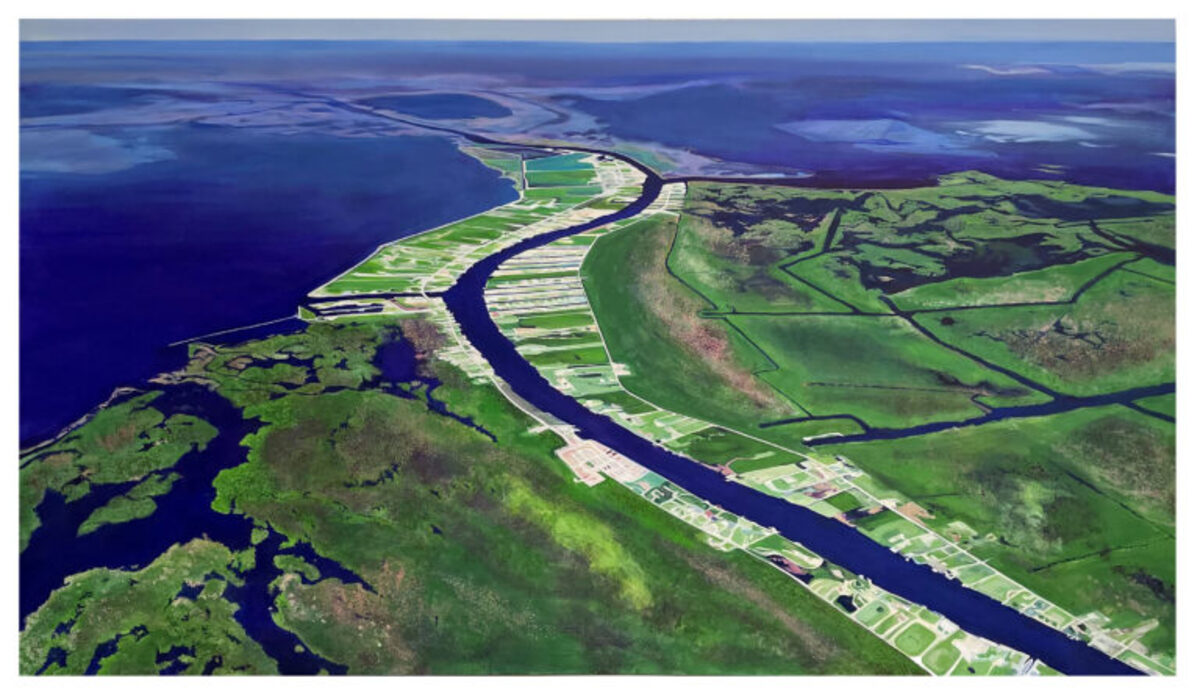 Leslie Wayne (b. 1953), Lafitte, 2025, oil on canvas. 67 x 118 inches. Photo credit: Cole Witter. Image courtesy of the artist.
Lafitte (2025) is an honest depiction of the difficult reality that rising waters are gradually harming communities. This aerial landscape is an image of the coastal town Jean Lafitte, Louisiana where it sits along the edge of the Barataria Basin. Other bodies of water in proximity to it include the Mississippi River, Barataria Bay, and the marshes and swamps of the Barataria-Terrebonne Estuary. Wayne represents the greenery of the landscape as lush and vibrant in color, but with a flatness suggestive of how the foundation of the terrain in this region is anything but stable. The intense blues of the resting water are right next to the pockets of settled communities, seen on a microscopic scale. Presumably, this is a scene on an ordinary, fair-weather day, but the precarity of this scene boils down to the possibility of how easy it would be for a slight elevation in water levels to erase an entire community and ecosystem, either as a result of tidal changes or a hurricane.
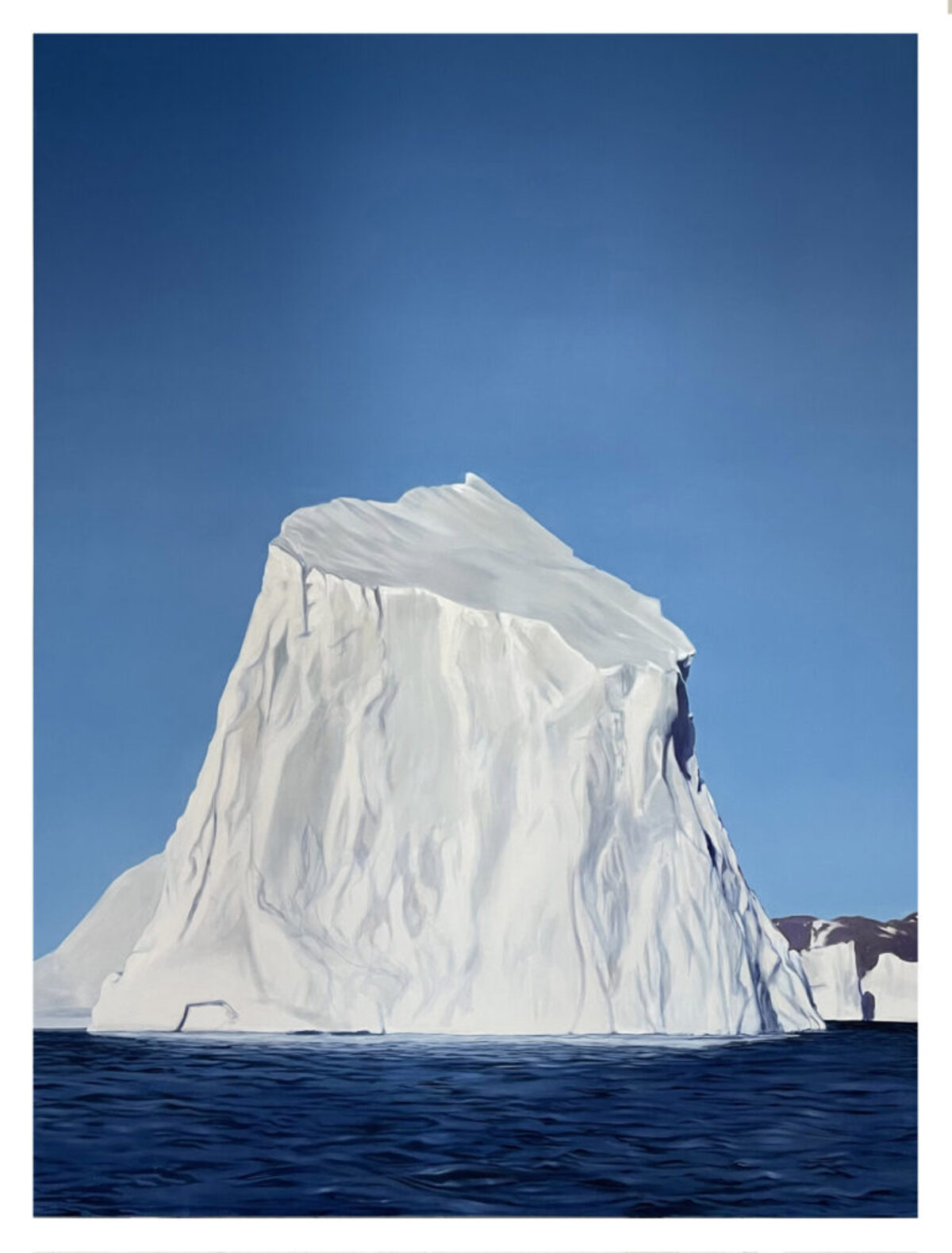 Leslie Wayne (b. 1953), Griese Fjørd, 2026, oil on canvas. 100 x 75 inches. Photo credit: Cole Witter. Image courtesy of the artist.
For the all-natural subjects, Wayne’s monolithic portrayals of glaciers and remote islands carry a somberness to them that almost could be likened to the darkly romantic landscapes of Arnold Böcklin, whose images ruminated on life and death. The topmost slant of the glacier in Griese Fjørd (2026) anticipates the worsening effects of polar warming causing the disappearance of these majestic frozen pillars. Melville Bay (2025), too, captures the final moments of when a glacial body loses its stolid form and is reduced to water, represented here with a collective of amorphous, icy shapes that are grouped like a family.
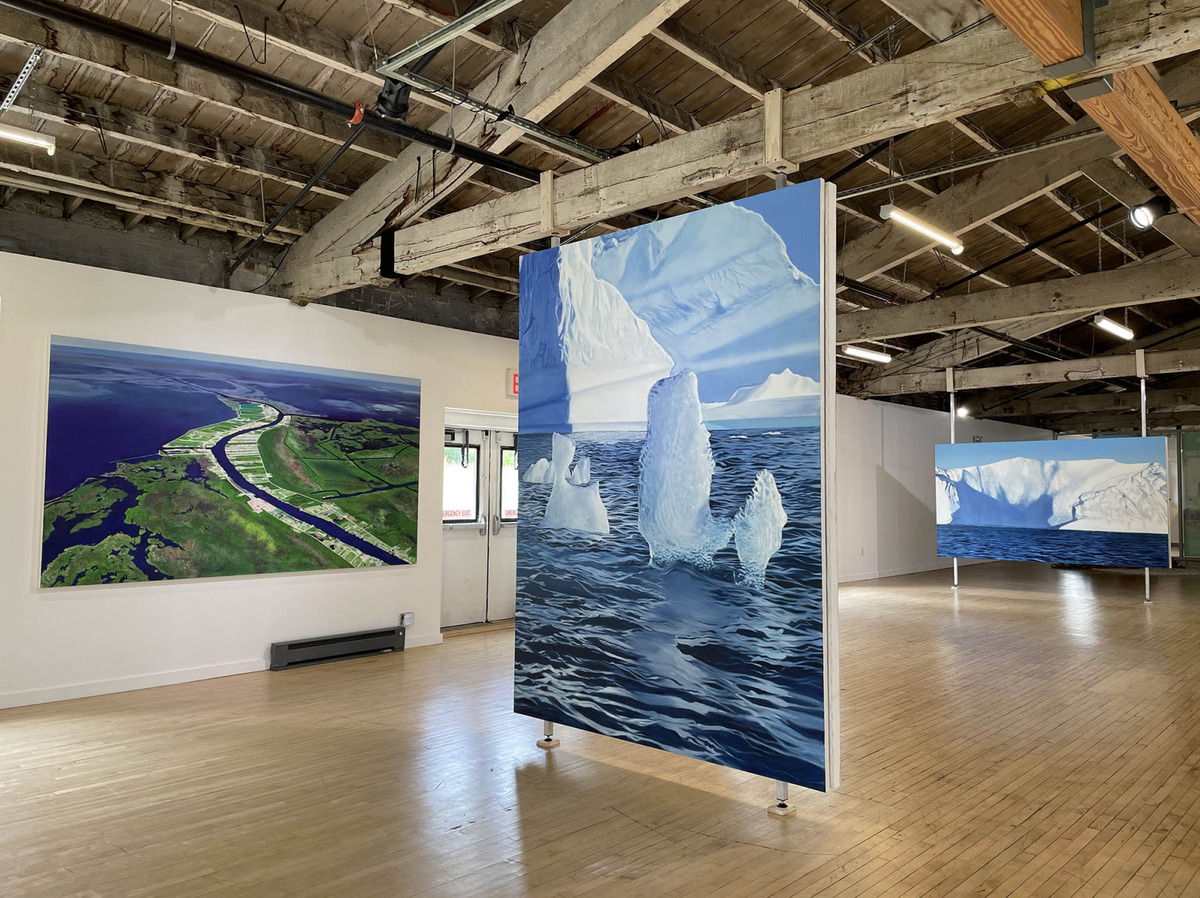 Installation view of Leslie Wayne: The Unintended Blues at LMCC, Governors Island. Photo credit: Cole Witter. Image courtesy of the artist.
Though painting is the prime focus in The Unintended Blues, Wayne brought in a few more works that contributed a multisensory and participatory component to the exhibition. Swept Away (2025 - 2026) is an installation in which reclaimed marine tug lines are wound against a large wooden spool while a recording of a view from underwater is projected onto them. The artist’s intent here is to highlight the benefits of hemp wires used for marine tugs because of their reliability as natural fibers that are resilient against saltwater while remaining durable for long periods of time. Inclusion of this work felt right at home with the space considering LMCC's location on an island at the intersection of much marine-based transportation.
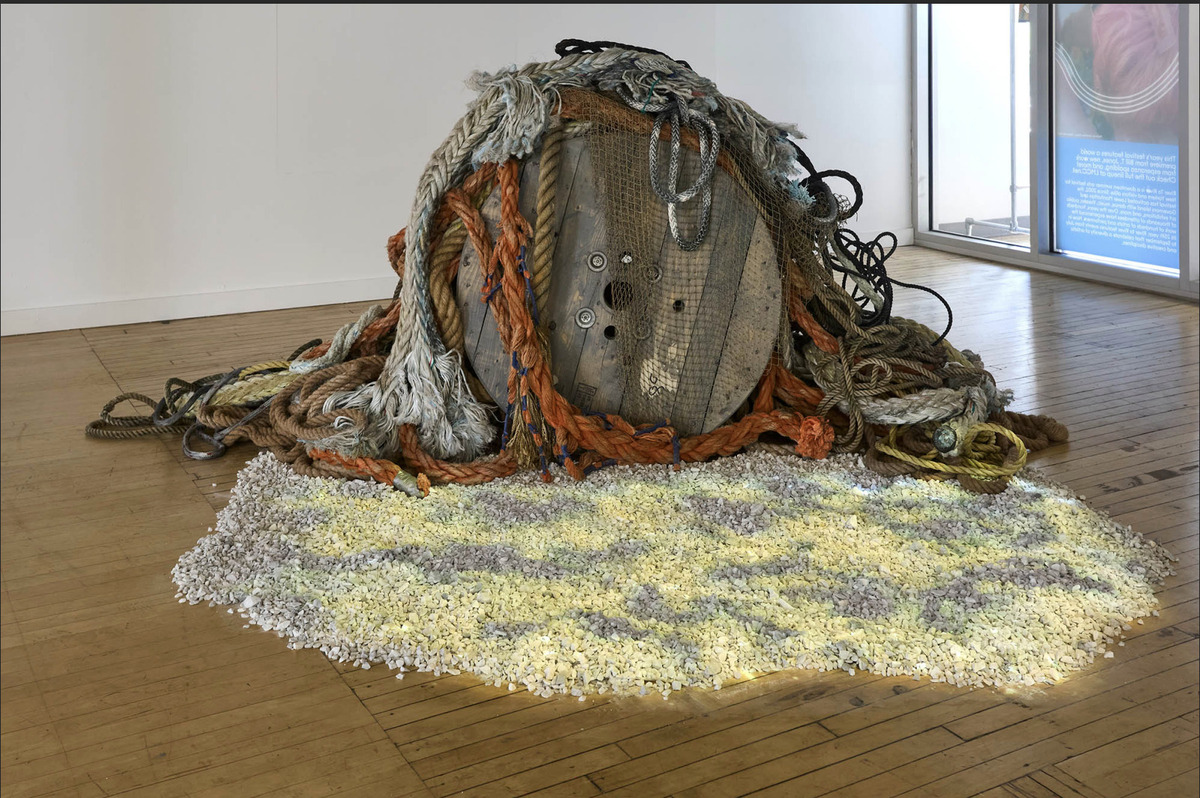 Leslie Wayne (b. 1953), Swept Away, 2025 - 2026, used marine line, wooden spool, single channel video and white gravel, overall dimensions variable. Photo credit: Cole Witter. Image courtesy of the artist.
Message in a Bottle to Congress (2026) featured a poster that listed 78 out of the 350 censored words by the Federal Administration related to environmentalism. Words as commonplace as “green”, “diesel”, and “wind power” were among those that were forbidden. Wayne asked visitors to share their thoughts about this issue along with broader questions, comments, and concerns on climate change, which were then placed into a glass bottle. Participating in this component of the exhibition could be done either before or after viewing the paintings, but either way, visitors were leaving LMCC with a much more refined perspective on the realities of this ongoing debate.
Going back to the title of the exhibition and series, “blues” carries a double meaning: the color of the ocean and the term used to describe feeling down or depressed. Yes, water is crucial for life on Earth, but deluges are antithetical because of their destructive potential in endangering the sustainability of human, animal, and plant life. After all, blue is the most prevalent color in these paintings, yet seeing too much of it is a sign of trouble.
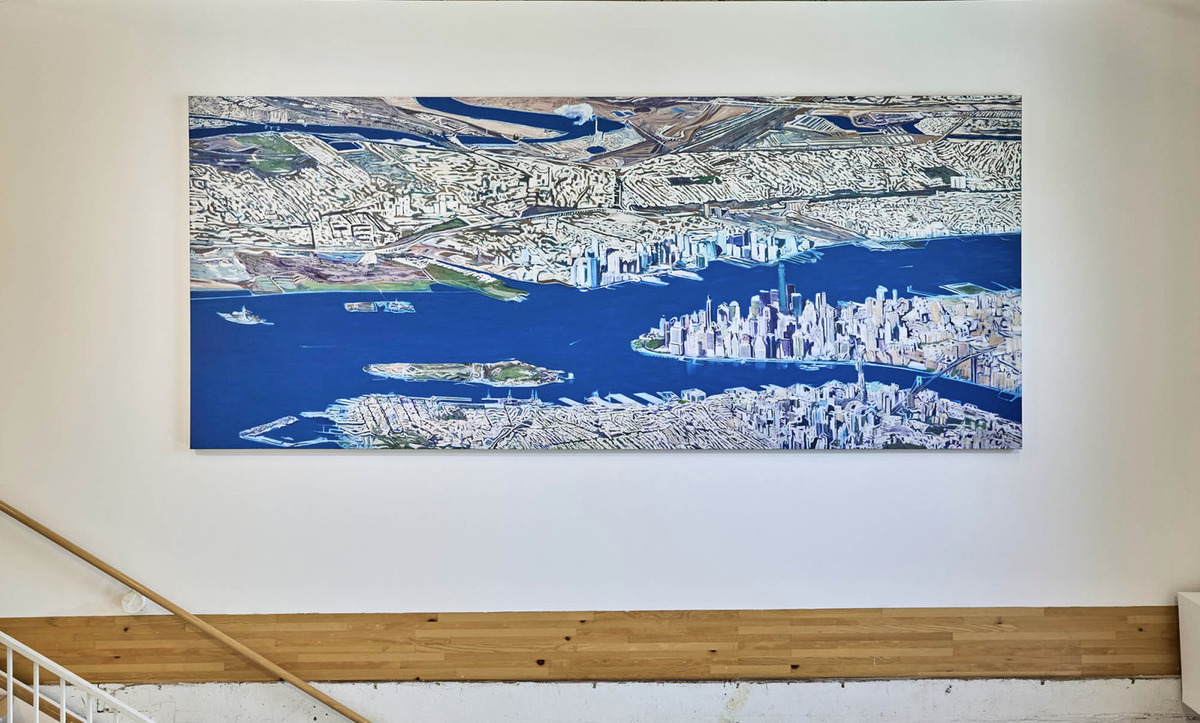 Installation view of Crossing Currents (2025) at LMCC, Governors Island.
Wayne’s decision to create these paintings on a gigantic scale is very much the artist saying to the viewer that the climate crisis is an unavoidable, no-compromise, in-your-face issue. With their all-over, front-back curation throughout LMCC’s exhibition space, that ever-presentness rings true exceptionally well. Every which way, the problem reveals itself. That point is also driven home by the fact that the windows of LMCC overlook part of the Hudson River, which has also undergone its own environmental changes.
The show’s mood can read as mournful and anxious given the emotive weight of climate change’s seeming insurmountability, but Wayne’s paintings do not feel like a dirge to a world that was. Rather, the framing of the exhibition as a call to action is inherently a message of hope that collective efforts can and should still be the way to not only slow, but ultimately cease these arduous crises. WM

Liam Otero
Liam Otero is a freelance art writer in NYC. He was recently named New York Editor of Whitehot Magazine.
view all articles from this author