Whitehot Magazine
October 2026
"The Best Art In The World"
"The Best Art In The World"
October 2026
The Intersection of Extraction and Ecology: The Neches River and Bill Pangburn’s Printed Traces
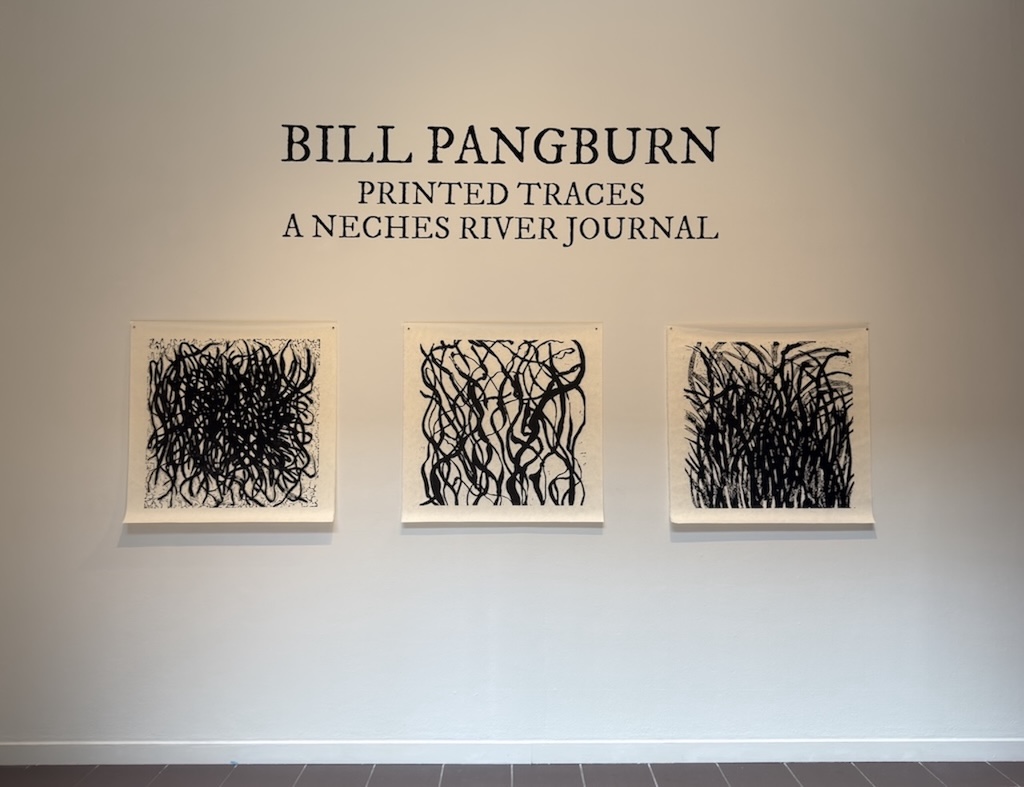 Neches Elephant Grass 1, 2, 3, 2026, woodcut print on paper. Image courtesy of the artist
By SOOJUNG HYUN May 24th, 2026
Beaumont, located in southeastern Texas near the Louisiana border, remains deeply marked by the history of American oil production. After the 1901 Spindletop discovery transformed the region into one of the early centers of the modern petroleum industry, refineries, shipping routes, and petrochemical infrastructure gradually became embedded within the physical landscape of Southeast Texas. Yet immediately adjacent to this industrial terrain, the Neches River persists with a primordial vitality. Dense underbrush, shifting light, marsh vegetation, and the slow movement of water compose a landscape that still carries an elemental wildness, resisting complete industrial containment.
Bill Pangburn’s exhibition, Printed Traces: A Neches River Journal, presented at the Art Museum of Southeast Texas (May 5- July 5, 2026), unfolds precisely within this duality of place. Far more than a conventional presentation of landscape printmaking, the exhibition emerges as a quiet yet deeply sustained inquiry into how we continue to perceive nature amid the ongoing tensions between industry and ecology, speed and slowness, development and endurance. In Pangburn’s work, the river becomes more than a geographic subject or natural image. It emerges instead as a metaphor for memory, duration, and the continuous flow of human existence itself. Through the language of woodcut, the artist transforms the river into a meditative reflection on time, materiality, and the fragile persistence of perception within an increasingly industrialized world.
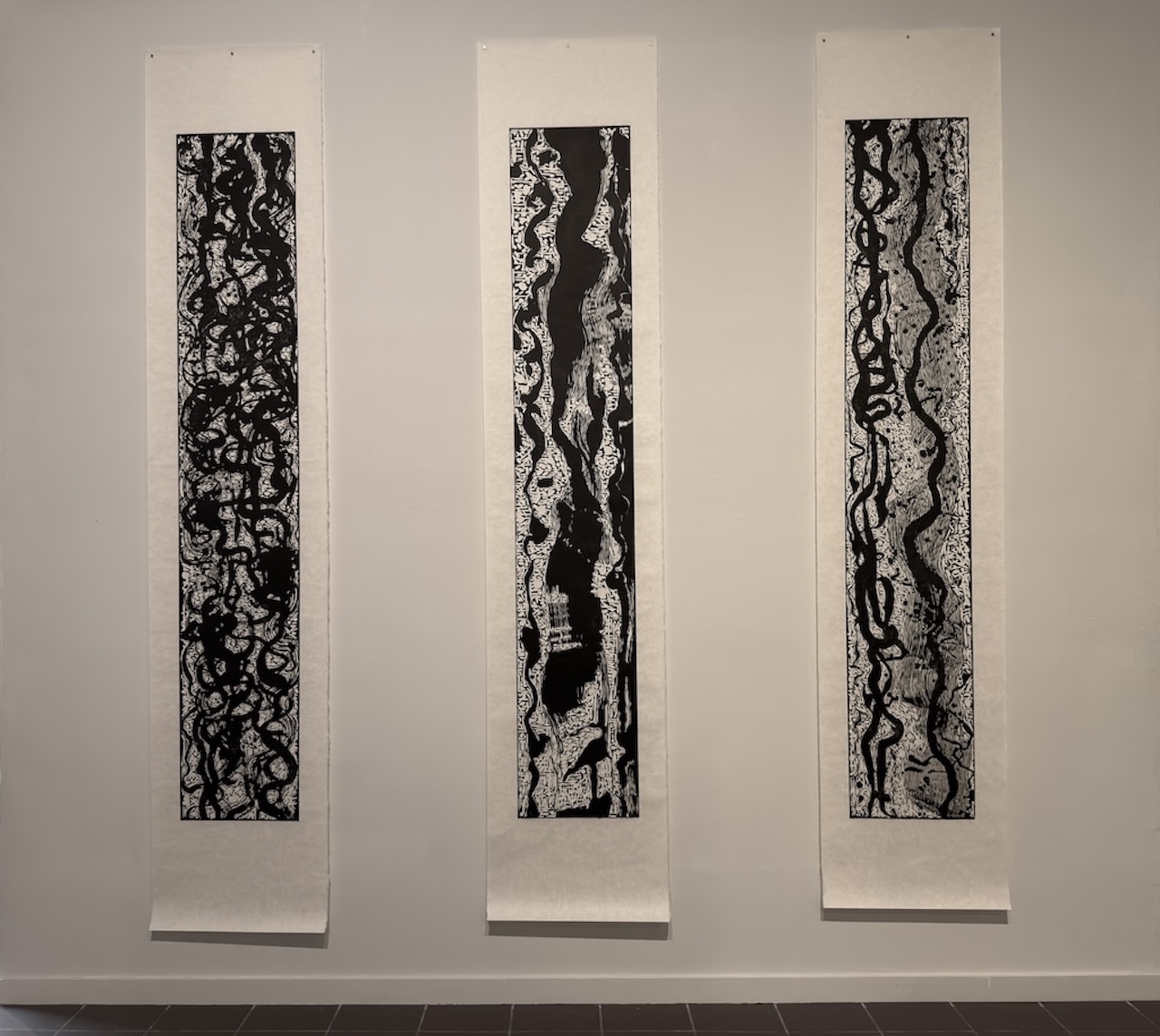 Big Thicket 3,2,1, 2026, woodcut print on paper. Image courtesy of the artist
The Fluidity of Memory: Pangburn’s River Philosophy
Pangburn’s engagement with the river extends far beyond a recent response to the landscape of Southeast Texas. A native of the Texas Panhandle, the artist recalls a formative adolescent experience of viewing the Canadian River from the aerial perspective of an airplane. From above, the river appeared as a vast, serpentine gesture across the land—a drawing carved into the earth by the force of nature itself. This early encounter established a lifelong conceptual framework: the river as a living line, a temporal trace of movement and flow.
Since settling in Tribeca near the Hudson River, Pangburn began to shift his focus and continually engages water as both a visual and psychological presence within his practice. Over the decades, he has pursued the rhythms of rivers and coastlines through travels across China, Germany, and the shores of Crete. These encounters with water reappear throughout his prints in shifting formal registers. At times, water unfolds as organic, sinuous lines moving laterally across the surface; elsewhere, it emerges as a vertical current that quietly organizes the composition from within.
The shimmering reflections, the subtle tremors of the surface, and the ephemeral traces left by a passing current are translated through the grain of his woodcuts into a repetitive, meditative pulse. For Pangburn, the image of the river leads an internal map—reflecting the human psyche’s own fluctuations, its moments of turbulence, and its stillness. In this context, his return to the Neches River represents more than a homecoming; it is a profound synthesis of his expansive "river philosophy" with the specific, resilient ecology of his native Texas.
Phenomenology of the Gallery: "Entering the River"
The spatial configuration of the exhibition extends beyond the conventional boundaries of traditional landscape display, unfolding into an immersive environment driven by movement and perception. The gallery is organized through two primary visual structures: woodcuts mounted along the walls and elongated vertical scrolls suspended from the ceiling. By bringing these two-dimensional works into the three-dimensional volume of the room, the exhibition transforms a static viewing gallery into a dynamic, living installation.
As Pangburn articulates, this layout facilitates a metaphorical “entering the river.” Viewers move through the center of the gallery while suspended scrolls evoke the sensation of navigating shifting currents. The long woodcut scrolls suspended from the ceiling sway gently in the air, creating a fluid rhythm of water, tangled vegetation, and dappled light that echoes the real atmosphere of the Neches River. Meanwhile, the gallery walls seem to remake the room's perimeter into expansive riverbanks. This strategic arrangement naturally slows the body’s pace; the elongated forms and rhythmic intervals between the hanging works force a deliberate pause. Within this space, the frantic pace of the outside world quietly fades, replaced by a deep sensory stillness. This phenomenological approach encourages viewers to imagine a living river environment. The installation fosters a more direct, deeply felt emotional resonance with the artwork.
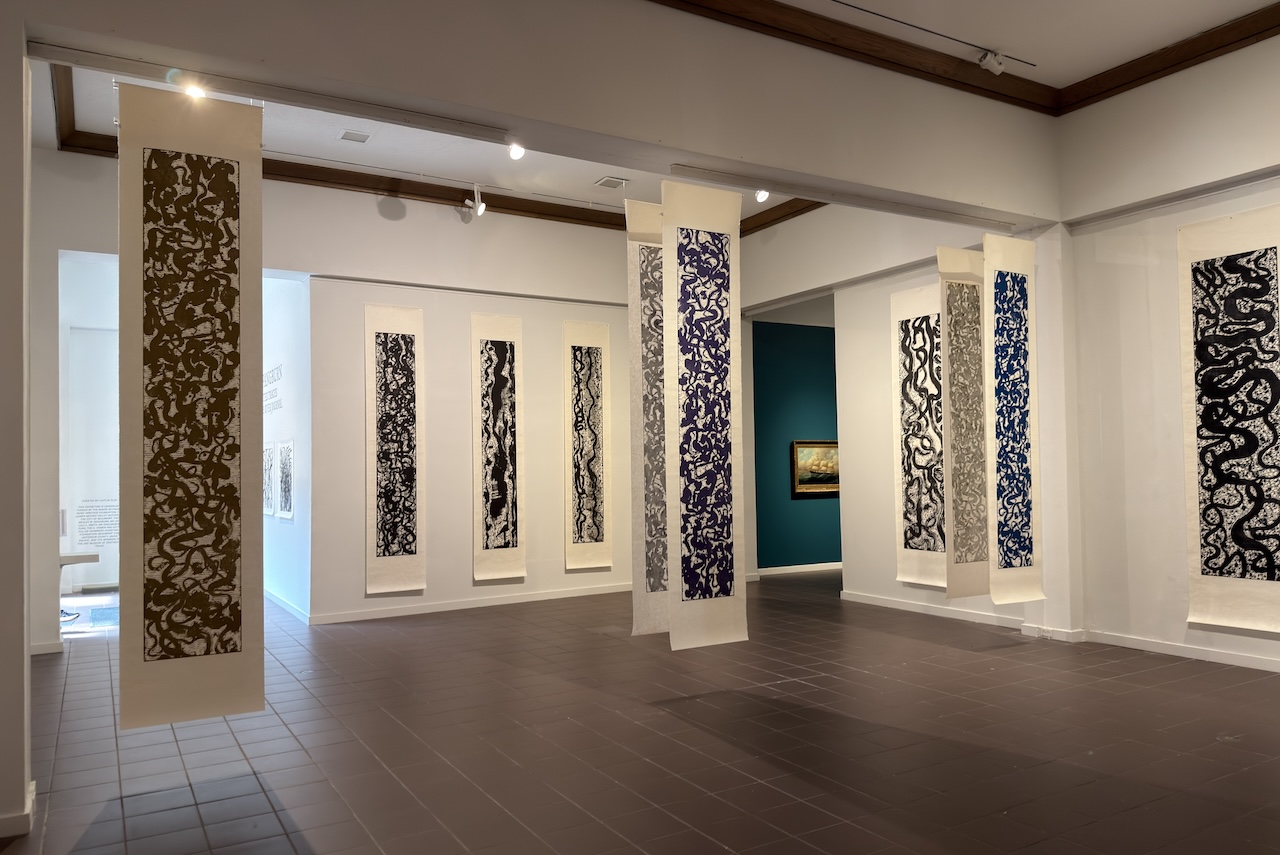 The gallery view, Bill Pangburn: Printed Traces: A Neches River Journal (The Art Museum of Southeast Texas, May 5 – July 7, 2026), Image courtesy of the artist
The Ink and the Mark: Calligraphy, Gesture, and Abstraction
Upon passing through the exhibition entrance, the vertically oriented woodcuts arranged in the first gallery space form the crucial thematic axis of this exhibition. Working within the restrained depth of black ink, Pangburn renders the river through movement, repetition, and trace. The currents at times fall straight down from the top of the composition, and at other times continue in subtle, undulating vibrations.
Pangburn describes these works as a deliberate synthesis of “tree, river, and calligraphy.” Indeed, certain pieces evoke the presence of monumental brushstrokes. This formal approach transcends the passive description of scenery; instead, it recalls the sensibilities of East Asian calligraphy, where landscape is unraveled through the disciplined movement and breath of the body. Through Panburn’s process, the river ceases to be a static pictorial image; it is translated into a living, non-objective movement through the physical language of carving, ink, and paper.
Pangburn’s emotive marks resonate with the German Expressionist print tradition while also remaining deeply indebted to Japanese woodcuts, including Katsushika Hokusai, and the meditative discipline of East Asian calligraphy. This stylistic synthesis establishes a compelling dialogue between disparate artistic traditions. What remains profoundly captivating is how these seemingly divergent historical traditions do not conflict within Pangburn’s practice; instead, they are seamlessly integrated into a single, unified sensory experience.
While a natural river flows horizontally across the earth, Pangburn reorients these currents vertically. By marrying this vertical compression with the absorbency of long, traditional East Asian paper, the marks generate a heightened sense of dynamic kinesis. The water surges and cascades, transforming the hanging scroll tradition into a vehicle for raw, elemental velocity. By stripping the landscape down to its essential linear and directional components, Pangburn arrives at an elegant abstraction where the marks embody the fluid dynamics of nature through a disciplined, calligraphic gesture.
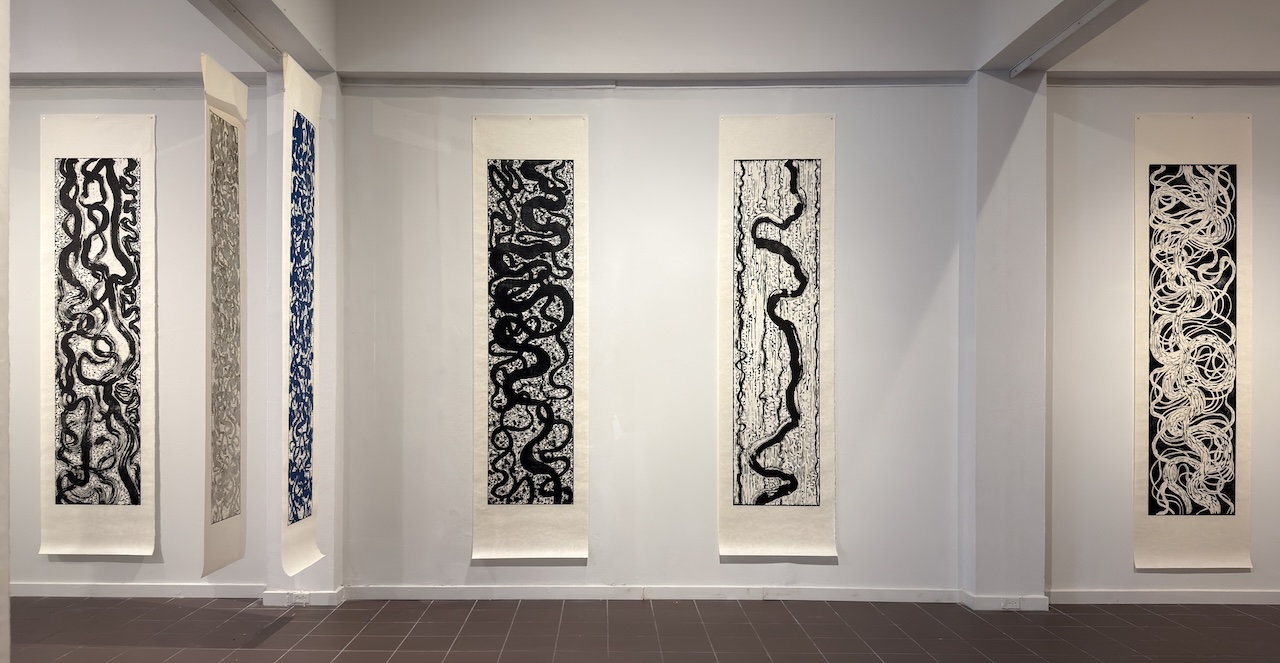 The gallery view, Bill Pangburn: Printed Traces: A Neches River Journal (The Art Museum of Southeast Texas, May 5 – July 7, 2026), Image courtesy of the artist
The Density of Life: Analyzing Neches Elephant Grass
As viewers move deeper into the gallery, the silent rhythms of flowing water gradually shift toward a more immediate encounter with the river’s surrounding biomass. Along one expansive wall, Pangburn presents Neches Elephant Grass 1 (2026), a formidable series of twenty-one colored woodcuts enveloping the space like a living screen. If the earlier works evoke the river’s temporal flow, this series captures its proliferation. Deep blues, verdant greens, earth-toned browns, and sudden flares of red permeate the surface, evoking not only vegetation but also the humidity, scent, and organic heat of the wetlands themselves.
The lines do not simply describe the grass; they tangle, overlap, and surge, mirroring the way nature expands and reproduces according to its own internal pace. In these works, Pangburn’s gaze shifts from observation to immersion. The elephant grass is presented as an autonomous, thriving entity with its own sovereign time and complex architecture. By saturating the visual field with this dense thicket of growth, Pangburn compels the viewer to acknowledge the river’s ecosystem as a site of untamable vitality—a resilient force that continues to flourish in the shadows of the surrounding industrial apparatus.
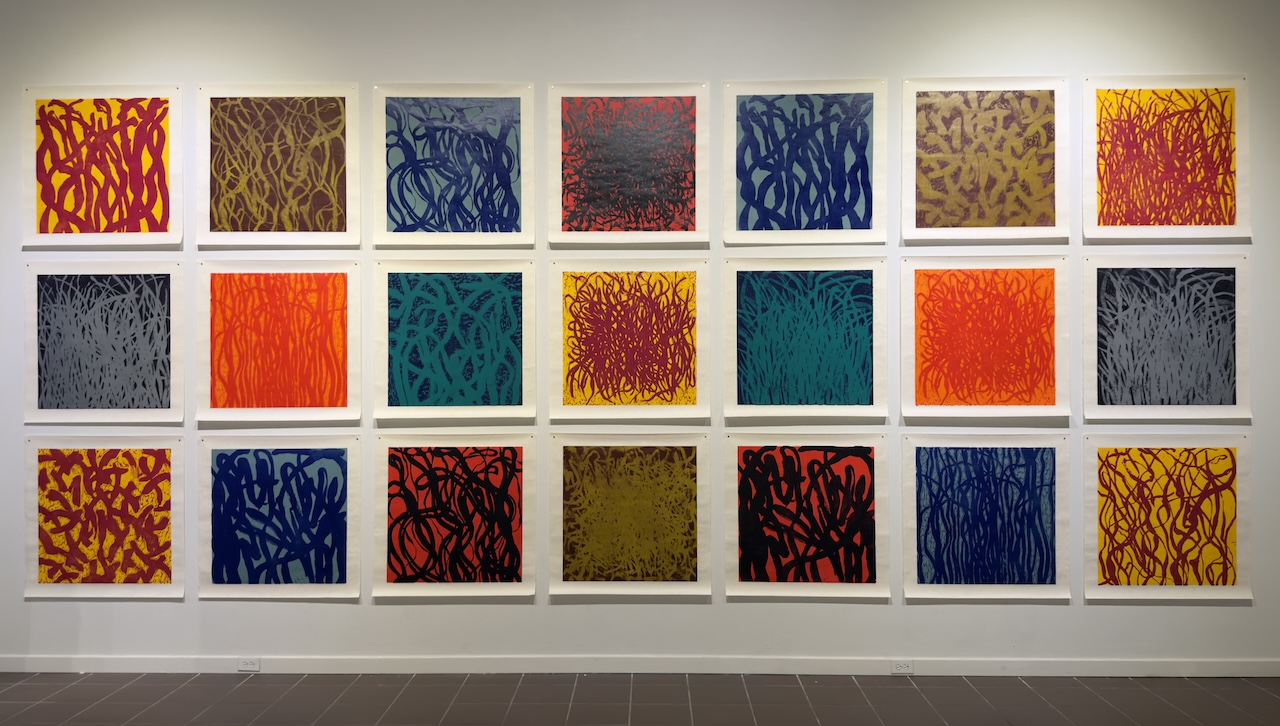 Elephant Grass 1, 2026, woodcut print on paper. Image courtesy of the artist
The Weight of Time: Woodcut Materiality and Tactile Temporality
The act of carving the wood matrix is, for Pangburn, far more than a technical means of production; it is a bodily performance akin to the calligraphic stroke. His prints hold physical force left by the pressure of the hand and the repetition of the body. In sharp contrast to digital image production, which privileges instantaneous circulation and frictionless consumption, woodcut printmaking demands duration. The image is forged incrementally: carving along the grain and transferring the pigment through manual or mechanical pressure onto the paper. Embedded within this process is the residue of labor and the slow, accumulating velocity of material time.
This tactile dimension is further heightened by Pangburn’s choice of support—a thin, delicate East Asian paper. While the resulting prints appear deceptively flat when viewed from a distance, a closer encounter reveals a low-relief, sculptural dimensionality at the threshold between the carved line and the untouched negative space. The depth with which the black ink permeates the fibers of the paper, combined with the ghosted impressions of the wood grain, creates a tense, tactile friction. It compels the spectator to move beyond the optical act of "looking" and instead participate in the physical texture of the medium itself. The fluid current in his woodcuts serves as a sensory apparatus, inviting the body to contemplate the intricate, entangled relationship between labor, time, matter, and the natural world.
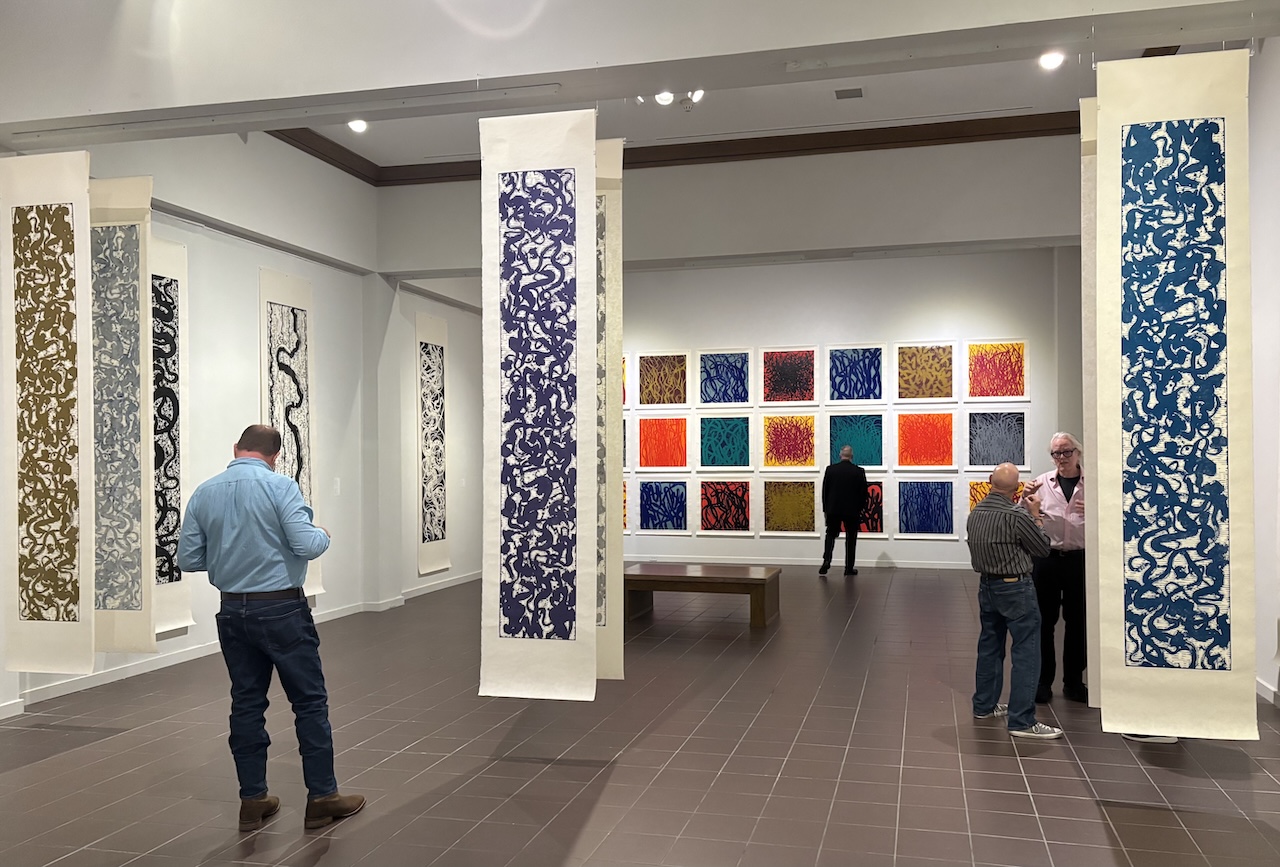 The gallery view, Bill Pangburn: Printed Traces: A Neches River Journal (The Art Museum of Southeast Texas, May 5 - July.7, 2026), Image courtesy of the artist
The Recovery of Perception
Ultimately, the exhibition, Printed Traces: A Neches River Journal, does not reject Beaumont’s industrial history so much as quietly reposition attention within it. His work remains attentive to what continues to persist alongside the infrastructures of extraction: the slow movement of water, the density of underbrush, the shifting quality of light, and the fragile rhythms of ecological duration that survive within a historically altered environment.
Throughout the exhibition, beauty emerges less as a distant visual ideal than as a condition recovered through sustained attention. Pangburn’s woodcuts ask viewers to slow their own perceptual rhythm to move at the tempo of water, material resistance, and accumulated time. In an era increasingly shaped by accelerated images and fractured attention, the works restore an awareness of duration, touch, and bodily presence.
In this light, the artist invokes the ancient Greek philosopher Heraclitus, who famously observed that "we never step into the same river twice." In Pangburn’s universe, the river is constantly shifting; it remains eternally present, a fluid site where history, nature, and the human body continuously converge and flow.
Soojung Hyun
Soojung Hyun is a New York–based curator, writer, and art historian. She has organized exhibitions at venues including the Anya and Andrew Shiva Gallery, AHL Project Space, and PS122 Gallery. She teaches Asian and contemporary art as an adjunct faculty member and contributes to the Archive of Korean Artists in America (AKAA). Her writing focuses on diasporic identity, material memory, and the intersection of Eastern and Western aesthetics.
view all articles from this author